AI算力

Search documents
中信证券:“自主可控、AI”为贯穿全年主线,“消费电子”为支线、关注重大转折机遇
Xin Lang Cai Jing· 2026-01-15 01:25
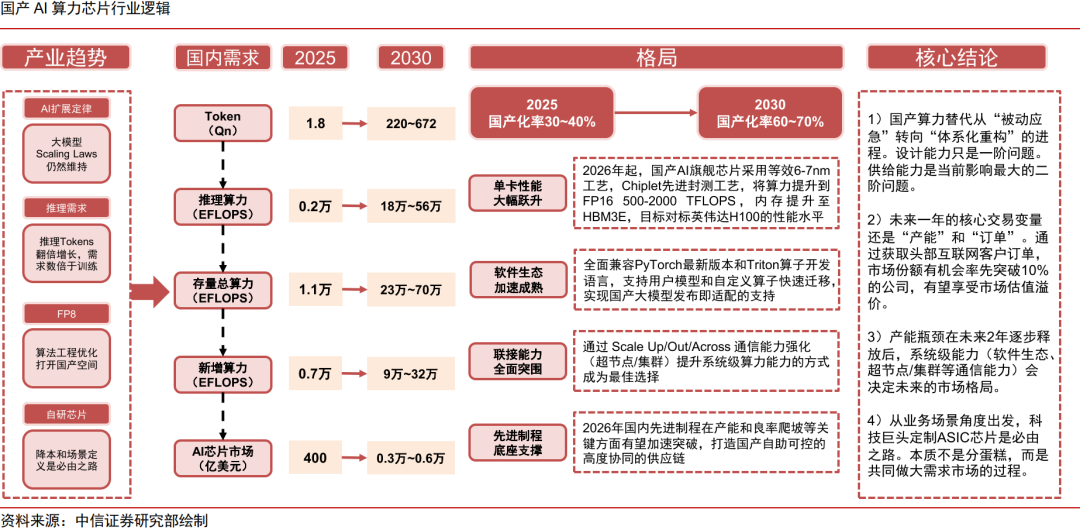
Core Viewpoint - The convergence of self-controllability and AI is expected to drive significant performance in related sectors in 2025, with this trend likely to strengthen further in 2026, making "self-controllability and AI computing power" a dominant theme in the electronics industry throughout the year [2][23]. Investment Theme 1: Focus on Domestic Computing Power and Semiconductor Equipment - Domestic computing power is anticipated to transition from point breakthroughs to systematic reconstruction by 2026, driven by increased overseas restrictions and urgent domestic demand, with market share for local manufacturers expected to rise from 30-40% currently to 60-70% by 2030 [4][25]. - The total addressable market (TAM) for domestic computing power is projected to grow from over $13 billion in 2025 to over $180 billion by 2030 [4][25]. - The semiconductor equipment sector is expected to benefit from a dual drive of wafer fab expansion and accelerated localization, with domestic equipment procurement rates estimated to rise from 18% in 2022 to 40% by 2026 [6][27]. Investment Theme 2: High Growth Certainty in AI PCB and Storage Sectors - The PCB sector is viewed as a critical upgrade point for AI chips, with strong demand for computing power expected to drive significant growth in 2026-2027 [9][30]. - AI storage is entering a super cycle driven by AI demand, with mainstream storage prices expected to rise significantly, maintaining a seller's market through at least the end of 2026 [11][32]. Investment Theme 3: Consumer Electronics Reversal and Edge AI Opportunities - The consumer electronics sector is expected to experience a reversal influenced by storage price increases and shortages, with potential stock price turning points anticipated in Q2 2026 [16][37]. - Innovations in AI smartphones, AI/AR glasses, and other AIoT applications are highlighted as key areas of focus [16][37].



放弃英伟达“乐高模式”:OpenAI豪赌晶圆级架构,百亿美元押注Cerebras单芯片算力革命
Zhi Tong Cai Jing· 2026-01-15 01:09
Core Viewpoint - The collaboration between OpenAI and Cerebras Systems, valued at $10 billion, is expected to significantly enhance AI infrastructure and performance, while also impacting the semiconductor industry and the broader tech market negatively due to rising capital expenditure concerns [1][6][7]. Company Summary - OpenAI has entered a strategic partnership with Cerebras Systems to utilize its hardware for AI model acceleration, aiming for faster response times and improved infrastructure deployment by 2028 [1][4]. - Cerebras' unique wafer-scale chip architecture, specifically the WSE-3, allows for a significant increase in processing speed, achieving 15 times faster inference compared to traditional hardware [2][6]. - The partnership is seen as a validation of Cerebras' technology and positions the company to capitalize on the growing AI computing infrastructure market, which is projected to be worth hundreds of billions [4][6]. Industry Summary - The tech sector is experiencing heightened volatility, with major indices declining, particularly in the semiconductor space, due to geopolitical tensions and competitive dynamics [1][7]. - The demand for high-energy AI tools is expected to remain strong, as evidenced by substantial investments from companies like Nvidia and AMD in AI infrastructure [6]. - The $10 billion contract with OpenAI signals a shift in the AI computing landscape, challenging Nvidia's dominance and prompting a reevaluation of tech giants' valuations amid concerns over profitability due to increased capital expenditures [7].

中信证券电子2026年投资策略:“自主可控、AI”为贯穿全年主线 “消费电子”为支线、关注重大转折机遇
智通财经网· 2026-01-15 00:55
Core Viewpoint - The report from CITIC Securities indicates that the synergy between self-controllable technology and AI will drive significant performance in related sectors by 2025, with expectations for further strengthening in 2026. The focus will be on domestic computing power and semiconductor equipment, alongside a potential turnaround opportunity in consumer electronics by Q2 2026 [1]. Investment Theme 1: Domestic Computing Power and Semiconductor Equipment - Domestic computing power is expected to transition from point breakthroughs to systematic reconstruction by 2026, driven by increased local demand and intensified overseas restrictions. The market share of domestic manufacturers is projected to rise from 30-40% currently to 60-70% by 2030, with the total addressable market (TAM) for domestic computing power anticipated to grow from over $13 billion in 2025 to over $180 billion by 2030 [1]. - The expansion of domestic wafer fabs is being driven by the dual forces of increased production capacity and accelerated localization. The domestic equipment procurement rate is estimated to rise from 18% in 2022 to 25% in 2023, and further to over 30% by 2025, with expectations of reaching 40% by 2026 [4][5]. Investment Theme 2: High Growth in AI-Driven PCB and Storage Sectors - The PCB sector is expected to benefit from the demand for AI computing power, with significant growth anticipated in 2026-2027. The need for high-speed transmission and interconnectivity in AI chips will drive the upgrade of PCB technology, enhancing its value [16]. - The storage sector is entering a super cycle driven by AI demand, with prices for mainstream storage products expected to rise significantly. The visibility of shortages is high, and prices for DRAM and NAND are projected to continue increasing through the first half of 2026 [23]. Investment Theme 3: Consumer Electronics and Edge AI Opportunities - The consumer electronics sector is currently facing challenges due to storage price increases and shortages, but a potential turnaround is anticipated in Q2 2026. Innovations in AI smartphones, AI/AR glasses, and other AIoT products are expected to drive growth [30].
【点金互动易】人形机器人+灵巧手,公司已确定成为北美头部机器人客户首批核心供应商,自研从核心部件到整机的多种人形机器人产品
财联社· 2026-01-15 00:55
Group 1 - The article emphasizes the importance of timely and professional information interpretation in investment, focusing on extracting investment value from significant events and analyzing industry chain companies [1] - The company has established itself as a core supplier for leading robotics clients in North America, delivering various humanoid robot products from core components to complete systems [1] - The company has also become a major supplier of cooling solutions for AI computing servers, having passed validation from a key client and providing specialized materials for high-performance cooling and connectivity [1]

券商晨会精华 | 自主可控、AI为贯穿全年主线
智通财经网· 2026-01-15 00:55
Market Overview - The market experienced a pullback after an initial rise, with the Shanghai Composite Index dropping by 0.31% while the Shenzhen Component and ChiNext Index rose by 0.56% and 0.82% respectively [1] - The total trading volume in the Shanghai and Shenzhen markets reached 3.94 trillion yuan, an increase of 290.4 billion yuan compared to the previous trading day, marking the third consecutive day of surpassing 3.5 trillion yuan [1] - Over 2,700 stocks in the market saw gains, with notable sectors including AI applications, computing hardware, and semiconductors showing strong performance [1] Investment Insights - CITIC Securities emphasizes that "self-controllability and AI" will be the main theme throughout the year, predicting significant performance in related sectors by 2025 [2] - China Galaxy Securities highlights the "AI leap + century change" synergy driving a super copper cycle, suggesting that copper prices have substantial upward potential despite recent highs [3] - CICC notes that the mid-term "stock-bond seesaw" effect will further support A-share performance, with a global interest rate cut cycle expected to enter its second half in 2026 [3]
利空也砸不下大A
虎嗅APP· 2026-01-15 00:29
Core Viewpoint - The A-share market is experiencing extreme enthusiasm, prompting regulatory measures to cool down the market, indicating a shift towards a "slow bull" market rather than a "crazy bull" market, emphasizing the need for investors to focus on fundamentals rather than emotions [5][6]. Market Sentiment and Regulatory Response - On January 14, the exchange announced an increase in the minimum margin ratio for financing from 80% to 100%, leading to an immediate market downturn [5]. - The regulatory stance is clear: the market can rise, but it should not be driven solely by emotions, and investors must return to fundamentals [6]. Investment Opportunities and Risks - The focus should be on identifying key sectors that are likely to perform well while avoiding those that may pose risks [7][8]. - The analysis will cover 13 high-interest sectors to provide insights on potential investment opportunities [9]. AI Computing Power - The rise of AI infrastructure is supported by increased investments from cloud vendors, with companies like "易中天" (New Yizhong, Zhongji Xuchuang, Tianfu Communication) showing significant stock price increases [11]. - However, the current high valuations may be unsustainable, and without new positive developments, there is a risk of a bubble burst in this sector [11]. Space Computing Industry - The space computing industry is expected to emerge as a significant market, with technologies deploying data centers in space to address ground-based limitations [13][15]. - China's advancements in space computing are supported by government initiatives, with plans for a comprehensive deployment strategy by 2025 [17][18]. Humanoid Robots - The humanoid robot sector is anticipated to see differentiation by 2026, with industrial applications being the primary focus, while household robots remain underdeveloped [20][22]. - Companies like 优必选 (UBTECH) are ramping up production, with expectations of significant output increases in the coming years [22][23]. Semiconductor Equipment - Domestic wafer fabs are planning expansions to meet AI chip demand and enhance production capacity, which will benefit semiconductor equipment suppliers [25][26]. Controlled Nuclear Fusion - The commercialization of controlled nuclear fusion is accelerating, with multiple technological pathways being explored [28][30]. - China is making significant strides in fusion energy, with projects like EAST and BEST expected to lead to practical applications by 2027 [32][33]. Commercial Aerospace - The commercial aerospace sector is experiencing a surge, driven by fears of missing out on investment opportunities, although there are concerns about the sustainability of this growth [41][42]. - China's satellite deployment is rapidly increasing, positioning the country as a major player in the global space race [44]. Photovoltaics - The photovoltaic sector is expected to reach a turning point in 2026, driven by supply-side adjustments and improved fundamentals [47][51]. - The cancellation of export tax rebates is likely to increase costs for exporters, benefiting larger firms with economies of scale [51][52]. Consumer Sector - The consumer sector is seen as a safe haven during market volatility, with specific focus areas including media, service consumption, and premium goods like liquor [66][70]. - The overall consumer demand is expected to recover gradually, but structural changes may lead to a lack of strong support for broad-based growth [67]. Banking Sector - The banking sector has shown resilience despite fundamental pressures, with attractive dividend yields drawing in long-term investors [72][73]. - However, the sector is unlikely to lead the market due to its lower growth potential compared to technology and growth stocks [74]. Insurance Sector - The insurance sector has outperformed banks, benefiting from stock market recovery and expected growth in both asset and liability sides [76]. - The aging population is likely to increase the importance of insurance companies in key areas like healthcare and retirement [76]. Brokerage Firms - Brokerage firms have seen strong earnings growth but face challenges in maintaining investor interest due to perceived volatility and lack of long-term growth [77].

中信证券:“自主可控、AI算力”有望成为电子行业贯穿全年的绝对强主线
Zheng Quan Shi Bao Wang· 2026-01-15 00:21
人民财讯1月15日电,中信证券研报认为,2025年,自主可控与AI共振带动相关板块取得亮眼表现。展 望2026年,这一产业趋势料将得到进一步强化,"自主可控、AI算力"有望成为电子行业贯穿全年的绝对 强主线,自主可控关注国产算力及半导体设备加速放量趋势,AI算力方向PCB与存储高确定性景气;此 外"消费电子"作为支线或迎重大转折机遇,关注2026年第二季度景气反转机会。 ...
三天涨超20%,锡价大涨,影响几何?
Zheng Quan Shi Bao· 2026-01-14 23:20
Group 1: Tin Market Dynamics - The main driver for the recent surge in tin prices is attributed to supply and demand dynamics, as well as macroeconomic factors, with the price reaching a historical high due to expectations of lower-than-anticipated production resumption in Myanmar [1] - The current spot price for tin has also reached a historical high, with Mysteel reporting a single-day increase of 7.6% to 412,000 RMB/ton [1] - The futures market is leading the spot price, with increased risk management needs from companies as the market sentiment strengthens [1] Group 2: Market Behavior and Trends - The current market shows a strong correlation between futures and spot prices, but high prices are causing trade and processing companies to pause external quotations, leading to a cautious market sentiment [2] - There is a risk of divergence between futures and spot prices, with potential downward pressure on spot prices if funds withdraw from the market [2] - Despite long-term demand from sectors like renewable energy and electronics, short-term consumption is weakening due to high prices, and inventory replenishment needs have not yet been realized [2] Group 3: Copper and Aluminum Price Trends - Copper and aluminum prices have also reached historical highs, with A00 aluminum price at 24,330 RMB/ton, up 4.38% from early January, and 1 electrolytic copper at 103,185 RMB/ton, showing a year-on-year increase of 36.8% [3][4] - The tightening supply expectations for aluminum are driven by limited new capacity and production declines, while concerns over supply disruptions in the copper market are exacerbated by challenges such as declining ore grades and community protests [4] - Long-term demand from emerging industries, including electric vehicles and energy storage, is expected to support price increases for both copper and aluminum [4][5]
存储板块首份年报预告出炉 约5倍业绩增长"剧透"行业高景气度
Zheng Quan Shi Bao· 2026-01-14 23:01
Core Viewpoint - The storage module leader, Baiwei Storage, anticipates significant growth in its financial performance for 2025, driven by a recovery in storage prices and the delivery of key projects [1] Group 1: Financial Performance - Baiwei Storage expects revenue for 2025 to be between 10 billion to 12 billion yuan, representing a year-on-year growth of 49.36% to 79.23% [1] - The company forecasts a net profit attributable to shareholders of 850 million to 1 billion yuan, indicating a substantial year-on-year increase of 427.19% to 520.22% [1] - The recovery in sales revenue and gross margin is anticipated to begin in the second quarter of 2025 as storage prices stabilize [1] Group 2: Market Trends - The global storage market has entered a strong price increase cycle since 2025, with DRAM prices significantly rising; DDR5 (16Gb) increased by 627.79% to $34.08, and DDR4 (16Gb) surged by 2252.57% to $75 [1] - NAND Flash prices also saw a notable increase, with 64G flash products priced at $7.113, up over 60% since the beginning of 2025 [1] - IDC predicts that global data volume will reach 213.6 ZB by 2025 and grow to 527.5 ZB by 2029, with a compound annual growth rate of 25.4% [2] Group 3: Supply and Demand Dynamics - The demand for storage chips is being driven by the explosion of AI computing power, leading to a continuous rise in storage requirements [2] - TrendForce forecasts a significant increase in DRAM contract prices by 55% to 60% in Q1 2026 due to supply constraints from advanced process transitions [2] - Citigroup's research indicates a "severe supply shortage" in the commodity storage market by 2026, driven by structural data growth, with DRAM average price growth expectations revised from 53% to 88% [2] Group 4: Capacity Expansion - Major storage manufacturers are actively expanding production capacity to seize market opportunities, with Tongfu Microelectronics planning to raise up to 4.4 billion yuan for capacity enhancement projects [3] - Other companies like Tianshan Electronics and Changjiang Electronics have also announced expansion plans [4] - Zhaoyi Innovation recently went public, raising approximately 4.611 billion HKD, with a significant portion allocated for strategic investments [4] Group 5: Company Performance Outlook - A-share listed companies in the storage sector are expected to see improved profitability as storage prices rebound from low levels [5] - Twelve storage-related stocks are projected to achieve year-on-year net profit growth or turnaround in 2025, with Jiangbolong and Quanzhi Technology expected to see profit increases exceeding 100% [6] - Jiangbolong reported a substantial increase in net profit for Q3 2025, achieving 698 million yuan, a nearly 20-fold year-on-year growth [6]
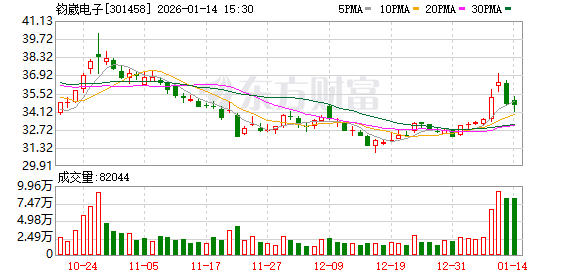
钧崴电子:深耕电子元器件领域 开拓AI算力业务
Zhong Guo Zheng Quan Bao· 2026-01-14 22:52
Core Insights - The electronic components industry is accelerating towards high-end and intelligent iterations, with Junwei Electronics focusing on precision resistors and fuses in passive components, aiming to increase market share through technology-driven strategies and deep cooperation with leading clients [2][3] Group 1: Business Performance - In the first three quarters of 2025, Junwei Electronics achieved revenue of 573 million yuan, a year-on-year increase of 18%, and a net profit attributable to shareholders of 114 million yuan, up 25.27% [3] - The rapid growth in performance is attributed to product upgrades and successful client expansion in the consumer electronics sector, including securing positions in the supply chains of major companies like Vivo, OPPO, Huawei, and Honor [3][4] Group 2: Market Trends and Future Outlook - The consumer electronics and home appliance markets are expected to maintain moderate recovery, driven by the continuous penetration of AI technology, with significant growth potential in mobile devices and wearables [4] - Junwei Electronics is optimistic about the long-term development prospects of these markets, having established a solid foundation and steadily increasing market share [4] Group 3: New Product Lines and Innovations - Junwei Electronics is actively developing core current sensor technologies, including fluxgate, Hall effect, and tunnel magnetoresistance (TMR) sensors, to transition into a comprehensive current sensing solution provider [6] - The company aims to enhance its value and customer loyalty in industrial, automotive, and renewable energy sectors through these innovations [6] Group 4: International Expansion - Junwei Electronics is accelerating its global market expansion, having established wholly-owned subsidiaries in the US and Japan, and is focusing on increasing its presence in overseas markets [7] - The acquisition of FLAT, a Japanese thin-film resistor manufacturer, is expected to enhance the company's capabilities and accelerate its international business development [7] Group 5: Strategic Focus - The company plans to continue deepening its expertise in precision resistors and fuses while expanding applications in new energy vehicles, photovoltaic storage, and smart terminals [8] - Junwei Electronics will increase R&D investment to develop intelligent current detection solutions, aiming to become a leading global provider of comprehensive current sensing technology services [8]