
全国统一大市场

Search documents
国家统计局:2024年我国经济发展新动能指数保持较快增长
Zhong Guo Xin Wen Wang· 2025-08-27 08:20
Core Insights - The economic development new momentum index for China in 2024 is projected to be 136.0, reflecting a 14.2% increase from the previous year, indicating strong growth in new industries, new business formats, and new models [1] Group 1: Economic Vitality - The economic vitality index for 2024 is estimated at 130.9, up 14.5% year-on-year, with 27.37 million new business entities established, averaging 24,000 new enterprises daily [2] - High-tech industry investment is expected to grow by 8.0%, outpacing overall investment growth by 4.8 percentage points, with high-tech manufacturing and services increasing by 7.0% and 10.2% respectively [2] - The express delivery sector is projected to handle 175.1 billion packages, generating revenue of 1.4034 trillion yuan, contributing to new consumption growth and economic circulation [2] Group 2: Innovation-Driven Growth - The innovation-driven index for 2024 is forecasted at 138.5, a 13.2% increase from the previous year, with R&D expenditure reaching 3.6 trillion yuan, up 8.3% [3] - Basic research funding is expected to rise to 249.7 billion yuan, a 10.5% increase, with the number of specialized "little giant" enterprises reaching 14,600 [3] - The number of high-value invention patents per 10,000 people is projected to increase by 2.2 to 14, with technology contract transaction value reaching 6.8354 trillion yuan, up 11.2% [3] Group 3: Network Economy - The network economy index is anticipated to reach 142.4 in 2024, reflecting a 16.2% increase, with mobile internet access traffic expected to hit 3,376 billion GB, an 11.6% growth [4] - The number of 5G base stations is projected to reach 4.25 million, accounting for 33.6% of total mobile base stations, an increase of 4.5 percentage points from the previous year [4] - Online retail sales are expected to reach 15.2 trillion yuan, growing by 7.2%, with physical goods online retail sales increasing by 6.5%, outpacing the growth of total social retail sales by 3.0 percentage points [4] Group 4: Continuous Transformation and Upgrading - The transformation and upgrading index for 2024 is projected at 127.8, a 12.5% increase, with the added value of strategic emerging industries continuing to accelerate [5] - High-tech manufacturing value added is expected to grow by 8.9%, outpacing the growth of overall industrial value added by 3.1 percentage points, with its share rising to 16.3% [5] - Non-fossil energy's share of total energy consumption is expected to increase by 1.8 percentage points, with electric vehicle exports surpassing 2 million units and lithium battery exports exceeding 3.9 billion units, setting a historical high [5]
畅通大市场:跨省共建产业园 借“港”出海促开放
Yang Shi Wang· 2025-08-27 05:10
Group 1 - The national unified market is a globally open market that promotes both domestic and international circulation, with Hainan Free Trade Port serving as a crucial link to the world [1] - Hainan Free Trade Port is leveraging its large domestic market and aligning with international high-standard economic and trade rules to explore collaborative opportunities between free trade policies and inland industries [1][5] - The establishment of the Xiang-Qiong Advanced Manufacturing Industrial Park in Hainan aims to address transportation challenges for large equipment from inland provinces, with a planned area of approximately 5,000 acres and expected production start in February 2026 [3][5] Group 2 - The cross-provincial industrial park initiative in Hainan capitalizes on the advantages of "zero tariffs, low tax rates, and simplified tax systems," while integrating resources from partner provinces in terms of industry, technology, talent, and capital [5] - The introduction of a local standard for the maintenance and remanufacturing of used construction machinery by market regulatory departments from Hunan and Hainan aims to enhance quality and reduce risks in cross-provincial cooperation [7] - The Guangdong-Hainan Advanced Manufacturing Cooperation Industrial Park is not merely about transferring industries but focuses on expanding overall market size through the establishment of the Qiong-Yue Industrial Investment Fund to attract social capital [9] Group 3 - Since the release of the overall plan for Hainan Free Trade Port over five years ago, Hainan has become a new frontier for China's opening up, implementing 22 special measures to relax market access and offering preferential tax rates, resulting in tax reductions exceeding 310 billion yuan for enterprises and 170 billion yuan for individuals [11] - As of now, personnel from 85 countries can enter Hainan visa-free, and the full island closure operation is set to officially start on December 18, which will accelerate the gathering of global quality resources and promote high-quality development of Hainan Free Trade Port [11]

7月中小企业利润由降转涨,分析师:上游成本下降和“反内卷”是主因
Xin Lang Cai Jing· 2025-08-27 05:00
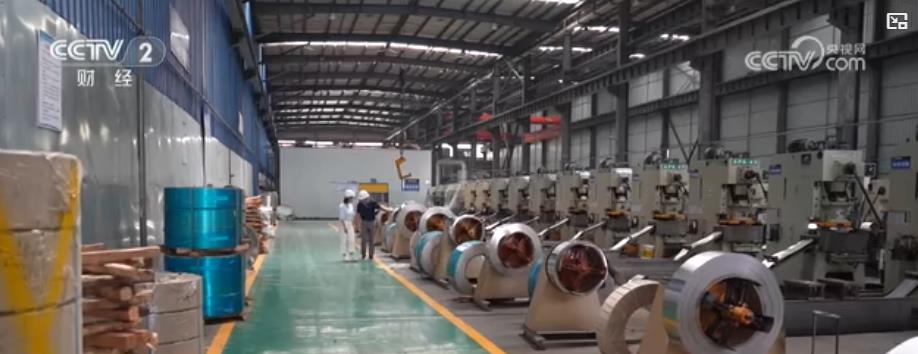
原材料价格方面,以有机硅和碳酸锂为例,2025上半年,国内有机硅上游原材料价格波动明显,价格先 扬后抑,但仍处于近年来低位水平。另外,锂电行业目前处于自2020年以来的第二轮波动。碳酸锂价格 在2022年最高涨至近60万元/吨,后经历剧烈震荡回落至当前的6万元/吨附近。 除了上游原材料价格波动,徐天辰还提到,上半年清欠工作和行业"反内卷"快速推进,中小企业是主要 受益者,财务状况也因此改善。 自2024年7月中共中央政治局会议首次提出防止"内卷式"恶性竞争以来,"反内卷"已成为我国经济工作 的重要导向。 登录新浪财经APP 搜索【信披】查看更多考评等级 炒股就看金麒麟分析师研报,权威,专业,及时,全面,助您挖掘潜力主题机会! 国家统计局最新公布数据显示,7月规模以上工业企业利润同比下降1.5%,降幅较6月收窄2.8个百分 点。尽管工业利润仍处于下降区间,但从企业规模来看,中、小企业呈现出修复态势。 数据显示,7月份,规模以上工业中型、小型企业利润分别由6月份下降7.8%、9.7%转为增长1.8%、 0.5%,效益状况改善较为明显。 分析师认为,中小企业利润回升的主要原因是上游价格的下降和"反内卷"的持续推进。 ...
上半年GDP增长5.7%,江苏经济增量居全国首位
Yang Zi Wan Bao Wang· 2025-08-26 07:37
Core Viewpoint - Jiangsu Province is committed to taking on the responsibility of being a major economic province, achieving significant economic growth and high-level openness through deep reforms and effective investment strategies [1][3]. Economic Performance - In the first half of the year, Jiangsu's GDP reached 6.7 trillion yuan, with a year-on-year growth of 5.7%, surpassing the national average by 0.4 percentage points, maintaining the highest economic increment in the country [1][3]. - The province's total foreign trade import and export amounted to 2.81 trillion yuan, marking a year-on-year increase of 5.2%, setting a historical record for the same period [1][3]. - Actual foreign investment reached 11.54 billion USD, maintaining the top position in the country [1]. Key Development Areas - Jiangsu has focused on five key areas: building a unified national market, expanding effective investment, optimizing the business environment, promoting urban-rural integration, and enhancing high-level openness [3][4]. - The province has made progress in breaking local protectionism and promoting efficient resource circulation, including the introduction of the Jiangsu Data Regulation and the establishment of a provincial data group [3][4]. Investment and Consumption - Major project investments totaled 423.2 billion yuan in the first half of the year, with significant contributions from equipment upgrades and consumption initiatives, leading to a retail sales growth of 5% [3][4]. - The "old-for-new" consumption initiative generated over 170 billion yuan in sales [3]. Business Environment - Jiangsu has been recognized as the best province for business reputation for five consecutive years, with a total of 14.61 million business entities registered [4]. - The industrial output value of private enterprises increased by 8.7% year-on-year [4]. Urban-Rural Integration - The income ratio between urban and rural residents decreased to 1.98, lower than the national average by 0.44 percentage points [4]. High-Level Openness - Jiangsu has fully removed restrictions on foreign investment in the manufacturing sector, with 400 Fortune 500 companies already invested in the province [4]. - The province's trade with countries involved in the Belt and Road Initiative reached 1.39 trillion yuan, a year-on-year increase of 9.5%, accounting for nearly half of the province's total foreign trade [4].
显微镜下的中国经济(2025年第32期):年内还有哪些政策值得关注
CMS· 2025-08-25 15:05
Policy Directions - The two main policy directions for the second half of the year are anti-involution and expanding domestic demand, aimed at stabilizing price levels[1] - Anti-involution policies are expected to further expand in industries like steel, cement, and photovoltaics, with potential governance in other sectors such as lithium batteries[1] Economic Indicators - Recent high-frequency indicators show a weakening in both supply and demand, with production rates for asphalt, cement, and rebar declining[1] - The national average operating rate for asphalt companies was 30.7%, down 2.2 percentage points week-on-week, but up 15.8% year-on-year[9] - The average operating rate for electric furnaces was 62.82%, a decrease of 0.64 percentage points week-on-week, with a year-on-year increase of 24.1%[12] Production and Prices - The average daily crude steel production in early August was 2.074 million tons, an increase of 92,000 tons from late July, with a year-on-year growth of 3.5%[72] - Cement production last week was 13.337 million tons, down 2.979 million tons week-on-week, but up 1.1% year-on-year[92] - The average price of cement in East China was 433 RMB/ton, up 15 RMB/ton week-on-week, while in Southwest China, it was 460 RMB/ton, up 17 RMB/ton[100] Market Risks - Key risks include geopolitical tensions, domestic policy implementation falling short of expectations, global recession, and major economies' monetary policies exceeding expectations[2]
中国经济微观察 从“破除”到“开放” 全国统一大市场建设迈入新阶段
Ren Min Wang· 2025-08-25 06:23
Core Viewpoint - The recent changes in the central government's approach to building a unified national market reflect a deeper upgrade in top-level design, marking a new phase in market construction in China [1] Group 1: Internal Opening - The core of internal opening is to treat all types of business entities equally, emphasizing a negative list system for market access [1] - The number of items in the negative list for market access has decreased from 117 in 2022 to 106 in 2025, indicating a release of market vitality [1][2] - Efforts are being made to eliminate local protectionism and market segmentation, promoting the rational flow of various factors across regions [2] Group 2: Regional Cooperation - Significant progress has been made in regional cooperation, with initiatives in the Yangtze River Delta promoting data security, resource cooperation, and integrated services [2] - The collaboration aims to facilitate resource sharing and contribute to the construction of a unified national data market [2] Group 3: External Opening - The focus of external opening is on steadily expanding institutional openness, which differs from traditional methods that emphasize tariffs and trade facilitation [3] - The establishment of the Hainan Free Trade Port, set to begin operations on December 18, is a significant step towards implementing institutional openness [3] - By aligning with international high-standard trade rules, China aims to create a transparent and stable business environment, enhancing its ability to allocate resources globally [3]
第33届广州博览会落幕 累计观展人数超16万人次
Guang Zhou Ri Bao· 2025-08-25 01:54
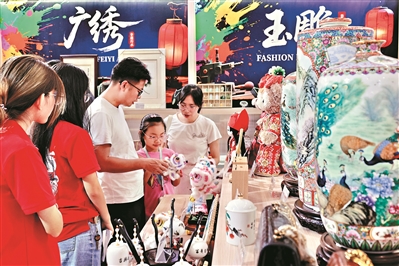
Core Insights - The 33rd Guangzhou Expo achieved a total intended signing amount of 400.81 billion yuan, attracting over 160,000 visitors and signing 83 economic cooperation projects [2][3]. Group 1: Event Overview - The expo showcased Guangzhou's role as a national central city and international trade center, featuring various thematic exhibition areas such as new productivity, rural revitalization, and healthcare [2][4]. - The total exhibition area reached approximately 180,000 square meters, marking a year-on-year increase of over 50% [3]. Group 2: International and Cultural Expansion - The expo was held concurrently with the 11th International Invention Exhibition, enhancing its international, cultural, and social dimensions [4]. - Over 4,000 business associations and enterprises participated, improving supply-demand matching and facilitating on-site transactions [4]. Group 3: Focus on Emerging Industries - The event emphasized the cultivation of new productivity, focusing on emerging industries such as artificial intelligence, smart vehicles, and aerospace [4]. - The International Invention Exhibition attracted over 300 guests from more than 30 countries, showcasing over 2,000 inventions [4]. Group 4: Future Outlook - A framework agreement was signed to promote domestic circulation and develop new productivity over the next three years, aiming to create a beneficial cycle through technology sharing and market connectivity [6]. - The expo plans to continue enhancing its internationalization and professionalism, establishing itself as a benchmark for global economic cooperation [6].
人民日报头版头条点赞四川:蜀道新歌
Ren Min Ri Bao· 2025-08-25 01:46
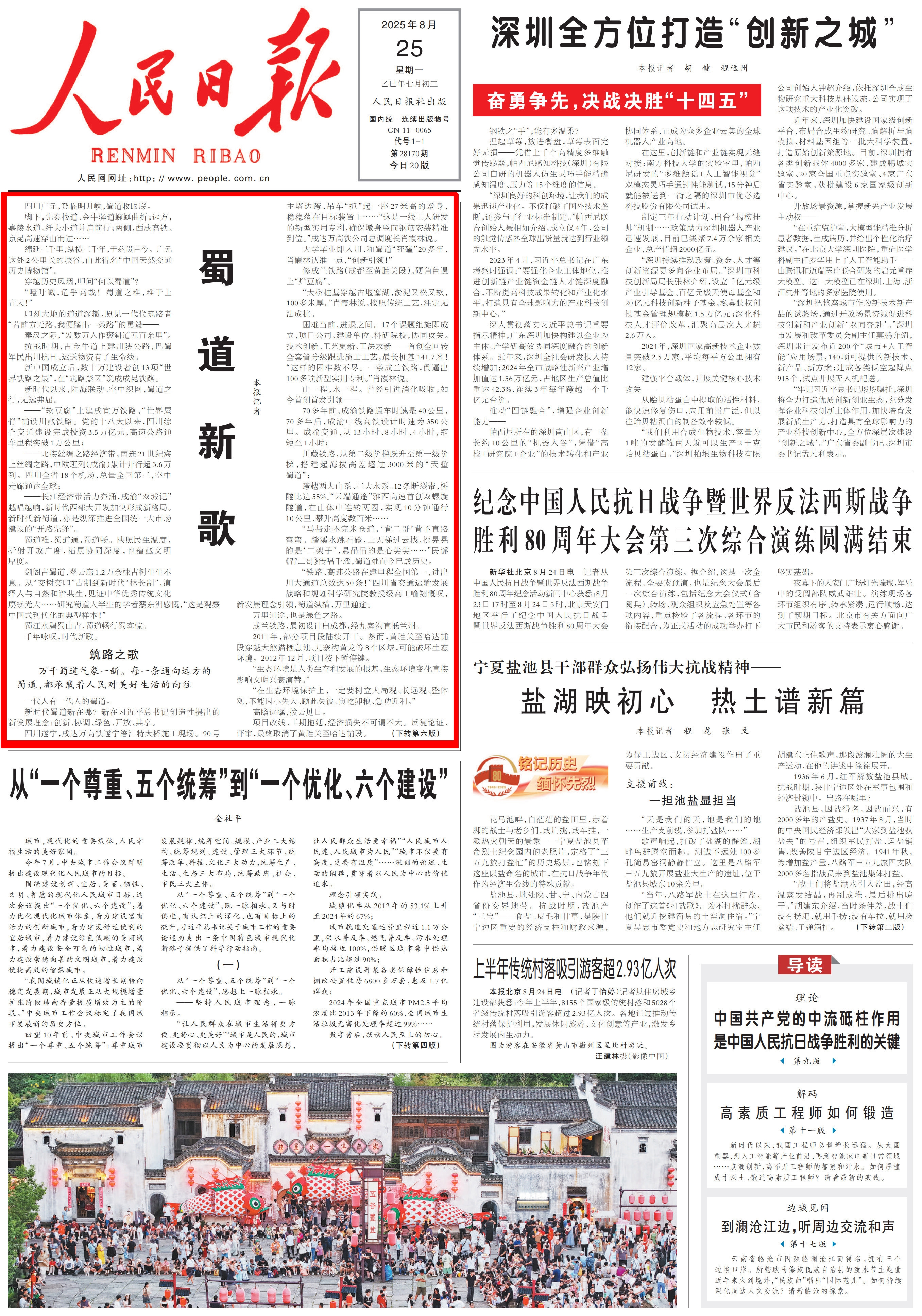
Core Viewpoint - The article "New Song of Shu Road" highlights the transformation of Sichuan's transportation infrastructure from the historical challenges of "Shu Road" to a modern, interconnected network that supports economic growth and regional integration [1][5]. Group 1: Historical Context - The article traces the historical significance of the Shu Road, emphasizing its evolution from ancient pathways to modern transportation systems, showcasing the resilience and innovation of builders throughout history [3][28]. - Key milestones include the construction of the Baoshan Road during the Qin and Han dynasties and the establishment of the Chengdu-Chongqing Railway, which marked significant advancements in transportation [29][30]. Group 2: Modern Infrastructure Development - Since the 18th National Congress, Sichuan has invested 3.5 trillion yuan in comprehensive transportation construction, with over 10,000 kilometers of expressways completed [32]. - The region has established 50 major transportation corridors, with the Chengdu-Chongqing economic circle becoming a national model for integrated development [44][70]. Group 3: Economic Integration and Growth - The Chengdu-Chongqing economic circle's GDP increased from 6.3 trillion yuan in 2019 to 8.7 trillion yuan in 2024, reflecting significant economic growth and regional collaboration [70]. - The establishment of the cross-provincial tax collection service center in the Gaotong New District exemplifies efforts to streamline administrative processes and enhance economic cooperation between Sichuan and Chongqing [60][66]. Group 4: Environmental Considerations - The article emphasizes the importance of ecological protection in infrastructure projects, highlighting the need for sustainable development practices that consider long-term environmental impacts [51][54]. - The construction of the Chengdu-Lanzhou Railway faced challenges due to environmental concerns, leading to project modifications to protect sensitive ecosystems [51][52]. Group 5: Future Prospects - The article concludes with a vision for the future of the Shu Road, emphasizing its role as a "pioneer" in promoting a unified national market and facilitating international trade [5][81]. - The development of logistics and transportation networks is expected to enhance the region's competitiveness in global markets, particularly through initiatives like the China-Europe Railway Express [81][85].
蜀道新歌
Ren Min Ri Bao· 2025-08-24 22:21
Core Viewpoint - The article highlights the historical and modern significance of the "Shu Road" in Sichuan, emphasizing its role in transportation, economic development, and cultural continuity in China. Group 1: Historical Significance - The Shu Road, known as "China's Natural Transportation History Museum," has a rich history dating back over 3,000 years, showcasing the efforts of ancient builders [1] - During the Anti-Japanese War, the ancient Jin Niu Road was transformed into a vital supply route for the military and civilians [2] - After the founding of New China, significant infrastructure projects like the Chengdu-Kunming Railway were completed, setting world records in railway construction [3] Group 2: Modern Infrastructure Development - Since the 18th National Congress, Sichuan has invested 3.5 trillion yuan in comprehensive transportation construction, with over 10,000 kilometers of expressways completed [4] - The province has established 18 airports, ranking third nationally, and has seen over 36,000 China-Europe freight trains operate [4] - The Chengdu-Chongqing economic circle has been promoted, enhancing regional connectivity and economic integration [4] Group 3: Innovation and Technology - The construction of the Chengdu-Lanzhou Railway faced significant challenges, leading to the development of over 100 new practical patents through collaborative innovation [11] - The design speed of the Chengdu-Chongqing Railway has increased from 40 km/h to 350 km/h over 70 years, significantly reducing travel time [12] - New construction techniques, such as the full rotation and full casing method, have been pioneered to address unique geological challenges [11] Group 4: Economic Integration and Policy - The establishment of the Chengdu-Chongqing economic circle has led to a significant increase in economic output, from 6.3 trillion yuan in 2019 to 8.7 trillion yuan in 2024 [24] - The "Chuan-Yu Tongban" initiative has streamlined over 355 government service items, enhancing administrative efficiency across the region [24] - The cross-provincial tax collection service center has been established to unify tax regulations, benefiting local businesses [21] Group 5: Cultural and Environmental Aspects - The Shu Road symbolizes the harmonious coexistence of nature and human development, reflecting traditional Chinese values [5] - The preservation of ancient trees along the Shu Road has been integrated into modern environmental protection practices [42] - Cultural initiatives, such as the digital exhibition of Sichuan's historical sites, aim to promote cultural heritage and tourism [46]
市场监管总局答每经记者问:坚决纠治各种封闭“小市场”等行为
Mei Ri Jing Ji Xin Wen· 2025-08-24 14:27
Core Viewpoint - The Chinese government is focusing on high-quality development of market regulation during the "14th Five-Year Plan" period, emphasizing the construction of a unified national market to facilitate domestic circulation and eliminate local protectionism [1][2]. Group 1: Market Regulation Achievements - The State Administration for Market Regulation has taken significant actions to combat administrative monopolies, with 239 cases of administrative monopoly investigated and over 8,000 local standards eliminated [1][3]. - A series of effective mechanisms have been established to enhance domestic circulation, including the first major revision of the Anti-Monopoly Law in 15 years and the third revision of the Anti-Unfair Competition Law [2][3]. - The establishment of a fair competition review mechanism has led to the review of 42,200 important policy measures, with 11,400 receiving modification suggestions to prevent adverse policies from being enacted [3][4]. Group 2: Focus on Key Sectors - Continuous anti-monopoly enforcement actions in the livelihood sector have led to the investigation of monopolistic practices in pharmaceuticals, utilities, and construction materials, effectively reducing public living costs [3][4]. - The market regulation department has reviewed 3,400 cases of operator concentration and addressed 145 illegal cases, maintaining fair competition in the market [3][4]. Group 3: Platform Economy Regulation - The rapid development of the platform economy has prompted the need for balanced regulation, with new rules established to enhance regulatory effectiveness while promoting healthy industry growth [6][7]. - Significant actions have been taken against online market irregularities, including the removal of 4.541 million illegal product listings and the investigation of 105,000 internet-related cases [7]. - The market regulation department is committed to improving compliance management mechanisms for platforms and enhancing communication with various stakeholders to ensure a supportive regulatory environment [7].