绿色转型

Search documents
欧洲央行原行长特里谢:AI投资未必能立即转化为生产率提升
Quan Jing Wang· 2025-10-23 08:48
Group 1 - The core agenda of the Bund Summit 2025 is structured around a "3-4-5" framework, focusing on three key topics: green transition and global climate governance, global changes and international order transformation, and artificial intelligence (AI) [1][2] - The emphasis on green transition highlights the collective responsibility to maintain the Earth as a unique "spaceship," which is a fundamental theme of the Bund Summit [1] - The rapid development of AI is acknowledged, with a reference to philosopher Karl Popper's view on the unpredictability of history due to technological advancements, indicating that AI's rise exemplifies this unpredictability [1] Group 2 - The call for enhanced multilateral cooperation is underscored, emphasizing the need for collaboration and unity among nations in a world increasingly characterized by multipolarity [2] - The interconnectedness of global goods, services, technologies, and ideas is highlighted, suggesting that the fate of all nations is closely linked, which aligns with the goals of the Bund Summit [2]
意中商业发展论坛主席:中国经济政策为国际经贸合作注入持久动力
人民网-国际频道 原创稿· 2025-10-23 08:41
Core Insights - The China-Italy and China-Europe economic and trade relations are entering a more mature and pragmatic phase after decades of development [1] - The bilateral trade volume between the EU and China has increased over 300 times in the past 50 years, with significant cooperation in pharmaceuticals, agricultural processing, industrial machinery manufacturing, and green technology [2] - Italy has unique advantages in high-quality industrial chains, particularly in geographical indication agricultural products, electromechanical automation, and health and life sciences [2] Group 1 - Ivan Catillo, Chairman of the China-Italy Business Development Forum, emphasizes the importance of stability and certainty in international cooperation amid significant global changes [2] - China has implemented various measures to enhance foreign investment, including easing industry access, strengthening intellectual property protection, and creating an international business environment [2] - The establishment of the "China Law Research Institute" aims to reduce information asymmetry and promote sustainable partnerships between China and Italy [4] Group 2 - Catillo advocates for a focus on "thematic dialogue" mechanisms to address specific issues, which can lead to more effective outcomes and enhance mutual trust between China and Italy [4] - The deep integration of value chains between Europe and China is driving companies to seek key components or co-develop production processes in each other's markets [2] - The ongoing commitment to high-quality development, green transformation, and international cooperation is evident in various sectors, including food safety and compliance management [2]


2025年全国汽车以旧换新补贴申请量突破1000万份
Di Yi Cai Jing· 2025-10-23 08:40
Core Insights - The automotive trade-in subsidy application volume has exceeded 10 million as of October 22, 2023, with over 3.4 million vehicles scrapped and more than 6.6 million vehicles replaced [1] - The trade-in policy is effectively promoting green transformation, with 57.2% of vehicles in the trade-in program being new energy vehicles [1] - Retail sales of new energy passenger vehicles increased by 24.4% year-on-year from January to September, achieving a market penetration rate of 52.1%, which rose to 57.8% in September, marking seven consecutive months of growth [1] - The level of resource recycling is also improving, with 7.345 million scrapped vehicles recovered in the first three quarters of the year, representing a year-on-year increase of 47.9% [1] - It is estimated that approximately 7.1 million tons of steel, 920,000 tons of aluminum, and 930,000 tons of plastic can be recycled, contributing to a carbon reduction of over 21 million tons [1]
深圳龙岗区:精准赋能助力突围家居卖场困境
Zhong Guo Jing Ji Wang· 2025-10-23 07:25
Core Insights - The "Qingchuang Meiju Building Materials and Home Furnishing Expo Center" in Longgang District, Shenzhen, has achieved 100% occupancy with 128 shops despite industry challenges such as rising vacancy rates and weak consumer demand [1] - The center reported impressive sales figures, with a single-day sales record exceeding 5 million yuan during its first anniversary celebration and total sales of 22.8 million yuan during its inaugural home expo [1] Group 1: Marketing and Promotion Strategies - The South Bay Street implemented a tailored "one enterprise, one policy" promotional empowerment plan for Qingchuang Meiju, creating comprehensive marketing strategies and leveraging new media platforms for targeted customer outreach [2] - Innovative cross-industry marketing strategies were employed, including the "Le Gou Nan Wan Drive Enjoy Life" event, which integrated automotive sales into the home goods market, enhancing customer traffic through collaborative promotions [2] Group 2: Support Services and Economic Development - The South Bay Street extended its services throughout the entire business development process by establishing a "virtual park i-enterprise service station," which integrates government and market resources to support businesses [3] - The service station assisted 83 enterprises in applying for national subsidies related to home renovation, securing nearly 6.5 million yuan in consumer subsidies, and provided various support services to 95% of merchants [3] Group 3: Green Transformation and Sales Growth - Qingchuang Meiju has invested 30 million yuan in green transformation projects, including a photovoltaic power generation system in collaboration with Huawei, expected to save over 1 million yuan in electricity costs annually [3] - The center adopted a multi-channel operational model combining physical stores, e-commerce platforms, and live streaming, achieving total sales exceeding 200 million yuan since its opening through various promotional activities [3]
欧盟新殖民实锤?逼非洲当能源奴隶,谁敢跟中国好就制裁断援助
Sou Hu Cai Jing· 2025-10-23 05:45
Group 1: European Union's Energy Strategy - The EU is shifting its energy dependence from Russia to Africa, seeking to secure oil and gas resources amid the Ukraine crisis [1][3] - By early 2025, several European countries have signed gas supply agreements with African nations like Mozambique and Senegal, with Mozambique's gas project showing a significant export increase of 24.6% year-on-year [1][3] - The EU's energy strategy reveals contradictions, as it previously urged African nations to reduce oil and gas production for green transition but now demands increased output to fill its energy gap [3] Group 2: China's Growing Influence in Africa - China is expanding its influence in Africa, pledging $50.7 billion in financial aid from 2025 to 2027, which includes $29.6 billion in loans and $11.3 billion in assistance [5] - Chinese investments in African resources, such as uranium and cobalt in Namibia, are significant, with a focus on development without political conditions [5] - Projects like Mozambique's Coral South LNG project highlight China's commitment to infrastructure development, contributing to Mozambique's status as a gas exporter [5] Group 3: African Nations' Response and Development Goals - African leaders are increasingly aware of the need for development autonomy and are advocating for industrialization and economic diversification, as emphasized in the African Union's Agenda 2063 [9] - The focus on technology transfer and industrial upgrades is seen as more beneficial for Africa's long-term interests compared to mere resource extraction [9] - Renewable energy development is accelerating in Africa, with projections indicating that renewable sources will account for 30% of total electricity generation by 2025 [10] Group 4: EU's Strategic Concerns and Actions - The EU is concerned about its declining influence in Africa, as surveys show that African citizens view China and the US more favorably than the EU [7] - To counter this, the EU is adopting a more aggressive competitive strategy in Africa, including plans to achieve a domestic processing rate of at least 40% for critical raw materials by 2030 [7] - The EU's approach to Africa is criticized for treating the continent as a resource supplier rather than a partner, revealing a hegemonic mindset [12]
菏泽:水土保持率呈现良好态势,良性循环机制促生态发展
Qi Lu Wan Bao Wang· 2025-10-23 05:33
Core Insights - The city of Heze has made significant progress in soil and water conservation, with compliance rates for construction projects increasing from 40.53% in 2021 to 71.22% in 2024 [1] - Heze's soil and water conservation rate for 2024 reached 97.23%, exceeding the provincial target of 97.12% and the provincial average by approximately 11 percentage points [1] - The city has successfully implemented a virtuous cycle mechanism for soil and water conservation through the first ecological product value conversion transaction in the Huangfan Plain area, promoting the "Two Mountains Theory" [1] Group 1: Regulatory and Management Efforts - The city has strengthened the enforcement of the "Three Simultaneities" system for soil and water conservation, ensuring comprehensive supervision of construction projects [2] - A total of 408 suspected violations of soil and water conservation regulations have been investigated and addressed this year, with 105 construction projects submitting approved conservation plans [2] - The city has achieved a 100% data entry rate for soil and water conservation documentation, ensuring full coverage of human-induced soil erosion monitoring [2] Group 2: Community Engagement and Awareness - The water authority has integrated soil and water conservation into the training programs for party and government leaders, enhancing legal awareness [2] - Community outreach efforts have been made to promote understanding of soil and water conservation laws among the public [2] Group 3: Ecological and Economic Benefits - The city has achieved a 100% greening rate for rivers with a drainage area of over 50 square kilometers and has completed the annual soil erosion control task of 10 square kilometers [3] - The ecological, economic, and social benefits of ongoing soil and water conservation projects have significantly improved the public's sense of gain, happiness, and security [3] Group 4: Future Directions - The water authority aims to establish a robust prevention, governance, and regulatory system for soil and water conservation, promoting sustainable development in Heze [4]
湖北恩施 以绿兴业擦亮生态名片
Jing Ji Ri Bao· 2025-10-22 22:10
Core Insights - Enshi Tujia and Miao Autonomous Prefecture aims to establish a "Two Mountains" practice innovation demonstration zone, leveraging its cultural, resource, and ecological advantages to enhance overall development and contribute to Hubei's strategic growth [1] Economic Performance - In the first half of the year, Enshi's GDP reached 76.991 billion yuan, with a year-on-year growth of 6.3%, outperforming the provincial average in 13 key economic indicators, with 7 indicators ranking in the top five in the province [1] Ecological Initiatives - The village of Tudianzai has achieved 100% clean energy supply, processing 3,850 tons of manure annually and generating 2 million kWh of electricity, reducing carbon emissions by 12,000 tons per year [2] - Enshi has maintained a 95% rate for the transfer and disposal of ship water pollutants, restored 482,000 acres of degraded forest, and completed 111 air pollution control projects [2] Green Finance and Industry - The GEP (Green Ecosystem Product) green finance loan product has been introduced, providing 15.2 million yuan in unsecured loans to seven tea companies, marking a significant step in ecological product value realization [3] - Enshi has created 11 national and provincial-level green factories, with energy consumption per unit of added value in regulated enterprises decreasing by 24.4% compared to the end of the 13th Five-Year Plan [3] Transportation Infrastructure - Enshi's international airport has opened its first international route, with 4 international and 19 domestic routes, facilitating over 12,000 inbound and outbound passengers in the first half of the year [4] - Major transportation projects are underway, including the Yifeng Railway and several highway constructions, enhancing the region's connectivity and logistics capabilities [4] Trade and Export Growth - Enshi's foreign trade import and export total reached 4.31 billion yuan, a 198.5% increase, with actual foreign investment of 22.39 million dollars, up 196.6% [5] - The region has successfully exported tea worth 37.157 million dollars and medicinal materials worth 25.748 million dollars, leading the province in both categories [5] Industrial Development - Enshi's wind power capacity totals 500,000 kW, generating over 800 million kWh annually, supporting the local AI computing center [6] - The region has established a modern industrial system, with over 1,000 industrial enterprises utilizing cloud services and achieving a 100% 5G coverage rate in administrative villages [6] Agricultural Innovations - The chicken farming base in Jianxi County utilizes advanced automation, contributing to a comprehensive industrial chain valued at over 10 billion yuan [7] - Enshi has introduced 296 projects related to its five leading industrial chains, with significant achievements in the selenium and tea industries, and a total output value of 54.04 billion yuan for the selenium industry [7]
中国经济信心说丨前三季度GDP增长5.2% 这“稳稳的幸福”来之不易
Yang Shi Xin Wen· 2025-10-22 16:04
Economic Performance - In the first three quarters, China's GDP reached 101.5 trillion yuan, with a year-on-year growth of 5.2% [1] - This growth rate positions China among the top economies globally, with the economic total in Q3 reaching 35.5 trillion yuan, surpassing the projected total for the third-largest economy in 2024 [1] Industrial Growth - Significant growth in new industries and technologies is evident, with industrial robots and service robots seeing production increases of 29.8% and 16.3%, respectively [2] - The manufacturing value added in lithium-ion battery production, shipbuilding, and electric motor manufacturing grew by 29.8%, 22.9%, and 17.1% year-on-year [2] Consumer Spending - Final consumption expenditure contributed 53.5% to economic growth, an increase of 9.0 percentage points compared to the previous year [2] - The number of applications for vehicle trade-ins exceeded 8.3 million, indicating strong consumer demand [2] Green Energy Transition - Production of new energy products such as electric vehicles and lithium-ion batteries increased by 29.7% and 46.9%, respectively, reflecting a robust green transition [3] - Wind and solar power generation also saw double-digit growth, indicating an increase in the "green content" of economic development [3] Economic Indicators - Positive indicators include a rise in the manufacturing purchasing managers' index for two consecutive months and an increase in industrial product prices, which may enhance corporate profitability [3] - Domestic travel during the Mid-Autumn and National Day holidays reached 888 million trips, showcasing a vibrant consumer market [3]
中国造船业交出高质量发展成绩单
Zhong Guo Xin Wen Wang· 2025-10-22 09:33
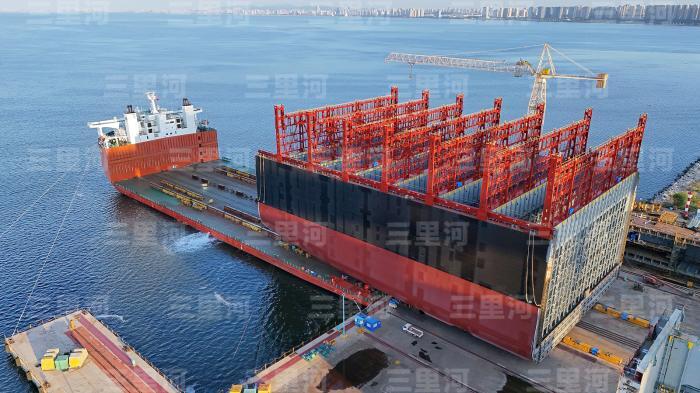
Core Insights - China's shipbuilding industry is experiencing significant growth, with full order books extending to the end of 2028 and some orders reaching into 2029 [1][4] - The global new ship orders during the "14th Five-Year Plan" period show that 64.2% are secured by Chinese shipbuilders, an increase of 15.1 percentage points compared to the "13th Five-Year Plan" [3] - Despite external pressures, such as the U.S. imposing port "service fees" on Chinese vessels, orders continue to flow to Chinese shipyards, exemplified by New Zealand's recent decision to award contracts to Chinese firms [3] Industry Performance - As of the first three quarters of 2025, China's market share in completed ships, new orders, and backlog orders stands at 53.8%, 67.3%, and 65.2% respectively, maintaining a global lead [3] - The shipbuilding sector's export value exceeded $40.1 billion in the first three quarters of 2025, reflecting a year-on-year growth of 21.4% [5] Technological Advancements - China's shipbuilding strength is attributed to significant advancements in self-innovation, overcoming previous technological monopolies held by a few countries [5] - The industry has successfully developed key high-end vessels, including aircraft carriers, large cruise ships, and large LNG carriers, positioning itself to challenge South Korea's record of $54.1 billion in exports set in 2011 [5] Green Transition - The Chinese shipbuilding industry is aligning with global decarbonization goals, with a projected 78.5% market share in new green ship orders by 2024 [6] - The industry has established a comprehensive supply chain that enhances its competitive edge, with a focus on domestic production and innovation [6] Economic Impact - The shipbuilding sector generates significant economic activity, with a reported 1 yuan investment in cruise ship construction yielding 14 yuan in industry output [7] - The industry has created thousands of jobs through domestic projects, demonstrating a strong multiplier effect on the economy [7] Competitive Landscape - China's shipbuilding industry has maintained its position as the world's leading shipbuilder for 16 consecutive years, driven by advancements in technology, sustainability, and a robust supply chain [7] - The ongoing transition of global shipbuilding centers reflects the industry's competitive evolution, with China emerging as a formidable player on the world stage [7]

赵伟:“十四五”规划回顾与“十五五”规划前瞻(《中国外汇》8月第16期)
申万宏源宏观· 2025-10-22 06:56
Core Viewpoint - The "15th Five-Year Plan" (2026-2030) is positioned as a critical period for deepening reforms, tackling challenges, and laying the foundation for achieving the 2035 long-term goals, building on the achievements and challenges of the "14th Five-Year Plan" [3][22]. Summary by Sections Review of the "14th Five-Year Plan": Achievements, Challenges, and Policy Evolution - The "14th Five-Year Plan" emphasizes an upgrade in goal orientation, with a focus on quality over speed, and a significant increase in the importance of livelihood and safety [4][6]. - Key areas of deployment include economic development, industrial innovation, regional layout, rural revitalization, social welfare, green ecology, cultural soft power, and security [5][7]. - The plan has shown significant achievements, with the economy expected to reach approximately 140 trillion yuan by 2025, contributing around 30% to global economic growth [7][8]. Policy Evolution During the "14th Five-Year Plan" - Initial policies focused on energy consumption control led to short-term industrial output declines, prompting a shift towards structural optimization rather than total control [9]. - The transition from administrative directives to market-oriented policies has supported economic growth while promoting green development [9]. Prospects for the "15th Five-Year Plan" - The "15th Five-Year Plan" is expected to focus on high-quality economic development, deepening green transformation, and key area reforms, with an average nominal growth rate of around 4% needed to meet 2035 goals [12][13]. - Key reform tasks include enhancing market-oriented reforms, promoting new quality productivity, and ensuring ecological and environmental targets are met [14][15]. Key Themes of the "15th Five-Year Plan" - The plan's three main themes are high-quality development, green transformation, and key area reforms, which are interrelated and mutually supportive [15]. - Emphasis will be placed on building resilient and sustainable economic systems, enhancing domestic supply chains, and reducing reliance on external technologies [16]. Signals from Research and Meetings on the "15th Five-Year Plan" - The National Development and Reform Commission has initiated research topics to support the planning process, focusing on both international and domestic variables affecting economic security and development [17][20]. - Local governments are actively engaging in planning efforts, aligning with national strategies to promote local industries, technological innovation, and ecological protection [21][22].