互联网泡沫

Search documents
重大!高盛公开唱空:股市将回调!是否可信,又是套路吗?
Sou Hu Cai Jing· 2025-10-05 21:40
Group 1 - Goldman Sachs warns that the stock market may experience a significant correction in the next one to two years, citing the AI boom as a potential risk similar to the internet bubble [1][3] - CEO David Solomon compares the current AI-driven market to the 1990s internet bubble, suggesting that a withdrawal of investments could lead to a market downturn [3][12] - The S&P 500's cyclically adjusted price-to-earnings ratio has surged to 38 times, indicating a historical high and raising concerns about market concentration risk [3][12] Group 2 - Goldman Sachs has a history of making inaccurate predictions regarding bank stocks, such as its 2023 report on China Merchants Bank, which underestimated the actual non-performing loan ratio [5][9] - The current market environment is complicated by high global government debt and rising interest rates, which could impact stock market stability [5][12] - There is a divergence in market reactions to Goldman Sachs' warnings, with some investors reducing their positions while others see potential buying opportunities [8][12] Group 3 - Retail investors are particularly vulnerable to panic selling in response to institutional warnings, as evidenced by the significant volume of high-risk options trading [8][12] - Goldman Sachs' contradictory stance—warning of an AI bubble while acknowledging the long-term potential of technology—raises questions about its motives [8][12] - Other financial institutions, like Morgan Stanley and Bank of America, are also issuing warnings about market risks, contributing to a confusing landscape for investors [12][13]



2027年AI泡沫必破?英伟达4万亿市值连环套,OpenAI或成爆雷点!
Sou Hu Cai Jing· 2025-10-04 23:04
Core Viewpoint - The current AI hype resembles the internet bubble of the late 1990s, with significant speculation and inflated valuations, but lacking a sustainable business model and profitability [1][10]. Group 1: AI Market Dynamics - Nvidia's market capitalization has surpassed $4 trillion, making it the most valuable company in history, but this valuation is largely based on speculative growth rather than actual earnings [3]. - Oracle announced that OpenAI will spend $300 billion on computing power over the next five years, averaging $60 billion annually, despite OpenAI currently losing $5 billion each year [4]. - Nvidia has committed to investing up to $100 billion in OpenAI, which is essentially a mechanism for OpenAI to purchase Nvidia's chips, inflating Nvidia's revenue and market value [4][5]. Group 2: Financial Interdependencies - The financial relationship among Nvidia, Oracle, and OpenAI creates a closed-loop funding scheme where money circulates without genuine revenue generation, resembling a "money game" [5][6]. - Oracle and Nvidia are leveraging the narrative of high demand for AI computing power to boost their stock prices, while OpenAI benefits from investments without immediate financial obligations [6]. Group 3: Future Profitability Concerns - By 2027, OpenAI will need to start making substantial payments to Oracle for computing power, which raises concerns about its ability to generate profits given its current losses [7][9]. - The AI bubble's potential collapse could mirror the internet bubble burst, with significant financial repercussions for companies involved, including Nvidia and OpenAI, as well as related domestic firms [12]. Group 4: Investment Strategy Implications - The current AI landscape is characterized by speculative investments, similar to the internet boom, where companies are valued based on potential rather than actual profitability [10]. - Investors should be cautious and critically assess the underlying value of AI companies, especially as the 2027 deadline approaches for OpenAI's financial commitments [12].



帮主郑重:政府停摆三天,美股反倒创新高?这股劲儿藏在哪
Sou Hu Cai Jing· 2025-10-04 03:20
Market Performance - The Dow Jones Industrial Average rose by over 238 points, closing at 46,758, with an increase of 0.51% [3] - The S&P 500 reached a new historical high during the day, peaking at 6,750, despite a minimal increase of 0.44 points at close [3] - The Nasdaq Composite experienced a decline of 63 points, down 0.28%, but all three major indices showed gains over the week: Dow up 1.1%, Nasdaq up 1.32%, and S&P up 1.09% [3] Government Shutdown Impact - The government shutdown entered its third day with no resolution, affecting 750,000 federal employees who are on unpaid leave [3] - Historical data suggests that government shutdowns have a temporary impact on the economy, with the S&P 500 averaging a gain of over 3% during previous shutdowns [4] AI Market Influence - The current market sentiment is heavily influenced by the AI boom, with investors experiencing "FOMO" (Fear of Missing Out), overshadowing concerns about the government shutdown [4] - Companies involved in AI storage, such as Seagate and Micron, have seen their stock prices double this year, contributing to bullish market sentiment [4] Economic Data and Federal Reserve - The government shutdown has disrupted the September non-farm payroll report, which is the first occurrence since 2013 [5] - The absence of this data may reduce potential pressure on the stock market, leading to increased confidence that the Federal Reserve will lower interest rates in October [5] Long-term Considerations - While the current market is buoyed by AI momentum, there are warnings from Wall Street veterans about potential similarities to the 1990s internet bubble, indicating that valuations may be high [5] - Key factors to monitor include the duration of the government shutdown and whether the AI hype can translate into actual profitability [5]

美股盘前要点 | 美国政府“关门”进入倒计时!特斯拉第三代人形机器人明年量产
Ge Long Hui A P P· 2025-09-30 12:33
Group 1 - US stock index futures experienced slight declines, with Nasdaq futures down 0.1% and S&P 500 and Dow futures down 0.14% [1] - European stock indices showed mixed results, with Germany's DAX up 0.02%, UK's FTSE 100 up 0.15%, France's CAC down 0.24%, and the Euro Stoxx 50 flat [1] - Citigroup raised its three-month price targets for gold and silver to $4000 and $55 respectively, maintaining a bullish technical outlook [1] - Tesla announced plans to launch a third-generation humanoid robot by the end of 2025, with mass production starting in 2026 [1] - Nvidia's CEO Jensen Huang sold 225,000 shares, cashing out over $40 million [1] - TSMC's third factory in Arizona is expected to start production in 2027, one year earlier than initially planned [1] - Boeing has begun developing a new narrow-body aircraft to replace the 737 MAX series [1] Group 2 - Lockheed Martin secured multiple defense contracts totaling over $12.8 billion [2] - Verizon is in talks to purchase a portion of EchoStar's wireless spectrum assets, particularly involving AWS-3 licenses [2] - ExxonMobil plans to lay off approximately 2,000 employees globally, exacerbating job losses in the oil industry [2] - American Airlines warned that a government shutdown could impact the airline industry, increasing the risk of flight delays [2] - Hesai plans to deepen its partnership with Xiaomi Automotive as a core strategic supplier from 2026 to 2027 [2] - Wolfspeed has exited bankruptcy protection, with former Micron and Corning executives joining its board [2]

"昂贵"就是新标准?华尔街开始接受股市估值"新常态"
Hua Er Jie Jian Wen· 2025-09-29 13:29
Core Viewpoint - The article discusses the shifting perception of stock market valuations, suggesting that high valuations should be viewed as a "new normal" rather than a temporary anomaly, driven by structural changes in the economy and market dynamics [1][2]. Group 1: Structural Changes in Valuation - The S&P 500 index's rolling average price-to-earnings (P/E) ratio has increased from approximately 14 times in the early 1990s to about 19.5 times today, indicating a significant upward shift in valuation norms [2]. - The frequency of economic recessions in the U.S. has decreased from about 42% historically to around 10% in the past 30 years, contributing to a more stable economic environment that supports higher valuations [2]. - The U.S. economy has transitioned from an industrial base to one dominated by technology and services, which tends to favor growth stocks that can sustain higher valuations [2]. Group 2: Support for High Valuations - Analysts from Bank of America argue that the intrinsic characteristics of current S&P 500 constituents, such as lower financial leverage and more stable profit margins, justify the elevated valuation multiples [3]. - The current index composition shows significant changes compared to the 1980s, 1990s, and early 2000s, suggesting that today's valuation multiples should be considered as a new benchmark rather than reverting to historical averages [3]. Group 3: Diverging Opinions on Valuation Trends - Some analysts, like Jonathan Golub from Seaport Research Partners, propose a more cautious view, suggesting that the market is not in a state of continuous upward valuation drift but rather "re-anchoring" at a higher level [4]. - Golub notes that high interest rates in the 1970s and 1980s contributed to lower valuations, and if borrowing costs were to rise significantly again, valuations could revert to historical averages, although he currently sees no such risk [4].
美联储警告美股泡沫危机,历史4次预言3次大跌!这次躲得掉吗?
Sou Hu Cai Jing· 2025-09-29 13:19
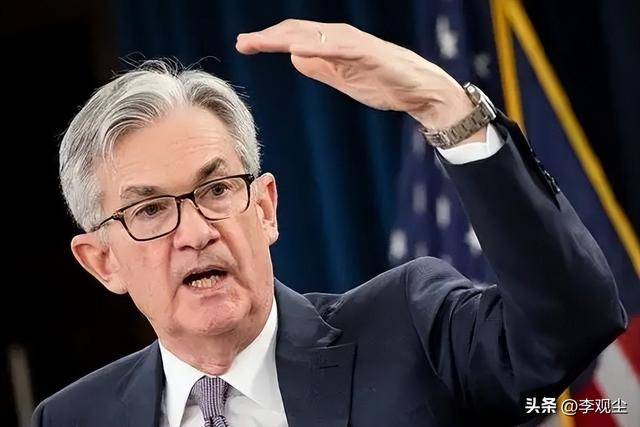
Group 1 - Powell's warning indicates that U.S. stock valuations are currently too high, which is a rare and significant statement from the Federal Reserve Chairman [4][5] - Historical context shows that similar warnings have often preceded significant market downturns, such as the 2000 internet bubble burst [7][9] - The warning serves as a "policy preventive measure," suggesting that subsequent interest rate hikes, rather than the warning itself, typically trigger market volatility [7][9] Group 2 - Powell's statement reflects a broader policy consideration, emphasizing the need to avoid excessive expectations of monetary easing amidst ongoing inflation concerns [9][12] - The relationship between Powell and Trump highlights a divergence in economic policy priorities, with Powell focusing on inflation control while Trump emphasizes economic growth [11][12] - The independence of the Federal Reserve is crucial, as it operates based on economic data rather than political pressures, contrasting with the approach of other central banks [16][18] Group 3 - Powell's warning underscores the ongoing tension between the Federal Reserve and the White House, reinforcing the Fed's commitment to its core responsibilities [18] - The potential for market volatility exists in the short term, but the long-term focus on inflation stability and economic fundamentals is beneficial for investors [18]
美股“泡沫警报”响起!三大趋势预示1999年狂欢前夜重现
Zhi Tong Cai Jing· 2025-09-29 08:33
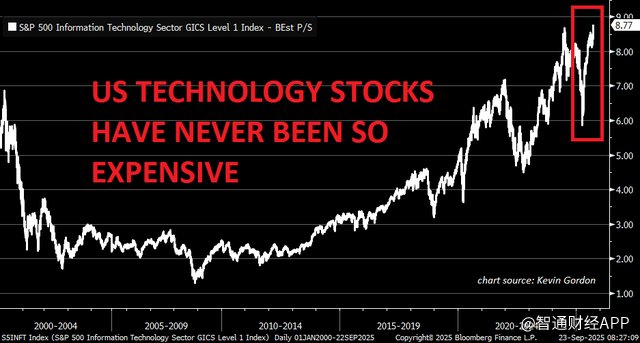
Core Viewpoint - Despite negative signs in the employment and real estate markets, major U.S. stock indices continue to rise, driven by unsustainable fiscal deficits and explosive growth in artificial intelligence spending. Analysts warn of a potential crisis reminiscent of the internet bubble [1]. Group 1: Valuation Concerns - Valuations have reached "crazy" levels, with the expected price-to-sales ratio of the S&P 500 Information Technology sector hitting 8.8 times, significantly higher than the levels seen at the end of the internet boom and the highest ever recorded [2]. - The Shiller price-to-earnings ratio is nearing 40, a level historically seen only twice, and is slightly below the peak reached in 1999. A CAPE above 25 indicates a period of "irrational exuberance" [5][6]. - The stock market capitalization to GDP ratio, known as the "Buffett Indicator," has reached a record high, indicating an overbought market [7]. Group 2: Market Dynamics - The return of "vendor financing" is noted, where companies like Cisco provided financing to customers purchasing their equipment, reminiscent of past market behaviors [9]. - Nvidia announced a potential investment of up to $100 billion in OpenAI to support the construction of data centers powered by Nvidia chips. Analysts are divided on this move, with some viewing it as a sign of robust AI infrastructure growth, while others see it as aiding a cash-strapped client [11][12]. - Market performance is increasingly polarized, with the top ten stocks accounting for about 40% of the total market value, similar to the late 1990s. Nvidia's market cap exceeds $4.3 trillion, surpassing the annual GDP of the UK and France, while Microsoft and Apple are also close to this valuation [13]. Group 3: Investor Sentiment - Factors such as FOMO (fear of missing out), momentum, algorithmic trading, and passive index investing may keep stock prices elevated despite high valuations. However, over time, such high valuations are difficult to sustain, suggesting that the current situation may not differ from past market behaviors [14].



陶冬:AI巨头千亿美元造梦,华尔街埋单?
Di Yi Cai Jing· 2025-09-29 03:48
Group 1 - The core viewpoint is that the future of AI investment depends on market willingness to finance dreams, with concerns about whether AI is a bubble or not [1][5] - The U.S. GDP growth for Q2 was revised to 3.8%, indicating strong consumer spending despite a weak job market, with business investment growing at 7.3% [1][2] - The trade and inventory fluctuations have caused significant variations in growth, but the underlying private consumption and business investment growth remains healthy at 2.9% [2][3] Group 2 - Major tech companies are collaborating to create a robust AI industry, with Nvidia investing $100 billion in OpenAI, which in turn is using the funds to build data centers with Oracle [3][4] - This collaboration is seen as a way to establish high barriers in the AI industry, potentially leading to larger orders and economic activity, but it is fundamentally an extension of capitalistic market dynamics [4][5] - Despite significant investments in AI exceeding $600 billion over the past two years, actual revenue remains low at around $35 billion, raising questions about the sustainability of such investments [4][5] Group 3 - Historical parallels are drawn between the current AI investment climate and the internet bubble, suggesting that while AI has the potential to change history, market volatility is likely [5] - The Federal Reserve's stance on high stock valuations indicates caution, but it does not imply an imminent market crash, as seen in past market behaviors [5] - Upcoming events to watch include the Japanese leadership election, potential U.S. government shutdown, and September non-farm payroll data, which could impact market conditions [5]
揭秘OpenAI错综复杂的交易网:奥特曼、黄仁勋豪赌AI能成功吗?
Feng Huang Wang· 2025-09-29 02:17
Core Insights - OpenAI's valuation has reached $500 billion, with significant investments and partnerships in the AI infrastructure space, including agreements worth hundreds of billions of dollars [1][2] - Nvidia's commitment to invest up to $100 billion in OpenAI has contributed to record highs in the Nasdaq and S&P 500 indices [1] - OpenAI has secured a $300 billion computing power procurement agreement with Oracle as part of a $500 billion infrastructure project funded by SoftBank [1] - CoreWeave has agreed to provide up to $22.4 billion in AI computing power to OpenAI, increasing from an initial $11.9 billion announced earlier this year [1] - Analysts express concerns over OpenAI's reliance on a complex network of infrastructure partners and the sustainability of its investment model [2][5] Investment Dynamics - Nvidia's investment not only provides equity in OpenAI but also revenue opportunities, highlighting the intertwined financial relationships [3] - OpenAI's CFO indicated that the company expects to generate $13 billion in revenue this year, emphasizing the need for bold investments in infrastructure to support AI technology growth [4] - Some analysts warn that the financing model between OpenAI and Nvidia resembles the vendor financing seen during the early 2000s internet bubble, raising concerns about potential market instability [5][6] Future Projections - Bain & Company predicts that global computing power demand could reach 200 gigawatts by 2030, necessitating annual investments of approximately $500 billion to build sufficient data centers [6] - To cover these costs, AI companies collectively need to generate $2 trillion in annual revenue, indicating a significant funding gap of $800 billion even with full investment in cloud services and data centers [6] - OpenAI's leadership remains optimistic about the necessity of large-scale infrastructure investments, asserting that current efforts are just the beginning of what is required for AI proliferation [6]
什么信号?这一美股估值指标触及“互联网泡沫”以来最高水平
Feng Huang Wang· 2025-09-25 05:14
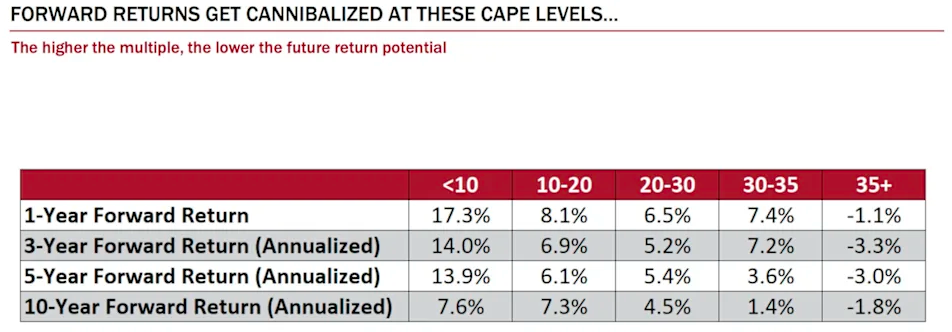
Group 1 - The S&P 500's Shiller Price-to-Earnings (CAPE) ratio has surpassed 40 for the first time since 2000, indicating a potential market bubble [1] - Historical data shows that when the CAPE exceeds 25, it enters a phase of "irrational exuberance," with the CAPE reaching 27.6 in May 2007 before the global financial crisis [1] - Investment director Russ Mould from AJ Bell noted that U.S. stock valuations are among the top 10% historically, suggesting that the market appears expensive compared to historical averages [1][2] Group 2 - David Rosenberg's research indicates that when the CAPE exceeds 35, the S&P 500 has shown negative returns over various future time frames, making it a critical threshold for investors [2] - The table provided shows that the one-year forward return for the S&P 500 is -1.1% when the CAPE is above 35, contrasting with positive returns at lower CAPE levels [2] - Federal Reserve Chairman Jerome Powell acknowledged that stock prices are relatively high, indicating that the Fed is monitoring the financial environment closely [3]