
太空经济

Search documents
我国商业航天发展面临的形势与挑战
Sou Hu Cai Jing· 2025-12-09 12:00
Core Viewpoint - The article emphasizes the dual nature of the current situation in China's commercial aerospace sector, highlighting both significant challenges from international competition and substantial domestic development opportunities. It calls for strategic measures to enhance the sector's quality and international competitiveness [2][5]. Group 1: Current Situation and Challenges - China's commercial aerospace is at a strategic crossroads, facing intense international competition while also having vast domestic market potential. The international landscape is characterized by resource monopolization and rule-setting by leading countries, which places China in a passive position [6][7]. - Key challenges include homogenized regional competition, insufficient breakthroughs in core technologies, limited application scenario development, imbalanced capital supply structures, and lagging institutional adaptation [5][18]. - The rapid development of China's commercial aerospace has been driven by technological innovation, capital empowerment, and policy guidance, with significant growth in investment from 1.1 billion yuan in 2015 to 34.13 billion yuan in 2024 [4][5]. Group 2: International Competition - The competition for frequency resources is fierce, with the U.S. leading in satellite deployment through initiatives like Starlink, which has launched over 9,000 satellites, compared to China's 230 satellites from its own plans [8][9]. - China's commercial aerospace companies face challenges in establishing a voice in international rule-making and market access, which limits their ability to compete effectively on a global scale [13][14]. Group 3: Domestic Opportunities - The central and local governments are increasingly collaborating to support the commercial aerospace sector, with policies and funding aimed at fostering innovation and development [15][16]. - The demand for commercial aerospace applications is expanding, with projections indicating that the global market could reach several hundred billion dollars by 2030, driven by needs in various sectors such as communication and resource exploration [17]. Group 4: Key Issues and Structural Challenges - The industry is experiencing structural challenges, including regional homogenization and overcapacity risks, as many provinces implement similar support policies without differentiation [20][21]. - There is a significant gap in core technologies, with China lagging behind the U.S. in critical areas such as rocket reusability and engine thrust capabilities, which affects competitiveness [23][24]. - The development of application scenarios is limited, with traditional markets dominating and new space economy applications still in exploratory stages [25][26]. Group 5: Strategic Recommendations - The article suggests enhancing top-level design and reforming institutional mechanisms to better align with the needs of the commercial aerospace sector [34][35]. - It advocates for breakthroughs in core technologies and the establishment of a collaborative innovation ecosystem involving academia, industry, and government [36][37]. - Expanding application scenarios and fostering new economic models in the space sector are crucial for unlocking the full potential of commercial aerospace [38][39].


关于扩展商业航天市场应用场景的建议
Sou Hu Cai Jing· 2025-12-08 14:08
Core Viewpoint - The expansion of commercial aerospace market application scenarios is essential for the transformation and upgrading of the aerospace industry and achieving the strategic goal of becoming a strong aerospace nation. Current challenges include insufficient participation from private enterprises, low penetration in the consumer market, and inadequate international competitiveness, which hinder the formation of a sustainable commercial ecosystem [2][4]. Group 1: Current State of Commercial Aerospace Development - The commercial aerospace industry is rapidly developing, driven by technological advancements and increasing market demand, showcasing significant market potential and social value. The Chinese government has intensified its focus on commercial aerospace, implementing various measures to accelerate market expansion [3][4]. - China has made notable progress in launch services and satellite applications, with the government incorporating satellite internet into "new infrastructure" and promoting large-scale application demonstrations of new technologies and products [3][4]. Group 2: Challenges Facing Commercial Aerospace - The commercial aerospace market is at a critical transformation period, facing challenges such as a lack of private enterprise participation and insufficient penetration in the consumer market. The existing application scenarios are predominantly focused on government and military tasks, with limited engagement in civilian sectors [4][21]. - The current market structure shows a significant "Matthew effect," where state-owned enterprises and leading private companies dominate the satellite application industry, making it difficult for smaller private enterprises to compete [24][25]. Group 3: Driving Factors for Market Expansion - Technological advancements are reshaping the market ecosystem by breaking cost barriers, enhancing service efficiency, and broadening application boundaries, thus driving the expansion of commercial aerospace market application scenarios [15]. - Market demand is accelerating the integration and innovation of traditional application scenarios, leading to the emergence of new application scenarios in communication, navigation, and remote sensing [16]. Group 4: Future Application Scenarios - A list of 12 potential application scenarios for the commercial aerospace market has been identified, focusing on launch services, satellite applications, and the space economy. These scenarios include commercial launch infrastructure, satellite communication, satellite navigation, and space tourism, among others [27][29]. - The commercial launch service market has significant potential, with a focus on low-cost and high-reliability technologies to meet the growing demand for satellite launches and expand the application scenarios of launch services [30][31]. Group 5: Policy Recommendations - Strengthening policy support for commercial launch services is crucial to overcoming infrastructure and technological bottlenecks. This includes encouraging private enterprises to build commercial launch sites and simplifying approval processes for launch permits [42][43]. - It is essential to foster an open and integrated industrial ecosystem for satellite applications by supporting small and medium-sized private enterprises and promoting the development of "satellite+" market applications that integrate with emerging fields [45][46].

2026年值得期待的十大技术应用都有啥?
Huan Qiu Wang Zi Xun· 2025-12-04 06:38
Core Insights - The article highlights the rapid advancements in technology expected by 2026, including emotional AI, wearable health devices, renewable energy innovations, and more, which are set to transform daily life and work environments [1]. Group 1: Emotional AI and Personalization - Emotional AI assistants are evolving beyond traditional voice assistants like Siri and Alexa, becoming capable of understanding human emotions through tone and expression, thus providing personalized support [2]. - These AI systems are increasingly being integrated into mental health support and personal development, marking a significant shift in the role of technology in daily life [2]. Group 2: Wearable Health Technology - Next-generation wearable devices are anticipated to monitor vital health metrics in real-time, shifting healthcare from reactive to proactive approaches [3]. - Innovations such as smart skin patches and AI watches are expected to provide early warnings for health risks, contributing to personalized health management [3]. Group 3: Renewable Energy Innovations - New night-time solar panels that capture infrared radiation are expected to overcome previous limitations of solar energy, enabling continuous power supply even in darkness [4]. - Advances in lithium-sulfur and solid-state battery technologies are projected to enhance energy storage, significantly improving electric vehicle performance and promoting sustainable transportation [4]. Group 4: Brain-Computer Interfaces - Brain-computer interface technology is moving from medical applications to everyday use, allowing users to control devices through thought, which could revolutionize rehabilitation and enhance daily life [6]. - This technology is expected to play a role in various fields, including prosthetics and augmented reality [6]. Group 5: Space Economy - The space economy is poised for growth, with reduced costs for suborbital flights and the emergence of zero-gravity hotels, indicating a new era of space exploration and commercial opportunities [7]. - Companies are exploring asteroid mining, suggesting a potential new frontier for resource acquisition [7]. Group 6: AI in Education - AI-driven personalized education is set to replace standardized teaching methods, adapting to individual learning styles and enhancing engagement for both children and adults [8]. - This transformation in education is expected to significantly impact workforce adaptability in response to industry changes [8]. Group 7: Quantum Computing - Quantum computing is anticipated to become practical by 2026, potentially solving complex problems beyond the capabilities of classical computers [9]. - Applications in pharmaceuticals and supply chain optimization could drastically reduce costs and timeframes in various industries [9]. Group 8: Smart Cities - The integration of AI and IoT technologies is expected to create smarter cities, improving traffic management, waste collection, and security systems [10]. - These advancements aim to enhance urban living by making cities cleaner, safer, and more efficient [10]. Group 9: Robotics - Robotics technology is expected to permeate everyday life, with applications in kitchens, construction, and elder care, making robots an integral part of daily routines [11]. - The decreasing costs and advancements in AI are driving this trend, leading to widespread adoption of robotic solutions [11]. Group 10: Bioprinting - The bioprinting field is projected to experience significant advancements, enabling the creation of disease models and personalized medical treatments [12]. - This technology could revolutionize organ transplantation and food production, addressing future challenges in healthcare and food security [12].
人民币升值!创近一年新高
Mei Ri Jing Ji Xin Wen· 2025-12-04 05:31
今天,市场关注的朱雀三号终于发射升空。 从结果来看,飞行任务完成,火箭二级进入预定轨道。 在大家关注的可回收方面,在火箭一级回收验证过程中发生异常燃烧,未能实现在回收场坪的软着 陆,回收试验失败。 可回收火箭有多重要?达哥简单说一说。 商业航天的最大瓶颈是火箭成本。如果能实现火箭可回收,那么意味着商业航天的成本都会大幅下 降。 有机构表示,一旦可回收发射技术实现规模化应用,有望将发射成本下降30%-50%。 可回收发射技术实现后,后续的重点是高频复用、成本降到极致。只要做到这两点,那么,一个低 成本、高频次、规模化的中国太空时代正在来临,未来太空经济版图也将发生重大变化。 马斯克旗下的星链,大家都熟知。到目前为止,星链卫星发射总数超过10000颗,其中在轨正常运 行的卫星超过8000颗。 目前,上证指数下方有四个短期支撑位,一是11月28日的低点3856点,二是11月24日反弹以来回撤 61.8%的3853点,三是11月24日反弹以来回撤80.9%的3835点,四是11月24日低点3816点。 在大国科技竞争加剧的背景下,谁也不想头顶上有这么多的外国卫星"覆盖"自己的国家。此外,卫 星所处的太空资源也是有限的 ...
2026年值得期待的十大技术应用
Ke Ji Ri Bao· 2025-12-04 00:55
Core Insights - The article highlights the rapid advancements in technology expected by 2026, including emotional AI, wearable health devices, renewable energy innovations, and more, which are set to transform daily life and work environments. Group 1: Emotional AI - The next generation of emotional AI assistants is surpassing traditional ones like Siri and Alexa by understanding human emotions through tone, expression, and wording, providing personalized relaxation recommendations and enhancing customer care [2] - Emotional AI is becoming a partner in daily life, playing a significant role in mental health support and personal growth [2] Group 2: Wearable Devices - By 2026, wearable devices are expected to evolve into "life guardians," with smart skin patches monitoring hydration, stress hormones, and nutrition levels, while AI watches can predict heart disease risks days in advance [3] - These innovations are shifting healthcare from reactive treatment to proactive prevention [3] Group 3: Renewable Energy - New night-time solar panels will capture infrared radiation, allowing for continuous power supply even in darkness, while advancements in lithium-sulfur and solid-state battery technologies will enhance energy storage for electric vehicles [4] - 2026 may mark a historical turning point for the decline of fossil fuels as the dominant energy source [5] Group 4: Brain-Computer Interfaces - Brain-computer interface technology is moving from medical applications to everyday use, enabling paralyzed patients to control devices with their thoughts and enhancing work efficiency through instant data retrieval [6] - By 2026, these interfaces will be integrated into daily life, impacting prosthetics, rehabilitation, and augmented reality experiences [6] Group 5: Space Economy - The space economy is set to flourish, with suborbital flight prices dropping below $100,000 and companies developing zero-gravity hotels, indicating a new era of space exploration and commercialization [7] Group 6: AI in Education - AI-driven personalized education is emerging, adapting courses to individual learning styles and helping adults with career transitions, fundamentally reshaping educational approaches [9] Group 7: Quantum Computing - Quantum computing is expected to solve complex problems beyond the capabilities of classical computers, significantly reducing drug development timelines and optimizing supply chains [10] Group 8: Smart Cities - Cities will become smarter by 2026, with AI traffic systems alleviating congestion, IoT-enabled waste management, and predictive security systems enhancing urban living [11] Group 9: Robotics - Robotics will become ubiquitous in households and various work environments, with cooking robots, construction robots, and personal care robots transforming daily tasks [12][13] Group 10: Bioprinting - The bioprinting field is anticipated to achieve significant advancements, enabling the creation of disease models, personalized medicine, and potentially addressing organ donation shortages [14]
太空经济新基建提速,商业航天如何破解产能与成本之困?
2 1 Shi Ji Jing Ji Bao Dao· 2025-12-01 12:27
Core Viewpoint - The space economy is emerging as a new frontier for global competition, with significant opportunities and challenges in satellite internet and remote sensing infrastructure development [1] Group 1: Industry Gaps and Opportunities - There is a significant gap between China and the US in the launch vehicle sector, with US rocket carrying capacity being approximately ten times that of China, and commercial launches accounting for over 80% in the US compared to single-digit percentages in China [2] - The large gap presents a vast space for catching up, with predictions that within three years, the launch costs in China could approach those of SpaceX, and within five years, potentially be lower than SpaceX's Falcon 9 [2] - In the laser communication terminal field, the US has over 10,000 in-orbit terminals with commercial applications, while China's industry is in a critical breakthrough phase from technology verification to mass production [2] Group 2: Cost Reduction Strategies - Reducing costs is seen as crucial for the development of the space economy, with companies aiming to halve rocket costs within three years and lower per-kilogram launch prices below foreign counterparts within five years [4] - Companies are focusing on design optimization, supply chain collaboration, and reusable technologies to achieve cost reductions [4] - The integration of modular production and batch assembly is expected to be a significant direction for long-term cost reduction in laser communication terminal manufacturing [4] Group 3: Need for Patient Capital - The valuation of leading commercial rocket companies has reached between 15 billion to 20 billion yuan, highlighting the need for better access to secondary market financing to share in the growth of the commercial space sector [6] - Long-term capital support is essential for the growth of commercial space enterprises, which require three to five years or more for technology development and capacity realization [6] - A more inclusive and encouraging policy environment is needed to allow commercial space companies to participate in large national projects, creating strong market incentives [6]
指数虚假繁荣背后:67%散户正在犯错
Sou Hu Cai Jing· 2025-11-30 17:32
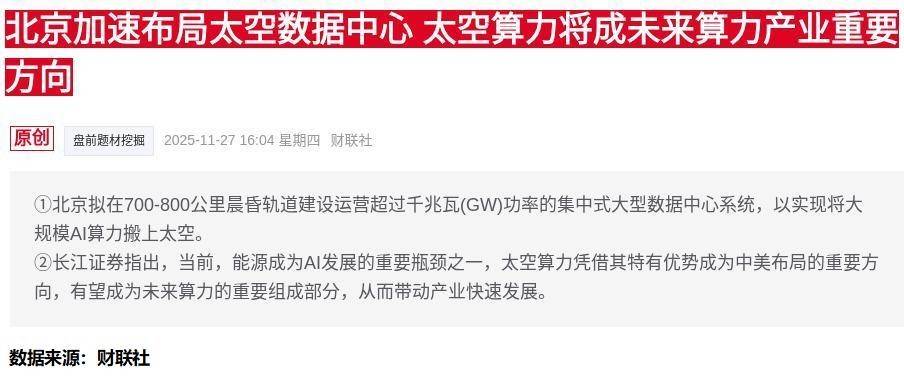
Group 1 - The core idea revolves around the competition between China and the US in the space computing sector, with Beijing planning to build a space data center with over 1,000 megawatts capacity in three phases [2] - The A-share market is experiencing fluctuations around the 4,000-point mark, reminiscent of 2015, with a historical 67.6% probability of A-shares rising in November over the past 34 years [2] - The current market scenario is characterized as an "index bull market, individual stock bear market," where only 60% of stocks are rising compared to 80% in 2020 [2] Group 2 - November is a critical month for A-shares, akin to Thanksgiving on Wall Street, where institutional investors engage in strategic maneuvers to boost or protect their year-end performance [2] - The comparison of two stocks illustrates the importance of following institutional capital flows, as one stock sees significant inflows while the other remains stagnant [5][7] - Historical breakthroughs in technology often stem from seemingly improbable events, suggesting that the space data center initiative could lead to significant advancements in the future [10][12] Group 3 - Investment in cutting-edge technologies like space data centers and quantum computing is associated with high volatility, recommending a cautious approach with no more than 10% of the portfolio allocated to such ventures [10] - Ordinary investors are advised to be wary of index performance, as not all components perform equally well, echoing Warren Buffett's sentiment about market realities [11] - Monitoring capital flows is emphasized as a more reliable indicator than technical metrics, alongside the use of quantitative tools available on various platforms [11]
周末重磅利好
Ge Long Hui· 2025-11-30 10:55
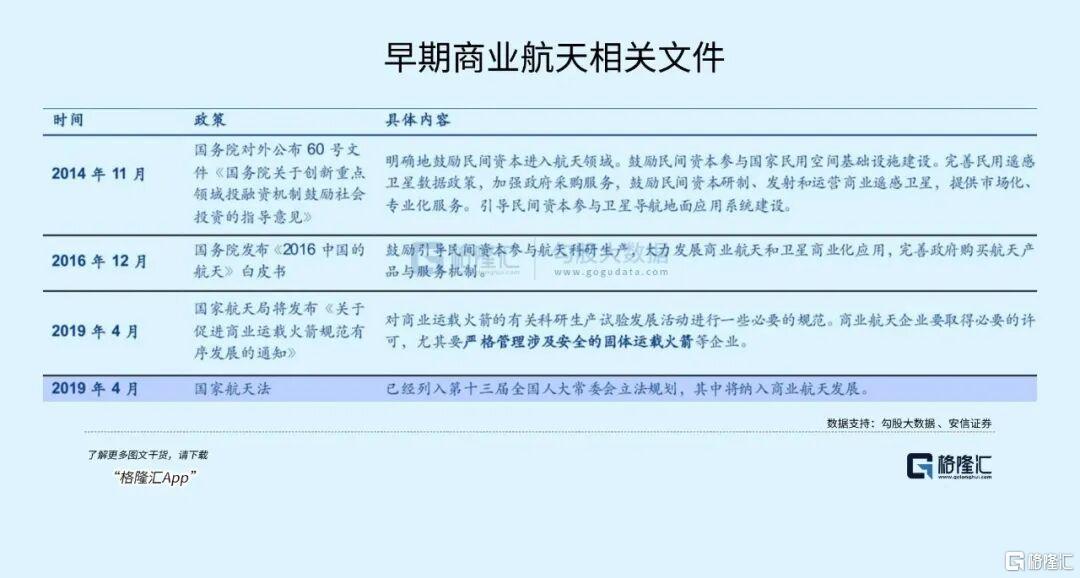
Core Insights - The establishment of the Commercial Space Administration marks a significant shift in China's space industry from "policy-driven" to "ecological-driven" development, providing a clear growth path for the 2.5 trillion market and supporting 600 commercial space enterprises [4][5][20]. Industry Overview - The commercial space sector in China has seen a dramatic transformation, with the market size growing from less than 50 billion in 2014 to 1.2 trillion in 2024, and projected to reach 4.8 trillion by 2027, reflecting a compound annual growth rate of 66% [10][28]. - The number of private enterprises in the space sector surged from single digits in 2015 to 160 by 2019, indicating a robust increase in private sector participation [17]. Policy Developments - Key policies have been introduced since 2014 to encourage private investment in the space sector, culminating in the 2019 guidelines that equalized the status of commercial and national space activities [12][16]. - The recent action plan for 2025-2027 aims to open national testing facilities to private companies, with a target of 70% accessibility by 2027, significantly reducing operational costs for private firms [20][21]. Financial Trends - In 2024, commercial space financing reached 14.02 billion, nearly tripling from 2023, with a notable increase in large investment deals [24]. - The establishment of a national commercial space development fund, estimated at 50-80 billion, aims to catalyze an investment scale of 200-300 billion, particularly in long-term projects like reusable rockets [24][25]. Market Segmentation - The commercial space market is diversifying, with significant growth in satellite applications (6.6 trillion in 2024) and emerging sectors like space tourism and in-orbit manufacturing, which are expected to grow at rates exceeding 500% [28][29]. - The rocket manufacturing segment has evolved into a streamlined production process, with the number of launches increasing from 8 in 2020 to 34 in 2024, achieving a success rate of 95% [36]. Technological Advancements - The industry is witnessing a shift towards cost-effective production methods, with the cost of launching satellites decreasing significantly due to mass production techniques [36]. - Innovations in materials, such as high-temperature alloys and aerospace-grade carbon fiber, are driving profitability, with some companies reporting gross margins exceeding 50% [32][33]. Competitive Landscape - The competitive environment is intensifying, with private companies capturing a significant share of the launch services market, accounting for 38% of domestic revenue in 2024 [36]. - The opening of national facilities and the influx of private capital are expected to enhance China's competitiveness in the global space market, which currently holds an 8% share [41].
银河航天徐鸣:太空基建呈“新四化” 特征
2 1 Shi Ji Jing Ji Bao Dao· 2025-11-29 09:05
Core Insights - The number of operational satellites has rapidly increased from 5,000 to 12,000 in less than five years, indicating a significant acceleration in space infrastructure development [1] - The space industry is experiencing a technological revolution driven by advancements in aerospace technology and artificial intelligence, characterized by low-cost, large-scale, and constellation-based satellite deployment [1][3] - The global space economy is projected to grow from $630 billion in 2023 to $1.8 trillion by 2035, with a compound annual growth rate of approximately 9% [3] Industry Developments - The concept of "Moore's Law in Space" suggests that satellite manufacturing is becoming faster, more powerful, and cheaper, similar to advancements in computer chips [1] - The demand for satellite broadband is expected to surge, particularly with the advent of direct satellite-to-mobile communication, marking a critical step towards mainstream adoption of satellite communication [3][4] - New application scenarios are emerging, including space supercomputing, space sensing, and space logistics, driven by the increasing capabilities of satellite infrastructure [4] Company Progress - The company has successfully launched 35 self-developed satellites, including the world's first high-frequency low-orbit millimeter-wave satellite [4] - The company is expanding internationally, collaborating with local operators in countries like Thailand and engaging in partnerships in the UAE, Saudi Arabia, and Indonesia to promote low-orbit satellite communication technologies [4] - The capital market has shown strong support for the commercial space industry, with approximately 2,200 space companies raising a total of $357.8 billion from 2009 to Q2 2025 [5]
中国商业航天爆发前夜 22项重点举措推动商业航天高质量发展
Zhong Guo Jing Ying Bao· 2025-11-26 09:19
Core Viewpoint - The National Space Administration of China has issued an action plan for the high-quality and safe development of commercial space from 2025 to 2027, aiming to achieve significant advancements in the industry by 2027 [1] Group 1: Action Plan Overview - The action plan outlines 22 key measures across five areas: enhancing innovation, efficient resource utilization, promoting industry growth, improving industry management services, and strengthening safety regulation [1][3] - The plan is a response to both domestic and international developments, emphasizing the need for China to keep pace with global commercial space advancements, particularly those led by companies like SpaceX [1][3] Group 2: Industry Development and Market Impact - The establishment of a new Commercial Space Department within the National Defense Science and Technology Industry Bureau aims to enhance policy coordination and support for the commercial space sector [2] - The commercial space market in China is projected to grow from approximately 0.38 trillion yuan in 2015 to 2.3 trillion yuan by 2024, with a compound annual growth rate of about 22% [8] - The action plan is expected to open up a trillion-yuan market space, attracting significant capital and talent into the sector [6][8] Group 3: Key Measures for High-Quality Development - The plan includes competitive opening of national research projects to commercial entities, promoting the commercialization of technological achievements, and establishing technology transfer centers [3][4] - It encourages the development of new business models in areas such as space resource utilization, space tourism, and space biotechnology [4][6] Group 4: Future Prospects and Industry Dynamics - The action plan is seen as a pivotal moment for China's commercial space sector, marking a transition from spontaneous exploration to a more structured and guided development approach [4][7] - The collaboration between state-owned enterprises and commercial entities is expected to deepen, leading to more partnerships where state entities provide platforms and commercial firms offer payloads or services [7] - The plan is anticipated to accelerate industry consolidation, with a focus on high-quality and safe practices, potentially eliminating weaker players and concentrating resources among leading firms [7]