
汇率波动

Search documents
你抛美债,我抛中债!外资开始大量减持中国债,很多资金流向美方?
Sou Hu Cai Jing· 2025-11-14 07:27
Core Viewpoint - Recent data indicates that foreign capital is significantly reducing its holdings in Chinese bonds, with a notable decline attributed to rising U.S. Treasury yields and currency fluctuations, which may impact China's financial market [1][3][4]. Group 1: Foreign Capital Reduction - As of October 2025, foreign institutions held 29,765 billion yuan in Chinese bonds, a decrease of 2,843 billion yuan or 8.7% since the beginning of the year, marking the longest net outflow in five years [1]. - The yield on 10-year U.S. Treasury bonds reached 4.8%, compared to approximately 2.6% for Chinese bonds, creating a 2.2 percentage point yield advantage that attracts international capital [1][3]. - Approximately 62% of surveyed international investors indicated that currency fluctuations are a primary factor in their decision to adjust their holdings in Chinese bonds [3][4]. Group 2: Global Monetary Policy and Economic Factors - The divergence in monetary policy, with the U.S. maintaining a stringent stance while China has implemented three interest rate cuts in 2025, has widened the interest rate differential, further encouraging capital flow to the U.S. [4]. - China's GDP growth slowed to 4.6% year-on-year in Q3 2025, which, while still higher than many global economies, has led to cautious sentiment among foreign investors regarding Chinese bonds [4]. Group 3: Impact on Financial Markets - Foreign holdings of Chinese bonds accounted for approximately 2.1% of the total bond market as of October 2025, down from a peak of 3.5% in 2023, suggesting that while the outflow has some impact, it is unlikely to cause severe disruption [6]. - The outflow of capital may exert some pressure on the renminbi, but China's foreign exchange reserves stood at $3.24 trillion as of September 2025, providing a solid foundation to manage currency fluctuations [6]. Group 4: Long-term Outlook - The internationalization of China's bond market is increasing, with Chinese bonds included in major international indices, which may provide a more stable source of foreign investment in the long run [7]. - A survey of 50 major asset management firms revealed that about 67% believe the proportion of Chinese bonds in their global asset allocation will increase over the next five years [7].

日元跌至九个月新低!日本政府干预预期升温
智通财经网· 2025-11-12 08:52
Core Viewpoint - The recent depreciation of the Japanese yen is testing the patience of Japanese policymakers and causing unease among investors, primarily driven by the new leadership's focus on economic growth without immediate interest rate hikes [1][3]. Group 1: Yen Depreciation and Economic Impact - The yen has weakened significantly, reaching a nine-month low against the dollar at 154.79, raising concerns about the impact on Japan's economy, particularly for an economy reliant on imported energy and materials [1][3]. - The depreciation of the yen has increased import costs, exacerbating inflationary pressures on households and squeezing profits for domestic market-oriented companies, leading to a cost-of-living crisis [3]. - The potential for government intervention in the currency market is heightened by external pressures, including criticism from U.S. officials regarding Japan's currency policies [3][11]. Group 2: Currency Intervention Mechanism - Currency intervention occurs when a central bank actively engages in the foreign exchange market to influence the value of its currency, with Japan's Ministry of Finance determining the timing of such interventions [4]. - Japan's foreign exchange reserves, amounting to $1.15 trillion as of the end of October, are typically used to fund interventions, often involving the sale of U.S. Treasury securities [5]. - The effectiveness of currency intervention is often temporary, serving primarily to signal to speculators that extreme fluctuations in currency value will not be tolerated [6]. Group 3: Historical Context and Future Actions - Japan has historically intervened in the currency market, with recent actions costing nearly $100 billion to support the yen, particularly around the 160 yen per dollar mark [7]. - Officials typically do not confirm interventions immediately, but they do release monthly reports on intervention expenditures to maintain market speculation and enhance the effectiveness of their policy signals [8]. - Verbal interventions by high-ranking officials can also serve to deter market speculation and stabilize the currency [9]. Group 4: Political and Diplomatic Considerations - Currency interventions can lead to significant market volatility, impacting speculative traders and complicating pricing and hedging for businesses [10]. - The political implications of currency intervention are complex, as actions perceived as currency manipulation can attract criticism, particularly if aimed at weakening the yen [10][11]. - Any intervention by Japan is communicated to the U.S. in advance, and if the outcome strengthens the yen, it may receive tacit approval from the Trump administration [12].
日元为何持续承压?央行态度与美元走势牵动汇率波动
Sou Hu Cai Jing· 2025-11-12 03:28
Group 1 - The Japanese yen remains under pressure, trading near its lowest level against the US dollar since February 13, due to cautious policy adjustments by the Bank of Japan and optimism regarding the US government's potential to avoid a shutdown [1][2] - The Bank of Japan's October policy meeting summary indicates some members see a possibility of a rate hike in December, although there are differing opinions suggesting a delay until January due to potential economic contraction in Q3 [1][2] - The US Senate has passed a bill to restart the federal government, alleviating the longest government shutdown in history, which has boosted market risk sentiment and further weakened the yen's safe-haven appeal [1][2] Group 2 - Economic scholars estimate that the recent prolonged US government shutdown could lead to a quarterly GDP growth rate decline of approximately 1.5 to 2.0 percentage points, contributing to a sustained pressure on the US dollar [2] - The market remains vigilant regarding potential intervention by the Japanese Ministry of Finance in the currency market, which could hinder further appreciation of the dollar against the yen [2] - The technical outlook for USD/JPY indicates a strong bullish trend, with potential resistance levels at 154.45 to 154.50, and if breached, targets could extend to 155.00 and beyond [4]
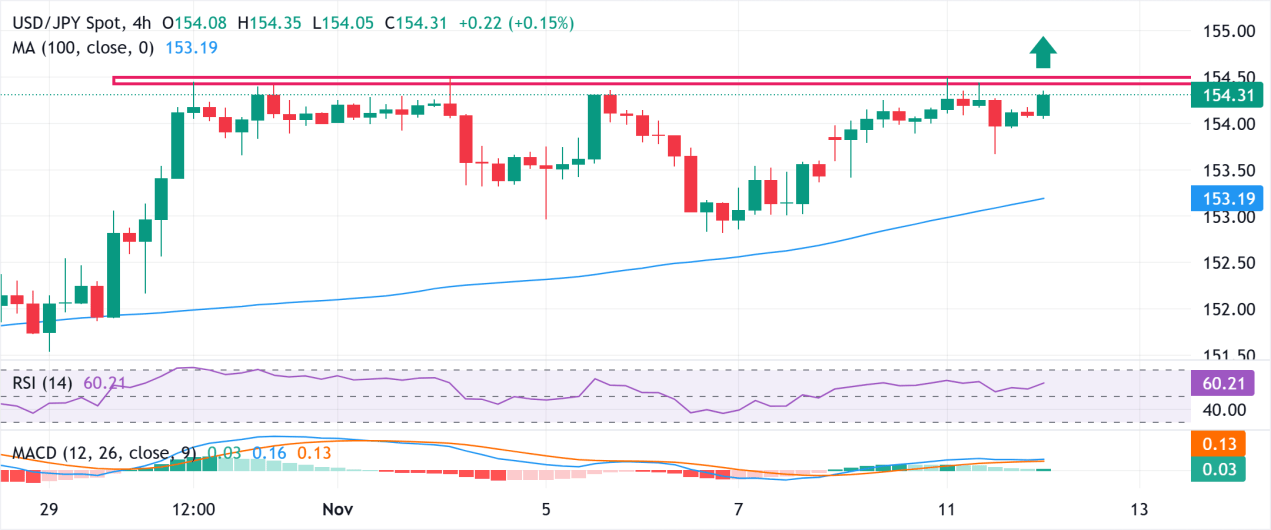
美元兑日元涨0.39%,报154.02日元
Mei Ri Jing Ji Xin Wen· 2025-11-10 22:09
(文章来源:每日经济新闻) 每经AI快讯,周一(11月10日)纽约尾盘,美元兑日元涨0.39%,报154.02日元。欧元兑日元涨0.36%, 英镑兑日元涨0.56%。欧元兑美元跌0.04%,英镑兑美元涨0.15%,美元兑瑞郎跌0.04%。 ...
供应需求及库存行情走势
Guo Tai Jun An Qi Huo· 2025-11-09 12:12
1. Report Industry Investment Rating No relevant content provided. 2. Core View of the Report As of November 7, the closing price of the main contract LG2511 was 778.5 yuan per cubic meter, a decrease of 1.4% from the previous week. The market showed a weak and volatile trend this week, and the fundamental situation remained relatively loose. The monthly spread changes were relatively small this week [20]. 3. Summary by Directory 3.1 Supply - As of November 2, there were 2 ships departing from New Zealand in November, all heading to mainland China. It is estimated that 2 ships will arrive in November and 0 in December, with an expected arrival volume of 1.04 million cubic meters in November [4][7]. - New Zealand log shipping schedule data shows two ships departing on November 2, 2025, with a load of 42,000 and 40,820 JAS m3 respectively, both heading to Lanshan Port in China and expected to arrive on November 21 - 22, 2025 [8]. 3.2 Demand and Inventory - As of the week ending October 31, the daily average shipment volume of Lanshan Port was 21,200 cubic meters (a week - on - week decrease of 2,700 cubic meters), and that of Taicang Port was 12,500 cubic meters (a week - on - week increase of 300 cubic meters). In terms of port inventory, Lanshan Port had about 1.2608 million cubic meters (a week - on - week increase of 17,000 cubic meters), Taicang Port had about 304,000 cubic meters (a week - on - week decrease of 47,900 cubic meters), Xinminzhou Port had about 310,200 cubic meters (a week - on - week decrease of 40,600 cubic meters), and Jiangdu Port had about 198,700 cubic meters (a week - on - week increase of 55,700 cubic meters). The total inventory of the four major ports was 2.0737 million cubic meters, a decrease of 15,800 cubic meters from the previous week [5][13]. - Inventory data shows detailed changes in the inventory of different ports and timber species over different time periods, including week - on - week and four - week - on - four - week changes [14]. 3.3 Market Trends - As of November 7, the closing price of the main contract LG2511 was 778.5 yuan per cubic meter, a decrease of 1.4% from the previous week. The monthly spreads were as follows: the 01 - 03 monthly spread was - 14 yuan per cubic meter, the 01 - 05 monthly spread was - 27 yuan per cubic meter, and the 03 - 05 monthly spread was - 13 yuan per cubic meter [20]. 3.4 Price and Spread - Log spot price data shows the prices and price changes of different tree species and specifications in Shandong and Jiangsu regions over different time periods, including week - on - week and four - week - on - four - week changes [24]. - The regional price spreads of mainstream timber species show the price differences of different tree species and specifications between Shandong and Jiangsu regions [26][35]. - The price spreads between tree species and specifications show the price differences between different tree species and specifications [43][45]. 3.5 Other - As of the week ending November 9, the Baltic Dry Index (BDI) was 2,063 points, an increase of 97 points (+4.9%) from the previous week. Its related sub - index, the Handysize Shipping Index (BHSI), was 815 points, a decrease of 3.8% from the previous week. The Shanghai Containerized Freight Index (SCFI) was 1,495.10 points, a decrease of 3.6% from the previous week [5][58]. - In terms of exchange rates, the US dollar index remained at a relatively high level recently. The US dollar to RMB exchange rate was 7.123, a week - on - week increase of 0.1%, and the US dollar to New Zealand dollar exchange rate increased by 1.7% to 1.777 [5][58].
美元存款利率真能到 4.2%?有人跨城抢额度,这坑可别踩
Sou Hu Cai Jing· 2025-11-09 04:07
Core Insights - The current interest rates for USD deposits are significantly higher than those for RMB, with some banks offering rates above 4%, attracting attention from depositors [2][3] - The fluctuation of interest rates is influenced by the Federal Reserve's actions, with recent cuts leading to a decrease in rates offered by many banks [3] - There is a notable disparity in interest rates among different banks, with smaller banks and foreign banks generally offering higher rates compared to state-owned banks [3][4] Interest Rate Trends - Recently, some city commercial banks offered rates above 4%, but these have dropped to around 2.5% within a couple of months due to the Federal Reserve's rate cuts [3] - The stability of interest rates from smaller banks is questionable, as they previously raised rates to attract deposits but are now reducing them due to cost pressures [3] Currency Exchange Risks - Depositors are cautioned about the risks associated with currency exchange, as fluctuations in exchange rates can negate the benefits of higher interest rates [2][4] - There are limitations on currency exchange quotas, which can restrict the ability to convert funds when needed [3] Investment Considerations - While the allure of a 4.2% interest rate is strong, it is not guaranteed that all depositors will benefit, and potential investors should assess their tolerance for exchange rate volatility [4] - It is suggested that individuals consider the overall stability of their investments rather than solely focusing on interest rates [4]

10月外汇储备增加47亿美元 温彬:受资产价格变化与汇率波动综合影响
Sou Hu Cai Jing· 2025-11-07 10:47
Core Insights - As of October 2025, China's foreign exchange reserves reached $3.34 trillion, an increase of $4.7 billion from September, reflecting a growth rate of 0.14% [1] - The rise in foreign exchange reserves is attributed to the Federal Reserve's interest rate cut, improved China-U.S. trade relations, and overall global asset price increases [1][2] - The U.S. dollar index rose by 2.1% to 99.8 in October, despite the Fed's rate cut, due to stronger-than-expected U.S. economic growth and depreciation of non-U.S. currencies [1] Foreign Exchange Reserves - The increase in foreign exchange reserves is influenced by a combination of asset price changes and exchange rate fluctuations, with a notable rise of $4.7 billion in October [1] - The Federal Reserve's decision to lower the federal funds rate by 25 basis points to a target range of 3.75% to 4.00% has contributed to this increase [1][2] Asset Prices - In October, the Fed's rate cut led to a 0.8% increase in the dollar-denominated global bond index and a 2.3% rise in the S&P 500 index [2] - The Nikkei index surged by 16.6%, reaching a historical high, driven by new fiscal policies under the leadership of a new prime minister [2] - The European Stoxx index rose by 2.6% as the Eurozone economy showed signs of gradual recovery [2] Gold Reserves - As of the end of October, China's gold reserves increased by 30,000 ounces (approximately 0.93 tons) to 74.09 million ounces, marking the 12th consecutive month of gold accumulation [2] - The global demand for gold among central banks remains high, with gold surpassing the euro as the second-largest reserve asset [2][3] - Increasing gold reserves helps optimize China's foreign exchange reserve structure and mitigate risks associated with high dollar asset exposure [3]
10月外汇储备增加47亿美元?温彬:受资产价格变化与汇率波动综合影响
Sou Hu Cai Jing· 2025-11-07 10:15
Core Insights - As of October 2025, China's foreign exchange reserves reached $3.34 trillion, an increase of $4.7 billion from September, reflecting a growth rate of 0.14% [1] - The rise in foreign exchange reserves is attributed to the Federal Reserve's interest rate cut and improved China-U.S. trade relations, which have led to an overall increase in global asset prices [1] - The U.S. dollar index rose by 2.1% to 99.8 in October, despite the Fed's rate cut, due to stronger-than-expected U.S. economic growth and a decline in non-U.S. currencies [1] Asset Prices - In October, the Fed's rate cut led to a 0.8% increase in the dollar-denominated global bond index and a 2.3% rise in the S&P 500 index [2] - The Nikkei index surged by 16.6%, reaching a historical high, driven by new fiscal policies [2] - The European Stoxx index increased by 2.6% as the Eurozone economy showed signs of gradual recovery [2] Economic Policies - The recent "14th Five-Year Plan" emphasizes "expanding high-level opening-up," indicating a commitment to reform and development through openness [2] - The plan aims to diversify markets, optimize trade, and cultivate new growth points, ensuring that exports stabilize cross-border capital flows [2] - The strategy includes facilitating foreign investment and guiding the cross-border layout of industrial and supply chains, which supports the balance of international payments [2] Gold Reserves - By the end of October, China's gold reserves increased by 30,000 ounces (approximately 0.93 tons) to 74.09 million ounces, marking the 12th consecutive month of gold accumulation [2] - Global demand for gold from central banks remains high, with gold surpassing the euro as the second-largest reserve asset [2] - Increasing gold reserves helps optimize China's foreign exchange reserve structure and mitigate risks associated with a high proportion of dollar assets [3]
本田汽车(HMC.US)Q2利润不及预期 大砍财年利润指引
Zhi Tong Cai Jing· 2025-11-07 08:17
Core Viewpoint - Honda Motor Co. has lowered its annual profit forecast by approximately 20%, citing a 25% decline in operating profit for the second fiscal quarter due to U.S. import tariffs and one-time costs associated with electric vehicles [1] Financial Performance - The revised annual operating profit forecast for the fiscal year ending March 2026 is now 550 billion yen (approximately $3.65 billion), down from the previous estimate of 700 billion yen, reflecting a 21% reduction [1] - For the quarter from July to September, Honda reported an operating profit of 194 billion yen (approximately $1.29 billion), which fell short of the average analyst expectation of 212.1 billion yen and decreased from 257.9 billion yen in the same period last year [2] - For the six months ending September 30, 2025, the company experienced a significant decline in comprehensive profit attributable to owners, which dropped 37% to 311.8 billion yen (approximately $2.03 billion) [3] - The diluted earnings per share for the same period were 76.30 yen, down from 103.25 yen year-over-year [3][4] Market Conditions - The company’s revenue for the first half of the fiscal year 2026 was 10.6 trillion yen, reflecting a slight decline of 1.5% year-over-year, indicating challenges in the macroeconomic environment and currency fluctuations [3] - The operating profit for the same period decreased by 41% to 438.1 billion yen, attributed to rising raw material costs and slow recovery in major export markets [3][4]


重庆新铝时代收购标的资产评估值13.1亿元 增值率265.96% 汇率波动影响有限
Xin Lang Cai Jing· 2025-11-06 15:08
Core Viewpoint - Chongqing New Aluminum Era Technology Co., Ltd. is progressing with its share issuance to acquire assets and raise supporting funds, with the target asset, Honglian Electronics, appraised at 1.31 billion yuan, reflecting a significant appreciation of 265.96% [1] Group 1: Asset Performance - The target asset, Honglian Electronics, is projected to achieve revenues of 1.105 billion yuan and 1.401 billion yuan in 2023 and 2024, respectively, representing a year-on-year growth of 26.79% [2] - Revenue from precision stamping and structural components has surged from 258 million yuan to 573 million yuan, marking a year-on-year increase of 122.22% [2] - The gross profit margins for the main business are reported at 29.35%, 30.75%, and 31.63% for the respective periods, consistently outperforming industry peers [2] Group 2: Customer Concentration and Foreign Revenue - The sales to the top five customers account for 59.99%, 58.73%, and 58.82% of total revenue, indicating a high customer concentration risk [3] - Foreign revenue has been increasing, with proportions of 52.13%, 54.69%, and 56.94% from 2023 to Q1 2025 [3] Group 3: Valuation and Market Comparison - The asset's valuation of 1.31 billion yuan is based on a discounted cash flow method, with a static price-to-earnings ratio of 12.88, lower than the industry average [4] - The asset's actual performance for January to August 2025 has exceeded expectations, with revenues of 1.004 billion yuan and net profits of 79.6036 million yuan, achieving annualized rates of 104.60% and 108.81%, respectively [4] Group 4: Risk Management - The assessment confirmed that the target asset has effective mechanisms in place to address risks related to customer structure, exchange rates, and production compliance [5] - The evaluation agency noted that the identified risks would not pose significant obstacles to the transaction, and the valuation has adequately considered various uncertainties [5]