美元走强

Search documents
美元走强压制金价上行,多头是坚守还是离场?中东局势仍存隐忧,黄金短线操作如何应对?点击查看详细分析!
news flash· 2025-06-18 08:13
Core Insights - The strengthening of the US dollar is suppressing gold prices, raising questions about whether bullish investors will hold their positions or exit the market [1] - Ongoing geopolitical tensions in the Middle East continue to pose risks, impacting short-term trading strategies for gold [1] Group 1 - The US dollar's strength is a significant factor affecting gold price movements [1] - Investors are faced with a decision to either maintain their bullish stance or consider exiting their positions due to market conditions [1] - The geopolitical situation in the Middle East remains a concern, influencing market sentiment and trading strategies [1]
万乾论金:6.18黄金行情走势分析及操作建议
Sou Hu Cai Jing· 2025-06-18 02:39
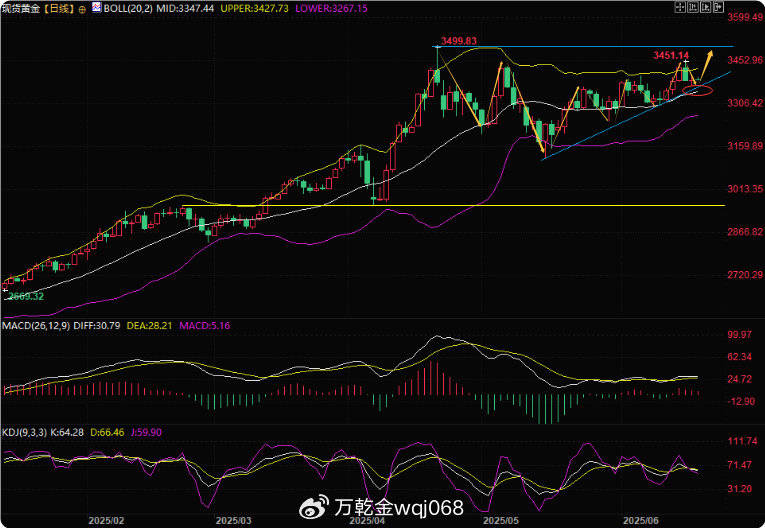
Group 1 - The geopolitical risks in the Middle East are increasing the demand for gold as a safe haven, with ongoing conflicts and military deployments raising market concerns about escalation [3] - The strong US dollar and weak economic data are suppressing gold prices, with the dollar index rising 0.7% to 98.83, marking the largest single-day increase in nearly a month, while US retail sales fell 0.9% month-on-month, the largest decline in four months [3] - The upcoming Federal Reserve interest rate decision is creating a cautious market sentiment, with expectations that the Fed will maintain the policy rate between 4.25%-4.50%, despite calls for a rate cut [3] Group 2 - On the daily chart, gold prices rebounded strongly after hitting a low of $3366, closing around $3388, indicating a fierce market battle between bulls and bears [3] - The short-term resistance for gold is at the 3405-3410 range, while key support levels are at $3364 and $3345, which are critical for maintaining bullish momentum [3] - The four-hour chart shows a potential double bottom formation, with the 10-day and 20-day moving averages providing crucial support [3]

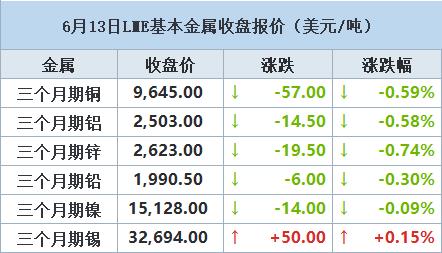
基本金属多数下跌,期铜触及近两周低点【6月13日LME收盘】
Wen Hua Cai Jing· 2025-06-14 08:58
Core Viewpoint - The escalation of tensions in the Middle East has led to a sell-off in risk assets, resulting in a stronger US dollar and a decline in most base metals on the London Metal Exchange (LME) [1][3]. Group 1: Market Performance - On June 13, LME three-month copper fell by $57 or 0.59%, closing at $9,645 per ton, with an intraday low of $9,532, marking the weakest level since June 3 [1][2]. - Other base metals also experienced declines, with three-month aluminum down $14.50 or 0.58% to $2,503.00, three-month zinc down $19.50 or 0.74% to $2,623.00, and three-month lead down $6.00 or 0.30% to $1,990.50 [2][6]. - The COMEX copper premium over LME copper reached $976 per ton [4]. Group 2: Market Sentiment and Analysis - The strong US dollar has made dollar-denominated commodities more expensive for buyers using other currencies, contributing to the market's risk reduction in copper and aluminum [3]. - Alastair Munro from Marex noted that the current events have diminished the likelihood of prices moving upward, suggesting that price declines may attract bargain hunters [3][5]. - The majority of selling pressure is attributed to commodity trading advisors (CTA) investment funds [5]. Group 3: Inventory and Demand Insights - In contrast to the LME, Shanghai aluminum has seen a third consecutive day of gains, closing at 20,440 yuan per ton, up 0.49%, supported by declining inventories [7]. - As of the week ending June 13, Shanghai Futures Exchange aluminum inventories fell to 110,001 tons, the lowest since February 2024, having decreased by 54% since late March [7].
6月9日晨间早报
Sou Hu Cai Jing· 2025-06-09 07:31
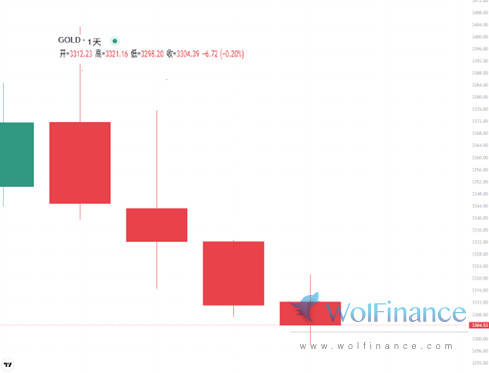
Market Overview - Spot gold fell by 1.27% on Friday, closing at $3309.47 per ounce, marking a near three-week low; COMEX gold futures dropped 1.31% to $3331.00 per ounce [1] - The U.S. non-farm payroll data for May exceeded expectations with an increase of 139,000 jobs, compared to the forecast of 126,000, while the unemployment rate remained steady at 4.2%, diminishing the likelihood of a Federal Reserve rate cut [1] - Market expectations for a September rate cut decreased from 88% to 60%, leading to a stronger dollar and rising 10-year Treasury yields, which suppressed gold's safe-haven demand [1] Gold Market Dynamics - On Monday, gold exhibited a downward trend, following several consecutive red candlesticks after an initial green candlestick, indicating a prevailing selling pressure [2] - The opening price was $3312.23, with a peak at $3321.16, reflecting a gradual decline in price [2] Currency Market Insights - The U.S. Dollar Index (DXY) showed some volatility on Friday, opening at 98.74, and remained in a fluctuating state, having previously touched a near 32-day low [4] - The market is closely monitoring the non-farm payroll data for further direction on the dollar's trajectory [4] Employment Data - The ADP report for May revealed an increase of 275,000 jobs, significantly surpassing the market expectation of 180,000, indicating robust demand for labor, particularly in the service and manufacturing sectors [5] Eurozone Economic Indicators - The final value of the Eurozone's May Services PMI was revised down to 53.2 from an initial 53.5, indicating a slowdown in growth despite remaining above the neutral level of 50 [6] - Weak new order growth and declining business confidence in Germany (PMI at 52.1) and France (PMI at 53.7) raise concerns about the overall economic recovery in the Eurozone [6] Federal Reserve Economic Assessment - The Federal Reserve's Beige Book reported moderate economic growth in the U.S. from mid-April to late May, with easing labor market tightness and stable consumer spending, although manufacturing activities face challenges [7] - Overall price pressures are easing, with most regions reporting a slowdown in cost increases [7]
黄金周线上涨 美联储可能推迟降息
Jin Tou Wang· 2025-06-08 22:59
Group 1 - The gold market experienced increased volatility due to multiple factors, with spot gold prices dropping over 1% on Friday but still recording a weekly gain of 0.8%, indicating a tug-of-war between safe-haven demand and a strengthening dollar [1] - The overall trend for the week was upward, driven by risk aversion, but prices fell sharply on Friday following stronger-than-expected U.S. non-farm payroll data [1] - Spot gold closed at $3,316.13 per ounce on Friday, down 1.1%, while U.S. futures gold fell 0.8% to $3,346.60 per ounce [1] Group 2 - The U.S. Labor Department reported that 139,000 non-farm jobs were added in May, exceeding market expectations of 130,000, with the unemployment rate stable at 4.2% [2] - Analyst Edward Meir indicated that the data suggests the Federal Reserve may delay interest rate cuts, with financial markets anticipating the earliest cut in September and only two cuts by 2025 [2] - The 10-year U.S. Treasury yield increased, putting pressure on gold prices [2] Group 3 - From a technical perspective, spot gold is at a critical area, with the Bollinger Bands expanding and prices near the middle band at $3,296.92, indicating short-term pressure [2] - A drop below the middle band could test the lower band at $3,171.53, while a rebound could challenge the upper band at $3,422.30 [2] - The 50-period moving average at $3,234.79 provides support, but the MACD indicator shows insufficient bullish momentum, with short-term direction dependent on the middle band [2]
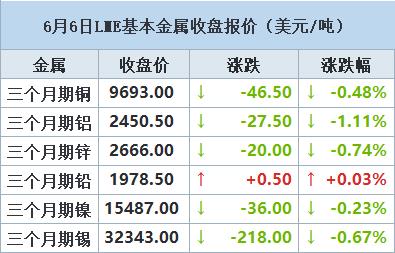
金属全线下跌 期铜收跌,受美元走强打压【6月6日LME收盘】
Wen Hua Cai Jing· 2025-06-07 07:54
Group 1 - LME copper prices declined on Friday due to a stronger US dollar, but concerns over short-term supply and ongoing inventory drawdowns limited the losses [1][3] - As of June 6, LME three-month copper closed at $9,693 per ton, down $46.50 or 0.48% [2][3] - LME copper inventory decreased by 5,600 tons or 4.06%, reaching a one-year low of 132,400 tons [3] Group 2 - The US labor market showed better-than-expected job growth in May, with 139,000 new jobs added, but the unemployment rate remained steady at 4.2% [3] - The US Department of Labor revised down employment data for March and April, which offset the positive outlook for May [3] - The market is awaiting results from an investigation into copper imports by Washington, which may lead to tariffs on copper imports [3] Group 3 - Shanghai Futures Exchange reported a 1.5% increase in copper inventory this week after a period of low levels last month [4] - LME three-month aluminum prices fell by $27.50 or 1.11%, closing at $2,450.50 per ton [5] - Following President Trump's announcement to increase tariffs on steel and aluminum, the aluminum premium in the US market surged to a record high of $1,378 per ton [5]
【期货热点追踪】空头回补持续进行,铜价能否延续上涨?美元走强或使铜价承压,但供应趋紧迹象料在长期内为市场提供支撑。
news flash· 2025-05-29 06:38
Core Viewpoint - Continuous short covering is observed, raising questions about whether copper prices can sustain their upward trend. A strong dollar may exert pressure on copper prices, but signs of tightening supply are expected to provide long-term support for the market [1] Group 1 - Short covering in the market is ongoing, indicating potential bullish sentiment for copper prices [1] - A strong dollar could create downward pressure on copper prices, complicating the market outlook [1] - Signs of tightening supply are emerging, which may offer long-term support for copper prices despite short-term challenges [1]
国际黄金价格剧烈波动进入回调周期,27日晚现货黄金跌破3300美元
Sou Hu Cai Jing· 2025-05-28 01:20
Core Viewpoint - International gold prices experienced significant volatility and entered a correction phase in late May 2025, with spot gold falling below $3,300 per ounce, marking a 1.4% decline in a single day and approximately 6% down from the historical high of $3,509.9 in April [1] Group 1: Downward Driving Factors - Decrease in safe-haven demand due to progress in US-China and EU-US tariff negotiations and easing Middle East tensions, leading to a shift of funds from gold to risk assets like US stocks [1] - Strengthening US dollar with the index rising above 99.6, marking the largest weekly gain since March 2023, and a reduction in market expectations for interest rate cuts from 53 basis points to 47 basis points, increasing the opportunity cost of holding gold [3] - Technical selling pressure intensified after gold prices fell below the key psychological level of $3,300, triggering stop-loss orders in program trading, with a 12% weekly decrease in COMEX gold futures open interest and a 35% drop in speculative long positions [3] Group 2: Market Chain Reactions - Divergence in consumption and investment, with domestic gold jewelry prices dropping to 987 yuan per gram, over 100 yuan lower than the April peak, while A-share gold stocks experienced a single-day decline of over 3% [4] - Global largest gold ETF (SPDR Gold Trust) increased holdings by 28 tons, indicating long-term investment interest, while short-term trading funds accelerated withdrawals, with COMEX gold put options reaching a historical high [5] Group 3: Future Trend Assessment - Short-term risks include potential declines to the $3,135 range if the $3,280 support level is breached, with extreme scenarios testing the $3,000 mark, and increased market volatility expected ahead of the Federal Reserve's June rate decision and the US core PCE index release [7] - Long-term support logic includes a 170% year-on-year increase in global central bank gold purchases in Q1 2025 and the introduction of gold weight in BRICS countries' settlement mechanisms providing structural support [8] Group 4: Investment Recommendations - Prioritize purchasing from Shenzhen Shui Bei wholesale market or promotional brand products, avoiding high-premium gold jewelry with processing fees exceeding 200 yuan per gram [9] - Ordinary investors are advised to gradually build positions in gold ETFs or bank accumulation gold, maintaining a portfolio allocation of 5%-10% of household assets, while leveraged traders should be cautious of liquidity risks in US debt markets [10] Group 5: Technical Focus Points - Key support levels identified at $3,280 (EMA20 period moving average) and $3,135 (Fibonacci 50% retracement level), with resistance levels at $3,342 (May 27 opening price) and $3,365 (downward trend line resistance) [11]
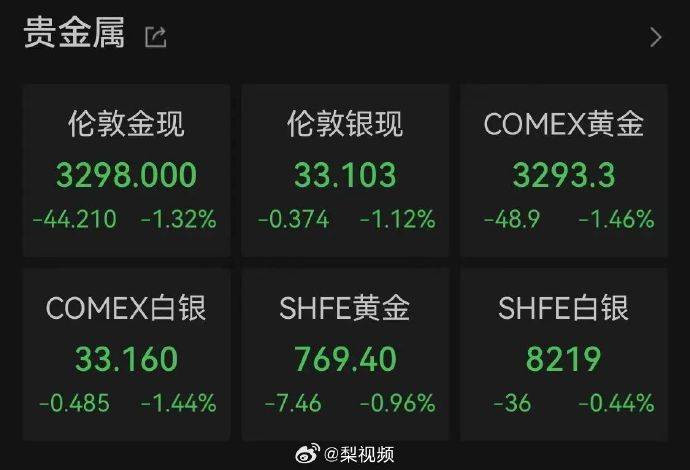
黄金回吐上周全部涨幅 关税延期叠加美元走强施压金价
news flash· 2025-05-27 15:12
Core Viewpoint - Gold futures prices are in a downward trend, reversing all gains from the previous week, despite a year-to-date increase of nearly 23% [1] Group 1: Market Reactions - President Trump announced a 50% tariff increase on the EU, which initially caused a spike in gold prices, but the subsequent postponement of the tariffs by five weeks led to a decline in gold prices [1] - The strengthening of the US dollar on Tuesday added further downward pressure on gold prices [1] Group 2: Investment Sentiment - Despite the recent decline, the overall weakness of the dollar and market uncertainty continue to make gold an attractive defensive investment choice for traders [1]
黄金价格暴跌!幕后推手竟是美元与美联储,未来会跌破700大关?
Sou Hu Cai Jing· 2025-05-21 06:31
Group 1: Core Reasons for Gold Price Decline - Strengthening US Dollar and Federal Reserve Policy: The rebound of the US dollar index has decreased the attractiveness of gold, as the market anticipates a delay in interest rate cuts due to the Federal Reserve's high rate expectations [1] - Increased Rate Hike Expectations: If the US April CPI data exceeds expectations, it may lead to further rate hikes by the Federal Reserve, increasing the opportunity cost of holding gold [2] - Easing Geopolitical Risks: Progress in US-China trade negotiations and a reduction in concerns over the Russia-Ukraine conflict have diminished the demand for gold as a safe-haven asset [3][4] Group 2: Market Sentiment and Technical Factors - Technical Sell-off: Gold prices breaking below key support levels (e.g., $3300/oz) have triggered algorithmic trading sell-offs, creating a vicious cycle of "sell more as prices drop" [5] - Profit-Taking by Bulls: Investors have chosen to lock in profits after a period of rising gold prices, leading to increased short-term selling pressure [6] Group 3: Macroeconomic Data Impact - Positive US Economic Data: Strong non-farm payroll data and a rebound in manufacturing PMI have alleviated recession fears, making risk assets like stocks more attractive and prompting funds to exit the gold market [8] - Rising Real Interest Rates: Increasing US Treasury yields have raised the opportunity cost of holding gold, pushing investors towards higher-yielding bonds or other assets [8] Group 4: Supply and Demand Dynamics - Slowing Central Bank Gold Purchases: While central banks have been increasing gold holdings in the long term, a short-term reduction in purchases (e.g., China pausing gold buying) may exacerbate market volatility [9] - Market Speculation: Some investors using leverage or loans for gold trading have been forced to liquidate positions due to price declines, further amplifying market volatility [10] Group 5: Other Contributing Factors - Normalization of Gold Premiums: The previous concerns over US tariffs on gold that led to inflated premiums are dissipating, reducing arbitrage opportunities and causing a decline in physical demand [11] - Consumer Demand Hesitance: With falling gold prices, consumer expectations of further declines have led to a temporary freeze in purchasing intentions, resulting in weak short-term demand [12]