AI革命

Search documents
AI富豪的帝国拼图
Sou Hu Cai Jing· 2025-11-20 23:14
Core Insights - The article emphasizes that the true power in the current technological revolution lies not in the flashy products but in controlling the underlying infrastructure that supports the economy, with key players like Musk and Bezos reshaping their business landscapes around AI-driven systems [1] Group 1: Key Players and Strategies - Musk views AI as integral to embedding intelligence into industrial systems, using it as the foundational logic for his empire, from Tesla's autonomous driving to SpaceX's rocket operations [2][3] - Bezos has returned to the industry with Project Prometheus, focusing on AI in manufacturing and engineering, aiming to rewrite his business landscape from the ground up [4] Group 2: Five Key Sectors - The five critical sectors identified as the new battlegrounds for investment are media, AI, robotics, electric vehicles, and space [5] - Media is seen as a tool for controlling attention and influence, serving as a data entry point for future AI systems [6][7] - AI is shifting from a model competition to a battle for energy and computing power, with data centers being likened to oil fields of the 21st century [8][9] - Robotics is anticipated to become a significant growth engine, with various types of robots being developed across multiple industries [10] - The electric vehicle sector is transitioning from hardware competition to a focus on intelligent systems, with 2026 marked as a pivotal year for autonomous driving [11][12] - Space is viewed as the next frontier for AI, with potential for training AGI in environments that minimize energy consumption and maximize deployment scale [17] Group 3: Infrastructure and Ecosystem - The competition is shifting from software to infrastructure, with the real battle being over who can create the systems that allow AI models to operate and expand in the real world [18] - Key components of this infrastructure include energy, data centers, and media, which are essential for the functioning of AI systems [19]

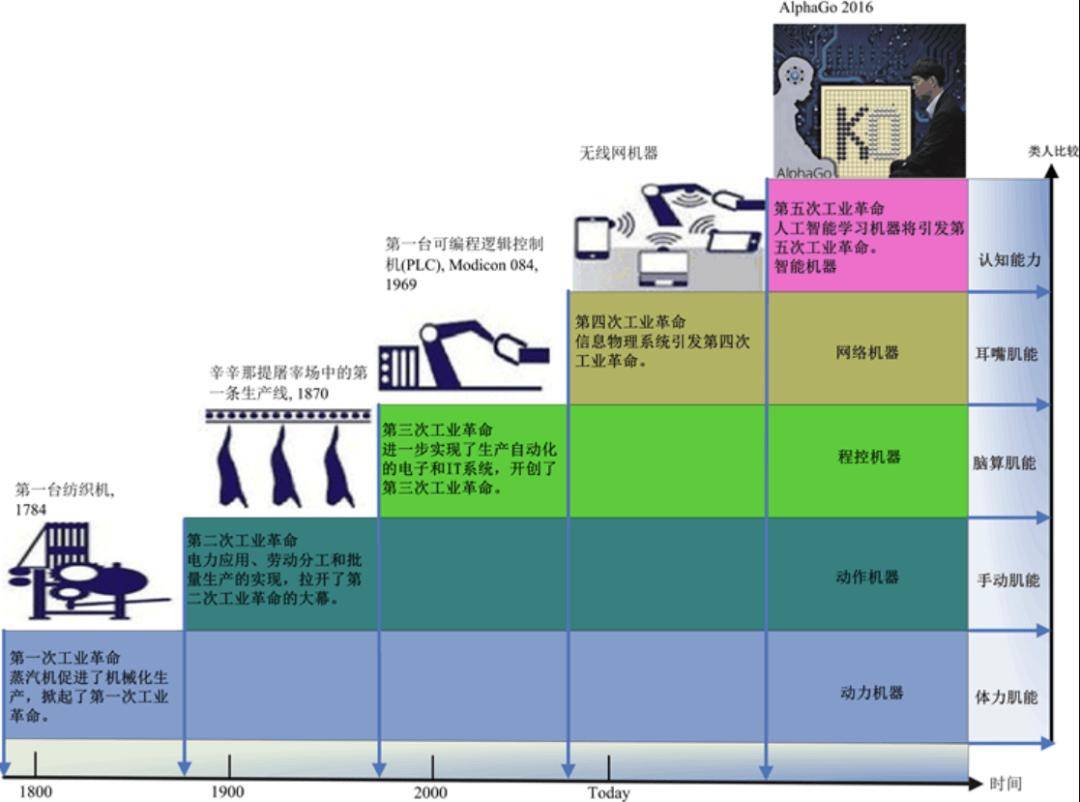
英伟达力挽AI泡沫论
Bei Jing Shang Bao· 2025-11-20 14:57
Core Viewpoint - The recent earnings report from Nvidia has temporarily alleviated concerns about a potential AI bubble, showcasing strong financial performance while also revealing some underlying risks [1][3]. Financial Performance - For the third quarter of fiscal year 2026 (ending October 26, 2025), Nvidia reported a revenue increase of 62.5% year-over-year, with net profit rising by 65% [3]. - The data center business achieved a quarterly revenue exceeding $50 billion for the first time [3]. - Nvidia's guidance for the next quarter anticipates total revenue of $65 billion, surpassing analyst expectations of $61.7 billion [4]. Demand Signals - Nvidia's Blackwell series chips are in high demand, and cloud GPUs are sold out, addressing market concerns about peak AI demand [3]. - However, Nvidia's accounts receivable have been rising, reaching $33.391 billion in the third quarter, with 65% coming from four major clients [5]. - Inventory levels have also increased to $19.784 billion, with inventory turnover days rising to 117.5 days, significantly higher than the average of the past five years [6]. Customer Concentration Risks - Nvidia's revenue is heavily reliant on a few major clients, with four direct customers contributing 61% of total revenue, up from 56% in the previous quarter [6][7]. - This high customer concentration poses risks to revenue stability if these clients alter their capital expenditure plans [7]. Market Sentiment - Analysts maintain a positive outlook on Nvidia, with firms like Morgan Stanley and UBS reiterating buy ratings and optimistic revenue forecasts [8]. - Conversely, notable investors like Peter Thiel and Bridgewater Associates have significantly reduced their holdings in Nvidia, indicating caution regarding its high valuation [9].


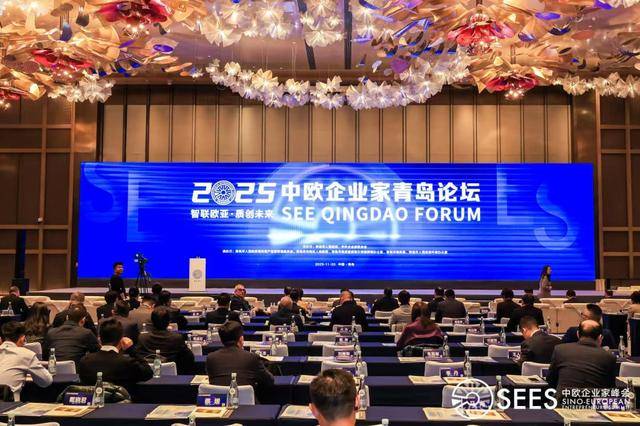
智联欧亚、质创未来,2025中欧企业家青岛论坛成功举办
Sou Hu Cai Jing· 2025-11-20 07:28
Core Insights - The 2025 China-Europe Entrepreneurs Forum was successfully held in Qingdao, attracting over 400 entrepreneurs and experts from both domestic and international backgrounds [1] Group 1: Event Overview - The forum is an international event approved by the Shandong Provincial Government, co-hosted by the Qingdao Municipal Government and the China-foreign Entrepreneurs Union [3] - Since its establishment in Qingdao in 2019, the forum has been held annually for seven consecutive years, becoming a significant platform for fostering trust and cooperation among entrepreneurs from various countries and regions [3] Group 2: Key Participants and Contributions - The event was co-hosted by several local government bodies, including the Qingdao State-owned Assets Supervision and Administration Commission and the Qingdao Business Bureau [5] - Notable attendees included former Vice Minister of Foreign Trade and Economic Cooperation Long Yongtu, Qingdao Mayor Ren Gang, and executives from major companies such as Cisco and Mercedes-Benz [5] - The forum featured discussions on topics like "National Strategy and Industrial Investment under the AI Revolution," with participation from companies like Microsoft, Siemens, and PwC [5] Group 3: Thematic Discussions - Two thematic sub-forums were held, focusing on "Social Responsibility and ESG Development" and "Safety and AI Leadership for Qingdao Enterprises Going Global," with participation from both local and international enterprises [7] - Representatives from Qingdao's outstanding state-owned and private enterprises engaged in experience sharing with representatives from central and foreign enterprises [7]
【招银研究|宏观深度】火与冰:美国经济与就业缘何背离?
招商银行研究· 2025-11-19 09:25
Core Viewpoint - The article discusses the significant divergence between the U.S. economy and employment since the third quarter, with economic recovery contrasting sharply with a rapid cooling in the job market. This situation has prompted the Federal Reserve to restart interest rate cuts, with future rate paths heavily dependent on the evolving relationship between economic performance and employment trends [2][3][4]. Economic Recovery Factors - The economic recovery is attributed to two main factors: the decline of negative narratives surrounding "tight fiscal" policies and "high tariffs," and the positive impact of the AI wave and a bull market in U.S. tech stocks, which have driven capital expenditure expansion in the corporate sector and wealth effects in the household sector [3][9]. - The fiscal expansion is highlighted by the introduction of the "Big and Beautiful Act," which has led to a significant increase in tax cuts, contributing to a rise in the fiscal deficit to $440 billion in the third quarter, a substantial increase from the previous quarter [9][12]. - The high tariffs imposed by the Trump administration have resulted in a notable increase in tariff revenue, estimated at around $30 billion per month, which has helped alleviate fiscal pressure despite its limited impact on inflation [12][19]. Employment Market Dynamics - The cooling of the job market is driven by both demand and supply factors. High interest rates have suppressed traditional industries, while tariffs have impacted corporate profits. Additionally, the AI technology has shown a contractionary effect on employment in the tech sector, leading to a continuous decline in hiring demand [3][29]. - From March to July, approximately 1.4 million immigrant workers exited the labor market, contributing to a simultaneous contraction in both demand and supply, resulting in a significant drop in new job additions while the unemployment rate remained stable [29][30]. - The article notes that the current employment growth is primarily affected by industries sensitive to interest rates, tariffs, and technology, with the tech sector exemplifying a "strong growth, weak employment" scenario [35][38]. Federal Reserve's Policy Outlook - The Federal Reserve is experiencing increasing internal divisions regarding future interest rate paths, with hawks focusing on the "strong economy" and doves emphasizing "weak employment." The current inflation rate is fluctuating between 2-3%, providing narrative space for both sides [4][43]. - Political factors and financial stability are identified as key variables influencing future Federal Reserve decisions. The upcoming changes in leadership within the Federal Reserve may enhance the influence of the Trump administration, potentially leading to a more dovish policy stance [4][55]. - The article predicts that by the end of 2026, the policy interest rate may drop to around 3%, corresponding to 3-4 rate cuts of 25 basis points each [4][56]. Market Implications - The article anticipates a continued bull steepening trend in U.S. Treasury yields, with the 10-year Treasury yield expected to decline from 4.3% to around 4.0% by 2026, while the yield curve will maintain its steepening characteristic [4][61]. - The U.S. dollar is projected to experience a phase of initial weakness followed by a potential recovery, with an overall oscillating trend expected, as the dollar index is forecasted to decline from 101 in 2025 to 99 by 2026 [4][69].

申万宏源陈达飞:刚性“泡沫”——申万宏源2026年海外经济宏观展望
Xin Lang Zheng Quan· 2025-11-19 03:03
Group 1 - The core viewpoint of the article emphasizes that the AI revolution is still in its early stages, and the potential for a "golden era" in AI capital may follow the current bubble phase [1][3] - The article discusses the divergence in asset prices since the emergence of ChatGPT, highlighting a conflict between strong expectations for the AI industry and weak economic realities [1] - It predicts that by 2025, the U.S. economy will experience a "soft landing," with a continued trend of interest rate cuts and a weakening dollar, while both risk and safe-haven assets will perform well [1][2] Group 2 - In 2025, AI capital expenditure is expected to become a new pillar of the U.S. economy, although there are concerns about cash flow pressures and debt financing needs for representative companies [3] - The article outlines that the monetary policy cycles in the U.S., Europe, and Japan will diverge, with the U.S. Federal Reserve expected to cut rates twice, while Japan may restart rate hikes depending on internal political stability [2] - It highlights the fiscal expansion expected in the U.S., Germany, and Japan, with respective increases in deficit rates of +1.0%, +0.84%, and +0.77%, and the impact on GDP growth from fiscal expansion is ranked as follows: Germany +0.63%, U.S. +0.6%, Japan +0.25%, and Eurozone +0.2% [2]

中伟新材正式登陆港交所 前驱体龙头驶入全球化布局快车道
Zheng Quan Shi Bao Wang· 2025-11-17 08:41
Core Insights - Zhongwei New Materials Co., Ltd. has successfully listed on the Hong Kong Stock Exchange, becoming the second "A+H" company in the new energy sector after CATL [2] - The company specializes in the research, production, and sales of new energy battery materials, particularly focusing on precursor cathode active materials (pCAM) [2] - The global market share for Zhongwei's nickel and cobalt pCAM is 20.3% and 28.0% respectively, maintaining the top global shipment volume for five consecutive years [2] Industry Overview - The global new energy battery market is experiencing significant growth, with shipments projected to increase from 260.6 GWh in 2020 to 1393.2 GWh by 2024, reflecting a compound annual growth rate (CAGR) of 52.1% [3] - By 2030, the market is expected to grow over three times, reaching 6019.1 GWh [3] - The expansion of electric vehicles, energy storage systems, and consumer electronics is driving demand for new energy materials [3] Company Performance - In 2024, Zhongwei is expected to achieve revenue of 40.223 billion RMB, a year-on-year increase of 17.77% [3] - For the first three quarters of 2025, the company reported revenue of 33.297 billion RMB, maintaining a growth rate of over 10% for three consecutive years [3] - The company’s high-nickel products are projected to capture 31.7% of the global market share in 2024, with ultra-high nickel products accounting for 89.5% [2] Future Development - Zhongwei emphasizes that technology and research are core to its business, aiming to enhance product performance and cost efficiency through continuous innovation [4] - The recent IPO will provide approximately 3.628 billion HKD for various initiatives, including the construction of a production base in South Korea and mining expenditures [3][4] - The listing is expected to strengthen the company's global integration and enhance its competitive edge in the international market [4]

中伟新材正式登陆港交所,前驱体龙头驶入全球化布局快车道
Zheng Quan Shi Bao Wang· 2025-11-17 08:26
Group 1 - Zhongwei New Materials Co., Ltd. (stock code 02579.HK) was listed on the Hong Kong Stock Exchange on November 17, becoming the second "A+H" company in the new energy sector after CATL [1] - The company, established in 2014, focuses on the research and development of cutting-edge new energy materials and has a global market share of 20.3% in nickel-based and 28.0% in cobalt-based pCAM as of 2024, ranking first in global shipments for five consecutive years [1] - Zhongwei New Materials has established a vertically integrated supply chain from upstream metal mining to material recycling, securing key mineral resources globally, including nickel ore in Indonesia and lithium salt in Argentina [1] Group 2 - The global new energy battery market is projected to grow from 260.6 GWh in 2020 to 1393.2 GWh in 2024, with a compound annual growth rate of 52.1%, and is expected to exceed 6019.1 GWh by 2030 [2] - The company achieved a revenue of 40.223 billion RMB in 2024, a year-on-year increase of 17.77%, and has maintained over 10% growth for three consecutive years [2] - The company raised approximately 3.628 billion HKD from its IPO, with about 50% allocated for the construction of a production base in South Korea and 15% for mining expenses in Kaiyang [2] Group 3 - The company emphasizes technology and R&D as the core of its business, aiming to enhance product performance and cost efficiency through continuous innovation [3] - The successful listing on the Hong Kong Stock Exchange opens new financing channels and strengthens the company's global integration strategy, enhancing product competitiveness [3] - The listing reflects the company's commitment to participating in international capital markets and providing new opportunities for international investors to access quality assets in the new energy sector [3]
4000点拉锯战还要多久?资金持续布局,上证综指ETF(510760)连续2日净流入
Mei Ri Jing Ji Xin Wen· 2025-11-17 06:37
Core Insights - The overall market has shown strong resilience since the index surpassed 4000 points, with a continuous upward shift despite occasional fluctuations [1] - The calendar effect is expected to re-emerge as the end of 2025 approaches, supported by the ongoing restructuring of international monetary order and significant breakthroughs in the renewable energy battery sector [1] - China's innovative industries are gradually realizing performance results, which is anticipated to continue supporting the performance of Chinese assets [1] Economic and Market Outlook - The domestic economy appears to be in a recovery phase, with the narrative surrounding artificial intelligence continuing to gain traction [1] - The market outlook remains positive, with recommendations for broad-based core allocations, particularly in the CSI A500 ETF (159338) and the SSE Composite Index ETF (510760), which may better withstand the anticipated high volatility in the near term [1]
AI革命:或引发薪资倒U型曲线,专家提三项建议
Sou Hu Cai Jing· 2025-11-17 03:12
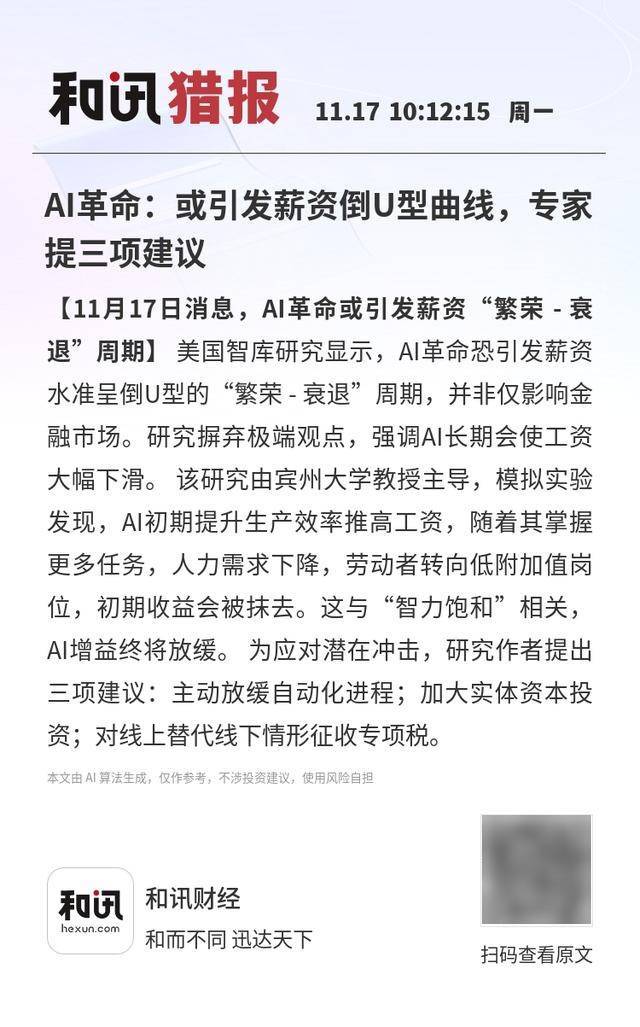
【11月17日消息,AI革命或引发薪资"繁荣 - 衰退"周期】美国智库研究显示,AI革命恐引发薪资水准呈 倒U型的"繁荣 - 衰退"周期,并非仅影响金融市场。研究摒弃极端观点,强调AI长期会使工资大幅下 滑。 该研究由宾州大学教授主导,模拟实验发现,AI初期提升生产效率推高工资,随着其掌握更多任 务,人力需求下降,劳动者转向低附加值岗位,初期收益会被抹去。这与"智力饱和"相关,AI增益终将 放缓。 为应对潜在冲击,研究作者提出三项建议:主动放缓自动化进程;加大实体资本投资;对线上 替代线下情形征收专项税。 本文由 AI 算法生成,仅作参考,不涉投资建议,使用风险自担 本文由 Al 算法生成,仅作参考,不涉投资建议,使用风险自担 和讯财经 和而不同 迅达天下 扫码查看原文 和讯猎报 11.17 10:12:15 周一 AI革命:或引发薪资倒U型曲线,专家 提三项建议 【11月17日消息,AI革命或引发薪资"繁荣 - 衰 退"周期】美国智库研究显示,AI革命恐引发薪资 水准呈倒U型的"繁荣 - 衰退"周期,并非仅影响金 融市场。研究摒弃极端观点,强调AI长期会使工资 大幅下滑。该研究由宾州大学教授主导,模拟实验 ...
美国智库:AI革命恐导致劳工收入先升后降,呈现倒U型曲线特征!强调AI长期恐致工资大幅下滑
Ge Long Hui· 2025-11-17 02:29
这项研究由宾州大学神经科学教授Konrad Kording与社会政策与实践学院副教授Ioana Marinescu主导, 通过模拟实验发现AI初期因提升生产效率推高工资,但随其掌握更多任务,人力需求下降,劳动者被 迫转向低附加价值岗位,初期收益将被抹去。这个过程与"智力饱和"密切相关,AI虽提升经济体智力水 平,但受限于现实工作需人机协同、依赖实体工具,增益终将放缓。 为因应潜在冲击,研究作者提出三项建议;一是主动放缓自动化进程,避免劳动市场剧烈震荡;二是加 大机器、设备等实体资本投资,维持劳工生产力;三是对线上虚拟服务替代线下的情形征收专项税,防 止产业生态被AI"掏空"。 格隆汇11月17日|根据美国智库布鲁金斯学会最新研究,AI革命恐引发薪资水准的"繁荣-衰退"周期, 呈现倒U型曲线特征,而非只有影响金融市场。研究摒弃"无限繁荣"或"全面失业"的极端观点,强调AI 长期恐致工资大幅下滑。 ...