
关税

Search documents
海外宏观周报:美国通胀下行趋势未改-20260120
China Post Securities· 2026-01-20 09:10
Economic Outlook - The U.S. inflation trend remains downward, with the core CPI increasing by only 0.2% month-on-month in December, below market expectations[3] - Historical patterns suggest a high probability that the Republican Party will lose control of the House in the upcoming midterm elections, given their current lead of only 5 seats[2] Housing Market - Despite a gradual recovery in new home supply, the overall housing market remains tight, leading to sustained high home prices and weak sales[3] - The proposed policy to purchase MBS to lower housing financing costs is unlikely to significantly impact long-term interest rates, as the $200 billion scale is relatively small compared to the overall economy[3] Inflation and Economic Indicators - The primary contributors to inflation have shifted, with used cars and energy commodities being significant factors, while tariff impacts on prices have proven weaker than expected[9] - Forward-looking indicators for housing rents suggest that the downward trend in inflation is not yet over[3] Risks and Federal Reserve Insights - Risks include potential inflation rebounds driven by energy or tariff factors, which could slow the pace of Federal Reserve rate cuts[4] - Federal Reserve officials express cautious optimism about inflation trends, with expectations for economic growth between 2.5% and 2.75% in 2026[25]
关税突发!特朗普:将征收200%关税!金价直线拉升
证券时报· 2026-01-20 05:21
Group 1 - The core viewpoint of the article is that President Trump announced a 200% tariff on French wine and champagne, which could significantly impact trade relations between the U.S. and France [2][3]. Group 2 - In the market aspect, international gold prices saw a significant surge, with spot gold briefly surpassing $4,700 per ounce [3].


五矿期货有色金属日报-20260120
Wu Kuang Qi Huo· 2026-01-20 02:18
1. Report Industry Investment Rating No relevant content provided. 2. Core Viewpoints of the Report - The overall sentiment in the non - ferrous metals market is affected by factors such as tariff expectations and market liquidity. Although there are some negative factors, the sentiment is not overly pessimistic in the context of a bullish precious metals market and loose US financial market liquidity expectations. In the double - wide cycle, the non - ferrous metals sector is generally regarded positively. However, the prices of different metals will show different trends based on their own supply - demand fundamentals. [2][3][5] 3. Summary by Metal Copper - **Market Information**: On January 19th, LME copper 3M rose 1.28% to $12,987/ton, and the SHFE copper main contract closed at 101,680 yuan/ton. LME copper inventory increased by 3,850 tons to 147,425 tons, with the increase coming from Asian warehouses. The domestic electrolytic copper social inventory increased by about 10,000 tons compared to last Thursday. The SHFE copper spot import loss was about 1,300 yuan/ton, and the refined - scrap copper price difference was 3,440 yuan/ton, slightly widening month - on - month. [2] - **Strategy Viewpoint**: The expectation of Trump's additional tariffs on key minerals has weakened, and the US plan to impose additional tariffs on 8 European countries has cooled market sentiment. However, with the strong performance of precious metals and the expectation of loose liquidity in the US financial market, the sentiment is not pessimistic. The copper ore supply remains tight, the LME spot market is strong, but the refined copper supply is relatively excessive. The copper price is expected to fluctuate at a high level in the short term. The reference range for the SHFE copper main contract today is 100,000 - 103,500 yuan/ton; the reference range for LME copper 3M is $12,800 - 13,200/ton. [3] Aluminum - **Market Information**: On January 19th, LME aluminum closed up 1.12% at $3,165/ton, and the SHFE aluminum main contract closed at 24,225 yuan/ton. The SHFE aluminum weighted contract position slightly increased to 698,000 lots, and the futures warehouse receipts increased by 1,000 tons to 141,000 tons. The domestic aluminum ingot social inventory increased by 15,000 tons compared to last Thursday, and the aluminum bar social inventory increased by 9,000 tons. The LME aluminum ingot inventory decreased by 3,000 tons to 485,000 tons. [4] - **Strategy Viewpoint**: The precious metals market has strengthened again, and market sentiment has improved. The high spot premium of US aluminum and the low LME global aluminum inventory at multi - year lows limit the downside of aluminum prices. Although high prices still affect domestic downstream demand, as prices decline, downstream inventory replenishment may increase. Coupled with the expectation of "rush - to - export" in the photovoltaic industry, the aluminum price may be relatively strong in the short term. The reference range for the SHFE aluminum main contract today is 23,900 - 24,400 yuan/ton; the reference range for LME aluminum 3M is $3,120 - 3,200/ton. [5][6] Cast Aluminum Alloy - **Market Information**: On January 19th, the price of cast aluminum alloy stabilized. The main AD2603 contract closed up 0.68% at 22,890 yuan/ton. The weighted contract position decreased to 24,600 lots, and the trading volume was 11,100 lots, a decrease month - on - month. The warehouse receipts decreased by 400 tons to 69,700 tons. The price difference between the AL2603 and AD2603 contracts was 1,200 yuan/ton, slightly widening month - on - month. The average price of mainstream domestic ADC12 remained flat, and the price of imported ADC12 decreased by 100 yuan/ton. The inventory of aluminum alloy ingots in three regions decreased by 300 tons to 43,200 tons. [8] - **Strategy Viewpoint**: The cost of cast aluminum alloy is strong, and supply - side disturbances continue. However, demand is relatively weak. The price is expected to fluctuate and consolidate in the short term. [9] Lead - **Market Information**: On Monday, the SHFE lead index fell 1.65% to 17,185 yuan/ton, with a total unilateral trading position of 112,100 lots. As of 15:00 on Monday, LME lead 3S fell $26.5 to $2,048.5/ton compared to the previous day, with a total position of 166,000 lots. The SMM1 lead ingot average price was 17,025 yuan/ton, the average price of recycled refined lead was 16,900 yuan/ton, and the refined - scrap price difference was 125 yuan/ton. The SHFE lead ingot futures inventory was 27,600 tons, and the domestic primary basis was - 135 yuan/ton. The LME lead ingot inventory was 206,400 tons, and the LME lead ingot cancelled warehouse receipts were 43,700 tons. [11] - **Strategy Viewpoint**: The visible inventory of lead concentrates has declined, and the operating rate of primary lead has remained high and increased slightly. The raw material inventory on the recycling side has increased, and the weekly operating rate of recycled lead has increased marginally. The lead price is still close to the upper limit of the long - term oscillation range, and the supply of lead ingots has increased marginally. The operating rate of downstream battery manufacturers has improved marginally, and the social inventory of lead ingots has increased. After the winter cooling, the transportation of waste batteries has become difficult, the scrap pricing coefficient has increased, and the smelting profit of recycled lead has declined slightly. The lead price has given back some of its gains as the sentiment in the non - ferrous metals sector fades. However, in the double - wide cycle, the non - ferrous metals sector is still regarded positively. The subsequent trends of leading varieties in the sector and the SHFE - LME ratio need to be observed. [11][12] Zinc - **Market Information**: On Monday, the SHFE zinc index fell 1.17% to 24,456 yuan/ton, with a total unilateral trading position of 232,300 lots. As of 15:00 on Monday, LME zinc 3S fell $41.5 to $3,222.5/ton compared to the previous day, with a total position of 232,200 lots. The SMM0 zinc ingot average price was 24,420 yuan/ton, the Shanghai basis was 40 yuan/ton, the Tianjin basis was - 20 yuan/ton, the Guangdong basis was at par, and the price difference between Shanghai and Guangdong was 40 yuan/ton. The SHFE zinc ingot futures inventory was 33,800 tons, and the LME zinc ingot inventory was 106,500 tons. [13] - **Strategy Viewpoint**: The port inventory of zinc ore has decreased slightly, and the import TC of zinc concentrates has decreased slightly. However, the increase in zinc price has slightly increased zinc smelting profits, and the industrial situation has not improved significantly. The social inventory of zinc ingots has started to increase, and the SHFE - LME ratio has stopped rising and declined. Since December 24, 2025, the domestic zinc - copper ratio has reached a new low since the listing of SHFE zinc in 2007, and since January 9, 2026, the domestic zinc - aluminum ratio has reached a new low since 2013. The zinc price has a large potential for catch - up growth compared to copper and aluminum. The zinc price is still in the process of catching up with the macro - attribute of the sector. It has given back some of its gains as the sentiment in the non - ferrous metals sector fades. However, in the double - wide cycle, the non - ferrous metals sector is still regarded positively. The subsequent trends of leading varieties in the sector and the SHFE - LME ratio need to be observed. [14] Tin - **Market Information**: On January 19th, the tin price continued to weaken. The SHFE tin main contract closed at 389,500 yuan/ton, a 3.88% decrease from the previous day. The smelting operating rates of tin ingots in Yunnan and Jiangxi were generally stable at a high level. Yunnan was about 87.81%, basically unchanged and production was normal. Jiangxi's refined tin output was still low due to the shortage of scrap tin raw materials. The resumption of production in Wa State, Myanmar has accelerated, and the increase in tin price has boosted the enthusiasm for resumption. In addition, it is estimated that about 5,000 tons of tin ore will be imported in December, and the raw material shortage in Yunnan has significantly eased compared to the previous period, with an expectation of further import increases. However, after the two regions resumed from maintenance, there was insufficient upward momentum, and there were constraints on the scrap side and downstream high - price waiting - and - seeing. The short - term supply was difficult to increase significantly. As of January 16, 2026, the social inventory of tin ingots in major domestic markets was 10,636 tons, an increase of 2,560 tons from last Friday. [15][16] - **Strategy Viewpoint**: The supply - demand situation of tin has improved marginally, but the short - term inventory accumulation trend may continue to put pressure on the price. Coupled with the withdrawal of speculative funds, the tin price may continue to decline in an oscillatory manner. It is recommended to wait and see. The reference range for the domestic main contract is 360,000 - 400,000 yuan/ton, and the reference range for LME tin is $46,000 - 50,000/ton. [17] Nickel - **Market Information**: On January 19th, the nickel price rebounded after hitting a low. The SHFE nickel main contract closed at 142,710 yuan/ton, a 0.66% increase from the previous day. In the spot market, the premium and discount of each brand gradually declined. The average premium of Russian nickel spot to the near - month contract was 600 yuan/ton, unchanged from the previous day, and the average premium of Jinchuan nickel spot was reported at 7,850 yuan/ton, an increase of 1,350 yuan/ton from the previous day. The nickel ore price remained stable. The ex - factory price of 1.6% grade Indonesian domestic red clay nickel ore was reported at $54.54/wet ton, and the price of 1.2% grade Indonesian domestic red clay nickel ore was reported at $23/wet ton, both unchanged from the previous day. The price of nickel iron increased significantly, and the average price of 10 - 12% high - nickel pig iron was reported at 1,012 yuan/nickel point, unchanged from the previous day. [19] - **Strategy Viewpoint**: Although there is an expectation of an increase in refined nickel production in January, it has not been continuously reflected in the visible inventory in the short term. It is expected that the SHFE nickel will still fluctuate widely in the short term. It is recommended to wait and see. The short - term reference range for the SHFE nickel price is 130,000 - 160,000 yuan/ton, and the reference range for the LME nickel 3M contract is $16,000 - 19,000/ton. [20] Lithium Carbonate - **Market Information**: The MMLC lithium carbonate spot index closed at 144,461 yuan in the evening session, a 2.84% decrease from the previous working day. The MMLC battery - grade lithium carbonate was quoted at 143,500 - 146,300 yuan, with the average price decreasing by 4,100 yuan (- 2.75%) from the previous working day. The industrial - grade lithium carbonate was quoted at 140,600 - 143,700 yuan, with the average price decreasing by 3.30% from the previous day. The LC2605 contract closed at 147,260 yuan, a 0.73% increase from the previous day's closing price. The average premium and discount of battery - grade lithium carbonate in the trading market was - 1,600 yuan. [22][23] - **Strategy Viewpoint**: The optimistic sentiment has eased, and the lithium price fluctuated widely on Monday. The progress of mine type change in Jiangxi mines has been made, but even if the mining license is obtained, there are still procedures such as the safety production license and environmental impact assessment approval, and it is difficult to directly translate into supply at present. The impact of this event on the sentiment level should be mainly concerned. If the increase in lithium price is fully transmitted to the end - users, the increase in battery cost will suppress some energy - storage demand, and the current price still has a certain emotional premium. The lithium carbonate price has fluctuated greatly recently, and there are many disturbances in the industrial and macro aspects. It is recommended to wait and see or make a light - position attempt. Pay attention to the market atmosphere, demand policies, downstream acceptance willingness, and changes in position on the disk. The reference range for the GZFE lithium carbonate 2605 contract today is 140,200 - 151,000 yuan/ton. [23] Alumina - **Market Information**: On January 19, 2026, as of 3 pm, the alumina index fell 0.69% to 2,726 yuan/ton, with a total unilateral trading position of 704,400 lots, an increase of 12,000 lots from the previous trading day. In terms of basis, the Shandong spot price remained at 2,565 yuan/ton, at a discount of 168 yuan/ton to the main contract. Overseas, the MYSTEEL Australian FOB price remained at $305/ton, and the import profit and loss was reported at - 82 yuan/ton. In terms of futures inventory, the futures warehouse receipts on Monday were reported at 187,900 tons, an increase of 111,000 tons from the previous trading day. The CIF price in Guinea remained at $63/ton, and the CIF price in Australia remained at $60/ton. [25] - **Strategy Viewpoint**: After the rainy season, the shipments from Guinea are gradually recovering, and the resumption of production in the AXIS mine is expected to cause the ore price to decline in an oscillatory manner. Pay attention to the support at the import cost position of Guinea ore. The over - capacity pattern in the alumina smelting end is difficult to change in the short term, and the inventory accumulation trend continues. The National Development and Reform Commission has proposed to prevent blind investment and disorderly construction in alumina and copper smelting, and the market expectation for the implementation of supply - contraction policies in the future has increased. However, continued rebound still faces three difficulties: over - capacity in the smelting end, downward - moving cost support, and the pressure of expiring warehouse receipt delivery. It is recommended to wait and see in the short term. The cost - performance of chasing up is not high. One can wait for an opportunity to short the near - month contract at a high price. The reference range for the domestic main contract AO2605 is 2,650 - 2,800 yuan/ton. Pay attention to supply - side policies, Guinea ore policies, and the Fed's monetary policy. [26] Stainless Steel - **Market Information**: At 15:00 on Monday, the stainless - steel main contract closed at 14,305 yuan/ton, a 0.21% (+ 30) increase on the day, with a unilateral position of 263,700 lots, an increase of 2,294 lots from the previous trading day. In the spot market, the Delong 304 cold - rolled coil price in the Foshan market was reported at 14,050 yuan/ton, a decrease of 100 yuan from the previous day, and the Hongwang 304 cold - rolled coil price in the Wuxi market was reported at 14,300 yuan/ton, a decrease of 50 yuan from the previous day. The Foshan basis was - 455 (- 130), and the Wuxi basis was - 205 (- 80). The Foshan Hongwang 201 was reported at 9,200 yuan/ton, unchanged from the previous day, and the Hongwang annealed 430 was reported at 7,750 yuan/ton, unchanged from the previous day. In terms of raw materials, the ex - factory price of high - nickel iron in Shandong was reported at 1,015 yuan/nickel, unchanged from the previous day. The recycling price of 304 scrap steel industrial materials in Baoding was reported at 9,450 yuan/ton, unchanged from the previous day.
光大期货:1月20日能源化工日报
Xin Lang Cai Jing· 2026-01-20 02:11
Oil Market - WTI prices were not available due to the Martin Luther King Jr. Day holiday, while Brent crude for March closed at $63.94 per barrel, down $0.19, a decrease of 0.30% [2][15] - Domestic crude oil production in China for 2025 is projected to be 21,605 million tons, a year-on-year increase of 1.5%, with processing volume at 73,759 million tons, up 4.1% [2][15] - The market is currently experiencing a seasonal decline in diesel and gasoline demand, with oil prices showing no significant driving force, maintaining a volatile trend [2][15] Fuel Oil - The main contract for fuel oil (FU2603) rose by 0.12% to 2,538 yuan per ton, while low-sulfur fuel oil (LU2603) increased by 0.07% to 3,060 yuan per ton [16] - Supply of low-sulfur fuel oil is expected to be sufficient, with Singapore receiving approximately 290-300 million tons in January, up from 260-270 million tons in December [16] - The geopolitical situation in Iran continues to significantly impact oil prices, with fluctuations expected to follow oil price movements [16][4] Asphalt - The main contract for asphalt (BU2602) increased by 0.29% to 3,142 yuan per ton, with concerns over raw material supply easing slightly [17] - The market is currently facing a "weak demand reality" against a backdrop of "strong cost expectations," particularly as winter weather impacts demand [17] Rubber - The main contract for rubber (RU2605) fell by 90 yuan per ton to 15,745 yuan per ton, with NR and BR contracts also experiencing declines [18] - China's rubber tire exports for 2025 are expected to reach 9.65 million tons, a year-on-year increase of 3.6% [18] - Inventory levels for natural rubber in Qingdao increased, indicating a seasonal accumulation trend [18] PX, PTA, and MEG - TA605 closed at 5,030 yuan per ton, up 0.24%, while EG2605 fell by 1.08% to 3,755 yuan per ton [19] - PX futures closed at 7,106 yuan per ton, with a slight increase of 0.28%, and the market is expected to see some support due to supply reductions [19] Methanol - Methanol prices in Taicang were reported at 2,207 yuan per ton, with CFR China prices ranging from $262 to $266 per ton [21] - Domestic supply remains stable, but demand is under pressure due to reduced operating rates in MTO facilities [21] Polyolefins - Polypropylene prices are under pressure, with production margins for various methods showing negative values [22] - Demand is expected to recover slightly in early January, but inventory levels are anticipated to rise as the month progresses [22] PVC - PVC prices have decreased, with the market experiencing a supply-demand imbalance and overall bearish sentiment [23] - The upcoming end of export tax rebates is expected to increase upward pressure on long-term contracts [23] Urea - Urea futures prices are experiencing weak fluctuations, with the main contract closing at 1,772 yuan per ton, down 1.45% [24] - Market sentiment is declining, with production rates and demand showing signs of weakness ahead of the Spring Festival [24] Soda Ash - Soda ash futures prices are fluctuating, with the main contract closing at 1,192 yuan per ton, down 0.33% [25] - The industry is facing pressure from supply and demand dynamics, with cautious sentiment prevailing in the market [25] Glass - Glass futures prices fell significantly, with the main contract closing at 1,070 yuan per ton, down 2.9% [26] - The market is experiencing a supply recovery, but demand remains cautious, leading to a bearish outlook [26]

张尧浠:避险加关税再起忧虑、黄金增强看涨前景预期
Sou Hu Cai Jing· 2026-01-20 00:31
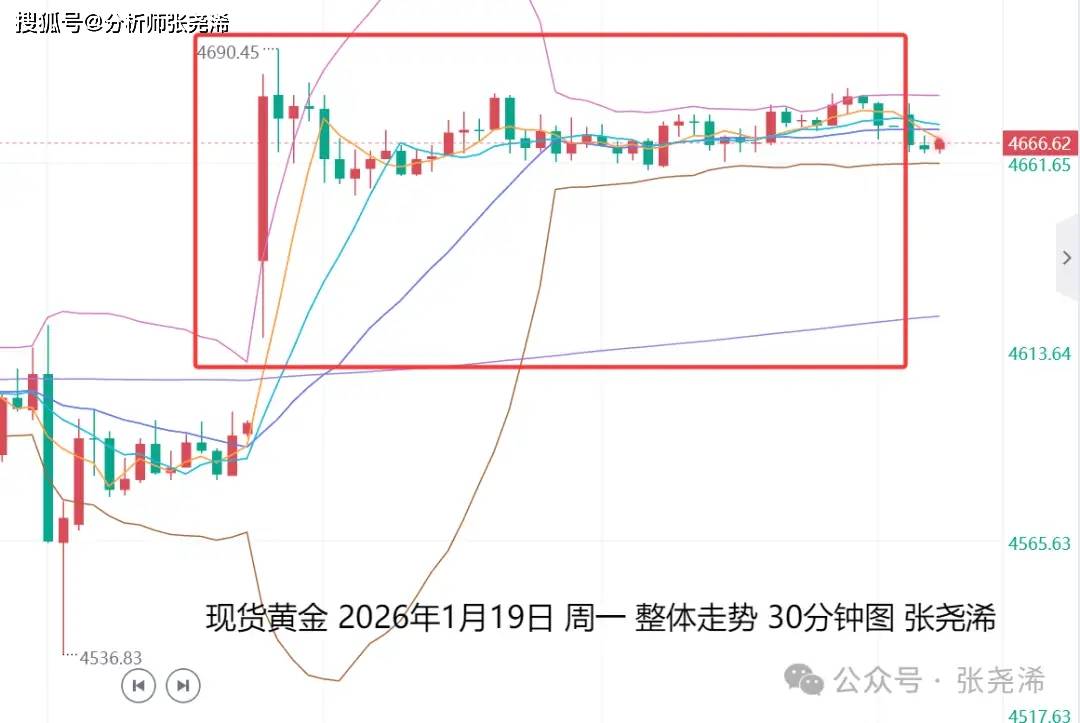
张尧浠:避险加关税再起忧虑、黄金增强看涨前景预期 上交易日周一(1月19日):国际黄金受美国总统特朗普在格陵兰岛争端中对多个欧洲国家发出加征关税警告所激发的避险需求推动,高开高走,再度收 阳,维持多头看涨前景,但目前走势触及上升趋势线压力附近,也有短线回落调整的需求,不过,如有回撤调整,下方各短周期均线支撑,也是再度入场 看涨的机会,反之,如继续反弹走强收阳至趋势线阻力上方,则将顺势跟进继续看涨上行。 具体走势上,金价自亚市高开于4615.41美元/盎司,先行录得日内低点4615.08美元,之后反弹拉升,触及日内高点4689.23美元,半小时内即出高低点, 在之后,多头动力有所减弱,并维持基本维持在4655-4677区间内持续盘整,一直到日收盘,收于4671.91美元,相对于上周五收盘价4594.07美元,周振幅 95.16美元,收涨77.84美元,涨幅1.69%。 展望今日周二(1月20日):国际黄金开盘走势有所偏弱,面临阻力调整需求,和日内短周期的背离形态,以及美元指数早盘的止跌走强压力,但多头仍具 优势和前景。短期如有进一步回撤,下方关注各周期的均线支撑,也都是入场看涨机会。 日内无重点关注数据及事件, ...
贵金属日报-20260119
Guo Tou Qi Huo· 2026-01-19 12:03
Report Summary 1. Report Industry Investment Rating - Gold: ★☆★ (indicating a bullish bias but limited trading opportunities on the market) [1] - Silver: ★☆★ (indicating a bullish bias but limited trading opportunities on the market) [1] - Platinum and Palladium: Resources are brittle, and it is still advisable to go long on dips, but track the expected shift in capital liquidity. [2] 2. Core Views - The U.S. economic data shows resilience, and Fed officials are cautious about rate cuts. The market expects the first rate cut this year to be in June. Geopolitical tensions, such as Trump's tariff threats, increase global uncertainty and support gold prices. The administrative order on key minerals eases concerns about silver tariffs and liquidity shortages. [1] - The platinum and palladium market on the Guangzhou Futures Exchange has calmed down after the initial enthusiasm. The price difference remains high. Although the bullish sentiment has declined due to the non - implementation of the 232 tariff, it is still advisable to go long on dips. Technically, it is at the end of a triangle consolidation, and an option strategy of buying a straddle can be considered after the second directional choice. [2] 3. Other Key Points - **Macroeconomic and Policy News** - Trump wants Hassett to stay in his original position, and Hassett promises to maintain the Fed's independence if he becomes the Fed chair. Fed officials have different views on rate cuts, with some focusing on potential lay - off risks and others emphasizing inflation control. [2] - Trump threatens to impose tariffs on countries with different views on Greenland, and the EU may impose tariffs on $93 billion of U.S. goods and plans an offline summit on January 22. [3] - Trump signs an executive order on key mineral imports, setting a 180 - day negotiation window and temporarily not imposing tariffs on key minerals. [1] - **Market Conditions** - The platinum - palladium spread on the Guangzhou Futures Exchange remains at a high of 140 yuan/gram. The market is at the end of a triangle consolidation, and a second directional choice is expected after volatility reduction. [2]
点,深证成指跌0.18%,创业板指跌0.2%。税等多个应对方案。白宫经济顾问哈塞特
Xin Yong An Guo Ji Zheng Quan· 2026-01-19 09:51
Market Performance - The Shanghai Composite Index fell by 0.26% to 4101.91 points, while the Shenzhen Component decreased by 0.18% and the ChiNext Index dropped by 0.2%[1] - The Hong Kong Hang Seng Index closed down 0.29% at 26844.96 points, with the Hang Seng Tech Index down 0.11% and the Hang Seng China Enterprises Index down 0.50%[1] - The total market turnover in Hong Kong was 2550.786 million HKD[1] Economic and Policy Developments - President Trump announced a 10% tariff on eight European countries starting February 1, increasing to 25% in June unless a Greenland acquisition agreement is reached[12] - The EU is reportedly discussing retaliatory tariffs against the U.S. in response to these measures[12] - Market speculation has shifted towards Kevin Walsh as a potential new Federal Reserve Chair, reducing expectations for interest rate cuts this year[12] Financial Data Insights - The U.S. Dow Jones Industrial Average fell by 0.17% to 49359.33 points, while the S&P 500 and Nasdaq both decreased by 0.06%[1] - Bloomberg forecasts that China's Q4 GDP growth may slow to 4.5%, down from 4.8% in Q3, marking a three-year low[12] - The one-year Loan Prime Rate (LPR) is expected to remain stable at 3.00%, with the five-year LPR also unchanged at 3.50%[12]


对关税的担忧压制风险资产 比特币价格跌破92000美元关口
Xin Lang Cai Jing· 2026-01-19 07:08
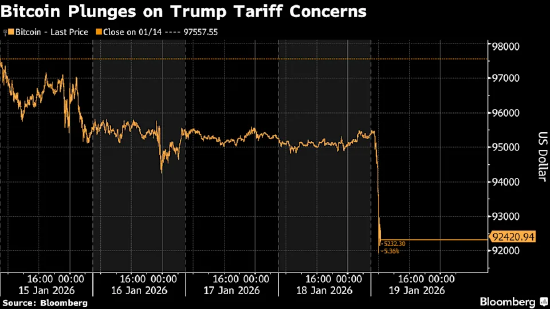
Group 1 - President Trump's proposal to impose new import taxes on eight European countries has led to a widespread decline in risk asset prices and an increase in demand for safe-haven assets [1][5] - Bitcoin's price dropped by 3.6%, falling below the $92,000 mark, while Ethereum and Solana experienced declines of 4.9% and 8.6%, respectively, resulting in a total market cap loss of approximately $100 billion in the cryptocurrency market [1][4] - Following Trump's announcement, U.S. stock index futures saw a significant drop, while gold and silver prices surged to historical highs [5] Group 2 - European leaders have condemned Trump's remarks and are preparing to suspend the approval process of a previously reached trade agreement [3][7] - The cryptocurrency market has struggled throughout 2025, failing to recover from a severe drop in October, although it began the year with a positive trend, with Bitcoin reaching just below $98,000 on January 14 [3][7] - Richard Galvin, co-founder of hedge fund DACM, noted that the recent market movements were influenced by a combination of year-end tax loss selling and investor stop-loss actions, with the latest import tax concerns hindering the market rebound [3][7] - Approximately $790 million in long positions in the cryptocurrency market were liquidated in the past 24 hours, with analysts suggesting that if current support levels are breached, Bitcoin could target $90,000 [7]
伦敦银处上涨趋势 关税暴露非约束条约问题
Jin Tou Wang· 2026-01-19 04:23
Group 1 - London silver is currently trading above $93.11, with an opening price of $90.61 per ounce and a current price of $93.28, reflecting a 3.71% increase [1] - The highest price reached was $94.36, while the lowest was $90.50, indicating a short-term oscillating trend in the market [1] Group 2 - The President announced new measures on the Truth Social platform, which seem to follow the precedent of the controversial International Emergency Economic Powers Act, granting broad powers in the face of "unusual and extraordinary threats" [1] - The Supreme Court may soon decide whether to overturn tariffs implemented under this act, potentially jeopardizing a new round of aid funding and openly challenging judicial intervention in a new trade war [1] - Scott Lincicome from the Cato Institute warned that the new threats expose the vulnerabilities of relying on unilateral agreements rather than binding treaties [1]
关税预期缓和,铜价高位震荡
Tong Guan Jin Yuan Qi Huo· 2026-01-19 01:52
1. Report Industry Investment Rating - Not provided in the content 2. Core Viewpoints of the Report - Last week, copper prices fell from their highs. The main reasons were that the Trump administration might have decided not to impose tariffs on rare earths, lithium, and key mineral resources, NVIDIA's financial report suggested that the previous estimate of copper usage in AI data centers might be overestimated, the strengthening of the US dollar index, and overseas funds taking profits at high levels, which put short - term pressure on the metal market. However, in the medium term, the long - bull logic of the precious metal market provides a solid foundation for the valuation increase of copper prices [2][7]. - In the overall situation, against the backdrop of tariff easing and the market gradually pricing in two expected interest rate cuts this year, some overseas funds are taking profits from long positions. The NVIDIA report's potential overestimation of AI data - center copper usage and the rebound of the US dollar index restrict the upward movement of metals. Fundamentally, overseas mine disruptions continue, domestic refined copper supply is narrowing marginally, traditional industries' consumption drag is obvious, and domestic inventories are continuously increasing. It is expected that copper prices will remain in a high - level range in the short term [2][10]. 3. Summary by Relevant Catalogs 3.1 Market Data - **Price Changes**: From January 9th to January 16th, LME copper decreased from $12,965.50/ton to $12,808.50/ton, a decline of $157.00/ton or - 1.21%; COMEX copper dropped from 589.05 cents/pound to 584.85 cents/pound, a decrease of 4.2 cents/pound or - 0.71%; SHFE copper fell from 101,410 yuan/ton to 100,770 yuan/ton, a decline of 640 yuan/ton or - 0.63%; international copper decreased from 90,150 yuan/ton to 89,650 yuan/ton, a decline of 500 yuan/ton or - 0.55%. The Shanghai - London ratio increased from 7.82 to 7.87, and the LME spot premium increased by 46.69% from $41.94/ton to $61.52/ton, while the Shanghai spot premium decreased from - 45 yuan/ton to - 125 yuan/ton [3]. - **Inventory Changes**: As of January 16th, the total global visible inventory exceeded one million tons, reaching 1,005,786 tons, an increase of 7.10% compared to January 9th. LME inventory increased by 4,600 tons to 143,575 tons (a 3.31% increase), COMEX inventory rose by 24,915 short tons to 542,914 short tons (a 4.81% increase), SHFE inventory increased by 32,972 tons to 213,497 tons (an 18.26% increase), and Shanghai bonded - area inventory increased by 4,200 tons to 105,800 tons (a 4.13% increase) [6]. 3.2 Market Analysis and Outlook - **Macro - aspect**: The Fed's Beige Book shows that the US economy has expanded moderately recently, inflation pressure has eased, and employment is generally stable. After the tariffs were implemented, enterprises' outlook on future economic activities has turned optimistic. The US consumer data is positive, and the inflation data has increased the probability of an interest - rate cut in April to over 40%. Trump's actions have increased market risk - aversion sentiment, driving up the copper - price center. In China, the State Grid plans to invest 4 trillion yuan in fixed assets during the "15th Five - Year Plan" period, a 40% increase compared to the "14th Five - Year Plan" period, mainly for the construction of a new power system and related industrial - chain upgrades [8]. - **Supply - demand aspect**: The global mine - end supply growth rate in 2026 will be less than 1.5% due to mine disruptions. Domestic refined - copper supply is expected to decline further. The demand from the power grid construction is large but the progress is slow, white - goods consumption is declining, and real - estate completion is lackluster. However, new industries such as new - energy vehicles, wind and solar power, and AI data centers are providing new consumption increments [9]. 3.3 Industry News - First Quantum Minerals welcomes Panama's plan to allow the Cobre Panama copper mine to process inventory ore. The government plans to make a formal decision on the mine's future development by June this year [11]. - Ivanhoe Mines' Kamoa - Kakula copper mine in Congo achieved its 2025 production target. It delivered 388,838 tons of copper concentrate, and the company reaffirmed its 2026 copper - production forecast of 380,000 - 420,000 tons [12]. - On January 15th, Luoyang Molybdenum released its 2025 performance forecast. Its annual net profit attributable to shareholders is expected to be between 20 billion and 20.8 billion yuan, a year - on - year increase of 47.80% - 53.71%. The company's copper production in 2025 reached 741,149 tons [13]. 3.4 Relevant Charts - The report provides charts on the price trends of SHFE copper and LME copper, LME copper inventory, global visible inventory, Shanghai Exchange and bonded - area inventory, LME inventory and cancelled - warrant ratio, COMEX inventory and cancelled - warrant ratio, SHFE copper basis, refined - scrap copper price difference, Shanghai Non - ferrous copper spot premium, LME copper premium, SHFE copper inter - month spread, spot premium and Yangshan copper premium, copper domestic - foreign price ratio, copper import profit and loss, copper concentrate spot TC, COMEX copper non - commercial net - long position ratio, and LME copper investment - fund net - position change [15][19][22][23][27][29][31][35][37][41]