
地缘政治风险

Search documents
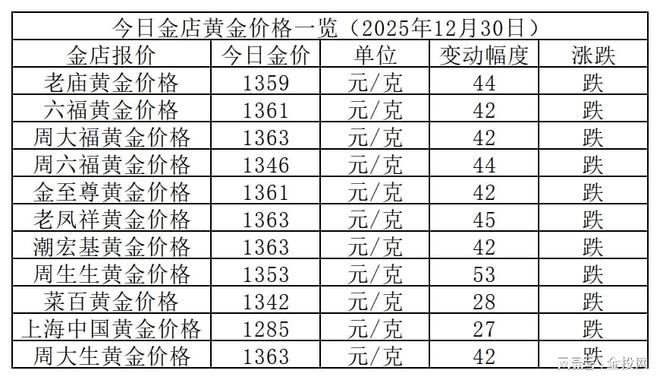
2025年12月30日金店报价速递:黄金价格跌幅超40元/克!
Jin Tou Wang· 2025-12-30 08:18
Group 1: Domestic Gold Prices - Domestic gold prices continue to decline, with most brands seeing a drop of over 40 yuan per gram [1] - Major brands like Chow Tai Fook, Chao Hong Ji, Lao Feng Xiang, and Zhou Da Sheng are priced at 1363 yuan per gram, the highest in the market [1] - Shanghai China Gold has the lowest price at 1285 yuan per gram, creating a price gap of 78 yuan per gram with the highest brands [1] - Detailed price list shows various brands with significant declines, such as Lao Miao at 1359 yuan per gram and Liufu at 1361 yuan per gram [1] Group 2: Platinum Prices - Platinum jewelry prices have also seen a significant drop, with Chow Tai Fook's platinum price falling by 79 yuan per gram to 871 yuan per gram [1] Group 3: Gold Recycling Prices - Gold recycling prices have also decreased, with the current market price for gold recycling at 983 yuan per gram [2] - Other brands show varying recycling prices, such as Cai Zi at 959.20 yuan per gram and Zhou Sheng Sheng at 948.90 yuan per gram [2] Group 4: International Gold Prices - International spot gold prices experienced a sharp decline, closing at 4331.65 USD per ounce, a drop of 4.45% [4] - As of the latest update, spot gold has rebounded to 4367.32 USD per ounce, reflecting a 0.82% increase [4] - The decline in gold prices is attributed to profit-taking by investors and increased trading costs due to margin hikes by the Chicago Mercantile Exchange [4] - Geopolitical tensions, including accusations between Russia and Ukraine and warnings from the U.S. regarding Iran, continue to provide safe-haven support for gold [4] Group 5: Future Outlook - There is potential for further increases in spot gold prices, with upcoming announcements from the Federal Reserve expected to influence market volatility [5]

金荣中国:金价早盘支撑位震荡,市场轻仓多单布局方案
Sou Hu Cai Jing· 2025-12-30 08:10
Core Viewpoint - The precious metals market, particularly gold, silver, and platinum, experienced significant price increases at the end of 2025, driven by expectations of Federal Reserve interest rate cuts, geopolitical tensions, and strong central bank gold purchases [1][5]. Group 1: Market Performance - On December 30, 2025, spot gold approached historical highs, opening at $4550.00 per ounce before dropping to around $4469 [1]. - Gold prices rose by 1.2% last Friday, reaching $4531.87 per ounce, with February futures closing at $4552.70, reflecting strong market momentum [3]. - Silver surpassed $80, platinum reached record highs, and palladium broke the $2000 mark, indicating a robust performance across precious metals [1]. Group 2: Influencing Factors - The anticipated easing of monetary policy by the Federal Reserve, with potential rate cuts in mid-2026, has fueled market optimism [3]. - Geopolitical uncertainties, particularly the ongoing Russia-Ukraine conflict, have heightened demand for safe-haven assets like gold [3]. - Central banks are expected to purchase an average of 70 tons of gold monthly in 2026, significantly above historical averages, providing strong support for gold prices [4]. Group 3: Future Outlook - Goldman Sachs forecasts that gold prices could reach $4900 per ounce by Q4 2026, with a possibility of exceeding $5000 in the first half of the year [4]. - The first quarter of 2026 may see a price pullback to $4200, followed by a gradual recovery to $4630 before reaching the projected highs [4]. - Investors are advised to monitor Federal Reserve policy meetings and developments in the Russia-Ukraine situation, as these will directly impact gold price trends [4].

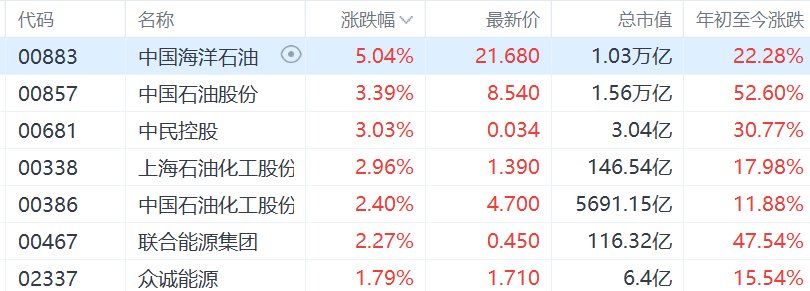
地缘政治风险再度升温促国际油价大涨,“三桶油”走高,中海油涨5%
Ge Long Hui· 2025-12-30 06:00
港股频道更多独家策划、专家专栏,免费查阅>> 责任编辑:栎树 与此同时,中东地缘紧张再度升温。沙特领导的联军周末向也门南部主要分裂势力发出停止军事行动的警告。有分 析称,也门局势恶化令红海航道和中东石油运输面临新威胁,供应中断风险显著上升。 此外,瑞银分析师强调,中国海运原油进口量保持强劲,为油市提供需求端支撑,进一步巩固价格底部。 | 代码 | 名称 | | 涨跌幅 √ | 最新价 | 总市值 | 年初至今涨跌 | | --- | --- | --- | --- | --- | --- | --- | | 00883 | 中国海洋石油 | (0) | 5.04% | 21.680 | 1.03万亿 | 22.28% | | 00857 | 中国石油股份 | | 3.39% | 8.540 | 1.56万亿 | 52.60% | | 00681 | 中民控股 | | 3.03% | 0.034 | 3.04亿 | 30.77% | | 00338 | 上海石油化工股份 | | 2.96% | 1.390 | 146.54亿 | 17.98% | | 00386 | 中国石油化工股份 | | 2.40% | 4 ...



兴业证券王涵 | 2026年潜在的六只地缘“黑天鹅”
王涵论宏观· 2025-12-30 05:30
Core Viewpoint - The report highlights the need for market participants to pay attention to potential geopolitical "black swan" events that could significantly impact global asset prices by 2026 [1][7]. Geopolitical Risks - The risk of escalation in the Russia-Ukraine conflict into a full-scale confrontation between Russia and Europe is increasing, driven by Russia's battlefield advantages and heightened concerns among Eastern European countries [9]. - The fragile peace in the Middle East and the Caucasus region poses a risk of renewed conflict, particularly with Israel potentially seeking decisive action to ensure its security amid a strategic U.S. withdrawal [14]. - The strategic balance in the South Asian subcontinent is under threat, as the U.S. shifts its focus away from the Indo-Pacific, potentially diminishing India's strategic value and increasing the likelihood of conflict with Pakistan [17]. - Domestic political risks in the U.S. are rising, particularly concerning Trump, as internal support fractures and external pressures mount, which could lead to increased political instability [22]. - Opportunistic strategic risks in the Asia-Pacific region may arise as the U.S. reduces its strategic presence, encouraging countries like Japan and the Philippines to take more adventurous actions [24]. - The rise of "new Monroe Doctrine" in South America could disrupt global trade and supply chains, as the U.S. seeks to assert its dominance in the region, increasing geopolitical risks [25]. Investment Recommendations - Despite the identified geopolitical risks, China's economic resilience and policy stability are viewed as crucial stabilizing factors for the global market [28]. - Investors are advised to establish a geopolitical risk monitoring framework, increase allocations to safe-haven assets like gold and the renminbi, and focus on regions that may benefit from uncertainty, particularly those closely linked to the Chinese economy [29].

大越期货原油早报-20251230
Da Yue Qi Huo· 2025-12-30 05:04
1. Report Industry Investment Rating - No relevant content provided 2. Core View of the Report - The overnight Russia-Ukraine negotiations are still far from reaching an agreement, and there are reports of a Ukrainian attack on the Russian president's residence, making the hope of peace talks slim. US President Trump issued a new threat against Iran, and geopolitical concerns still provide support. The subsequent release of full-caliber inventory accumulation in the US EIA has a certain impact on prices. In the short term, oil prices will still fluctuate with geopolitical events, but the "anchor" determining the lower limit is always the oversupply. It is expected that oil prices will fluctuate. SC2602 is expected to operate in the range of 430 - 440, and long - term investors should wait [3]. 3. Summary by Directory 3.1 Daily Tips - **Fundamentals**: Russia accused Ukraine of attempting to attack President Putin's residence, but Kiev refuted it. Kazakhstan's oil production in December decreased by about 6% due to a decline in the output of the Tengiz oil field. Trump threatened to strike Iran again. The overall situation is neutral [3]. - **Basis**: On December 29, the spot price of Oman crude oil was $61.72 per barrel, and that of Qatar Marine crude oil was $60.78 per barrel. The basis was 13.87 yuan/barrel, with the spot at a premium to the futures, which is bullish [3]. - **Inventory**: The API crude oil inventory in the US for the week ending December 19 increased by 2.391 million barrels, and the EIA inventory increased by 0.405 million barrels, contrary to the expected decrease of 2.432 million barrels. The Cushing area inventory increased by 0.707 million barrels. The Shanghai crude oil futures inventory remained unchanged at 3.464 million barrels as of December 29, which is bearish [3]. - **Disk**: The 20 - day moving average is flat, and the price is below the average, which is neutral [3]. - **Main Position**: As of December 16, both WTI and Brent crude oil main positions were long positions, but the long positions decreased, which is bearish [3]. - **Expectation**: Oil prices are expected to fluctuate. SC2602 is expected to operate in the range of 430 - 440, and long - term investors should wait [3]. 3.2 Recent News - Trump expressed concerns about Iran's nuclear and missile programs and threatened to strike Iran again. He also said he would support Israel in striking Iran if it continued its missile program. He had previously launched strikes on Iran's key facilities in June [5]. - Russia accused Ukraine of attempting to attack President Putin's residence, but Kiev refuted it. The intense exchange between the two sides added new uncertainty to the prospects of peace in Ukraine [5]. - Trump said the US had "struck" an area in Venezuela used for loading drug - carrying ships, but details were unclear [5]. 3.3 Long - Short Concerns - **Likely Bullish Factors**: No relevant content provided - **Likely Bearish Factors**: The situation in the Middle East eases [6] - **Market Drivers**: In the short term, wait for geopolitical bullish factors; in the medium - to - long term, there is a risk of oversupply [7]. - **Risk Points**: Disruption of OPEC+ internal unity and increased production; escalation of war risks; sanctions against Russia; tense situation in Venezuela; consistent expectations of oil oversupply among institutions; some progress in the peace agreement negotiations between the US and Russia [7] 3.4 Fundamental Data - **Futures Market**: The settlement price of Brent crude oil decreased from $61.80 to $60.24, a decrease of 2.52%. The settlement price of WTI crude oil decreased from $58.35 to $56.74, a decrease of 2.76%. The settlement price of SC crude oil increased from 443.0 to 443.4, an increase of 0.09%. The settlement price of Oman crude oil decreased from $62.57 to $62.27, a decrease of 0.48% [8]. - **Spot Market**: The price of UK Brent Dtd increased by 0.79%, WTI decreased by 0.05%, Oman crude oil increased by 0.71%, Shengli crude oil increased by 0.19%, and Dubai crude oil increased by 0.47% [10]. - **API Inventory**: As of December 19, the API inventory increased by 2.391 million barrels compared to the previous week [11]. - **EIA Inventory**: As of December 19, the EIA inventory increased by 0.405 million barrels compared to the previous week [14]. - **Supply - Demand Balance Sheet**: The report provides data on the supply - demand gap, OPEC+ crude oil production, and Call on OPEC+ from 2023 to 2026 - Q4 [20]. 3.5 Position Data - **WTI Crude Oil Fund Net Long Position**: As of December 16, the net long position was 54,896, a decrease of 3,537 compared to the previous period [17]. - **Brent Crude Oil Fund Net Long Position**: As of December 16, the net long position was 32,940, a decrease of 74,876 compared to the previous period [19].
张德盛:12.30黄金今日还会涨吗?积存金行情走势分析操作
Sou Hu Cai Jing· 2025-12-30 03:28
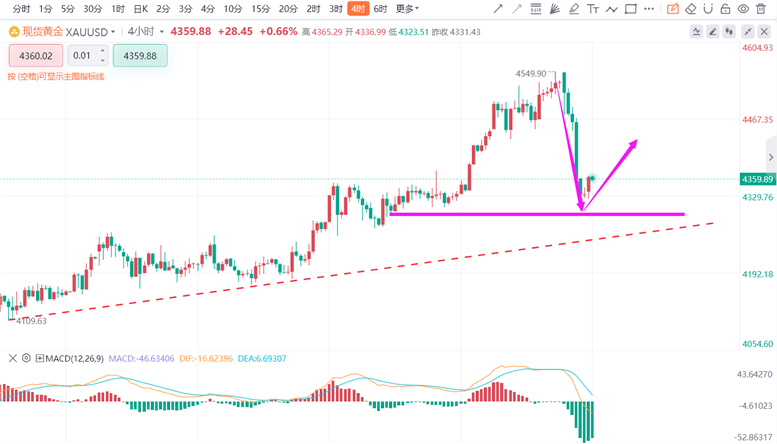
Market Overview - International gold prices experienced a significant drop, falling over $200, as investors opted for profit-taking after a week of bullish activity and a surge in silver prices [3] - Despite the recent decline, the overall trend remains bullish, supported by global economic uncertainties, geopolitical risks, and central bank gold purchases [3] Technical Analysis - Gold prices fell from a peak to a low of 4305, indicating a substantial decline, but the market has not broken key support levels, suggesting a potential for recovery [4] - If gold stabilizes above 4400, it may indicate a shift back to a strong bullish trend, with targets set at 4500 [4] Investment Strategy - Investors are advised to consider entering long positions in gold, particularly if prices approach 4330, with initial targets at 4400 and further upside potential at 4500 [4] - For domestic gold contracts, a cautious approach is recommended, with opportunities to enter long positions as the market adjusts after recent declines [4]
格林大华期货早盘提示:纯苯-20251230
Ge Lin Qi Huo· 2025-12-30 01:32
更多精彩内容请关注格林大华期货官方微信 格林大华期货研究院 证监许可【2011】1288 号 2025 年 12 月 30 日星期二 Morning session notice 早盘提示 研究员:吴志桥 从业资格:F3085283 交易咨询资格:Z0019267 联系方式:15000295386 | 板块 | 品种 | 多(空) | 推荐理由 【行情复盘】 周一夜盘主力合约期货 BZ2603 价格下跌 62 元至 5470 元/吨,华东主流地区现货价 格 5360 元/吨(环比+35),山东地区现货价格 5206 元/吨(环比+39)。持仓方面, 多头持仓增加 652 手至 1.72 万手,空头持仓增加 1863 至 2.2 万手。 【重要资讯】 1、供应方面,11 月国内纯苯产量 191.8 万吨,同比-0.93%。12 月计划内检修偏多。 10 月纯苯进口量 49.67 万吨,环比+14.1%。市场消息:华东某炼厂计划 1 月对 1000 万吨常减压以及一套重整检修,影响纯苯产能 60 万吨。 | | --- | --- | --- | --- | | 能源与化 | 纯苯 | 震荡 | 2、库存方面,截 ...
张尧浠:金银获利了结跳水调整、中长期看涨前景仍不变
Sou Hu Cai Jing· 2025-12-30 01:32
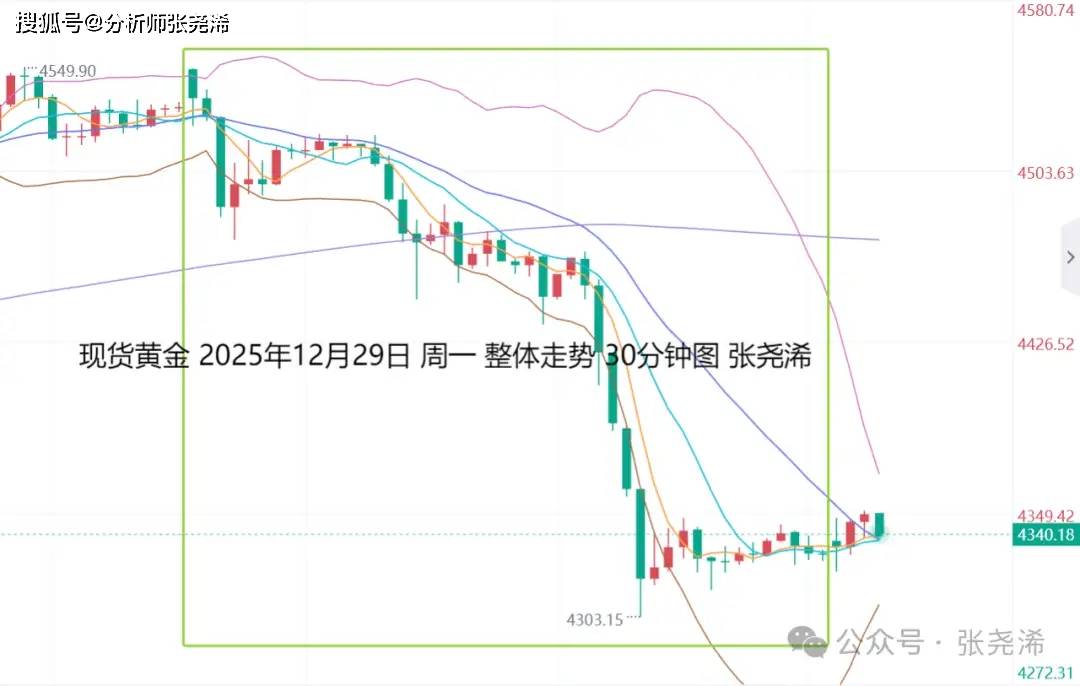
Core Viewpoint - The recent significant drop in gold prices is attributed to profit-taking after a bullish trend, but the medium to long-term outlook remains bullish due to ongoing geopolitical risks and central bank gold purchasing trends [1][5][6]. Price Movements - On December 29, gold opened at $4537.12 per ounce, peaked at $4548.58, and then fell to a low of $4303.73, closing at $4331.93, marking a daily decline of $202.19 or 4.46% [3][5]. - The price volatility for the day was $244.85, indicating significant market fluctuations [3]. Market Influences - Upcoming economic indicators, such as the FHFA House Price Index and Chicago PMI, are expected to exert downward pressure on gold prices [5]. - The Federal Reserve's monetary policy meeting minutes are anticipated to have limited positive impact on gold prices, with the market likely to remain in a consolidation phase [5]. Long-term Outlook - Despite short-term fluctuations, the long-term bullish perspective on gold remains unchanged due to global economic uncertainties, geopolitical tensions, and inflation hedging demands [5][6]. - The potential for further interest rate cuts by the Federal Reserve is seen as a key driver for gold price increases, with a target of $5000 per ounce by 2026 being considered achievable [6][8]. Technical Analysis - Monthly and weekly charts indicate a potential for gold to test support levels around $4000-$3900, with a bullish outlook if it breaks above previous resistance levels [8][10]. - Daily charts show that gold is currently supported by key moving averages, suggesting opportunities for bullish positions [12]. Trading Strategy - Suggested trading levels include support at $4315 or $4260 and resistance at $4380 or $4440 for gold, with similar levels provided for silver [13].
机构:银价正从峰值回落 黄金则因获利回吐而走软
Sou Hu Cai Jing· 2025-12-29 13:17
Core Viewpoint - Silver prices reached a record high above $80 per ounce on Monday but subsequently retreated, while gold prices also fell from near historical highs due to profit-taking by investors and a perceived reduction in geopolitical risks [1] Group 1: Market Reactions - Investors engaged in profit-taking after gold prices hit record highs, leading to a decline in both gold and silver prices [1] - Optimism regarding progress in U.S. government-led peace negotiations in Ukraine contributed to a moderate headwind for safe-haven buying [1] Group 2: Upcoming Events - The market is currently focused on the Federal Reserve's December meeting minutes scheduled for release on Tuesday, which may provide insights into future interest rate outlooks [1] Group 3: Analyst Insights - UBS analysts noted that gold prices are at a high premium, and a sudden hawkish shift by the Federal Reserve or significant outflows from large ETFs could pose downward risks to the market [1]
年末黄金投资热潮涌动 专家提示需理性应对风险
Sou Hu Cai Jing· 2025-12-29 12:00
Group 1 - The international gold market is experiencing a strong performance as it approaches the end of 2025, driven by multiple favorable factors including the Federal Reserve entering a rate-cutting cycle and increasing geopolitical tensions [3][4] - Gold is becoming a focal point for investors due to its traditional role as a safe-haven asset, with central banks globally increasing their gold reserves, further supporting the upward trend in gold prices [3][4] - Despite the attractiveness of gold as a long-term value preservation tool, its prices are subject to cyclical volatility influenced by various factors, necessitating cautious investment decisions [4][8] Group 2 - Investors are advised to adopt a rational investment strategy, diversifying their portfolios and treating gold as a stabilizing asset rather than a singular investment [6][8] - Recommendations for investors include gradual accumulation of gold to mitigate price volatility, closely monitoring policy developments from the Federal Reserve, and selecting appropriate investment vehicles such as physical gold for long-term holding or gold ETFs for short-term trading [9]
