人民币汇率

Search documents
管涛:2025年或是中国迈向成熟对外净债权国的起点
Di Yi Cai Jing· 2025-07-07 12:13
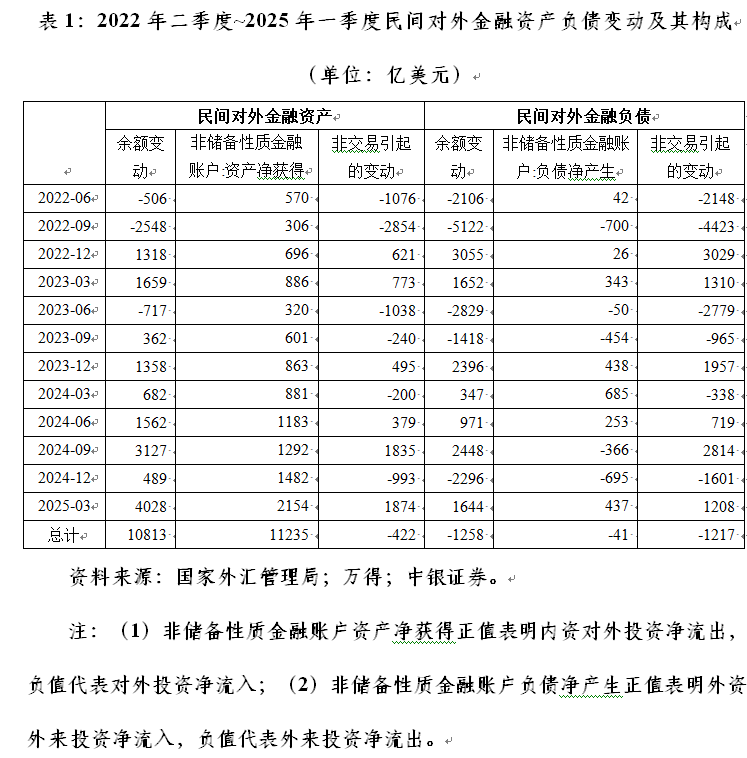
Core Viewpoint - The sustainability of the private sector's net foreign assets in China is crucial for the country to transition into a mature net creditor nation, especially as the depreciation of the RMB approaches its end [1][7]. Group 1: Changes in Private Sector's Net Foreign Position - China's private sector's net foreign position has shifted from negative to positive, with a net asset of $785 billion as of Q1 2025, marking the first positive net position since 2004 [1][9]. - The private sector's net foreign liabilities increased from $3,778 billion at the end of 2004 to a peak of $23,732 billion by mid-2015, influenced by the long-term appreciation of the RMB [2][3]. - Following the "8·11" exchange rate reform in 2015, the private sector's net foreign liabilities began to decline, reaching $11,130 billion by the end of 2016, a reduction of 53% from the peak [3]. Group 2: RMB Exchange Rate Trends - The RMB has experienced a general depreciation since early 2022, with the onshore midpoint and spot rates falling by 11.3% and 12.7% respectively by the end of 2024 [5]. - In 2025, the RMB began to appreciate against the backdrop of a weakening USD, with the dollar index dropping by 10.8% in the first half of the year [5][6]. - The exchange rate fluctuations have played a significant role in adjusting the private sector's foreign liabilities, with a negative valuation effect of $5,796 billion due to the RMB's depreciation from Q2 2022 to Q1 2025 [10]. Group 3: Implications for China's Net Creditor Status - The transition to a positive net foreign position is supported by a structural trade surplus, which has been a significant factor in maintaining stable foreign exchange reserves [9][13]. - The reduction in private sector net liabilities is attributed to increased foreign asset holdings and a decrease in foreign liabilities, with a net outflow of $11,235 billion in foreign investments [9]. - If the trend of positive net foreign assets continues, 2025 could mark the year China officially becomes a mature net creditor nation, although potential risks from trade surplus fluctuations and exchange rate volatility remain [13].

2025年7月7日银行间外汇市场人民币汇率中间价
news flash· 2025-07-07 01:19
Summary of Key Points Core Viewpoint - The interbank foreign exchange market shows a mixed performance in the RMB exchange rates against various currencies, indicating fluctuations in the currency's strength and market dynamics [1]. Exchange Rate Changes - USD/RMB is reported at 7.1506, down by 29 points, indicating an appreciation of the RMB against the USD [1]. - EUR/RMB is at 8.4292, up by 64 points, suggesting a depreciation of the RMB against the Euro [1]. - HKD/RMB is at 0.91092, down by 5.8 points, reflecting a slight appreciation of the RMB against the HKD [1]. - GBP/RMB is at 9.7688, down by 148 points, indicating a significant appreciation of the RMB against the GBP [1]. - AUD/RMB is at 4.6863, down by 240 points, showing a notable appreciation of the RMB against the AUD [1]. - CAD/RMB is at 5.2610, down by 141 points, reflecting an appreciation of the RMB against the CAD [1]. - JPY/RMB is at 4.9545, up by 77 points, indicating a depreciation of the RMB against the JPY [1]. - RMB/RUB is at 10.9917, down by 375 points, suggesting a significant appreciation of the RMB against the RUB [1]. - NZD/RMB is at 4.3304, down by 234 points, indicating an appreciation of the RMB against the NZD [1]. - RMB/MYR is at 0.58924, down by 10.5 points, reflecting a slight appreciation of the RMB against the MYR [1]. - CHF/RMB is at 9.0110, down by 32 points, indicating an appreciation of the RMB against the CHF [1]. - SGD/RMB is at 5.6167, down by 13 points, reflecting a slight appreciation of the RMB against the SGD [1].
中外资机构热议下半年投资机遇
中国基金报· 2025-07-06 13:12
Core Viewpoint - The article discusses the investment opportunities in the second half of 2025, highlighting a positive outlook for the Chinese stock market and the need for diversified asset allocation in a weak dollar scenario [2]. Group 1: Investment Strategies for Chinese Markets - A-shares and H-shares are expected to maintain a high-level oscillation pattern, with potential upward space due to improved fundamentals and profit expectations [12][11]. - The technology sector, particularly in 5G, robotics, and AI applications, is anticipated to yield excess returns, supported by increased capital inflow from southbound funds [12][11]. - A "barbell" strategy is recommended, focusing on high-dividend state-owned enterprises as defensive assets while also investing in technology and consumer sectors [13][14]. Group 2: Currency Outlook - The RMB is projected to appreciate moderately with two-way fluctuations, supported by a stable domestic economy and potential interest rate cuts by the Federal Reserve [15][18]. - The current account surplus is expected to maintain around 1% of GDP, providing a solid foundation for RMB stability [15][18]. Group 3: Macroeconomic Policy Predictions - Fiscal policy will focus on growth support and structural optimization, with an emphasis on social welfare, green transition, and new productivity [17]. - Monetary policy is likely to remain moderately loose, with potential for one interest rate cut and one reserve requirement ratio cut within the year [18][19]. Group 4: Impact of U.S. Policies - The "Big and Beautiful" Act may raise concerns about U.S. fiscal sustainability, potentially leading to increased market volatility and long-term economic challenges [21][22]. - The Federal Reserve's focus may shift from inflation control to growth preservation, with expected interest rate cuts in the latter half of 2025 [22][23]. Group 5: Global Asset Allocation Strategies - A declining dollar index may relieve global debt burdens and shift capital flows towards non-dollar assets, increasing demand for gold, euros, and RMB [25][26]. - A diversified global stock allocation is recommended, with an emphasis on emerging markets and alternative investments as attractive options [26][27].

人民币汇率年中成绩单:韧性持续增强
Zhong Guo Zheng Quan Bao· 2025-07-04 20:28
Core Viewpoint - The resilience of the Renminbi (RMB) against the US dollar is attributed to multiple factors, including domestic economic recovery and macroeconomic policies, with expectations for continued stability and potential mild appreciation in the second half of the year [1][2]. Group 1: RMB Exchange Rate Performance - As of July 4, the offshore RMB to USD exchange rate was reported at 7.1643, an increase of 58 basis points from the previous close [1]. - In the first half of the year, the onshore and offshore RMB to USD exchange rates rose by 1.82% and 2.45%, respectively [1]. - The RMB to USD central parity rate was adjusted up by 298 basis points in the first half of the year [1]. Group 2: Factors Supporting RMB Resilience - The decline of the US dollar index by 10.79% in the first half of the year contributed to the strengthening of the RMB [2]. - Domestic policies aimed at counter-cyclical adjustments provided significant support for the RMB exchange rate [2]. - The narrowing gap between onshore, offshore, and central parity rates indicates a potential convergence of these rates, suggesting a more stable exchange environment [2]. Group 3: Outlook for the Second Half of the Year - Experts predict that the RMB may experience mild appreciation due to favorable external and internal factors [2]. - Continued domestic growth policies are expected to play a crucial role in stabilizing the exchange rate [2]. - The People's Bank of China plans to enhance the foreign exchange market, including the introduction of RMB foreign exchange futures trading, which may further support the RMB's stability [3]. Group 4: Market Resilience and Risk Management - The maturity and rationality of market participants have improved, with the proportion of enterprises using foreign exchange hedging rising to around 30% [3]. - The ability to manage exchange rate fluctuations has significantly increased, bolstering confidence in maintaining a stable RMB exchange rate [3].
金管局200亿港元入场,港股走向成谜?港股通科技ETF(513860)盘中小幅回调
Jin Rong Jie· 2025-07-03 03:01
Group 1 - The core viewpoint of the article highlights the positive market atmosphere created by the trade agreement between the US and Vietnam, leading to a collective rise in the Hong Kong stock market [1] - The Hong Kong Stock Connect Technology ETF (513860) experienced a slight decline of 0.56% as of 10:35 AM, despite having gained over 4% last week and nearly 30% year-to-date [1] - Notable stock performances include a rise of over 7% for companies like Innovent Biologics and CanSino Biologics, while companies such as Kelun-Biotech and Zai Lab saw increases of over 6% [1] Group 2 - The Hong Kong Monetary Authority (HKMA) intervened in the market by selling US dollars and buying Hong Kong dollars, involving an amount of HKD 20.018 billion to stabilize the currency [1] - The total bank system surplus has decreased to HKD 144.1 billion, following a cumulative purchase of approximately HKD 30 billion by the HKMA from June 26 to July 2 [1] - The Hibor rate has dropped from 4.5% to 0.4%, indicating a significant change in the liquidity environment [1] Group 3 - Goldman Sachs indicated a strong interest from investors in the Hong Kong market and Hong Kong dollar assets, with a relatively abundant liquidity environment [1] - The Hong Kong IPO market remains active without causing liquidity issues, and there is an increasing demand for the Hong Kong dollar from overseas investors [1] - The top ten weighted stocks in the Hong Kong Stock Connect Technology ETF (513860) account for 69.41% of the index, including major companies like Xiaomi, Tencent, and BYD [1]
瑞达期货股指期货全景日报-20250702
Rui Da Qi Huo· 2025-07-02 09:47
Report Summary 1. Report Industry Investment Rating No information provided on the report industry investment rating. 2. Core Viewpoint - The June PMI shows that the domestic prosperity level remains in an expansion state, which is beneficial to the stock market. The State Council Executive Meeting emphasizes strengthening the main position of enterprise technological innovation, which is expected to bring more benefits to growth - style technology stocks. The recent weakening of the US dollar index has also relieved the pressure on the RMB exchange rate. It is recommended to buy on dips with a light position [2]. 3. Summary by Related Catalogs Futures Disk - **Contract Prices**: IF (2509) is 3894.2 (+4.8), IH (2509) is 2696.8 (+4.2), IC (2509) is 5756.6 (-14.0), IM (2509) is 6117.0 (-17.0). IF (2507) is 3921.0 (+6.0), IH (2507) is 2703.0 (+4.6), IC (2507) is 5856.6 (-15.4), IM (2507) is 6262.2 (-24.8) [2]. - **Contract Spreads**: IF - IH spread is 1218.0 (+2.4), IC - IF spread is 1935.6 (-20.8), etc. [2]. - **Season - to - Current Month Spreads**: IF when - season to current month is - 26.8 (-1.2), IH is - 6.2 (0.0), IC is - 100.0 (+3.4), IM is - 145.2 (+8.2) [2]. Futures Position - IF top 20 net position is - 30,725.00 (+104.0), IH is - 11,962.00 (-155.0), IC is - 10,395.00 (+7.0), IM is - 34,573.00 (-258.0) [2]. Spot Price - CSI 300 is 3943.68 (+0.9), SSE 50 is 2722.55 (+4.8), CSI 500 is 5892.95 (-41.7), CSI 1000 is 6309.48 (-64.3) [2]. Market Sentiment - A - share trading volume is 14,051.09 billion yuan (-914.22 billion), margin trading balance is 18,545.63 billion yuan. North - bound trading volume is 1318.02 billion yuan (-260.71 billion) [2]. - The proportion of rising stocks is 35.87% (-12.64%), Shibor is 1.365% (-0.002) [2]. Wind Market Strength - Weakness Analysis - All A - shares score is 4.00 (-1.60), technical aspect is 3.60 (-1.20), capital aspect is 4.40 (-1.90) [2]. Industry News - China's June official manufacturing PMI is 49.7, up 0.2 points from last month; non - manufacturing PMI is 50.5%, up 0.2 points; comprehensive PMI is 50.7%, up 0.3 points [2]. - A - share major indices generally declined. The Shanghai Composite Index fluctuated narrowly, while the Shenzhen Component Index and ChiNext Index weakened. The Shanghai Composite Index fell 0.09%, the Shenzhen Component Index fell 0.61%, and the ChiNext Index fell 1.13% [2]. Key Data to Focus On - On July 2, at 19:30, focus on US June Challenger job - cuts; at 20:15, focus on US June ADP employment [3]. - On July 3, at 20:30, focus on US June non - farm payrolls, unemployment rate, and labor participation rate [3].
流动性月报:资金面利多大于利空-20250702
SINOLINK SECURITIES· 2025-07-02 08:58
1. Report Industry Investment Rating - No relevant content provided. 2. Core View of the Report - In June, the capital market was loose with a slight downward shift in the capital center under the central bank's care. In July, the capital market may continue to be moderately loose due to favorable factors, but it may not loosen significantly [2][4][6]. 3. Summary by Relevant Catalogs 3.1 6 - Month Review: Central Bank's Care Leads to Slight Downward Shift in Capital Center - **Capital Market Looseness**: In June, the capital market remained loose, with most - term capital centers moving down. DR001, DR007, and DR014 operation centers decreased by 11bp, 2bp, and 1bp respectively compared to May. DR001 mostly operated below the policy rate, and the deviation of DR007 from the policy rate "anti - seasonally" narrowed [2][12]. - **Central Bank's Warm Attitude**: The central bank showed a warm attitude. It conducted two outright reverse - repurchase operations in June with early announcements, net - injecting 2000 billion yuan. MLF continued to increase, with a net injection of 118 billion yuan in June. The central bank's total net - injected funds in June were the second - highest among the same periods since 2018 [16]. - **Inter - bank Certificate of Deposit (NCD)**: In June, the maturity scale of NCDs reached a record high, and the issuance scale was the second - highest in history. However, the NCD issuance rate, after rising in mid - to - late May, started to decline in June under the central bank's long - term capital injection. The R - DR spread seasonally widened [3][19][21]. 3.2 7 - Month Outlook: Capital Market May Continue to be Moderately Loose under Favorable Factors - **Historical Seasonal Pattern**: Historically, capital rates in July tend to decline seasonally. Since 2018, the capital market in July has been more relaxed than in June, mainly manifested by the narrowing of the deviation of DR007 from the policy rate [4][24]. - **Exchange Rate Factor**: The recent dissipation of RMB depreciation pressure and the exchange rate approaching 7.15 mean that the current exchange - rate environment no longer restricts the central bank's monetary easing [4]. - **Central Bank's Mention of "Preventing Capital Idling"**: Although the central bank mentioned "preventing capital idling" in the second - quarter monetary policy meeting, since 2024, when this statement was made, the capital rate did not rise significantly. The central bank's frequent mention of it in 2025 may not be directly related to a change in its attitude [5][31][32]. - **Liquidity Gap**: In July, the net financing pressure of government bonds will slightly increase by 80 billion yuan compared to June. The increase in government deposits may widen the liquidity gap. Considering the maturity of monetary tools, the liquidity gap will be 2.06 trillion yuan. Assuming the central bank conducts equal - amount roll - overs, the estimated excess - reserve ratio in July is about 1.3%, slightly lower than in June [6][37][42].
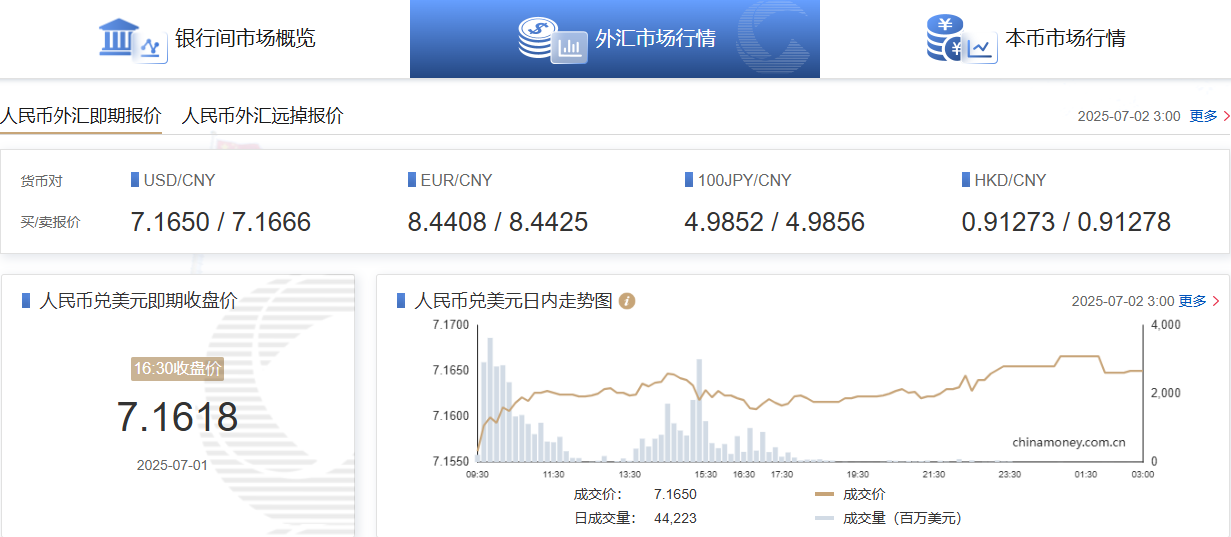
在岸人民币兑美元(CNY)北京时间03:00收报7.1650元,较周一夜盘收盘跌14点。成交量442.23亿美元。
news flash· 2025-07-01 19:17
Group 1 - The onshore Chinese yuan (CNY) closed at 7.1650 against the US dollar, reflecting a decline of 14 points compared to the previous night session [1] - The trading volume for the yuan was reported at 44.223 billion USD [1]
股指日报:股指延续收涨,期指均贴水加深-20250701
Nan Hua Qi Huo· 2025-07-01 11:18
Group 1: Report Overview - Report Date: July 1, 2025 [1] - Authors: Wang Mengying (Z0015429), Liao Chenyue (F03120676) [1] - Investment Advisory Business Qualification: CSRC License [2011] No. 1290 [1] - Report Title: Stock Index Daily Report [1] Group 2: Market Review - Stock Index Performance: The stock index continued to rise, with the CSI 300 index closing up 0.17%. The trading volume of the two markets decreased by 20.842 billion yuan. Among the stock index futures, IF decreased in volume, IH and IC increased in volume, and IM decreased in volume. [2] Group 3: Important News - Tariff Announcement: With only 10 days left until the "tariff deadline" on July 9, Trump clearly stated that there is no need to extend the upcoming tariff deadline. He will directly send letters to hundreds of countries to notify them of the tariff rates and will no longer conduct individual trade negotiations. [3] Group 4: Core View - Market Outlook: The stock index continued to rise today, but the trading volume of the two markets continued to shrink. There is a lack of positive information to drive the index up, and the future strength of the RMB exchange rate remains to be seen. The market sentiment is cautious, and the sustainability of this round of the stock index rise is uncertain. If the trading volume continues to shrink and the upward momentum weakens, a short - term adjustment is expected. [4] Group 5: Strategy Recommendation - Strategy: Hold and wait for further development [5] Group 6: Futures Market Observation | Futures Type | Main Contract Intraday Change (%) | Volume (10,000 lots) | Volume MoM (10,000 lots) | Open Interest (10,000 lots) | Open Interest MoM (10,000 lots) | | --- | --- | --- | --- | --- | --- | | IF | -0.03 | 7.0001 | -0.8991 | 23.8772 | -0.5835 | | IH | 0.08 | 3.2102 | -0.8576 | 8.3173 | -0.2668 | | IC | 0.01 | 6.8686 | -0.2617 | 22.0821 | -0.054 | | IM | -0.36 | 18.1858 | 0.9846 | 32.7974 | 1.0329 | [5] Group 7: Spot Market Observation | Index Name | Value | | --- | --- | | Shanghai Composite Index Change (%) | 0.39 | | Shenzhen Component Index Change (%) | 0.11 | | Ratio of Rising to Falling Stocks | 1.03 | | Trading Volume of the Two Markets (billion yuan) | 146.6015 | | Trading Volume MoM (billion yuan) | -20.842 | [6]
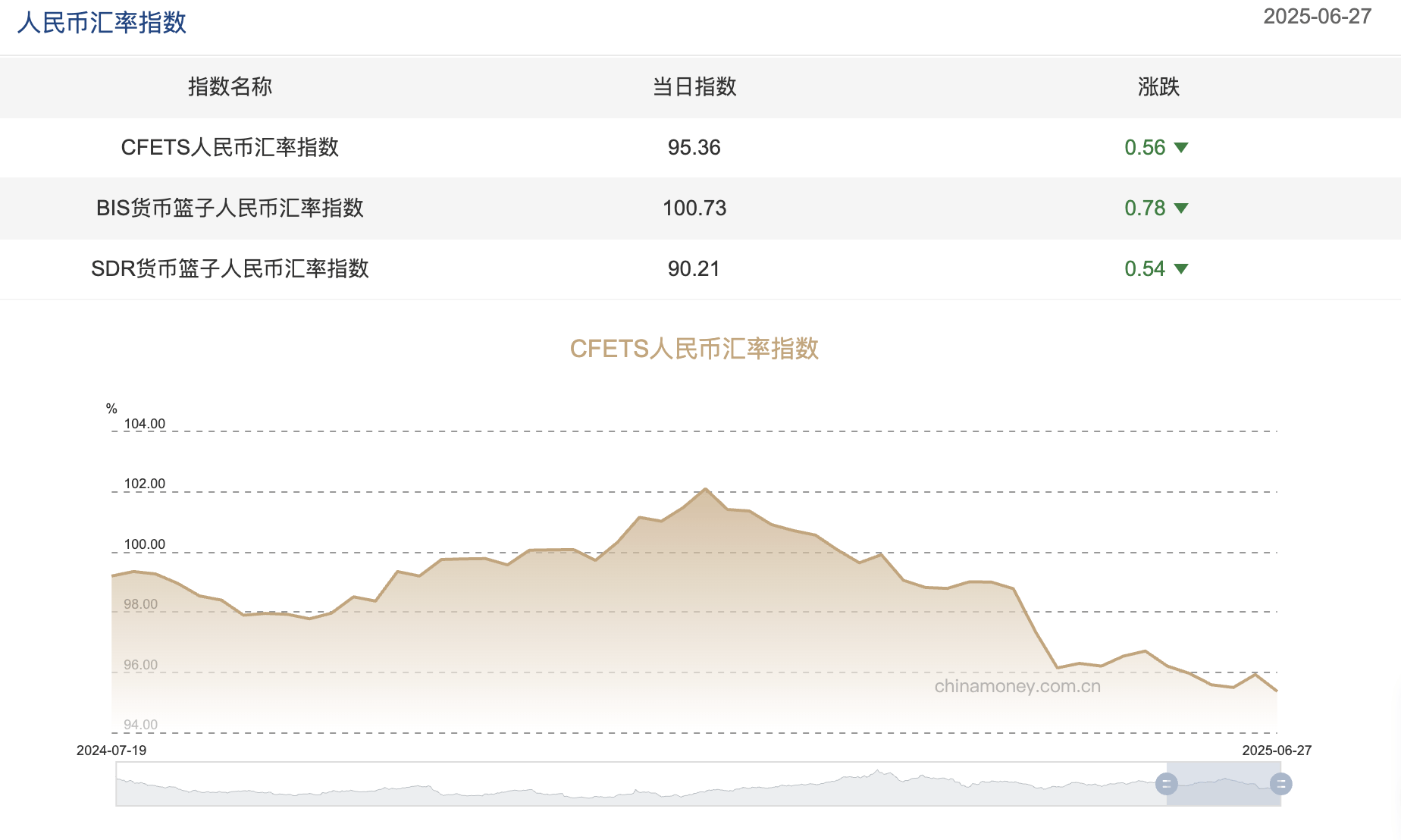
三大人民币汇率指数上周全线下挫,CFETS按周跌0.56
Sou Hu Cai Jing· 2025-06-30 02:56
Core Viewpoint - The recent decline in the three major RMB exchange rate indices indicates a weakening of the Chinese yuan against a basket of currencies, with the CFETS index hitting its lowest level since December 2020 [1][2]. Exchange Rate Indices - The CFETS RMB exchange rate index is reported at 95.36, down 0.56% week-on-week, marking a low not seen since December 2020 [1][2]. - The BIS currency basket RMB exchange rate index stands at 100.73, down 0.78% week-on-week, the lowest since July 2023 [1][2]. - The SDR currency basket RMB exchange rate index is at 90.21, down 0.54% week-on-week, the lowest since August 2020 [1][2]. Market Context - The geopolitical situation and rising expectations for a Federal Reserve rate cut have contributed to a decline in the US dollar, which fell 1.52% last week to 97.26, its lowest in nearly three years [5]. - Non-USD currencies saw gains, with the Swiss franc rising 2.35%, the British pound up 1.97%, and the euro increasing by 1.7% [5]. - The onshore RMB against the USD closed at 7.1711, down 126 basis points for the week, while the offshore RMB closed at 7.1729, down 65 basis points, a decline of 0.09% [5]. Analyst Insights - Analysts suggest that the future trajectory of the RMB is closely tied to the outlook for the US dollar, with a clear direction for gradual appreciation of the RMB in the medium to long term [6]. - Li Liuyang, Chief Analyst at CICC, indicates that the RMB exchange rate will maintain a moderate appreciation in a weak dollar environment, supported by stable exchange rate policies [5][6]. Economic Data - The National Bureau of Statistics reported that from January to May, profits of large-scale industrial enterprises totaled 27,204.3 billion yuan, an increase of 6,034.1 billion yuan compared to the previous four months [7]. - The Ministry of Finance reported that from January to May, total operating revenue of state-owned enterprises was 328,062.5 billion yuan, a year-on-year decrease of 0.1%, while total profits were 16,514.5 billion yuan, down 2.8% year-on-year [8].