人工智能(AI)

Search documents
这些指标不仅事关美国消费者,更关系美国假日经济是否放缓
Di Yi Cai Jing· 2025-11-13 12:59
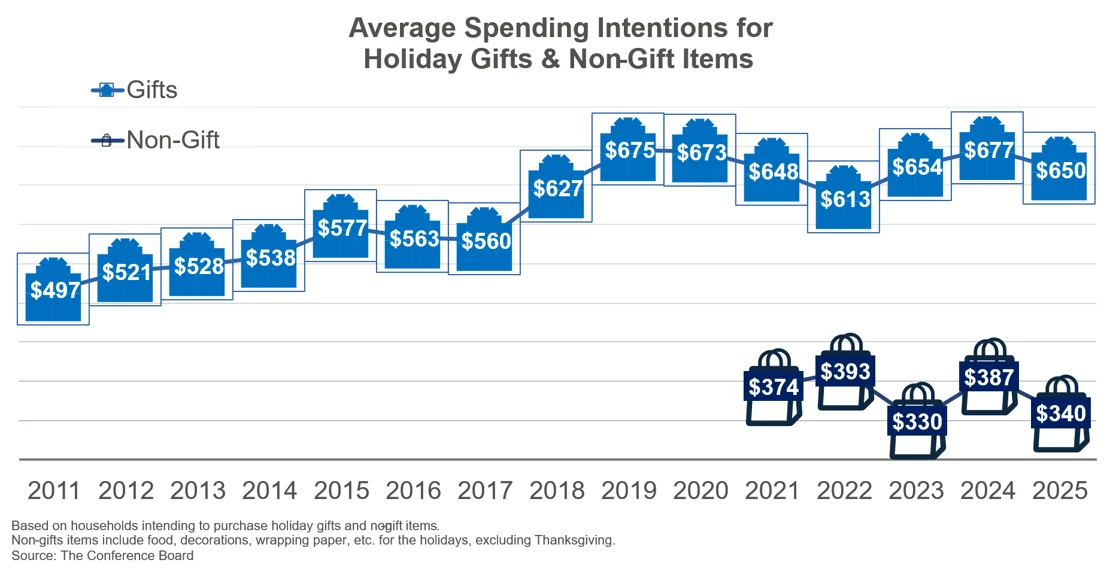
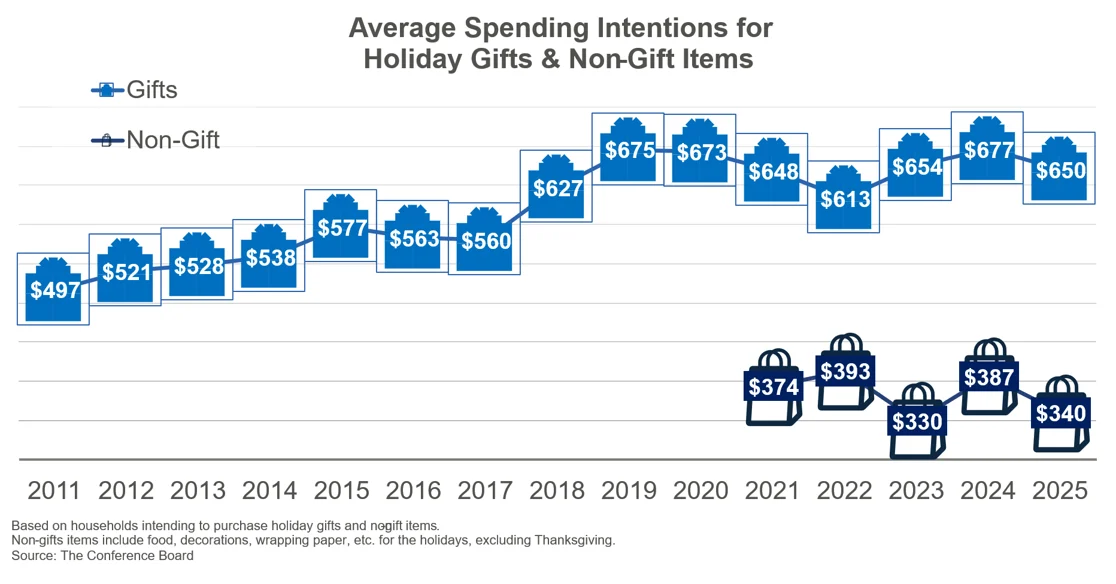
Group 1: Holiday Spending Outlook - The upcoming holiday spending outlook in the U.S. is impacted by inflation, labor market slowdown, and tariff factors, with only consumers aged 65 and above planning to increase spending on gifts and non-gifts compared to last year [1] - The Conference Board survey indicates that younger consumers (under 35) are the primary reason for the decline in gift spending, while consumers aged 35-45 and 55-64 are tightening their budgets in non-gift areas [2][5] - The survey predicts that the average holiday-related spending per consumer in the U.S. will be $990 in 2025, a 6.9% decrease from $1,063 in 2024, and lower than 2022 and 2021 levels [6] Group 2: Consumer Behavior Changes - Consumers are becoming more pragmatic, favoring essential gifts over desired items, with gift spending expected to drop to $650 this year, the lowest since 2022 [6] - The budget for non-gift items, including food and decorations, is expected to decrease by 12% to $340 [6] - There is a notable increase in the intention to purchase toys and games, vacation and travel products, and gift cards in 2025, with toys and games rising to the top of the list [7] Group 3: Employment and Retail Dynamics - Retailers are hiring fewer seasonal employees, with predictions of less than 500,000 temporary hires in the last quarter of 2025, the lowest since 2009 [12] - Major retailers like Walmart and Target are cautious about hiring, reflecting a cautious outlook for the holiday shopping season due to ongoing inflation and economic uncertainty [13] - The Michigan Consumer Sentiment Index has dropped to its lowest level since June 2022, indicating declining consumer confidence [13] Group 4: Economic and Trade Factors - The logistics and trade sectors report that tariffs and inflation are contributing to a decline in domestic demand, with a noted decrease in consumer spending capacity [10] - The retail sector is maintaining low inventory levels due to economic uncertainties and tariff situations, with a "K" shaped recovery trend becoming more apparent [11] - The Oxford Economics survey indicates a one-third probability of the U.S. entering a recession in the next 12 months, with trade policy being a major concern for businesses [15]

这些指标不仅事关美国消费者,更关系美国假日经济是否放缓|全球贸易观察
Di Yi Cai Jing· 2025-11-13 12:38
Group 1: Consumer Spending Trends - Consumers aged 35 and under are the primary reason for the decline in gift spending this year, with older consumers (65+) planning to spend more than last year [1] - The average holiday-related spending per consumer in the U.S. is projected to be $990 in 2025, a decrease of 6.9% from 2024 and close to the 2023 estimate of $985 [4] - Consumers plan to spend an average of $650 on gifts this year, down 3.9% from last year's $677, marking the lowest level since 2022 [4] Group 2: Employment and Retail Dynamics - U.S. employers are expected to hire fewer than 500,000 seasonal workers in the last quarter of 2025, the lowest level since 2009 [7] - Retailers are cautious about the upcoming holiday shopping season, with a significant reduction in seasonal hiring compared to previous years [8] - The Michigan Consumer Sentiment Index has dropped to its lowest level since June 2022, reflecting consumer uncertainty [8] Group 3: Economic Influences - Inflation and a slowing labor market are impacting holiday spending, with a notable decrease in hiring for retail and hospitality sectors [1][4] - The retail sector is experiencing a "K" shaped economic recovery, indicating divergent trends in consumer spending and business performance [6] - Trade policies and tariffs are significant concerns for businesses, with many citing them as major risks to economic stability [10]
WTO:与AI相关商品贸易措施“限制数量”逐年增加
Di Yi Cai Jing· 2025-11-13 11:51
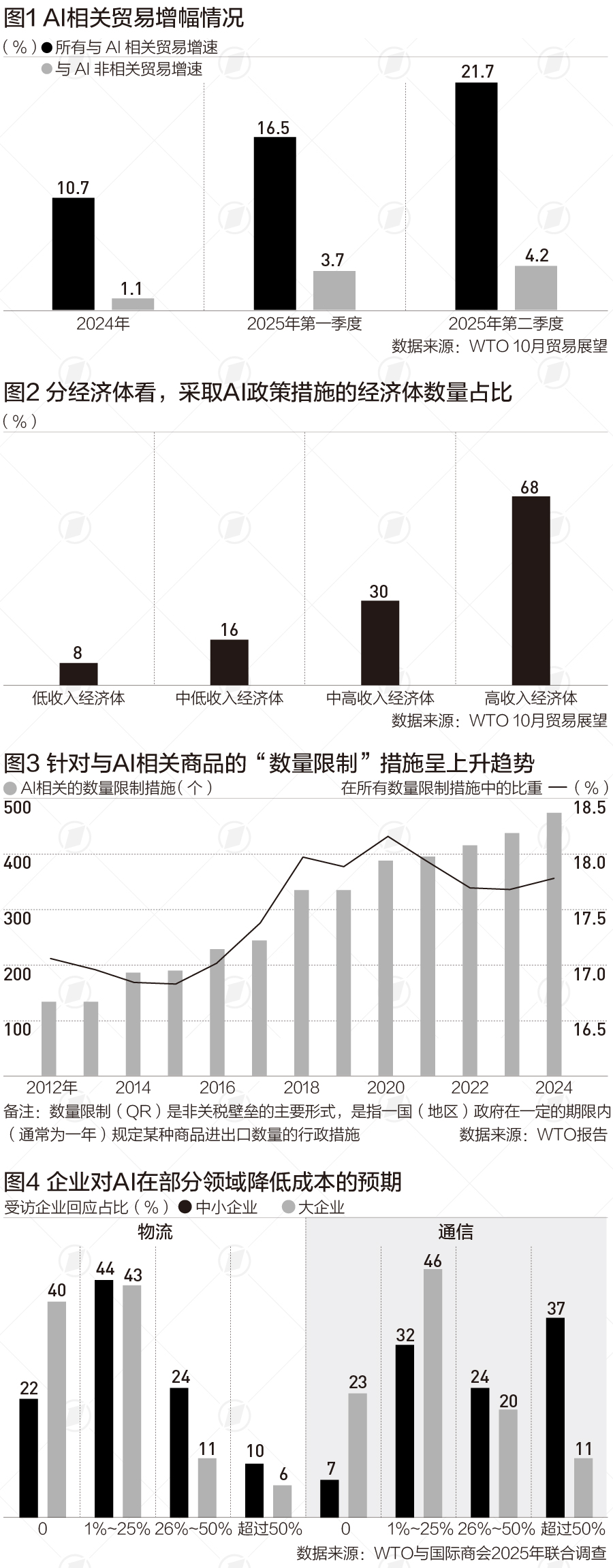
Core Insights - The rapid development of artificial intelligence (AI) is expected to significantly reshape global trade, with projections indicating that AI could drive global service trade growth by nearly 40% and global GDP growth by 12% to 13% by 2040 [1][12]. Group 1: AI and Trade Growth - AI-related goods trade reached $2.9 trillion in 2022 but slightly decreased to $2.3 trillion in 2023, with a notable increase in imports driven by intermediate goods such as computer components [2]. - The trade growth of AI-related goods was robust in the first half of 2025, with a year-on-year increase of 20%, despite AI goods accounting for less than 10% of total global goods trade [2][3]. - The majority of AI-related trade growth is concentrated in Asia, which accounted for nearly two-thirds of the total growth in AI-related trade in the first half of 2025 [3]. Group 2: Cost Reduction and Efficiency - AI is recognized as a crucial catalyst for trade-driven growth, optimizing supply chains, automating customs clearance, and reducing language barriers, thereby lowering trade costs [11]. - A joint survey by WTO and ICC revealed that 70% of businesses expect AI to reduce trade costs, with small and medium-sized enterprises (SMEs) being more optimistic than larger firms [11]. - In logistics, compliance, and communication, a significant percentage of SMEs anticipate substantial cost reductions due to AI, with 44% expecting at least a 25% reduction in logistics costs [11]. Group 3: Trade Policy and Digital Divide - The report highlights an increase in non-tariff measures, particularly quantity restrictions on AI-related goods, which are projected to reach nearly 500 by 2024 [15]. - There is a notable digital divide, with low-income economies lagging in internet access and AI application, as over 26 billion people globally remain unconnected, primarily in developing regions [15][16]. - To bridge the digital divide, international cooperation is deemed essential, with WTO planning to expand the scope of the Information Technology Agreement and promote data rule coordination [16].
微软CEO纳德拉:软件计费模式将从“按用户”转向“按AI智能体”
Sou Hu Cai Jing· 2025-11-13 11:14
Core Insights - Microsoft is rethinking its software pricing model, focusing on "AI agents" instead of traditional user-based billing [3] - The company is shifting its strategic focus from developing software for human employees to providing support for "AI coworkers" [3][4] - The transition reflects a broader industry change where AI systems are becoming active users of software, prompting companies to redesign their pricing logic [3] Group 1 - Microsoft CEO Satya Nadella announced the consideration of a shift from "per user" to "per agent" billing, charging based on the number of AI systems capable of autonomous tasks [3] - The existing services like Microsoft 365 will evolve to become the core workspace for AI agents [3][4] - Nadella emphasized that the new infrastructure business will grow faster than user numbers, indicating a significant shift in business dynamics [4] Group 2 - Earlier this year, Microsoft introduced a "pay-as-you-go" pricing model for its AI agents, allowing businesses to pay flexibly based on the actual work completed by their AI systems [4] - This new billing mechanism complements the free Copilot chat experience available to Microsoft 365 users, enhancing the overall value proposition [4]


新思科技计划裁员约2000人
Zheng Quan Shi Bao Wang· 2025-11-13 10:59
Core Insights - Synopsys plans to lay off approximately 10% of its workforce, affecting around 2,000 employees, to reallocate investments towards growth opportunities, particularly in AI chip design and system simulation software [1] - The layoffs are part of a strategic adjustment following the completion of Synopsys' $35 billion acquisition of Ansys, aimed at enhancing resource allocation and cost structure to meet the demands of the AI era [1] - The company anticipates pre-tax costs of $300 million to $350 million related to severance and other one-time benefits, with most layoffs expected to occur in fiscal year 2026 and the restructuring plan to be largely completed by the end of fiscal year 2027 [1] Financial Performance - For the third fiscal quarter ending July 31, Synopsys reported a 14% year-over-year revenue increase to $1.74 billion, with adjusted earnings per share of $3.39, slightly down from $3.43 in the previous year [2] - The design automation business saw a 23% year-over-year revenue growth to $1.31 billion, exceeding market expectations, while the design IP business experienced a 7.7% decline to $427.6 million, falling short of market forecasts [2] - The adjusted operating profit for the quarter was $669.8 million, with the CEO attributing the underperformance in the IP business to new U.S. export restrictions affecting Chinese chip design projects and challenges faced by major foundry clients [2] Market Context - Synopsys, along with Cadence and Siemens EDA, constitutes the "big three" in the EDA market, collectively holding over 70% market share [3] - In May, the U.S. Department of Commerce imposed export restrictions on the EDA giants, requiring licenses for sales to mainland China, but these restrictions were lifted by July, allowing full access for Chinese customers to their software and technology [3]

从自动生成笔记,到视障者的 “眼睛”,百度用 AI 内化重构人与科技的关系
Xi Niu Cai Jing· 2025-11-13 09:27
Core Insights - The article emphasizes the pervasive integration of AI into daily life by 2025, highlighting its applications across various sectors such as education, entertainment, research, and business operations [2][3][4] Market Growth and Application - The global AI agent market is projected to exceed $50 billion by 2025, with a compound annual growth rate (CAGR) of over 40%, potentially reaching $300-500 billion by 2030 [3] - AI applications are expanding in manufacturing, finance, and consumer services, with examples like self-diagnosing equipment in factories and AI credit systems in banks improving efficiency [3][4] Learning and Education - AI tools like Baidu's AI note-taking feature significantly enhance learning efficiency, as demonstrated by users who have successfully utilized these tools for exam preparation and skill acquisition [5][6] - AI is transforming educational experiences by providing personalized learning plans and real-time assistance, making it akin to having a dedicated tutor available 24/7 [6][10] Business Efficiency - AI is being adopted in business operations to reduce costs and improve efficiency, exemplified by the use of AI agents in educational institutions to handle customer inquiries and generate tailored responses [7][8] - The implementation of AI in various sectors is leading to substantial business growth and improved customer service, even in high-demand situations [8][10] Emotional and Social Impact - AI is evolving from a mere tool to a companion, fulfilling emotional and social needs, as evidenced by the rise of AI companions and assistants that provide comfort and support [11][12] - The emotional value of AI applications is becoming increasingly recognized, with users finding solace and companionship through AI interactions [12][15] Internalization of AI Capabilities - The concept of "internalizing AI capabilities" is gaining traction, suggesting that AI should be integrated into personal workflows and cognitive processes, transforming it from a cost into a productivity enhancer [16][18] - This shift towards a collaborative human-AI relationship is expected to democratize access to AI technologies, enabling broader participation in the technological revolution [18]


资金回归中国制造业股
日经中文网· 2025-11-13 02:46
Group 1 - The core viewpoint of the article indicates that the Chinese manufacturing sector is experiencing a recovery, with manufacturing profits increasing by 22% year-on-year in September, marking the highest growth rate since November 2023 [2][8] - The Shanghai Composite Index has risen approximately 20% compared to the end of 2024, with semiconductor company Cambricon Technologies seeing its stock price more than double this year, driven by advancements in AI and technology-related stocks [4] - The trend of rising manufacturing stock prices is expanding, with about 90% of the top 100 stocks projected to increase by mid-2025 being from the manufacturing sector [4] Group 2 - The background of this trend is the Chinese leadership's push to correct excessive competition, referred to as "involution," with policies introduced to limit unproductive price-based competition [5] - The expectation of profit recovery due to the elimination of excess capacity is evident, as seen in the stock price surges of companies like Sungrow Power Supply, which increased nearly threefold in the second half of the year [7] - Overall, the industrial stock price index on the Shanghai Stock Exchange rose over 20% in the second half of the year, surpassing the 16% increase of the Shanghai Composite Index, indicating a shift in market focus from shareholder returns to manufacturing performance recovery [7] Group 3 - Macroeconomic statistics show that fixed asset investment decreased by 7% year-on-year in August and September, indicating a significant reduction in manufacturing investment activities [8] - The Chinese government is focusing on boosting consumption as part of its economic strategy for 2026-2030, with the effectiveness of the "anti-involution" policy being crucial for stimulating domestic demand [10] - The sustainability of stock price increases remains uncertain, as the balance between eliminating inefficient production and stimulating consumption is delicate [10]
低空经济投资机会解析(第一部分:概述
Sou Hu Cai Jing· 2025-11-13 02:40
Core Insights - The low-altitude economy is entering a rapid development phase driven by policy, technology, and market demand, presenting comprehensive investment opportunities across the entire industry chain in the A-share market [3] Group 1: Definition and Core Drivers - Low-altitude economy refers to the economic activities utilizing airspace below 1,000 meters, employing drones and light aircraft to serve various industries, forming a comprehensive ecosystem that integrates advanced manufacturing, information technology, and modern services [3] - Strong policy support is evident as low-altitude airspace management reforms act as a "master switch" for industry development, creating a favorable growth environment [3] - Technological advancements have transitioned drone technology from manual operation to highly intelligent, autonomous flight, with the integration of 5G, AI, and IoT addressing core bottlenecks for large-scale commercial applications [3] - There is a significant market demand explosion in sectors such as agricultural protection, logistics, emergency rescue, and power inspection, showcasing the cost-reducing and efficiency-enhancing advantages of low-altitude solutions [3] Group 2: Industry Chain Analysis and A-share Investment Opportunities - Upstream opportunities include materials and components such as traditional and new aviation materials, flight control systems, navigation modules, communication modules, batteries, and sensors [3] - Midstream focuses on research and manufacturing of complete aircraft designs, including drones and eVTOLs, with key players being manufacturers of industrial and consumer-grade drones, system integrators, and maintenance service providers [3] - Downstream involves operations and services that provide various application services and data solutions based on aircraft, which are crucial for value realization [3] Group 3: Downstream Application Scenarios - High-value scenarios validated include drone logistics, industrial inspections, precision agriculture, and public safety and emergency services, indicating a vast market potential [3] Group 4: Investment Opportunities and Core Focus Areas - Hardware development should prioritize "core" technologies and complete aircraft manufacturing, focusing on companies with strong R&D investment, patent portfolios, product performance, and cost control capabilities [3] - Operational excellence is key, with a focus on companies that can deeply integrate into specific industries and provide comprehensive solutions, emphasizing business model maturity, order acquisition capabilities, and data processing abilities [3] - Infrastructure and support service opportunities are critical, with companies providing low-altitude flight management platforms, communication network support, and takeoff/landing site construction showing stronger stability and certainty [3] Group 5: Investment Strategy - Short-term focus should be on the implementation of low-altitude airspace reform pilot policies and major orders from listed companies in logistics and inspection sectors [3] - Mid-term attention should be on technological breakthroughs and the expansion of downstream application scenarios, favoring companies with precise positioning in core segments and first-mover advantages [3] - Long-term investments should target companies capable of building or integrating into a healthy industry ecosystem, with strong integration and management capabilities [3]

黄金:降息预期回升白银:再创新高铜:市场情绪修复价格上涨
Guo Tai Jun An Qi Huo· 2025-11-13 01:50
1. Report Industry Investment Ratings No industry investment ratings were provided in the report. 2. Core Views of the Report - Gold: Expectations of interest rate cuts are rising [2]. - Silver: Reached a new high [2]. - Copper: Market sentiment has recovered, leading to price increases [2]. - Zinc: Experiencing minor fluctuations [2]. - Lead: Reduced overseas inventories are supporting prices [2]. - Tin: The price has exceeded 300,000 yuan [2]. - Aluminum: Showing a slightly bullish and volatile trend [2]. - Alumina: Trading within a range [2]. - Cast Aluminum Alloy: Following the trend of electrolytic aluminum [2]. - Nickel: High inventories are accumulating, conflicting with risks in Indonesia, resulting in low - level fluctuations [2]. - Stainless Steel: Lacking upward momentum, but also with limited downside potential [2]. 3. Summaries by Related Catalogs 3.1 Gold and Silver - **Price Movements**: - Gold:沪金2512昨日收盘价945.76,日跌幅 - 0.33%,夜盘收盘价963.32,夜盘涨幅1.78%;Comex黄金2512昨日收盘价4201.40,日涨幅1.65% [4]. - Silver:沪银2512昨日收盘价12073,日涨幅1.65%,夜盘收盘价12508.00,夜盘涨幅4.81%;Comex白银2512昨日收盘价53.230,日涨幅4.22% [4]. - **Trading Volume and Open Interest**: - Gold:沪金25122510昨日成交260,377,较前日减少21,972;持仓124,540,较前日减少6,505;Comex黄金2512成交278,020,较前日增加38,441;持仓278,065,较前日减少13,785 [4]. - Silver:沪银2512昨日成交101,561,较前日增加31,704;持仓88,600,较前日减少5,753;Comex白银2512成交155,458,较前日增加57,975;持仓122,583,较前日无变化 [4]. - **Inventory Changes**: - Gold: Comex黄金(金衡盎司,前日)库存37,575,140,较前日减少154,316 [4]. - Silver: Comex白银(金衡盎司,前日)库存478,558,059,较前日减少546,636 [4]. - **Trend Intensity**: Gold and silver both have a trend intensity of 1 [6]. 3.2 Copper - **Price Movements**:沪铜主力合约昨日收盘价86,840,日涨幅0.24%,夜盘收盘价87430,夜盘涨幅0.68%;伦铜3M电子盘昨日收盘价10,897,日涨幅0.53% [8]. - **Trading Volume and Open Interest**:沪铜指数昨日成交159,202,较前日增加2,758;持仓552,936,较前日减少173;伦铜3M电子盘成交19,884,较前日增加6,498;持仓319,000,较前日减少5,408 [8]. - **Inventory and Spread**: - Inventory:沪铜期货库存44,088,较前日增加1,124;伦铜库存136,250,较前日无变化 [8]. - Spread: LME铜升贴水较前日变动 - 6.43;上海铜现货对LMEcash价差较前日增加72 [8]. - **Trend Intensity**: Copper has a trend intensity of 1 [10]. 3.3 Zinc - **Price Movements**:沪锌主力收盘价22680,涨幅0.02%;伦锌3M电子盘收盘价3069,跌幅 - 0.53% [11]. - **Trading Volume and Open Interest**:沪锌主力成交量71426,较前日减少10276;持仓量105905,较前日减少1570;伦锌成交量9073,较前日减少844;持仓量220862,较前日增加946 [11]. - **Inventory and Spread**: - Inventory:沪锌期货库存70890,较前日增加372;LME锌库存35875,较前日增加575 [11]. - Spread: ZN00 - ZN01较前日变动15 [11]. - **Trend Intensity**: Zinc has a trend intensity of 0 [13]. 3.4 Lead - **Price Movements**:沪铅主力收盘价17660,涨幅1.26%;伦铅3M电子盘收盘价2067,涨幅0.51% [14]. - **Trading Volume and Open Interest**:沪铅主力成交量55843,较前日增加24988;持仓量50539,较前日减少4568;伦铅成交量8189,较前日减少1092;持仓量155924,较前日增加2283 [14]. - **Inventory and Spread**: - Inventory:沪铅期货库存24686,较前日增加917;LME铅库存225225,较前日减少1500 [14]. - Spread: PB00 - PB01较前日变动 - 15 [14]. - **Trend Intensity**: Lead has a trend intensity of 0 [15]. 3.5 Tin - **Price Movements**:沪锡主力合约昨日收盘价292,440,日涨幅1.48%;伦锡3M电子盘昨日收盘价37,405,日涨幅1.93% [17]. - **Trading Volume and Open Interest**:沪锡主力合约昨日成交124,419,较前日增加74,980;持仓40,779,较前日增加4,387;伦锡3M电子盘成交180,较前日减少9;持仓13,988,较前日增加53 [17]. - **Inventory and Spread**: - Inventory:沪锡期货库存5,446,较前日减少136;伦锡库存3,055,较前日增加40 [17]. - Spread: SMM 1锡锭价格较前日增加1,500;长江有色1锡平均价较前日增加4,300 [17]. - **Trend Intensity**: Tin has a trend intensity of 1 [20]. 3.6 Aluminum, Alumina, and Cast Aluminum Alloy - **Price Movements**: - Aluminum:沪铝主力合约收盘价21880;LME铝3M收盘价2880 [21]. - Alumina:沪氧化铝主力合约收盘价2821 [21]. - Cast Aluminum Alloy:铝合金主力合约收盘价21245 [21]. - **Trading Volume and Open Interest**: - Aluminum:沪铝主力合约成交量223798;持仓量420066 [21]. - Alumina:沪氧化铝主力合约成交量267963;持仓量412758 [21]. - Cast Aluminum Alloy:铝合金主力合约成交量6280;持仓量15573 [21]. - **Inventory and Spread**: - Aluminum: LME注销仓单占比6.19%;LME铝cash - 3M价差 - 23.69 [21]. - Alumina: No significant spread data mentioned [21]. - Cast Aluminum Alloy:近月合约对连一合约价差 - 235.00 [21]. - **Trend Intensity**: Aluminum and cast aluminum alloy have a trend intensity of 1, while alumina has a trend intensity of 0 [23]. 3.7 Nickel and Stainless Steel - **Price Movements**: - Nickel:沪镍主力收盘价118,710;1进口镍119,000 [24]. - Stainless Steel:不锈钢主力收盘价12,425 [24]. - **Trading Volume and Open Interest**: - Nickel:沪镍主力成交量98,248 [24]. - Stainless Steel:不锈钢主力成交量139,703 [24]. - **Industry - related Data**: - Nickel: 8 - 12%高镍生铁(出厂价)909;镍板进口利润 - 1,577 [24]. - Stainless Steel: 304/2B卷 - 毛边(无锡)宏旺/北部湾12,825 [24]. - **Trend Intensity**: Both nickel and stainless steel have a trend intensity of 0 [28].
2026-2032年全球及中国自动多功能料理机市场监测调查及投资战略评估预测报告
Sou Hu Cai Jing· 2025-11-13 01:43
Group 1 - The global multifunctional cooking machine market is projected to reach USD 3.88 billion by 2031, with a compound annual growth rate (CAGR) of 7.5% from 2024 to 2031, indicating a steady growth trend [7][9] - Key drivers for market growth include the adaptation of consumer demand to fast-paced lifestyles, an increase in home cooking frequency by 32% since 2019, and the integration of IoT and AI technologies into cooking machines [9][10] - The market has expanded from high-end products to a diverse range of price points, with domestic brands reducing entry-level product prices to below 1,000 yuan, making them more affordable for a wider audience [9][10] Group 2 - Major obstacles to market development include the perceived gap in cooking quality compared to manual methods, high prices of mid-to-high-end products, product homogeneity leading to competitive pricing wars, and a steep learning curve for users [10][11] - The global market is moderately concentrated, with the top ten manufacturers holding approximately 35% of the market share in 2024, featuring both international brands like Thermomix and domestic brands like Joyoung [11]