投资于人

Search documents
宏观专题报告:设备投资,能否“持续高增”?
Shenwan Hongyuan Securities· 2026-01-06 03:41
Group 1: Misconceptions about Equipment Investment Growth - Equipment investment growth is not primarily driven by the "Juga Cycle" but rather by strong infrastructure and service sector investments, with construction industry growth at 65.5% and narrow infrastructure at 46.1% in 2024, contributing an additional 8.2 percentage points to overall equipment investment[2] - The notion that equipment investment strength is influenced by the "Two New" policies is misleading; significant increases in manufacturing investment and equipment purchases occurred as early as February 2024, with equipment purchase investment growth reaching 17%[2] - Manufacturing equipment purchase investment growth was only 6.5% in 2024, significantly lower than the overall equipment investment growth of 15.7%[3] Group 2: Drivers of Equipment Investment Growth - The establishment of a modern industrial system has driven strong digital infrastructure investments, with software industry growth at 53% and computer services at 35%, contributing to overall equipment investment[4] - Public utility equipment investment has surged since the "dual carbon" policy was intensified in 2021, with electricity and heat equipment investment growth at 17.6%[4] - Service sector equipment investment has outpaced construction investment since 2023, with growth rates of 13.9% compared to 2.8% for construction investment in 2024[5] Group 3: Sustainability of Equipment Investment Growth - Equipment investment is expected to continue high growth in 2026, supported by a rebound in narrow infrastructure, particularly in digital infrastructure and hub-related investments[6] - The "dual carbon" policy is anticipated to further enhance investment in carbon reduction technologies, including high-energy-consuming industry upgrades and renewable energy investments[6] - Policies focused on "investing in people" are likely to increase service sector equipment investment, with a projected growth rate of around 6% in 2026, surpassing the overall fixed asset investment growth of 3%[7]
中国12月RatingDog服务业PMI降至52
Sou Hu Cai Jing· 2026-01-05 03:00
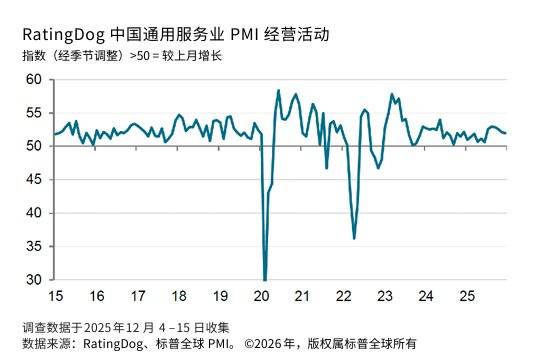
Group 1 - The core viewpoint indicates a slight decline in China's service sector activity in December, with the RatingDog service index dropping to 52.0 from 52.1, marking four consecutive months of marginal slowdown in expansion [1] - The demand side of the service sector shows a mixed performance, with resilient domestic demand contrasted by weak external demand. The new orders index continues its growth trend since early 2023, but overall growth has narrowed due to a contraction in export business [1] - Employment in the service sector has contracted for the fifth consecutive month, with the most significant decline since September, primarily due to cost control and restructuring efforts by companies [1] Group 2 - Input prices have risen for ten consecutive months, driven by increases in raw material and labor costs, while sales prices have entered a contraction phase again after a brief recovery in November, forcing companies to resort to discount promotions to maintain sales [1] - Business confidence has significantly improved, with the business activity expectations index reaching its highest point in nine months. This optimism is largely attributed to the central government's focus on "investing in people," leading companies to formulate more aggressive business expansion plans for 2026 [1] - Overall, the service sector is characterized by "low growth, high expectations" by the end of 2025, with improved operating expectations providing confidence for the start of 2026, although external demand fluctuations and cost pressures remain key constraints [2]

“投资于人”对年轻人意味着什么
Sou Hu Cai Jing· 2026-01-04 23:09
Core Concept - The article emphasizes the strategic shift in China's development philosophy from focusing solely on material investment to a combined approach of investing in both material and human resources, particularly targeting youth as the core beneficiaries of this strategy [3][5][7]. Group 1: Investment in Human Capital - The transition to "investing in people" signifies a move towards enhancing the quality and sustainability of development, recognizing human resources as the primary asset through education and skill enhancement [5][6]. - The emphasis on integrating material and human capital aims to foster a synergistic effect that promotes technological innovation and industrial upgrading, essential for achieving high-quality development [5][6]. - The current global competition is increasingly centered around talent, necessitating a shift from traditional growth models to those that prioritize human capital investment to overcome technological bottlenecks [5][6]. Group 2: Policy Implications and Youth Engagement - The article discusses the need for a systematic upgrade in governance values and policy logic, focusing on who development serves, shifting from mere economic growth to enhancing individual well-being and public value [7][11]. - It advocates for establishing mechanisms that allow youth to actively participate in policy-making, ensuring their voices are heard in discussions about education, employment, and health [11][12]. - The evaluation of policies should incorporate youth satisfaction and sense of gain as core indicators, creating a feedback loop that informs policy adjustments based on their experiences [12][15]. Group 3: Future Outlook and Societal Impact - The envisioned outcome of successful human capital investment is a generation of youth characterized by interdisciplinary knowledge, innovation capabilities, and a strong sense of social responsibility [17][18]. - This new generation is expected to drive China's economic transformation towards high-end, intelligent, and sustainable development, enhancing the country's position in the global value chain [18][19]. - The article posits that fostering a culture of innovation among youth will not only reshape national identity but also elevate China's role in global governance and collaborative efforts to address worldwide challenges [18][20].

守正创新出特色 以“大思政课”拓展全面育人新格局
Si Chuan Ri Bao· 2026-01-04 22:36
Group 1 - The core argument emphasizes the importance of integrating ideological and political education (IPE) with the Party's innovative theories to enhance the quality of education and address fundamental questions about the purpose and methods of education [1][11][12] - The concept of "subjectivity" in IPE is explored through three dimensions: value subjectivity, theoretical subjectivity, and practical subjectivity, each contributing to a more active and generative educational framework [2][3] - The current landscape presents both opportunities and challenges for IPE, necessitating reforms that align educational practices with the evolving societal context and technological advancements [3][4] Group 2 - The establishment of a collaborative educational ecosystem involving schools, families, society, and government is crucial for effective IPE, requiring a comprehensive approach to resource integration and collective effort [4][5] - The role of teachers as central figures in IPE is highlighted, with a focus on enhancing their political literacy and teaching skills to effectively convey ideological values [5][19] - The need for innovative teaching methods that engage students and foster meaningful dialogue is emphasized, moving away from traditional authoritative teaching styles [5][10] Group 3 - The synchronization of IPE with the Party's innovative theories is framed as a strategic necessity for cultivating a new generation capable of addressing contemporary challenges and contributing to national rejuvenation [12][13][14] - Practical approaches to implementing this synchronization include addressing discrepancies between rapidly evolving theories and stable educational materials, as well as ensuring effective communication of complex ideas to students [14][15] - The importance of continuous theoretical research and practical application in IPE is underscored, with a call for integrating innovative teaching practices and leveraging technology to enhance educational outcomes [16][17][18]
人形机器人跳秧歌、“苏超”万人喊加油,2025经济活力藏在哪?
Sou Hu Cai Jing· 2026-01-02 20:51
Group 1 - The core idea of the article emphasizes that China's economy is steadily advancing towards a "new and better" direction, driven by significant policy changes and technological advancements [2][19] - The "14th Five-Year Plan" is highlighted as a key policy document that focuses on investing in human capital, indicating a shift from merely accumulating resources to nurturing talent [4][19] - The military-to-civilian technology transfer is becoming increasingly evident, with advancements in defense technology spilling over into civilian applications, enhancing productivity and efficiency in various sectors [7][9] Group 2 - The rise of "new quality productivity" is discussed, showcasing how new technologies and models are being integrated into production processes, particularly through initiatives like "AI+" [9][11] - Emerging industries such as quantum technology, biomanufacturing, and hydrogen energy are gaining traction, with significant investment interest, reflecting a shift towards future-oriented sectors [11][19] - The "silver economy" is gaining momentum, driven by the increasing demand for smart products tailored for the elderly, indicating a growing market for age-friendly technologies [15][19] Group 3 - Cultural consumption is on the rise, with local sports leagues and creative products gaining popularity, showcasing a newfound confidence in Chinese culture and consumer preferences [17][19] - The article notes that the economic landscape is being shaped by a combination of policy support, technological innovation, and active consumer participation, creating a robust environment for growth [21] - The overall sentiment is optimistic, suggesting that as long as the current momentum continues, China's economic narrative will become increasingly vibrant and compelling [21]


聚焦国家账本:以投资之力托举民生福祉
Xin Lang Cai Jing· 2026-01-02 19:32
文 杜丽娟 2025年,财政政策以"投资于人"为导向,将更多资金精准投向民生领域,在"幼有所育、学有所教、劳 有所得、病有所医、老有所养"等关键领域取得显著成效,为高质量发展注入持久动力。 这一政策导向并非空泛的口号,而是转化为一系列聚焦关键群体、看得见摸得着的具体举措。从生育托 育到社会保障,"一老一小"作为政策精准发力的重点群体,是2025年财政"投资于人"的生动实践。 在养老服务方面,北京丰台区获得中央专项彩票公益金711万元,资金主要用于计划建设家庭养老床位 不少于780张和提供居家养老上门服务不少于1500人次。在托育方面,四川省通过公办幼儿园资源改扩 建托班,新增托位9000个,同时推出普惠托育补助政策,对备案机构按每人每月200元给予补贴,直接 减轻家庭育儿负担。此外,中央财政还对3周岁以下婴幼儿每年发放3600元育儿补贴,自2025年秋季学 期起免除公办幼儿园学前一年保育教育费,政策惠及1200万大班儿童。 这些实践正是"投资于人"理念在基层的具象化落地,既精准回应了群众在养老、托育等领域的急难愁 盼,更通过全生命周期民生保障筑牢人力资本根基,也为后续的政策讨论奠定了坚实的现实基础。 2025 ...
“三驾马车”向新向优开局马年
Sou Hu Cai Jing· 2026-01-02 04:22
Economic Overview - The global economy is at a critical juncture, facing multiple challenges such as tariff disputes and geopolitical tensions, yet China's economy shows resilience and vitality amid these challenges [1] - The International Monetary Fund (IMF) has raised China's economic growth forecast for 2026 by 0.3 percentage points to 4.5%, indicating China's role as a key engine for global growth [1] Export Performance - China's exports of ice and snow sports equipment have seen significant growth, with a 37.5% increase in ski goggles exports in the first ten months of 2025 [2] - In the first eleven months of 2025, China's total goods trade reached 41.21 trillion yuan, a 3.6% year-on-year increase, with exports amounting to 24.46 trillion yuan, up 6.2% [2] - Emerging markets have become crucial for stabilizing foreign trade, with exports to ASEAN and the EU increasing significantly, offsetting declines in exports to the US [2][3] Export Structure and Quality - The export structure is shifting towards higher quality and value-added products, with electromechanical products accounting for over 60% of total exports, growing by 8.8% year-on-year [3] - Private enterprises are increasingly active in foreign trade, with their imports and exports reaching 23.52 trillion yuan, a 7.1% increase, making up 57.1% of total foreign trade [3] Import Trends - China's imports showed a slight increase of 0.2% year-on-year, totaling 16.75 trillion yuan in the first eleven months of 2025, indicating a weaker performance compared to exports [6] - The central economic work conference emphasized the need to strengthen domestic demand and build a robust domestic market as a strategic priority for 2026 [6] Consumption and Domestic Demand - The central economic work conference plans to enhance consumer spending, with a potential increase in fiscal spending for consumption from 300 billion yuan to 500 billion yuan in 2026 [7] - There is a focus on improving the supply of services and products to meet the growing demand in sectors like tourism, education, and healthcare [9] Investment Outlook - Fixed asset investment in China decreased by 2.6% year-on-year in the first eleven months of 2025, with manufacturing investment showing growth while infrastructure investment slowed [11] - The central economic work conference aims to stabilize investment growth, emphasizing the need for structural improvements and effective investment strategies [12][13] - Key areas for investment include urban renewal, strategic infrastructure, and major engineering projects to support economic growth [13] Conclusion - The coordinated efforts in exports, consumption, and investment are expected to drive China's economy forward, establishing a solid foundation for the "14th Five-Year Plan" and contributing to global economic stability [14]
“投资于人”方能改善微观体感
Sou Hu Cai Jing· 2026-01-01 15:05
经观评论 张林 | 文2025年12月27日至28日召开的全国财政工作会议,明确了2026年财政工作的重点任务。其中首要任务是大力提振消费,并在"人的全面发展"领域扩 大有效投资。此前中共中央关于"十五五"规划的建议也提出,扩大内需要坚持"投资于物"和"投资于人"紧密结合。 各领域投资增速的普遍下行,说明基础设施、制造业、房地产等传统领域已进入存量时代,进一步追加投资的空间明显收窄。与此同时,通过"投资于物"所 形成的供应能力,不仅能覆盖国内需求,也足以应对全球市场的商品需求。在中美贸易摩擦持续的背景下,2025年前11个月我国贸易顺差仍创下1万亿美元 的历史新高。"投资于物"是我国形成强大生产能力的重要原因,但是,实现这一成就并非没有代价。 第一个代价是"低价困境":由于供给能力相对过剩,大量中低端产品价格偏低。企业为追求利润规模,往往选择扩大生产、以价换量,这又进一步压制了产 品价格。自2022年10月以来,我国PPI(工业品出厂价格指数)同比持续为负,这种循环可能制约了中低收入群体的收入增长——数据显示,PPI的变动与居 民工资性收入增速之间存在较强的相关性。 从国际比较来看,韩国、欧盟、日本制造业的人 ...

2026年资本市场有哪些机会?专家解读来了
Zhong Guo Zheng Quan Bao· 2026-01-01 14:34
Group 1 - The central economic work conference emphasizes the integration of investment in goods and investment in people, highlighting opportunities in industries such as artificial intelligence, financial technology, and elder care services due to existing supply gaps [3] - The focus on new production capacities and boosting domestic demand in the 2026 industrial policy suggests that sectors related to artificial intelligence and low-altitude economy, as well as domestic consumption, are worth monitoring [3] - The active capital market is crucial for supporting the development of emerging industries, which in turn promotes employment and enhances the effectiveness of "investment in people" [4] Group 2 - The conference signals a strong emphasis on domestic demand as a primary driver, indicating that expanding domestic demand is both a short-term challenge and a long-term strategic choice [6] - The two main directions for the 2026 economic policy are ensuring "quantitative expansion" through domestic demand and "qualitative improvement" via innovation [6] - The macroeconomic policy for 2026 is expected to be more proactive, with an emphasis on moderately loose monetary policy and more active fiscal policy, aiming for a coordinated macro policy approach [7] Group 3 - The capital market is anticipated to experience a positive trend in 2026, driven by improved operating conditions for listed companies, ample liquidity, and a favorable external environment [9] - Key sectors to watch include technology, electronics, and artificial intelligence, which are expected to present new opportunities [9] - The performance of the artificial intelligence and chip industries in 2025 indicates significant growth potential, with ongoing opportunities in various "AI+" sectors [9]
再见2025,你好2026
21世纪经济报道· 2026-01-01 13:16
Group 1 - The core viewpoint of the article emphasizes that understanding the Chinese economy requires looking beyond GDP growth rates, focusing instead on five key themes that will shape the economy leading into 2026, the start of the 15th Five-Year Plan [1] Group 2 - Keyword 1: Artificial Intelligence - AI is seen as a revolutionary technology that is becoming a universal efficiency amplifier across all industries, with significant advancements in manufacturing, logistics, healthcare, and governance. The complete industrial ecosystem around AI is being established, positioning it as a new infrastructure for China's economic growth over the next decade [2] - Keyword 2: Expanding Domestic Demand - The focus is on enhancing consumer willingness and capacity by addressing the entire production-distribution-保障 chain. The aim is to stabilize income and improve social security, making "expanding domestic demand" a critical task for economic work in 2026 [3] - Keyword 3: Investment in People - The shift from "investment in material" to "investment in people" highlights the importance of improving residents' income, social security systems, education, and healthcare. This represents a paradigm shift from a "Chinese economy" to a "people-centric economy" [4] - Keyword 4: Countering "Involution" Competition - The article discusses the need to move away from low-level repetitive competition that harms profits and innovation. The government aims to refocus competition on efficiency and value creation, indicating a structural adjustment in supply-side economics that may be painful in the short term but necessary for long-term stability [5] - Keyword 5: Quality Housing - The focus has shifted from merely having housing to ensuring the quality of housing, which should be safer, more energy-efficient, and better suited to real living needs. This indicates a return to the residential attributes of real estate, moving away from its financial characteristics [6]