电动化

Search documents
柳 工(000528) - 2026年1月27柳工投资者关系活动记录表
2026-01-28 09:20
Domestic Business Overview - In 2025, the domestic business showed robust performance across key markets and product lines, driven by unexpected recovery in earthmoving demand, with earthmoving machinery leading the growth [3] - The company anticipates stable growth in the engineering machinery market in 2026, supported by national planning and major project advancements [3] - The strategy focuses on high-quality development, emphasizing product segmentation and integrated solutions to enhance customer loyalty and lifecycle value [3] International Business Expansion - The company plans to increase overseas investments, establishing six new subsidiaries in Nigeria, Italy, and Peru, with overseas business revenue expected to grow over 10% in 2025 [4] - International business now accounts for approximately 47% of total revenue, with core earthmoving machinery sales outpacing the industry by 8 percentage points [4] - The 2026 strategy includes a "three comprehensive" approach to enhance global operations and localize manufacturing capabilities [4] Product Development and Innovation - The mining machinery segment includes a full range of equipment for open-pit mining, with plans to expand into underground equipment [7] - Despite a significant market downturn in 2025, the mining business outperformed the industry by over 15 percentage points due to strategic partnerships [7] - The company aims to become a leading provider of new energy mining machinery by focusing on innovative solutions and a comprehensive product matrix [7] Electric Loader and Agricultural Machinery - The electric loader segment saw over 100% sales growth in 2025, with products now available in over 50 countries [9] - The company is developing a new generation of tractors, with a focus on high-horsepower models and innovative technology to meet market demands [11] Financial Management and Risk Mitigation - The company has incorporated rising raw material prices and currency exchange impacts into its 2026 budget assumptions [12] - Strategies for managing foreign exchange risks include optimizing procurement and utilizing financial instruments for hedging [12]

港股异动 | 三一国际(00631)涨超6% 矿类大宗价格持续走强 全球矿机景气度有望升温
智通财经网· 2026-01-28 06:26
Core Viewpoint - Sany International (00631) has seen its stock price rise over 40% this month, reaching a new high of 12.85 HKD, driven by rising metal commodity prices and positive market sentiment regarding the mining machinery industry [1] Group 1: Company Performance - Sany International's stock price increased by 6.25% to 12.75 HKD, with a trading volume of 324 million HKD [1] - The company is expected to benefit from a recovery in domestic mining activities, with sales of tunneling machines and haul trucks anticipated to rebound [1] Group 2: Industry Outlook - According to China Merchants Securities, the global mining machinery industry may be at a turning point due to strengthened expectations of U.S. Federal Reserve interest rate cuts and rising commodity prices [1] - The outlook for the mining machinery sector is optimistic, with expectations of a new upward cycle driven by tightening resource supply and declining ore quality [1] - Galaxy Securities noted that Sany International's leading position in tunneling machines is expected to remain strong, with an increasing share of non-coal mining equipment and advantages in automation, electrification, and globalization [1]
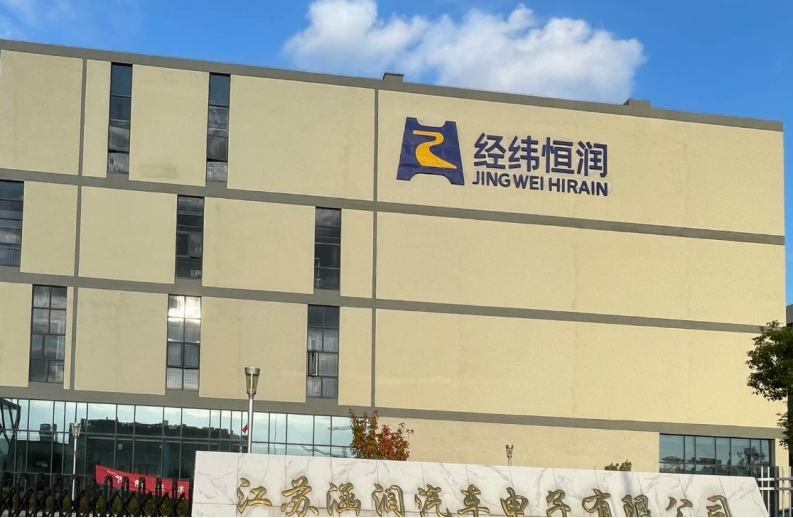
研发成果有效释放,经纬恒润2025年预计实现扭亏为盈
Ju Chao Zi Xun· 2026-01-28 02:52
Core Viewpoint - The company expects to achieve a net profit attributable to shareholders of the parent company in the range of 75 million to 110 million yuan for the year 2025, marking a turnaround from a loss of 55.03 million yuan in the previous year [2] Group 1: Performance Expectations - The projected net profit range for 2025 represents a significant improvement compared to the previous year's loss [2] - The expected net profit after deducting non-recurring gains and losses is estimated to be between 27.5 million and 41 million yuan, compared to a loss of 61.84 million yuan in the prior year [2] Group 2: Reasons for Performance Change - The primary reasons for the performance change include the release of R&D results and an expansion in revenue scale, driven by the rapid development of automotive intelligence and electrification [2] - New product lines, particularly domain controller products, have seen rapid revenue growth, while existing products have gained more customers and project opportunities [2] - Cost reduction and efficiency improvement measures have begun to show results, with the application of AI tools, promotion of domestic alternatives, and smart manufacturing effectively controlling costs and expenses, leading to an increase in gross margin and a significant decrease in period expense ratio [2]


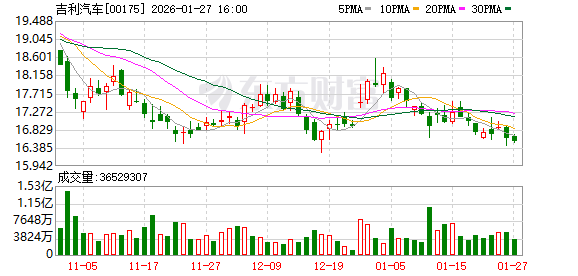
战略升维 吉利锚定2030年:跻身全球前五大车企、向万亿营收迈进
2 1 Shi Ji Jing Ji Bao Dao· 2026-01-27 16:17
Core Insights - The automotive industry is undergoing a transformation towards electrification and intelligence, with Geely Holdings transitioning from a traditional car manufacturer to a smart mobility technology company [2] - Geely's strategic goals for 2030 include achieving annual sales of over 6.5 million vehicles, revenue exceeding 1 trillion yuan, and becoming one of the top five global automakers, with 75% of sales from new energy vehicles [2][3] Group 1: Strategic Goals and Achievements - In 2025, Geely's total global sales reached 4.116 million vehicles, a 26% increase year-on-year, marking its entry into the top seven global automakers [2] - The company aims for an annual compound growth rate of approximately 9.5% to reach its 2030 sales target of 6.5 million vehicles [4] - Geely's new energy vehicle sales reached 2.293 million units in 2025, a 58% increase, with a penetration rate of 56% [2][7] Group 2: Strategic Framework - Geely's strategy focuses on a "six-in-one" capability system, emphasizing brand, technology, vehicle, ecology, talent, and sustainable development [4][5] - The company is enhancing its brand matrix by integrating its sub-brands into a cohesive global strategy, ensuring clear positioning and complementary strengths [5][6] Group 3: Technological Advancements - Geely is building a comprehensive technology ecosystem covering smart driving, smart cockpit, electronic architecture, battery, and electric drive systems [8][11] - The company has introduced the "Qianli Haohan" smart driving solution, which includes multiple levels of autonomous driving capabilities, with plans for L3 and L4 functionalities [10][12] Group 4: International Expansion - Geely's overseas sales reached 420,000 units in 2025, with over 1200 sales outlets established in 88 countries [12][13] - The company is pursuing a localized approach to international markets, exemplified by its collaboration with Renault in Brazil and the AHTV project in Malaysia [14][15]

中欧协会智能网联汽车分会:乘用车规则生变,商用车电动化提速
2 1 Shi Ji Jing Ji Bao Dao· 2026-01-27 09:07
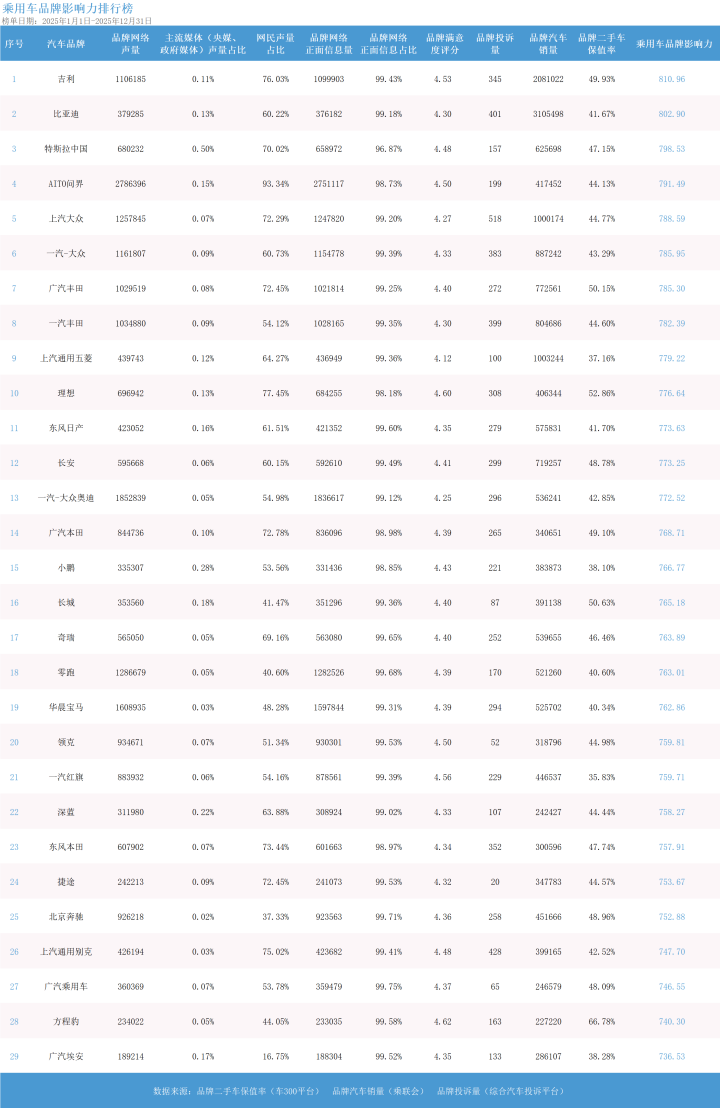
Group 1: Passenger Vehicle Market Insights - The report indicates a differentiated development trend in the Chinese automotive market, with domestic brands like Geely, BYD, and AITO leading the passenger vehicle sector due to their technological, ecological, and user reputation advantages [1] - Geely ranks first in the passenger vehicle brand influence index with a score of 810.96, achieving a market sales volume of 2.081 million units and a positive information ratio of 99.43% [2][3] - BYD follows closely in second place with a score of 802.90, selling 3.105 million units and maintaining a positive sentiment ratio of 99.18% [3] - Tesla China ranks third with a score of 798.53, with a mainstream media voice share of 0.50% [3] Group 2: Competitive Landscape - The top brands exhibit a diversified competitive landscape, with traditional brands relying on scale and system capabilities, while new entrants leverage user recognition and community engagement to establish differentiated advantages [4] - AITO's annual network voice reached 2.786 million, with a user voice share of 93.34%, supported by Huawei's technology in smart driving and cockpit systems [4] - Traditional automakers are also seeing significant growth in their new energy series, with brands like Geely and Great Wall continuously launching new products in hybrid and pure electric segments [4] Group 3: Commercial Vehicle Market Insights - In the heavy-duty truck market, China FAW leads with a score of 738.53, significantly surpassing competitors with a mainstream media voice share of 17.50% [6][7] - Dongfeng ranks second with a score of 709.85, maintaining a strong network voice and zero complaints throughout the year [6] - China National Heavy Duty Truck ranks third with a score of 699.35, achieving over 300,000 units in annual sales, with notable contributions from overseas exports [6] Group 4: Market Trends and Challenges - The report highlights that traditional joint venture brands are entering a strategic adjustment phase due to competition from domestic brands in electrification and intelligence [5] - Joint venture brands face challenges such as mismatched global model update cycles and rapid changes in Chinese market demands, necessitating accelerated local R&D for electric products [5] - The commercial vehicle sector is transitioning from policy-driven to market-driven electrification, with traditional brands and new energy brands still in a competitive phase regarding overall sales and lifecycle costs [9]



经纬恒润(688326.SH):预计2025年净利润7500万元到1.1亿元
Xin Lang Cai Jing· 2026-01-27 08:30
Core Viewpoint - The company, Jingwei Hengrun (688326.SH), expects to turn a profit in 2025, projecting a net profit attributable to shareholders of the parent company between 75 million and 110 million yuan, compared to a loss in the previous year [1] Financial Performance - The net profit attributable to shareholders, excluding non-recurring gains and losses, is anticipated to be between 27.5 million and 41 million yuan [1] Business Development - The company has been actively expanding its domestic and international markets, investing strategically to promote product upgrades and iterations [1] - The release of research and development results is expected to significantly contribute to revenue growth, particularly through new products like domain controllers [1] - The existing product lineup has also gained more customers and project opportunities, further driving revenue expansion [1]
常州女首富带队!百亿车灯龙头星宇股份递表港交所
Shen Zhen Shang Bao· 2026-01-27 07:22
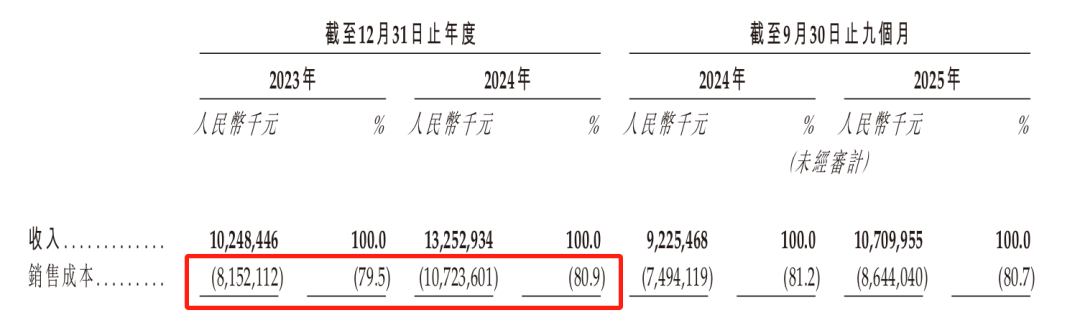
Core Viewpoint - Changzhou Xingyu Automotive Lighting Co., Ltd. (Xingyu) has submitted an application for listing on the Hong Kong Stock Exchange, aiming to leverage the capital market for technological development and global expansion [1][4]. Financial Performance - In 2023, 2024, and the first three quarters of 2025, Xingyu's revenues were RMB 10.25 billion, RMB 13.25 billion, and RMB 10.71 billion, respectively, indicating a growth trend [2][3]. - Despite revenue growth, the gross profit margin has declined from 20.5% in 2023 to 19.1% in 2024, with a slight recovery to 19.3% in the first three quarters of 2025, reflecting pressure on profitability [2][3]. Market Position - Xingyu holds a market share of 11.0% in China and 4.2% globally in the automotive lighting market, ranking first in China and seventh worldwide [1]. - The company has established partnerships with nine of the top ten global automotive manufacturers, indicating a strong market presence [4]. Global Expansion - Xingyu operates a factory in Serbia and has established R&D centers or subsidiaries in Germany and North America, with a total of 12 factories and 15 R&D centers globally as of September 2025 [3]. - The company faces potential risks from geopolitical issues, trade agreement changes, and tariffs that could adversely affect its overseas operations [3]. Customer Concentration Risk - Revenue from the top five customers accounted for 68.2%, 69.5%, and 66.7% of total revenue in the respective periods, indicating a significant customer concentration risk [4]. - The increasing competition in the electric vehicle market and the entry of new players intensify the competitive landscape in the automotive lighting industry [4]. Leadership and Future Plans - As of the latest date, Ms. Zhou Xiaoping holds a 42% stake in the company and is recognized as a leading figure in the industry [4]. - The funds raised from the Hong Kong listing will be allocated for technological R&D, global production base expansion, and digital transformation, with expectations for the automotive lighting market in China to grow to RMB 168.6 billion by 2030 [4].

650万辆、万亿营收,吉利未来五年剑指全球前五
Zhong Guo Jing Ji Wang· 2026-01-27 07:02
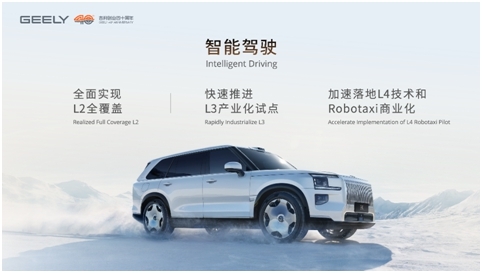
Core Insights - Geely has achieved remarkable results over the past year under the guidance of the "Taizhou Declaration," aiming to become a leader in high-quality global development for Chinese enterprises as it celebrates its 40th anniversary [1] - The company has launched the "One Geely, Comprehensive Leadership" strategy for 2030, focusing on global coordination and a unified strategic framework to enhance competitiveness [1][2] - Key targets for 2030 include global sales exceeding 6.5 million units, revenue surpassing 1 trillion yuan, and a significant increase in the share of new energy vehicle sales to approximately 75% [1][2] Strategic Focus - The "Taizhou Declaration" emphasizes five core strategies: focus, integration, collaboration, stability, and talent, marking a new phase in Geely's strategic transformation [1] - Geely aims to strengthen its brand matrix and enhance its international influence while leveraging its various brands to create a collaborative and mutually beneficial brand cooperation model [5][6] Technological Advancements - Geely has made significant strides in electric and intelligent vehicle technologies, establishing a strong technological moat with innovations such as the "Shen Dun Jin Zhuan" battery and the new generation of AI hybrid engines [2][3] - The company has completed a comprehensive AI layout, including the "Qianli Haohan" driver assistance system, which boasts the highest computing power in the industry [3] Sales Performance - In 2025, Geely's sales are projected to reach 4.116 million units, a 26% year-on-year increase, with new energy vehicle sales expected to hit 2.293 million units, reflecting a 58% growth [3] Future Ecosystems - Geely plans to develop three major ecological business areas: user service ecology, future mobility ecology, and methanol-hydrogen electric ecology, enhancing its competitive edge in these sectors [8][9] - The company aims to establish a nationwide service capability and launch 100,000 customized Robotaxi vehicles for commercial operations globally by 2030 [9] Talent and Sustainability - Geely is committed to building a talent pipeline and enhancing organizational culture, with plans to invest 500 million yuan in youth innovation and entrepreneurship initiatives [9][11] - The company will integrate green and low-carbon principles throughout its product lifecycle, promoting the use of new environmentally friendly materials and aiming for carbon neutrality in its factories [11]
今日新闻丨我国纯电动车保有量突破3000万辆!汽车转向系统强制性国标发布!
电动车公社· 2026-01-26 16:06
Group 1 - The core viewpoint of the article emphasizes the implementation of a mandatory national standard for automotive steering systems, which will enhance safety and promote the development of new technologies like steer-by-wire [2][5] - The new standard, effective from July 1, clarifies technical requirements and testing methods for automotive steering systems, particularly for steer-by-wire technology, which offers significant advantages in response speed and control precision [2][5] - NIO, as one of the leaders in the development of this standard, has already applied steer-by-wire technology in its ET9 model, indicating a trend towards broader adoption among other brands [5] Group 2 - The current number of new energy vehicles in China has reached 43.97 million, with 30.22 million being pure electric vehicles, accounting for 68.74% of the total new energy vehicle ownership [6] - The data indicates that the market share of new energy vehicles is approaching parity with traditional fuel vehicles, with pure electric vehicles becoming mainstream, accelerating the trend towards electrification [6][7] - By 2025, the total number of motor vehicles in China is projected to reach 469 million, with nearly half of the population holding a driver's license, reflecting the country's commitment to becoming a major automotive power [6][7]

跨国车企在华格局生变:谁在倒退,谁在增长?
3 6 Ke· 2026-01-26 12:49
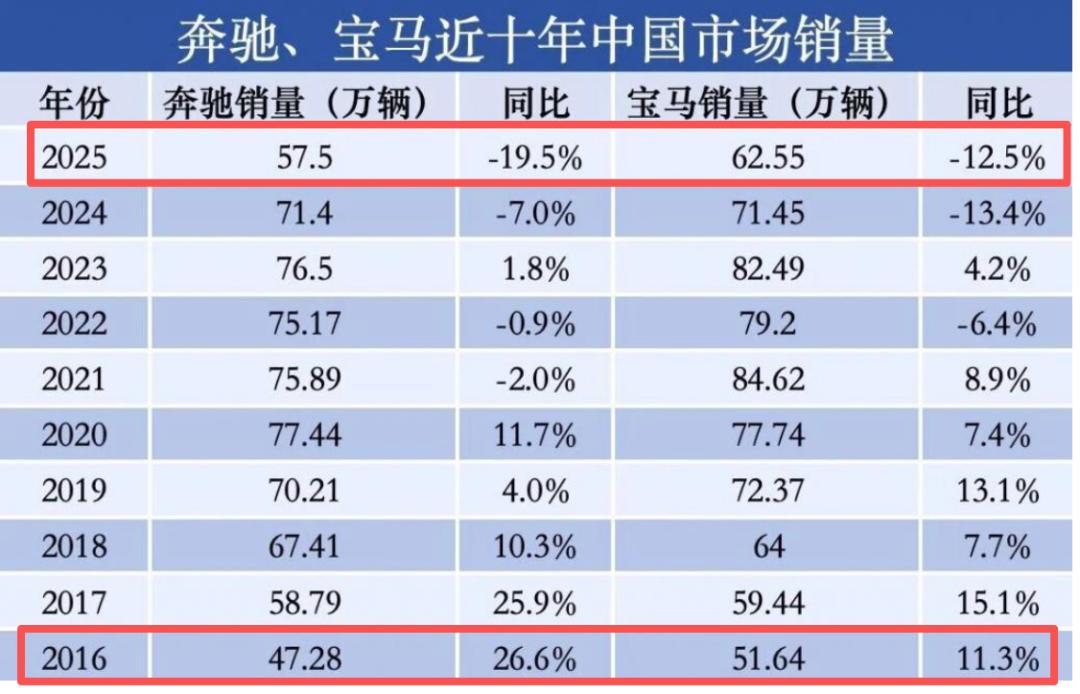
Core Insights - The automotive market in China is experiencing a significant shift, with domestic brands like Leap Motor, AITO, Xpeng, and Xiaomi seeing substantial sales growth, while multinational brands such as Mercedes-Benz, BMW, and Porsche are facing declining sales [1][3] Group 1: Sales Trends of Multinational Brands - Mercedes-Benz and BMW have provided preliminary demand forecasts for 2026, each predicting sales below 500,000 units, a level comparable to their sales in 2016 [1] - Mercedes-Benz's sales in China are projected to drop to 575,000 units in 2025, a decline of 19.5% year-on-year, while BMW's sales are expected to fall to 625,500 units, down 12.5% [2][19] - The decline in sales for these brands reflects a broader trend of losing market share to domestic competitors, with significant drops in brand influence and sales volume [3][19] Group 2: Performance of Other Multinational Brands - Toyota and General Motors are showing stable performance, with Toyota's sales in China exceeding 1.78 million units in 2025, marking a slight increase of 0.23% [3][5] - General Motors reported a notable recovery with sales of 535,000 units, a year-on-year increase of 22.99%, ending a seven-year decline [3][8] Group 3: Challenges Faced by Korean Brands - Korean brands like Hyundai and Kia are struggling, with their market share shrinking from 3.8% in 2020 to 0.9% in 2025 [11] - Hyundai's sales in 2025 are reported at 210,000 units, a 14.8% increase, but this is seen as insufficient given the historical context of their performance [13] - Kia's sales are approximately 254,000 units in 2025, a slight increase of 2.3%, but still far below their peak of 650,000 units in 2016 [14] Group 4: Decline of BBA and Other German Brands - The BBA (Benz, BMW, Audi) group is experiencing significant declines, with Mercedes-Benz's sales dropping from a peak of 774,000 units in 2020 to 575,000 units in 2025 [19][20] - BMW's sales are projected to decrease from 825,000 units in 2023 to 625,500 units in 2025, losing approximately 200,000 units in just two years [20] - Audi's sales are also declining, with projections of 617,500 units in 2025, down 5% from previous years [21] Group 5: Market Dynamics and Consumer Preferences - The shift in consumer preferences is evident, with a growing focus on technology and practical features over brand prestige, impacting the sales of traditional luxury brands [25] - The rapid rise of domestic brands in technology and electric vehicle offerings is reshaping the competitive landscape, making it difficult for multinational brands to maintain their market positions [26]