
自研芯片

Search documents
小米集团-W(01810.HK):持续成长,持续创新
GOLDEN SUN SECURITIES· 2025-06-02 13:25
Investment Rating - The report maintains a "Buy" rating for Xiaomi Group [3][6] Core Views - Xiaomi Group achieved record high revenue and profit in Q1 2025, with total revenue of 111.3 billion yuan, a year-on-year increase of 47.4%, and adjusted net profit of 10.7 billion yuan, up 64.5% year-on-year [1][3] - The smartphone segment regained the top market share in China, with a global shipment of 41.8 million units, a 3% increase year-on-year, and a global market share of 14.1% [1][3] - The IoT business is focusing on high-end and international expansion, with revenue reaching 32.3 billion yuan and a gross margin of 25.2% in Q1 2025 [2][3] - The automotive segment reported revenue of 18.6 billion yuan, with the new SUV model YU7 expected to become a bestseller upon pricing announcement [2][3] Financial Summary - Revenue projections for Xiaomi Group are 486.7 billion yuan in 2025, 634.5 billion yuan in 2026, and 764.8 billion yuan in 2027, with year-on-year growth rates of 33%, 30%, and 21% respectively [3][5] - Adjusted net profit for the main consumer electronics business is expected to be 41.9 billion yuan in 2025, 52.0 billion yuan in 2026, and 61.1 billion yuan in 2027, with growth rates of 25%, 24%, and 18% respectively [3][5] - The report anticipates a significant increase in automotive adjusted net profit, projecting a turnaround to 10.1 billion yuan in 2026 and 20.6 billion yuan in 2027 [3][5] Key Financial Metrics - The report provides a detailed financial forecast, including revenue, adjusted net profit, and earnings per share (EPS) for the years 2023 to 2027, indicating a strong growth trajectory [5][13] - The expected adjusted EPS is projected to be 1.6 yuan in 2025, 2.4 yuan in 2026, and 3.1 yuan in 2027 [3][5] - The price-to-earnings (P/E) ratio is expected to decrease from 29 in 2025 to 15 in 2027, indicating a potentially attractive valuation [3][5]

小米集团-W(01810):持续成长,持续创新
GOLDEN SUN SECURITIES· 2025-06-02 13:02
Investment Rating - The report maintains a "Buy" rating for Xiaomi Group [3][6] Core Views - Xiaomi Group achieved record high revenue and profit in Q1 2025, with total revenue of 111.3 billion yuan, a year-on-year increase of 47.4%, and adjusted net profit of 10.7 billion yuan, up 64.5% year-on-year [1][3] - The smartphone segment regained the top market share in China, with revenue of 50.6 billion yuan and a gross margin of 12.4% in Q1 2025, while global smartphone shipments reached 41.8 million units, a 3% increase [1][3] - The IoT business continues to focus on high-end and international markets, generating 32.3 billion yuan in revenue with a gross margin of 25.2% in Q1 2025 [2][3] - The automotive segment reported revenue of 18.6 billion yuan, with the new SUV model YU7 expected to become a bestseller upon pricing announcement [2][3] Financial Summary - Revenue projections for Xiaomi Group are 486.7 billion yuan, 634.5 billion yuan, and 764.8 billion yuan for 2025, 2026, and 2027 respectively, with year-on-year growth rates of 33%, 30%, and 21% [3][5] - Adjusted net profit for the core consumer electronics business is expected to be 41.9 billion yuan, 52.0 billion yuan, and 61.1 billion yuan for 2025, 2026, and 2027 respectively, with year-on-year growth rates of 25%, 24%, and 18% [3][5] - The report anticipates a target price of 60 HKD for Xiaomi Group based on a P/E ratio of 20x for 2026 estimates [3][6]
不鸣则已一鸣惊人?小米处理器跑分很强劲,雷军公布巨额投入
Sou Hu Cai Jing· 2025-06-01 08:38
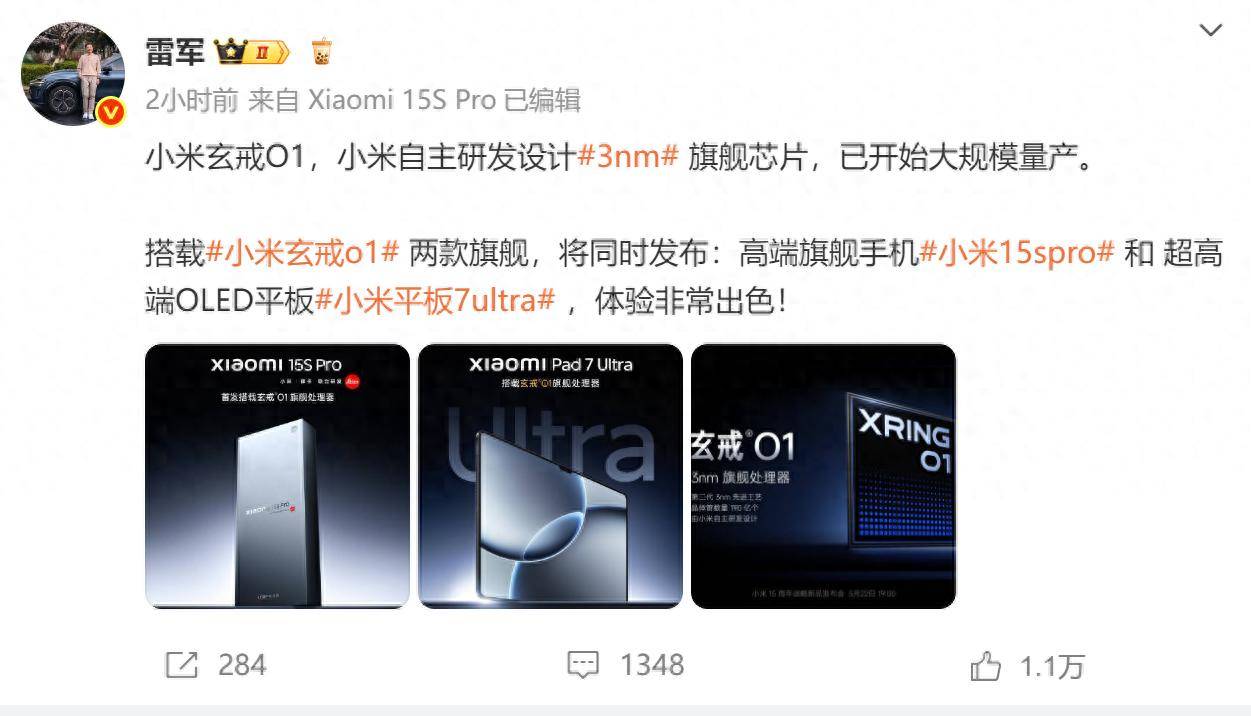
Core Insights - Xiaomi has made significant announcements during its 15th anniversary strategic product launch on May 22, including the introduction of the YU7 electric SUV, the flagship smartphone Xiaomi 15S Pro, and the high-end OLED tablet Xiaomi Pad 7 Ultra, along with the self-developed SoC chip, Xuanjie O1 [1][10] Group 1: Product Launches - The Xiaomi YU7 is the company's first pure electric SUV [1] - The Xiaomi 15S Pro smartphone and Xiaomi Pad 7 Ultra tablet were also unveiled, showcasing advanced features [1][8] - The Xuanjie O1 chip is set to be integrated into the Xiaomi 15S Pro and Xiaomi Pad 7 Ultra, marking a significant technological advancement for the company [1][3] Group 2: Chip Development - The Xuanjie O1 chip is a self-developed 3nm flagship processor, making Xiaomi the fourth company globally to produce such a chip, following Qualcomm, Apple, and MediaTek [1][3] - The chip is manufactured using TSMC's second-generation 3nm process and contains 19 billion transistors, achieving GeekBench 6 scores of 3119 for single-core and 9673 for multi-core performance, positioning it as a flagship-level chip [3] - Xiaomi has invested over 13.5 billion RMB in chip development, with a team of 2,500 people, and plans to invest 50 billion RMB over the next decade to support its chip business [6]

理想汽车-W(2015.HK):I8上市在即 看好VLA模型上车
Ge Long Hui· 2025-05-31 01:57
Core Viewpoint - The company reported Q1 performance with revenue of 25.9 billion yuan, showing a slight increase of 1% quarter-on-quarter but a significant decrease of 41% year-on-year, while net profit attributable to shareholders was 650 million yuan, up 9% quarter-on-quarter but down 82% year-on-year, aligning with expectations [1] Financial Performance - Q1 automotive gross margin was 19.8%, reflecting a quarter-on-quarter increase in both metrics, with total vehicle sales reaching 93,000 units, up 16% quarter-on-quarter but down 41% year-on-year [1] - The company’s overall gross margin for Q1 was 20.5%, with automotive gross margin at 19.8%, showing a slight increase of 0.5% quarter-on-quarter [1][2] - The average selling price (ASP) and gross profit per vehicle were 266,000 yuan and 53,000 yuan respectively, down 11.9% and 10.0% year-on-year, and down 1.1% and 0.7% quarter-on-quarter [2] Cost Management - The company demonstrated improved cost control with SG&A and R&D expense ratios at 9.8% and 9.7%, respectively, showing a year-on-year decrease of 1.9% and 2.2% [2] - The company expects to continue enhancing quality and efficiency in Q2, with projected deliveries of 123,000 to 128,000 units and revenue between 32.5 billion and 33.8 billion yuan [2] Product Development - Recent launches of the L series and MEGA smart driving models have been smooth, with the MEGA Home version performing well, enhancing expectations for the company's electric vehicle strategy [2] - The company plans to launch the i8 and i6 models in H2 2025, with the i8 featuring a 5C battery and a range of 720 km, which is expected to alleviate range anxiety for users [2] Technological Advancements - The introduction of the Thor-U chip in the L series and MEGA models enhances computational power, and the company is accelerating its self-developed chip initiatives [3] - The existing dual-system architecture will be upgraded to the VLA driver model in July 2025, which is expected to improve generalization capabilities and enhance autonomous driving features [3] Profit Forecast and Valuation - The company maintains its profit forecasts, expecting GAAP net profits of 10.3 billion, 15.8 billion, and 17.8 billion yuan for 2025-2027, with Non-GAAP net profits of 13 billion, 18.6 billion, and 20.8 billion yuan [3] - The target price has been adjusted to 140.34 HKD, maintaining a "buy" rating based on a 21x PE for 2025 [3]

理想汽车-W(02015):I8上市在即,看好VLA模型上车
HTSC· 2025-05-30 02:44
Investment Rating - The report maintains a "Buy" rating for the company [8] Core Views - The company reported Q1 revenue of 25.9 billion RMB, with a year-on-year increase of 1% and a quarter-on-quarter decrease of 41%. The net profit attributable to shareholders was 650 million RMB, reflecting a year-on-year increase of 9% but a quarter-on-quarter decrease of 82%, aligning with expectations [1] - The company is expected to continue improving quality and efficiency, with a projected Q2 delivery of 123,000 to 128,000 vehicles and revenue of 32.5 to 33.8 billion RMB [2] - The launch of new electric models, particularly the i8, is anticipated to enhance sales performance, with expectations of over 5,000 units in steady monthly sales [3] - The introduction of the Thor-U chip in new models is expected to enhance computing power and reduce costs in autonomous driving hardware [4] - The company forecasts GAAP net profits of 10.3 billion, 15.8 billion, and 17.8 billion RMB for 2025-2027, with a target price adjustment to 140.34 HKD based on a 21x PE for 2025 [5][13] Financial Summary - The company expects revenues of 123.9 billion RMB in 2023, growing to 250.2 billion RMB by 2027, with a compound annual growth rate of 5.97% [7] - The projected net profit attributable to shareholders is expected to recover from 8.0 billion RMB in 2024 to 17.8 billion RMB in 2027, indicating a significant growth trajectory [7] - The report highlights a gross margin of 20.5% for Q1 2025, with an automotive gross margin of 19.8%, reflecting improved cost control [2]
小米集团-W(1810.HK)2025Q1业绩点评:IOT业务高速增长 单季度业绩再创新高
Ge Long Hui· 2025-05-30 01:47
Core Viewpoint - Xiaomi Group reported record high revenue and adjusted net profit for Q1 2025, driven by strong performance in its smartphone and IOT segments, alongside a strategic focus on cost reduction and efficiency improvement [1][2][3] Financial Performance - Q1 2025 revenue reached 1112.93 billion, a year-over-year increase of 47.4% and a quarter-over-quarter increase of 2.1% [1] - Adjusted net profit for the same period was 106.76 billion, reflecting a year-over-year growth of 64.5% and a quarter-over-quarter growth of 28.4% [1] - Overall gross margin stood at 22.8%, with a year-over-year increase of 0.5 percentage points [1] Business Segments - The smartphone and AIOT segment generated revenue of 927.13 billion, a year-over-year increase of 22.8% [1] - The smart electric vehicle and AI innovation segment achieved revenue of 185.80 billion [1] - IOT business revenue surged to 323.39 billion, marking a year-over-year increase of 58.7% and contributing 29.1% to total revenue [2] - Internet services revenue reached 90.76 billion, with a year-over-year increase of 12.8% [2] Market Position - Xiaomi's smartphone shipments reached 41.8 million units in Q1 2025, a year-over-year increase of 3.0%, maintaining a global market share of 14.1% [2] - In mainland China, Xiaomi regained the top position in smartphone shipments with a market share of 18.8% [2] R&D and Future Outlook - The company plans to invest 2000 billion over the next five years in core technology development [3] - R&D expenditure for Q1 2025 was 67 billion, a year-over-year increase of 30.1% [3] - The launch of self-developed 3nm flagship SoC chip and the open-sourcing of the Xiaomi MiMo model are significant advancements [3] Investment Recommendation - The company is expected to benefit from its brand recognition and supply chain advantages, with projections for revenue and net profit growth from 2025 to 2027 [4] - Forecasted revenues for 2025, 2026, and 2027 are 5062.65 billion, 6052.13 billion, and 7008.88 billion respectively, with corresponding net profits of 357.09 billion, 457.75 billion, and 598.89 billion [4]
小米集团-W:IoT/汽车业务毛利率超预期-20250530
HTSC· 2025-05-30 00:45
Investment Rating - The report maintains a "Buy" rating for the company [8] - The target price is set at HKD 71.20 [8][9] Core Insights - The company's revenue for Q1 2025 reached a historical high of RMB 111.3 billion, with a year-on-year growth of 47% [1] - Adjusted operating profit increased by 114% year-on-year to RMB 9.96 billion [1] - The IoT and automotive business showed strong gross margins, with the IoT revenue growing by 58.7% year-on-year to RMB 32.3 billion [2] - The automotive segment's gross margin improved to 23.2%, benefiting from increased scale [3] - The smartphone average selling price (ASP) reached a record high of RMB 1,211, with a gross margin of 12.4% [4] Summary by Sections Revenue and Profitability - Q1 2025 revenue was RMB 111.3 billion, a 47% increase year-on-year [1] - Adjusted operating profit for Q1 2025 was RMB 9.96 billion, up 114% year-on-year [1] - IoT revenue reached RMB 32.3 billion, with a gross margin of 25.2%, up 5.4 percentage points year-on-year [2] Automotive Business - The company delivered 75,869 units of the SU7 series in Q1 [3] - The automotive segment reported a gross margin of 23.2%, exceeding expectations [3] - The first SUV, YU7, is expected to launch in July 2025, with a focus on consumer feedback post-launch [3] Smartphone Segment - The smartphone ASP reached RMB 1,211, marking a 5.8% year-on-year increase [4] - The smartphone business maintained a gross margin of 12.4% [4] - The launch of self-developed chips is anticipated to enhance the company's high-end market share [4] Valuation and Future Outlook - The target price of HKD 71.20 is based on a sum-of-the-parts (SOTP) valuation method, reflecting the growth potential in IoT and automotive sectors [5][17] - The forecasted net profit for 2025 is adjusted to RMB 40.99 billion, with a projected growth rate of 50.06% [7][15] - The report anticipates a continued increase in IoT revenue, projecting a 24% year-on-year growth for 2025 [2]
小米集团-W(01810):IoT/汽车业务毛利率超预期
HTSC· 2025-05-29 10:13
Investment Rating - The report maintains a "Buy" rating for the company [8] - The target price is set at HKD 71.20 [8][9] Core Insights - The company's revenue for Q1 2025 reached a historical high of RMB 111.3 billion, with a year-on-year growth of 47% [1] - Adjusted operating profit increased by 114% year-on-year to RMB 9.96 billion [1] - The IoT and automotive business showed strong gross margins, with the smartphone ASP reaching a record high [1] - The launch of self-developed chips is seen as a significant step for the brand in expanding its ecosystem [1] Summary by Sections IoT and Consumer Products - In Q1 2025, IoT and consumer products revenue grew by 58.7% year-on-year to RMB 32.3 billion, with a gross margin of 25.2% [2] - The growth is attributed to the rapid expansion of large home appliances, which saw a revenue increase of 113.8% year-on-year [2] - The forecast for the IoT business is a 24% year-on-year revenue growth in 2025, with an adjusted gross margin prediction of 23.8% [2] Automotive Business - The automotive division reported a gross margin of 23.2%, exceeding previous forecasts [3] - The company delivered 75,869 units of the SU7 series in Q1, although the division incurred an operating loss of RMB 500 million [3] - The first SUV, YU7, is expected to launch in July 2025, with consumer feedback being a key focus [3] Smartphone Business - The smartphone ASP for Q1 2025 was RMB 1,211, marking a 5.8% year-on-year increase [4] - The smartphone business maintained a gross margin of 12.4%, reflecting stability despite a weak overall market [4] - The introduction of self-developed chips is anticipated to enhance the company's market share in the high-end smartphone segment [4] Financial Projections - The company’s projected revenue for 2025 is RMB 495.1 billion, with a year-on-year growth of 35.3% [7] - The net profit attributable to the parent company is forecasted to reach RMB 40.99 billion in 2025, representing a 50.1% increase [7] - The report adjusts the non-GAAP net profit estimates for 2025-2027 to RMB 41.0 billion, RMB 51.3 billion, and RMB 63.2 billion respectively [5] Valuation Methodology - The target price of HKD 71.20 is based on a sum-of-the-parts (SOTP) valuation method, assuming a long-term exchange rate of HKD to RMB at 0.92 [17] - The valuation reflects a 41x PE ratio for the 2025 forecast [17] - The smartphone and IoT business is valued at HKD 44.9 per share, while the automotive business is valued at HKD 26.3 per share [19]
小米集团-W(01810):智能手机出货份额重回国内第一,单季营收、经调整净利润再创新高
EBSCN· 2025-05-29 06:44
Investment Rating - The report maintains a "Buy" rating for Xiaomi Group (1810.HK) [6] Core Insights - Xiaomi achieved a record high quarterly revenue of 111.3 billion RMB in Q1 2025, representing a year-on-year growth of 47.4% and marking the second consecutive quarter with revenue exceeding 100 billion RMB [1] - The Non-IFRS net profit reached 10.7 billion RMB, up 64.5% year-on-year, with a net profit margin improvement to 9.6% [1] - The company regained the top position in the domestic smartphone market with a market share of 18.8%, a 4.7 percentage point increase year-on-year, and a 40% growth in shipments in China, significantly outpacing the industry growth rate of 5% [2] - The average selling price (ASP) of Xiaomi smartphones increased to 1,211 RMB, reflecting a 5.8% year-on-year and 0.7% quarter-on-quarter growth, driven by higher ASP products in the domestic market [2] - The gross margin for the smartphone business improved to 12.4%, up from 12.0% in the previous quarter, benefiting from an improved product mix in overseas markets [2] Summary by Sections Smartphone Business - Xiaomi's global smartphone shipments reached 41.8 million units in Q1 2025, a 3% year-on-year increase, with a notable performance in the Chinese market [2] - The ASP of smartphones rose due to increased sales of high-end models and government subsidies [2] IoT and Internet Services - IoT revenue surged to 32.3 billion RMB, a 59% year-on-year increase, with significant growth in smart home appliances [3] - Internet services revenue grew by 13% to 9.1 billion RMB, driven by a 20% increase in advertising revenue [3] - The number of monthly active users (MAU) for Xiaomi's internet services reached 720 million globally and 180 million in mainland China, both hitting record highs [3] Automotive and AI Innovations - The newly integrated "Smart Electric Vehicles and AI Innovations" business generated 18.6 billion RMB in revenue with a gross margin of 23.2% [4] - The delivery volume of vehicles increased to 75,869 units, an 8.9% quarter-on-quarter rise, with the ASP of vehicles slightly increasing to 238,000 RMB [4] - The YU7 series, a luxury high-performance SUV, is set to launch in July 2025 [4] Financial Forecast and Valuation - The report raises the Non-IFRS net profit forecasts for 2025 and 2026 to 46.4 billion RMB and 65.6 billion RMB, respectively, with a new forecast for 2027 at 84.9 billion RMB [5] - The revenue projections for 2025 and beyond show significant growth, with a projected revenue of 492.9 billion RMB in 2025, reflecting a 34.7% growth rate [5]
小米集团-W:IOT和汽车毛利率超预期,高端化和规模化推高盈利能力(繁体版)-20250529
第一上海· 2025-05-29 05:40
Investment Rating - The report maintains a "Buy" rating for the company with a target price of HKD 67.9, indicating a potential upside of 29.28% from the current price of HKD 52.50 [6][10]. Core Insights - The company reported revenue of RMB 111.3 billion for Q1 2025, a year-on-year increase of 47.4%, surpassing market expectations of RMB 109 billion. The overall gross margin improved to 22.8%, up 0.5 percentage points year-on-year. Net profit reached RMB 10.9 billion, a significant year-on-year increase of 161.0%, with adjusted net profit at RMB 10.7 billion, up 64.5%, exceeding market expectations of RMB 9.1 billion [2]. - The company aims to invest RMB 200 billion in R&D from 2026 to 2030 to strengthen its technological moat, with a focus on AI and chip technology, expecting to invest RMB 7.5 billion in AI this year [2]. - The smartphone segment saw revenue of RMB 50.6 billion, a year-on-year increase of 8.9%, with a market share of 18.8%, marking a return to the top position in domestic smartphone shipments after ten years. The average selling price (ASP) of smartphones increased by 5.8% to RMB 1,211 [3]. - The Internet of Things (IoT) segment experienced explosive growth, with revenue increasing by 58.7% to RMB 32.3 billion, and a gross margin of 25.2%, up 5.4 percentage points year-on-year [4]. - The automotive business reported revenue of RMB 18.6 billion, with a gross margin of 23.2%, and a significant reduction in operating losses, with the new luxury SUV model YU7 receiving positive market feedback [5]. Financial Summary - The company’s projected revenues for 2025, 2026, and 2027 are RMB 495.6 billion, RMB 627.0 billion, and RMB 721.4 billion, respectively. Adjusted net profits are expected to be RMB 45.6 billion, RMB 57.8 billion, and RMB 70.2 billion for the same years [6][7]. - The gross margin is projected to improve from 21.21% in 2023 to 23.33% by 2027, reflecting enhanced operational efficiency and product mix [13]. - The company’s earnings per share (EPS) is forecasted to grow significantly from RMB 0.69 in 2023 to RMB 2.61 in 2027, indicating a robust growth trajectory [7][13].