
适度宽松的货币政策

Search documents
上市银行首批2025年业绩快报出炉;财政部集中发布了五项重要财政金融政策|每周金融评论(2026.1.19-2026.1.25)
清华金融评论· 2026-01-26 10:31
Group 1: Banking Sector Performance - The first batch of 2025 performance reports from listed banks has been released, with eight banks including China Merchants Bank and Huatai Bank reporting positive growth in net profit attributable to shareholders, with seven of them achieving both revenue and net profit growth [6][7] - Key characteristics observed among these banks include steady asset expansion, improved asset quality with no significant increase in non-performing loan ratios, and increased provisioning efforts despite a decline in coverage ratios [7] - The outlook for 2026 suggests that benefiting from monetary policy, the decline in interest margins is expected to stabilize, potentially leading to a rebound in net interest income growth, while insurance policies are anticipated to boost fee income [7] Group 2: Fiscal and Monetary Policies - The Ministry of Finance has released five important fiscal and financial policies aimed at stimulating economic growth, including optimizing personal consumption loan subsidies and implementing special guarantees for private investment [8][9] - These policies are designed to lower financing costs across various sectors, enhance credit demand in key areas, and improve the efficiency of fund utilization, thereby injecting strong momentum into the economy [9][10] - The government emphasizes a combination of proactive fiscal policies and moderately loose monetary policies to support high-quality development and address challenges in the economy [8] Group 3: Regulatory Developments - The China Securities Regulatory Commission (CSRC) has announced the addition of 14 futures and options products as specific domestic varieties, marking a significant step in the internationalization of China's futures market [11] - This expansion is the largest in history, with the total number of specific domestic varieties reaching 38, and aims to enhance China's pricing power in global markets [11] - The CSRC's recent actions reflect a zero-tolerance approach towards market manipulation, as evidenced by a substantial fine of 1.02 billion yuan imposed for long-term stock price manipulation [12] Group 4: Global Economic Outlook - The International Monetary Fund (IMF) has slightly raised its global economic growth forecast for 2026 to 3.3%, reflecting resilience despite challenges such as trade disruptions [13] - Emerging markets and developing economies are expected to maintain growth rates above 4.0%, while advanced economies are projected to grow at 1.8% and 1.7% in 2026 and 2027, respectively [13]


休整蓄势 上行基础稳固
Qi Huo Ri Bao· 2026-01-26 08:36
Market Performance - The A-share market exhibited a volatile consolidation pattern last week, with significant structural characteristics and active performance in thematic stocks, while heavyweight stocks were relatively weak [1] - The CSI 500 index led with a 4.34% increase, while the CSI 1000 index rose by 2.89%. Conversely, the CSI 300 index fell by 0.62%, and the SSE 50 index decreased by 1.54% [1] - The average daily trading volume in the A-share market was 2.8 trillion yuan, indicating a decline in trading enthusiasm [1] Economic Structure and Growth - The GDP is projected to grow by 5% year-on-year in 2025, with a 4.5% growth expected in the fourth quarter, aligning with market expectations [2] - The retail sales of social consumer goods are expected to increase by 3.7% year-on-year in 2025, accelerating by 0.2 percentage points compared to the previous year, with service retail sales growing by 5.5% [2] - Fixed asset investment is expected to decline, with real estate investment decreasing by 17.2% and infrastructure investment down by 1.48%, while manufacturing investment is projected to grow by 0.6% [2] Industrial Production - The industrial added value for large-scale industries is expected to grow by 5.9% year-on-year in 2025, with manufacturing added value increasing by 6.4% [3] - The added value of equipment manufacturing is projected to rise by 9.2%, accounting for 36.8% of the total industrial added value [3] - High-tech manufacturing is expected to see a 9.4% increase in added value, becoming a core driver of high-quality industrial development [3] Macroeconomic Policies - The National Development and Reform Commission emphasized the steady development of new productive forces and plans to expand domestic demand comprehensively [4] - A more proactive fiscal policy and moderately loose monetary policy will be implemented, with a focus on promoting reasonable price recovery [4] - The Ministry of Finance plans to maintain necessary levels of fiscal deficit, debt, and total expenditure in 2026, indicating continued support for economic growth and key sector development [5] Investment Outlook - Despite recent market fluctuations, the upward foundation remains solid, supported by active macroeconomic policies [5] - The global macro environment is expected to remain loose, with inflows from foreign capital, institutional funds, and household savings likely to continue [5] - The technology growth style may continue to outperform due to industry policy catalysts [5]
国新国证期货早报-20260126
Guo Xin Guo Zheng Qi Huo· 2026-01-26 02:54
Variety Views Stock Index Futures - On January 23, the three major A-share indexes closed up. The Shanghai Composite Index rose 0.33% to 4136.16 points, the Shenzhen Component Index rose 0.79% to 14439.66 points, and the ChiNext Index rose 0.63% to 3349.50 points. The trading volume of the Shanghai, Shenzhen, and Beijing stock markets reached 3118.4 billion yuan, an increase of 401.7 billion yuan from the previous day [1]. - The CSI 300 Index adjusted and consolidated on January 23, closing at 4702.50, a decrease of 21.21 from the previous day [2]. Coke and Coking Coal - On January 23, the weighted index of coke fluctuated strongly, closing at 1724.1, an increase of 43.3 from the previous day [2]. - On January 23, the weighted index of coking coal fluctuated and consolidated, closing at 1163.3 yuan, an increase of 32.0 from the previous day [3]. - For coke, the spot market price at ports is stable. Most coke enterprises maintain normal production, and the cost support is still strong. However, due to the off - season of terminal consumption, steel mills' shipments are weak, and their demand for coke is low [4]. - For coking coal, the price of some coals has changed. The supply is gradually recovering, and the downstream demand has some support, but the procurement enthusiasm of some enterprises has slowed down [4]. Zhengzhou Sugar - The 2025/26 global sugar production is expected to reach 189.3 million tons, a strong increase from 180.97 million tons in 2024/25. Affected by this, the US sugar fluctuated lower last Friday. Speculators continued to increase their net short positions in ICE raw sugar futures and options [4]. Rubber - Due to the large short - term increase, the Shanghai rubber futures fluctuated and adjusted slightly higher on the night of January 22. As of January 23, the inventory and futures warehouse receipts of natural rubber and 20 - grade rubber have changed [5]. Soybean Meal - Internationally, on January 23, the closing price of the CBOT soybean main contract was 1067.5 cents per bushel, an increase of 0.33% from the previous day. Brazil's soybean harvest has started, and the export volume is expected to be large. Domestically, the main contract of soybean meal M2505 closed at 2751 yuan/ton on January 23, a decrease of 0.61% from the previous day. The inventory decline provides some support for the price [5]. Live Pigs - On January 23, the main contract of live pigs LH2603 closed at 11600 yuan/ton, an increase of 1.13%. The supply pressure is increasing in the short term, and the demand has some support, but the medium - term supply pressure is still large [5]. Palm Oil - On January 23, the palm oil futures price showed a profit - taking trend during the day but jumped up at night. The main contract P2605 closed above 9000 yuan for the first time since October last year. The Malaysian Palm Oil Board will launch an official reference price for used cooking oil in Q1 2026 [5]. Shanghai Copper - On the night of January 22, the main contract of Shanghai copper closed at 102830 yuan/ton, a sharp increase of 2.21%, hitting a recent high. The futures are stronger than the spot. The tight supply at the mine end, good macro - data, and a weak US dollar boost the price [5]. Iron Ore - On January 23, the main contract of iron ore 2605 fluctuated and rose, with a gain of 1.21%, closing at 795 yuan. The shipments from Australia and Brazil and domestic arrivals have decreased, and the port inventory is accumulating. The short - term price is in a volatile trend [5]. Asphalt - On January 23, the main contract of asphalt 2603 fluctuated and closed up, with a gain of 0.68%, closing at 3236 yuan. The refinery supply is low, the inventory is slightly accumulating, and the demand is weak. The short - term price is in a volatile trend [6]. Logs - The main contract of logs 2603 opened at 771, with a low of 767, a high of 779.5, and closed at 776 on January 23, with a reduction of 3311 lots. The spot price is stable, and the supply - demand relationship has no major contradictions [6]. Cotton - On the night of January 22, the main contract of Zhengzhou cotton closed at 14590 yuan/ton. The inventory increased by 28 lots. Textile enterprises are cautious in replenishing raw materials [6]. Steel - The central bank's loose monetary policy provides some support for industrial product prices. However, the steel market needs further implementation of industry - stabilizing policies to improve the supply - demand relationship. As the Spring Festival approaches, the demand for steel is expected to decline, and the inventory is accumulating [6]. Alumina - The supply of raw materials is increasing, and the price of bauxite is showing a slight weakening trend. The domestic alumina supply is still in excess, and the inventory is accumulating. The demand is stable [6]. Shanghai Aluminum - The supply of alumina is at a low level, and the electrolytic aluminum production is stable. The demand is in the off - season, and the inventory is accumulating. The aluminum price is affected by macro - expectations and remains high [6].
权威访谈·开局“十五五”丨潘功胜:将引导金融机构加力支持扩大内需、科技创新、中小微企业等重点领域
Yang Guang Wang· 2026-01-26 01:56
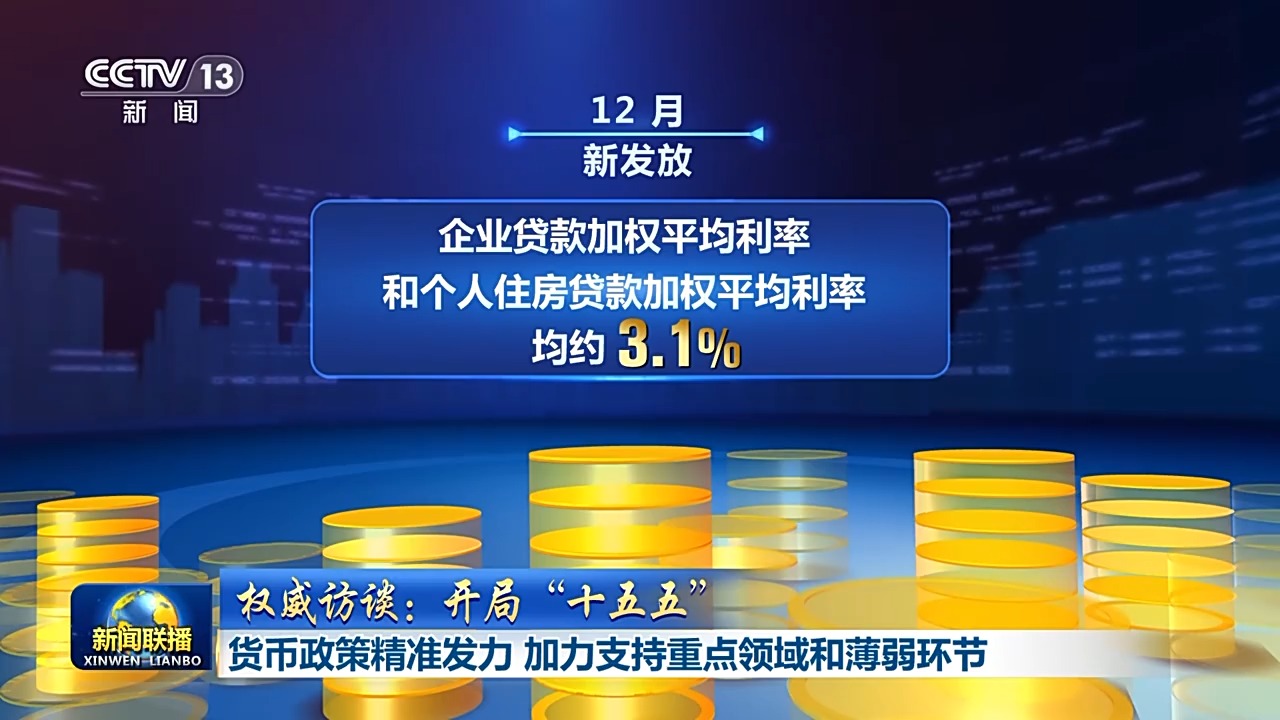
Core Viewpoint - The People's Bank of China (PBOC) is committed to implementing a moderately accommodative monetary policy to support economic growth and maintain financial stability, with specific measures outlined for 2026 [1][2]. Group 1: Monetary Policy and Financial Stability - The PBOC aims for social financing scale and broad money supply to significantly exceed nominal GDP growth by 2025, ensuring reasonable growth in financial totals [1] - As of December, the average weighted interest rates for new corporate loans and personal housing loans are approximately 3.1%, indicating low financing costs [1] - The PBOC plans to maintain ample liquidity and match the growth of social financing and money supply with economic growth and price level expectations [1] Group 2: Support for Key Sectors - Financial institutions will be guided to enhance support for expanding domestic demand, technological innovation, and small and micro enterprises [2] - A total of 500 billion yuan will be allocated for service consumption and elderly care re-loans, addressing diverse financial needs in the consumption sector [2] - The re-loan quota for technological innovation and technological transformation will be increased to 1.2 trillion yuan, promoting the development of the bond market's "technology board" [2] Group 3: Financial System Opening and Internationalization - The PBOC will deepen institutional opening in the financial sector and advance the internationalization of the renminbi [3] - Efforts will be made to build a multi-channel, comprehensive, secure, and efficient cross-border payment system for the renminbi [3] - The PBOC will enhance international cooperation in cross-border payments and strengthen regulatory capabilities to ensure national financial security [3]
节前累库时段,期价震荡走势
Tong Guan Jin Yuan Qi Huo· 2026-01-26 01:54
Report Industry Investment Rating - No relevant content provided Core Viewpoints - The People's Bank of China will continue to implement a moderately loose monetary policy in 2026, with room for reserve requirement ratio cuts and interest rate cuts. The steel market is currently in a weak supply - demand balance, and steel prices are expected to fluctuate mainly [1][4]. - Affected by seasonal demand, market transactions have weakened. Last week's industrial data was average, with stable production of five major steel products, declining apparent demand, and gradual inventory accumulation. The production of rebar rebounded, apparent demand declined, and both factory and social inventories increased. The inventory of hot - rolled coils decreased slightly, with little data change [1][5]. Summary by Directory 1. Transaction Data | Contract | Closing Price | Change | Change Rate (%) | Total Volume (Lots) | Total Open Interest (Lots) | Price Unit | | --- | --- | --- | --- | --- | --- | --- | | SHFE Rebar | 3142 | - 21 | - 0.66 | 4363197 | 2373958 | Yuan/ton | | SHFE Hot - Rolled Coil | 3305 | - 10 | - 0.30 | 1840077 | 1453320 | Yuan/ton | | DCE Iron Ore | 795.0 | - 17.0 | - 2.09 | 1409932 | 566469 | Yuan/ton | | DCE Coking Coal | 1157.0 | - 14.0 | - 1.20 | 5090547 | 657580 | Yuan/ton | | DCE Coke | 1722.0 | 5.0 | 0.29 | 98670 | 39991 | Yuan/ton | [2] 2. Market Review - Last week, steel futures fluctuated and adjusted. Seasonally weak demand pressured steel prices, but as the macro - situation improved and market sentiment stabilized, steel prices rebounded. They first fell and then rose during the week, with the overall center of gravity declining slightly. In the spot market, the price of Tangshan billet was 2940 (- 30) yuan/ton, Shanghai rebar was quoted at 3270 (- 30) yuan/ton, and Shanghai hot - rolled coil was 3290 (- 10) yuan/ton [4]. - In 2025, national real estate development investment was 8278.8 billion yuan, a 17.2% decrease from the previous year. The housing construction area of real estate development enterprises was 659.89 million square meters, a 10.0% decrease; the new housing construction area was 58.77 million square meters, a 20.4% decrease; the housing completion area was 60.348 million square meters, an 18.1% decrease; the sales area of newly - built commercial housing was 881.01 million square meters, an 8.7% decrease; and the sales volume of newly - built commercial housing was 8393.7 billion yuan, a 12.6% decrease [4]. 3. Industry News - No relevant content provided 4. Related Charts - The report includes charts on the futures and monthly spreads of rebar and hot - rolled coils, the basis of rebar and hot - rolled coils, the regional price differences of rebar and hot - rolled coil spot, the smelting profits of long - process steel mills, the profits of short - process electric furnaces in the East China region, the blast furnace operating rate of 247 national steel mills, the daily average hot - metal output of 247 steel mills, the production, inventory, and apparent consumption of rebar and hot - rolled coils, etc. [8][10][12][14][16][21][22][25][27][33][35][39]
央行行长潘功胜:今年降准降息还有一定的空间
2 1 Shi Ji Jing Ji Bao Dao· 2026-01-25 14:16
Core Viewpoint - The People's Bank of China (PBOC) is set to implement a moderately accommodative monetary policy in 2026, focusing on maintaining liquidity and aligning social financing and money supply growth with economic growth and price level expectations [4][10]. Monetary Policy Implementation - The PBOC will utilize various monetary policy tools such as reserve requirement ratio (RRR) cuts and interest rate reductions to ensure ample liquidity [4][10]. - There is still room for further RRR cuts and interest rate reductions this year [4][10]. Financial Sector Focus - Financial institutions will be guided to support key areas such as domestic demand expansion, technological innovation, and small and micro enterprises [5][12]. - A total of 500 billion yuan will be allocated for consumption and pension-related re-loans, while the quota for technological innovation and transformation re-loans will be increased to 1.2 trillion yuan [5][15]. Support for Small and Micro Enterprises - The PBOC aims to enhance the accessibility and convenience of financing for small and micro enterprises by increasing the re-loan and rediscount quotas by 500 billion yuan, bringing the total to 4.35 trillion yuan [6][14]. - A dedicated 1 trillion yuan re-loan will be established to specifically support private small and micro enterprises [6][14]. Cross-Border Payment System - The PBOC is committed to developing a multi-channel, comprehensive, secure, and efficient cross-border payment system for the renminbi [8][17]. - There will be an emphasis on international cooperation in cross-border payments and active participation in international financial governance [8][17].
货币政策精准发力 加力支持重点领域和薄弱环节
Xin Lang Cai Jing· 2026-01-25 13:05
Core Viewpoint - The People's Bank of China (PBOC) is committed to implementing a moderately accommodative monetary policy to support economic growth and maintain financial stability, with a focus on key areas such as domestic demand, technological innovation, and small and micro enterprises. Group 1: Monetary Policy Implementation - In 2026, the PBOC will continue to implement a moderately accommodative monetary policy, ensuring that the growth of social financing and money supply aligns with economic growth and price level expectations [5] - The average interest rates for new corporate loans and personal housing loans are approximately 3.1%, with social financing costs remaining low [3] - There is still room for further reductions in reserve requirements and interest rates this year [5] Group 2: Financial Support Focus Areas - Financial institutions will be guided to enhance support for expanding domestic demand, technological innovation, and small and micro enterprises [7] - A total of 500 billion yuan will be allocated for consumer services and pension re-loans to meet diverse financial needs in the consumption sector [7] - The quota for re-loans for technological innovation and technological transformation will be increased to 1.2 trillion yuan, promoting the development of the bond market's "technology board" [7] Group 3: Support for Small and Micro Enterprises - The PBOC aims to improve the accessibility and convenience of financing for small and micro enterprises, increasing the re-loan and rediscount quota for agricultural and small enterprises by 500 billion yuan, totaling 4.35 trillion yuan [9] - A dedicated 1 trillion yuan re-loan for private enterprises will be established to specifically support small private enterprises [9] - Financial institutions will be encouraged to issue financial bonds for small and micro enterprises and improve the credit enhancement system for private small and medium-sized enterprises [9] Group 4: Internationalization and Payment Systems - The PBOC will continue to build a multi-channel, comprehensive, safe, and efficient cross-border payment system for the renminbi [11] - There will be an emphasis on enhancing international cooperation in cross-border payments and actively participating in international financial governance [11] - The PBOC will strengthen regulatory capabilities to match high-level openness and firmly safeguard national financial security [11]
金融大家评 | 2026年全球货币政策展望
清华金融评论· 2026-01-24 10:12
Core Viewpoint - The article emphasizes the importance of maintaining a moderately loose monetary policy in China for 2026, highlighting its role in stabilizing market confidence and supporting the recovery of the real economy [2][7]. Group 1: Monetary Policy Implementation - The preference for reserve requirement ratio (RRR) cuts over interest rate cuts is noted, as RRR cuts are seen to better align with fiscal policy and enhance the liquidity of commercial banks [3]. - The current economic conditions suggest that significant interest rate cuts may not be feasible due to low elasticity of consumption and investment to interest rates [3][4]. - There is still some room for interest rate cuts, primarily due to low price levels and a stable RMB exchange rate, which supports gradual reductions [4]. Group 2: Structural Changes in Monetary Policy - The monetary policy's target function is expected to evolve, focusing on "broad credit" rather than merely increasing loans to households and enterprises [5]. - The central bank is likely to maintain a "quantity easing, price stability" approach, with a focus on medium to long-term funding [5][6]. - The anticipated reduction in the RRR is limited, with expectations of only one 50 basis point cut in 2026, likely occurring in the first quarter [6]. Group 3: Economic Implications of Monetary Policy - The continuation of a moderately loose monetary policy is crucial for managing expectations and promoting stable economic growth, especially in light of persistent supply-demand imbalances [7][8]. - The policy aims to boost confidence among business entities and financial institutions, thereby creating a favorable financial environment for growth [8]. - The low inflation environment and the need to address demand contraction are key reasons for the implementation of this monetary policy [8][9]. Group 4: Global Monetary Policy Outlook - The global monetary policy landscape is shifting towards a "multi-speed" approach, with major central banks adopting cautious and differentiated strategies [11]. - The Federal Reserve is expected to slow its rate cuts, while the European Central Bank may maintain current rates due to stable economic conditions [11][12]. - Japan is projected to cautiously increase interest rates, reflecting a shift from ultra-loose monetary policy as economic conditions improve [12][13].

“十五五”开局之年,适度宽松的货币政策如何发力?165秒快速了解↓
Yang Shi Wang· 2026-01-24 06:09
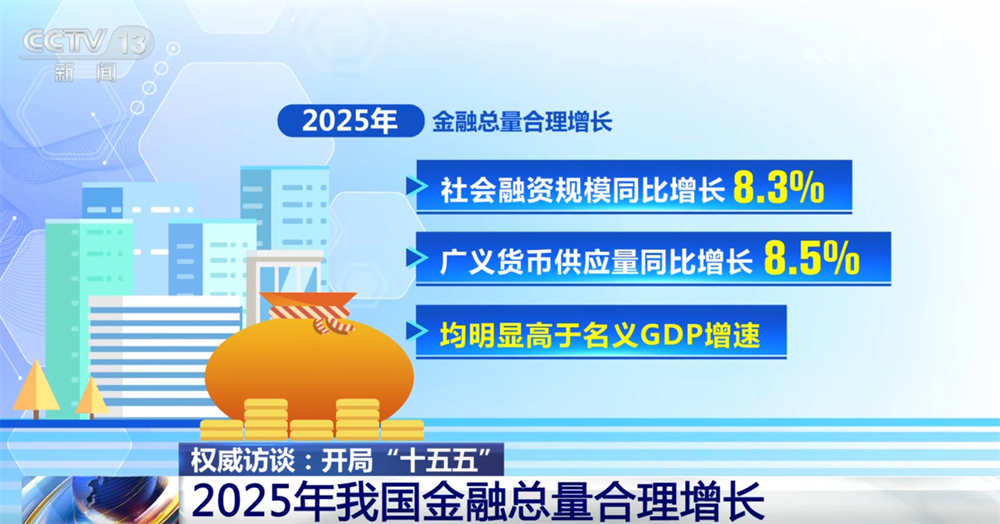
Core Viewpoint - The People's Bank of China (PBOC) is committed to implementing a moderately accommodative monetary policy to support economic stability and reasonable price recovery during the 14th Five-Year Plan period [5][14]. Group 1: Monetary Policy and Financial Growth - By 2025, China's financial total is expected to grow reasonably, with a social financing scale increase of 8.3% year-on-year and a broad money supply growth of 8.5%, both significantly higher than the nominal GDP growth rate [2]. - The PBOC will continue to implement a moderately accommodative monetary policy in 2026, focusing on promoting stable economic growth and reasonable price recovery as key considerations [5][7]. Group 2: Financial Market Stability - The financial market is operating stably, with the RMB maintaining basic stability against a basket of currencies, and the 10-year government bond yield stabilizing around 1.8% to 1.9% [4]. - The PBOC aims to keep liquidity ample, ensuring that the growth of social financing and money supply aligns with economic growth and price level expectations [7][14]. Group 3: Support for Key Sectors - In 2026, the PBOC plans to increase the quota for re-lending for technological innovation and technological transformation from 800 billion yuan to 1.2 trillion yuan, enhancing support for key areas such as domestic demand expansion and small and medium-sized enterprises [8]. - The PBOC will also increase the re-lending and rediscounting quota for agricultural and small enterprises by 500 billion yuan to 4.35 trillion yuan, with a dedicated 1 trillion yuan for private enterprises [10]. Group 4: Internationalization and Open Financial Services - The PBOC will continue to promote high-level openness in the financial services industry and financial markets while advancing the internationalization of the RMB in 2026 [11]. - Efforts will be made to build a multi-channel, comprehensive, safe, and efficient cross-border payment system for the RMB, enhancing international cooperation in cross-border payments [13]. Group 5: Interest Rate and Exchange Rate Mechanisms - The PBOC will improve the market-oriented interest rate formation, regulation, and transmission mechanisms, ensuring smooth transmission from central bank policy rates to market benchmark rates [16]. - The PBOC will also enhance the RMB exchange rate formation mechanism, maintaining the decisive role of the market while preventing excessive fluctuations in the exchange rate [16].
湖北2025年新增贷款超6700亿元
Sou Hu Cai Jing· 2026-01-24 01:49
Core Insights - The financial system in Hubei Province has shown continuous growth in 2025, with significant support for the real economy, as evidenced by an increase in various loans and social financing scale [1][2] Group 1: Financial Growth and Support - In 2025, Hubei Province's total financial volume grew, with new loans in both domestic and foreign currencies amounting to 673.2 billion yuan, an increase of 98.7 billion yuan year-on-year [1] - The cumulative increase in the social financing scale reached 1.09 trillion yuan, marking the fourth consecutive year of exceeding one trillion yuan [1] - By the end of 2025, the total asset scale of financial institutions in the province reached 12.9 trillion yuan, a year-on-year growth of 7.27% [1] Group 2: Loan Structure Optimization - The average interest rate for corporate loans in Hubei Province was 3.09%, a decrease of 43 basis points year-on-year, indicating a decline in financing costs [1] - Loans in key areas such as technology finance, green finance, inclusive finance, pension finance, and digital finance reached 3.91 trillion yuan by November 2025, a year-on-year increase of 15.9%, accounting for 80.1% of all new loans [2] - Notably, loans for the pension industry saw a staggering year-on-year growth rate of 200.6% [2] Group 3: Financial Innovation and Policy Effectiveness - Financial reforms have introduced new highlights, including the exploration of "three-value" credit loans to alleviate financing difficulties for technology and small and micro enterprises [2] - By the end of 2025, the balance of re-loans and rediscounts for supporting agriculture and small businesses reached 114.6 billion yuan, a year-on-year increase of 50% [2] - The total amount of policy funds disbursed in 2025 reached a historical high of 201.7 billion yuan [2]