
新能源

Search documents
泉果基金刚登峰:十六载穿越牛熊的投资进化论
中国基金报· 2026-01-12 02:26
Core Viewpoint - The article emphasizes the investment philosophy of a seasoned investor, Gang Dengfeng, who focuses on long-term value creation through a solid research framework and macroeconomic understanding, particularly in the context of China's economic transition and the opportunities in technology, new energy, and cyclical industries [1][10]. Group 1: Investment Philosophy - Gang Dengfeng has developed an investment framework that combines macroeconomic research with industry analysis, focusing on capturing industry trends to identify investment opportunities [1][4]. - The core selection criteria for stocks include "good companies," which are defined by their competitive advantages, business models, governance structures, and profitability [4][5]. - The investment approach has evolved to emphasize the importance of industry trends, recognizing that companies in upward-trending industries can leverage their competitive strengths to generate shareholder returns [5][7]. Group 2: Market Outlook - The current economic transition in China is nearing completion, with diminishing impacts from real estate shocks and a more diversified export structure, creating a favorable investment environment in A-shares and Hong Kong stocks [10][11]. - The focus for future investments will be on three main areas: technology, new energy, and cyclical stocks, with technology being the most critical driver of the upcoming bull market [11][12]. - In the technology sector, key areas of interest include consumer electronics benefiting from AI integration, domestic computing power infrastructure, and AI-driven products in the internet and software space [11][12]. Group 3: Industry Insights - In the new energy sector, there is a focus on the lithium battery supply chain, which is expected to experience growth due to strong demand for energy storage, with certain material segments entering a price increase cycle [12][13]. - The cyclical sector, particularly non-ferrous metals, is showing strength due to improved supply-demand fundamentals, with industrial metals like copper and aluminum expected to see price stability and potential upward trends [13]. - Traditional industries such as chemicals and paper are also showing signs of recovery after capacity reductions, leading to improved competitive dynamics and potential price elasticity [13].


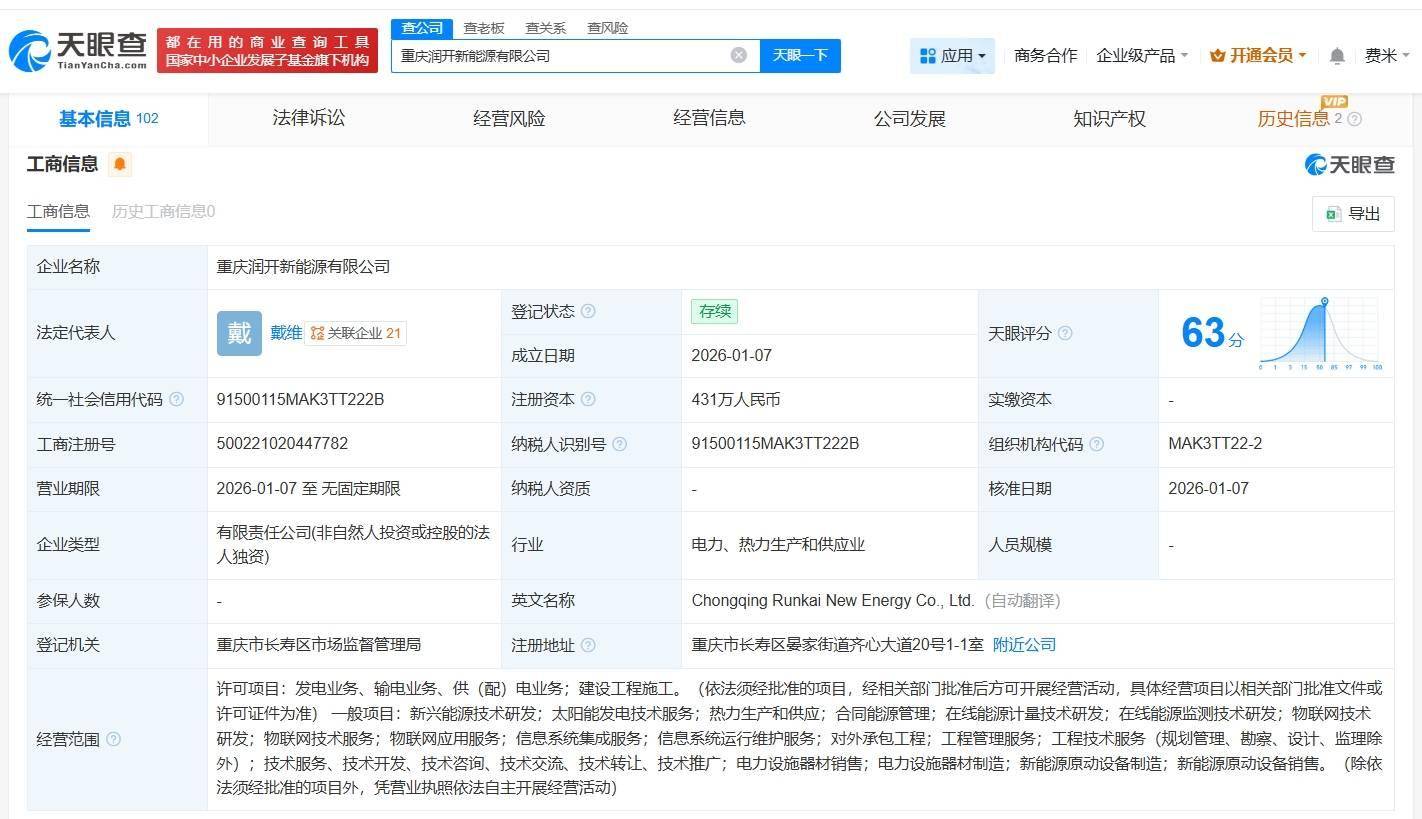
宁德时代在重庆成立新能源公司 注册资本431万
Sou Hu Cai Jing· 2026-01-12 01:49
Group 1 - Chongqing Runkai New Energy Co., Ltd. has been established with a registered capital of 4.31 million RMB, focusing on power generation, transmission, and emerging energy technology research and development [1][2] - The company is wholly owned by Times Green Energy Co., Ltd., which is a wholly-owned subsidiary of Contemporary Amperex Technology Co., Ltd. (CATL) [1][2] - The business scope includes solar power generation technology services, energy management contracts, and online energy metering technology research and development [2]

1.12盘前速览 | 20万颗卫星申请创纪录!AI热点扩散,沪指放量破4100
Jin Rong Jie· 2026-01-12 01:46
【卫星互联网】 国家级战略:我国向国际电联申请超20万颗卫星频轨资源,专家解读此举标志卫星资源申请上升至国家 战略层面。 国内外进展:美FCC批准SpaceX部署7500颗二代星;上海、海南等地推进商业火箭及回收技术;国内多 款新火箭计划近期首飞。 应用与畅想:SpaceX在伊朗开通星链;NASA载人绕月任务计划2月发射;《人民日报》文章提及"南天 门计划"概念。 相关ETF: 卫星产业ETF(场内:159218) 【人工智能】 模型进展:DeepSeek V4或于春节发布,聚焦编程能力;行业领袖热议AI范式演进与模型"品味"竞争。 相关ETF: 云计算ETF(场内:159890,场外:021716)、软件龙头ETF(场内:159899,场外:018385)、 半导体设备ETF(场内:561980,场外:020464)、TMT50ETF(场内:159909,场外:004409) 产业生态:马斯克宣布一周内开源X平台推荐算法;沃尔玛将商品购物集成至Gemini;Meta成为全球最 大核能买家。 硬件与供应:闪迪要求客户预付全款锁定未来1-3年存储芯片配额;卖方提示部分光模块上游物料面临 硅光替代带来的过剩压力。 ...
强势品种回调,锂价仍在高位运行
Yin He Qi Huo· 2026-01-12 01:29
1. Report's Industry Investment Rating - Not provided in the content 2. Core Viewpoints of the Report - In the industrial aspect, the off - season for terminal demand is coming, but vehicle sales from January to February may be better than expected due to factors such as early national subsidy distribution, car companies' support for vehicle purchase tax, etc. Energy storage demand grows steadily limited by production capacity. There may be a rush to export lithium batteries in the first quarter due to the reduction of export tax rebates after April 1st. On the supply side, imported concentrates of traders are arriving at ports, but high lithium ore prices and high - level operation of lithium salt plants limit supply growth, and January supply may be flat month - on - month. Inventory also supports prices. In the futures aspect, although a recent meeting aimed to suppress over - expansion of lithium battery production capacity, the market is still strong, and lithium prices may continue to rise due to the expected rush to export. In the medium - to - long - term, the idea of buying on dips is recommended [5] 3. Summary According to the Table of Contents Demand Analysis New Energy Vehicles - Off - season but Better than Expected - From January to November 2025, domestic new energy vehicle sales reached 1.2466 billion, a year - on - year increase of 23.2%. The off - season from January to February has the lowest vehicle sales, but factors like early national subsidy distribution and car companies' support for purchase tax may make the seasonality of power batteries stronger than expected. Power cell production follows the trend of new energy vehicle sales, with a cumulative year - on - year increase of 41.9% to 1245.5GWh from January to December, and a 6.1% month - on - month decline in ternary power in January [11] New Energy Vehicles - Differentiated Electrification Progress in Europe and the US - From January to November 2025, global new energy vehicle sales increased by 20.1% year - on - year to 1.839 billion. European sales increased by 29.2% year - on - year to 3.434 million, while US sales increased by only 0.7% year - on - year to 1.39 million. The US取消IRA新能源汽车补贴 led to an early sales peak, while European countries' subsidies and carbon emission requirements stimulated sales growth. China's new energy vehicle exports from January to November 2025 reached 2.283 million, a year - on - year increase of 100% [15] Energy Storage Market - Strong Orders but Production Capacity Bottlenecks Limit Scheduling Growth - In 2025, China's energy storage cell production reached 529.4GWh, a year - on - year increase of 54%. Energy storage cell inventory is at a three - year low, and the delivery cycle is extended. Scheduling in January increased by 1% month - on - month [20] January Downstream Scheduling Weakens but May be Revised Upward - In December 2023, battery production increased by 3.5% month - on - month, while in January 2024, it decreased by 5.9% month - on - month. Cell production also showed different trends in December and January. In January, affected by weak power demand, the off - season continued, but it may be revised upward due to the expected rush to export, with a continued month - on - month decline expected in February [27] Supply Analysis Stable but Slightly Declining Lithium Carbonate Production - In January, due to the maintenance of some smelters, production scheduling decreased by 1.2% month - on - month. From January to December, domestic lithium carbonate production reached 871,000 tons, a cumulative year - on - year increase of 44%. This week, mica - based lithium production decreased, but other raw material production made up for it, keeping the production relatively stable [32] China's Monthly Lithium Carbonate Production by Raw Material - Not elaborated further in the content other than presenting relevant charts January Supply of Lithium Carbonate Declines Marginally - From January to November 2025, China's lithium carbonate imports were 219,000 tons, a year - on - year increase of 6%. In November, Chile's total lithium carbonate exports decreased. It is expected that both lithium concentrate imports and lithium carbonate imports will decline month - on - month in January [41] Supply - Demand Balance and Inventory Lithium Carbonate Supply - Demand Balance Estimation - Not elaborated further in the content other than presenting relevant charts Lithium Carbonate Turns to Inventory Accumulation - This week, social inventory increased by 337 tons, turning to inventory accumulation for the first time in 20 weeks. Upstream and downstream destocking led to accelerated inventory accumulation in the trading sector [44]
广州加速布局商业航天,1-11月全球动力电池同比增长33%【电新周报260111】
Xin Lang Cai Jing· 2026-01-12 01:19
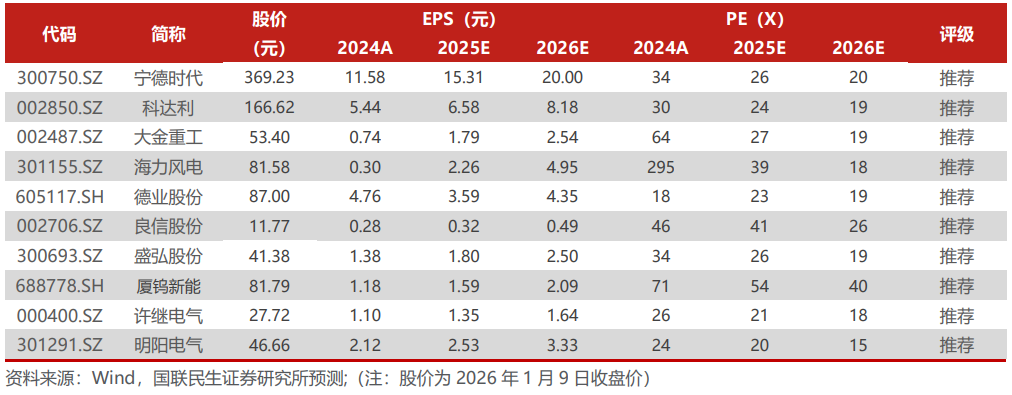
Industry Overview - The electric power equipment and new energy sector rose by 5.02% this week, ranking 13th in terms of performance, outperforming the Shanghai Composite Index [48][59] - The nuclear power index saw the highest increase at 7.47%, while the lithium battery index had the smallest rise at 1.14% [50][59] New Energy Vehicles - In the period from January to November 2025, global power battery installation reached 1046 GWh, marking a year-on-year growth of 32.60% [2][8] - CATL led the market with 400 GWh, followed by BYD with 175.2 GWh and LG Energy with 96.9 GWh [2][9] - Hive Energy showed significant growth with an installation volume of 27.5 GWh, up 85.60% year-on-year [2][9] New Energy Generation - The Ministry of Finance announced the cancellation of the VAT export rebate for photovoltaic products starting April 1, 2026, with a reduction in the rebate rate for battery products from 9% to 6% until the end of 2026 [3][15] - The cancellation of export rebates is expected to increase direct costs for companies and reduce price competitiveness [3][15] Electric Power Equipment and Automation - The National Development and Reform Commission and the National Energy Administration plan to enhance grid construction, aiming to establish a new type of grid platform by 2030 [4][61] - The new grid platform will significantly improve resource allocation capabilities, with a target of over 420 million kW for the "West-to-East Power Transmission" project [4][61] Commercial Aerospace - China submitted an application for an additional 203,000 satellites to the International Telecommunication Union, which includes 14 satellite constellations [4][32] - This increase in satellite applications is expected to stimulate demand for rockets and satellites, positively impacting the industry chain [4][32] Key Companies to Watch - Companies of interest this week include CATL, Keda, Dajin Heavy Industry, Haili Wind Power, Deye Shares, Liangxin Shares, Shenghong Shares, Xiamen Tungsten New Energy, XJ Electric, and Mingyang Electric [5][62]

基金早班车丨首周46只新基齐发,科技消费赛道抢占2026风口
Sou Hu Cai Jing· 2026-01-12 00:39
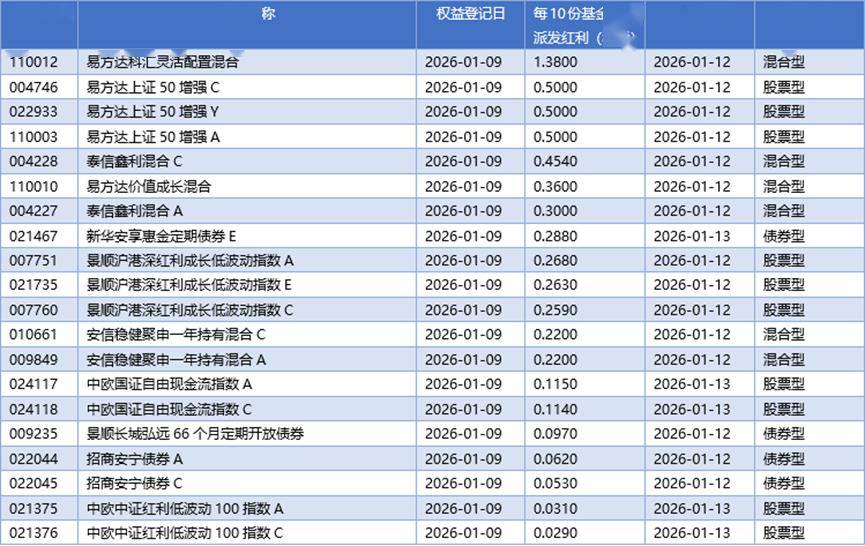
Group 1: Market Overview - In the first trading week of 2026, 46 new funds were launched, with 16 equity mixed funds and 10 passive index funds, making equity funds account for nearly 60% of the total [1] - On January 9, A-shares saw a significant increase, with the Shanghai Composite Index rising by 37.45 points (0.92%) to close at 4120.43 points, and the Shenzhen Component Index increasing by 160.67 points (1.15%) to 14120.15 points [1] - The total trading volume of the Shanghai and Shenzhen stock exchanges reached 31,227.67 billion yuan, marking the first time this year that the volume exceeded 30 trillion yuan, and the fifth occurrence in history [1] Group 2: Fund News - On January 9, six new funds were launched, primarily bond funds and funds of funds (FOF), with the Southern Huayi Stable Income Bond A aiming to raise 5 billion yuan [2] - A total of 20 funds distributed dividends, with the highest dividend payout being 1.38 yuan per 10 shares from the E Fund Ke Hui Flexible Allocation Mixed Securities Investment Fund [2] - Regulatory authorities have mandated that fund companies allocate more QDII quotas to public funds, aiming to reduce the proportion of separate accounts by half by the end of 2026 and to below 20% by the end of 2027 [2] Group 3: Investment Strategies - The consensus among public fund strategies indicates that technology sectors such as AI and semiconductors remain the core focus, while new energy and resource products are also seen as valuable for allocation amid economic recovery and expectations of RMB appreciation [3] - Institutions plan to explore profit elasticity along the "wind-solar-storage + lithium battery materials" and "copper-aluminum-gold" chains, forming a diversified portfolio of technology offensive and cyclical defensive strategies [3]
中信建投:央国企改革进入纵深推进阶段
Zheng Quan Shi Bao Wang· 2026-01-12 00:05
Core Viewpoint - The report from CITIC Construction Investment indicates that the reform of central state-owned enterprises (SOEs) will deepen from late 2025 to early 2026, focusing on professional restructuring, strategic upgrades, and industrial synergy [1] Group 1: Restructuring and Integration - The vertical integration of Sinopec and China Aviation Oil serves as a benchmark, creating a comprehensive "refining-storage-distribution" system [1] - This integration not only aligns with the policy direction of SOE reform but also addresses the industry's pain points regarding insufficient collaboration in aviation fuel [1] Group 2: Competitive Advantage and Supply Security - The restructuring enhances international competitiveness and supply security capabilities [1] - The establishment of a Sustainable Aviation Fuel (SAF) industrial ecosystem supports the low-carbon transition of the aviation industry [1] Group 3: Focus Areas for Future Development - Central SOEs are concentrating on intelligent, green, and integrated transformations, leveraging the "14th Five-Year Plan" to expand into emerging industries [1] - Key focus areas include new energy, 6G technology, and biobreeding [1]


加速!新能源重卡跑向中长途
Xin Hua Wang· 2026-01-11 23:32
Core Insights - The rapid growth of the new energy heavy truck market is driven by policy support, cost advantages, and expanded application scenarios, with sales reaching over 180,000 units in the first 11 months of 2025, a nearly twofold increase year-on-year [1][2]. Group 1: Market Dynamics - The market focus has shifted towards new energy vehicles, with traditional fuel heavy truck sales declining as old vehicles are replaced due to policy incentives [2]. - New energy heavy truck sales by China National Heavy Duty Truck Group increased by 233% in 2025, with total production and sales exceeding 300,000 units [2]. - The application scenarios for new energy heavy trucks have expanded beyond fixed routes to include diverse logistics needs, with significant penetration in short-distance and medium-distance transport [2][3]. Group 2: Cost and Infrastructure Advantages - The cost per kilometer for new energy heavy trucks is approximately 1 yuan, compared to 2.5-3 yuan for diesel trucks, leading to annual savings of around 270,000 yuan based on average mileage [3]. - Government policies, including subsidies for scrapping old vehicles and incentives for purchasing new energy trucks, are effectively driving market growth [3][4]. - Infrastructure improvements, such as the deployment of charging stations and battery swap stations, are enhancing refueling efficiency, with super-fast charging capabilities allowing for 400 kilometers of range in just 15 minutes [4]. Group 3: Challenges and Future Outlook - Despite the growth, challenges remain in scaling up new energy heavy trucks for long-distance transport, with current applications primarily limited to short-distance scenarios [5]. - The Ministry of Transport is committed to promoting the large-scale development of new energy transport equipment, emphasizing the importance of transitioning from older vehicles to low-emission options [6]. - Companies are increasing R&D efforts and forming partnerships to advance technology in new energy heavy trucks, focusing on battery innovations and hydrogen fuel cell applications [7].
政策助力、优势凸显、场景拓宽 加速!新能源重卡跑向中长途(经济聚焦)
Ren Min Ri Bao· 2026-01-11 21:59
Core Insights - The rapid growth of the new energy heavy truck market is driven by the replacement of old fuel trucks and supportive government policies, with sales reaching over 180,000 units in the first 11 months of 2025, a nearly twofold increase year-on-year [1][2]. Market Dynamics - The market focus has shifted towards new energy vehicles, with traditional fuel truck sales declining. In 2025, a heavy truck dealer reported selling over 200 new energy trucks, while traditional fuel truck sales decreased [2]. - The sales volume of new energy heavy trucks from China National Heavy Duty Truck Group increased by 233% year-on-year, surpassing 300,000 units [2]. Application Scenarios - New energy heavy trucks are expanding beyond fixed routes in ports and mines to more diverse applications, including logistics and freight transport over distances up to 500 kilometers [2]. - The penetration rate of new energy heavy trucks in short-distance transport scenarios has reached 74% [2]. Cost Advantages - The cost of operating new energy heavy trucks is significantly lower, with energy costs around 1 yuan per kilometer compared to 2.5-3 yuan for diesel trucks. This translates to annual savings of approximately 270,000 yuan based on average annual mileage [3]. - Government incentives, such as subsidies for scrapping old vehicles and purchasing new energy trucks, further enhance the cost-effectiveness of new energy heavy trucks [3]. Infrastructure Development - The establishment of charging stations and battery swap stations along logistics routes has improved refueling efficiency, with super-fast charging capabilities allowing for 400 kilometers of range in just 15 minutes [4]. - The current infrastructure still faces challenges, particularly in expanding the use of new energy heavy trucks for medium to long-distance transport [5]. Future Outlook - The Ministry of Transport is committed to promoting the large-scale development of new energy transport equipment, with policies supporting the replacement of older trucks with low-emission vehicles [6]. - Technological advancements are needed in battery systems and hydrogen fuel cells to support the growth of new energy heavy trucks [6][7]. - Leading manufacturers are increasing R&D efforts and collaborating with academic and industry partners to drive innovation in new energy heavy truck technology [7].
宏观“解构者”的守正与创新
Zhong Guo Zheng Quan Bao· 2026-01-11 20:49
Core Viewpoint - The investment strategy of Yin Ye Investment, led by Chief Investment Officer Xu Siyang, emphasizes a transition from a "bond expert" to a "multi-strategy allocation expert" in response to the evolving asset management landscape and declining risk-free returns [1][2]. Group 1: Investment Philosophy - The fundamental principle of asset management is to manage clients' finances effectively, while the methods to achieve this must continuously evolve [1]. - The company adopts a long-term approach based on deep macro research, embracing diverse strategies, and prioritizing absolute returns [1][2]. Group 2: Macro and Micro Research Integration - Xu Siyang's investment framework integrates macroeconomic analysis with micro-level industry insights, emphasizing the importance of understanding the intricate details within industries to identify market-driving variables [2][3]. - The research system at Yin Ye Investment is structured as a dynamic decision-making loop, where macro insights guide industry research, and micro data validate or adjust macro perspectives [3]. Group 3: "Fixed Income +" Strategy - The "Fixed Income +" strategy is central to the company's transformation, recognizing that a single asset class cannot meet clients' needs for stable returns across cycles [4]. - Xu Siyang prefers a combination of "Fixed Income + Quantitative Index Enhancement" for its dual support in risk management and return stability, while acknowledging the need for dynamic adjustments based on market conditions [4][5]. Group 4: Market Outlook for 2026 - For the bond market in 2026, the core contradiction is expected to shift from declining price expectations to marginal upward pressure, influenced by structural supply issues in long-term bonds [6][7]. - The company emphasizes the importance of micro-level industry research to uncover real economic vitality and market opportunities, focusing on cash flow changes and sector-specific improvements [6][7]. Group 5: Strategic Development and Industry Insights - Yin Ye Investment aims to enhance its alpha capabilities in existing areas while expanding its strategy breadth to become a multi-strategy collaborative platform [7]. - The company adheres to a strict development discipline, prioritizing strategy and talent development over rapid asset management scale expansion [7][8].