低利率环境

Search documents
高股息和科技成长双管齐下 “哑铃策略”或仍适配当下行情
Cai Fu Zai Xian· 2025-08-25 05:20
Core Viewpoint - The Shanghai Composite Index has reached a 10-year high, closing at 3825.76 points on August 22, raising concerns about market overheating and sustainability of the rally [1] Group 1: Market Trends - The insurance capital has been actively increasing its stake in the market, with nearly 30 instances of stake increases recorded in 2025, the highest in four years [1] - The focus of these investments is primarily on low-valuation, high-dividend sectors such as banking, public utilities, and energy [1] - The ongoing low interest rate environment and "asset shortage" are driving funds towards high-dividend stocks, particularly in the banking sector [1] Group 2: Investment Strategies - A "barbell" investment strategy is recommended for ordinary investors, balancing low-volatility, high-dividend sectors with high-growth technology sectors [2] - The Huian Zhongzheng Dividend Low Volatility 100 Index Fund is being launched, which tracks a diversified index focused on low volatility and high dividend yield [2] - The index includes stocks from 23 primary industries, mainly concentrated in banking, transportation, and coal, providing a solid equity base for investors [2] Group 3: Fund Performance - Huian Fund offers several high-performing products to help investors capitalize on market trends, including funds focused on AI and technology micro-cap stocks [3] - The Huian Growth Preferred Mixed Fund has received five-star ratings from both China Merchants Securities and Guotai Junan Securities, focusing on AI-related assets [4] - The Huian Multi-Factor Mixed Fund utilizes a quantitative investment approach combined with active equity research to adapt to current market styles and future industry trends [4]
早盘直击|今日行情关注
申万宏源证券上海北京西路营业部· 2025-08-25 02:44
Core Viewpoint - The market demonstrated strong resilience last week, remaining unaffected by external disturbances, indicating its independence from overseas market fluctuations [1] Market Performance - The A-share market continued to rebound, with the Shanghai Composite Index reaching a new high for the current market cycle, closing at its highest point of the year on Friday [1] - The Shenzhen Component Index accelerated its recovery, successfully surpassing the high point from the fourth quarter of last year [1] - Average daily trading volume exceeded 25 billion yuan for two consecutive weeks, indicating significant market activity [1] Investment Trends - The main market focus was on the TMT (Technology, Media, and Telecommunications) and consumer sectors, with technology stocks leading in gains [1] - The low interest rate environment has prompted a gradual shift of deposit funds towards equity assets, contributing to the market's rebound [1] Market Dynamics - The Shanghai Composite Index has surpassed the 2021 market high, with its focus continuing to shift upward [1] - The index broke through the upper boundary of a weekly large box pattern earlier this month, which has now turned from a resistance level into a support level [1] - The market is currently in a process of upward movement within this box pattern [1]


品牌工程指数上周涨4.81%
Zhong Guo Zheng Quan Bao· 2025-08-24 20:10
Market Performance - The market experienced a significant increase last week, with the China Securities Index rising by 4.81% to 1865.89 points [1] - The Shanghai Composite Index rose by 3.49%, the Shenzhen Component Index by 4.57%, the ChiNext Index by 5.85%, and the CSI 300 Index by 4.18% [1] Strong Stock Performances - Notable strong performers included ZTE Corporation, which increased by 32.21%, and Zhaoyi Innovation, which rose by 22.77% [1] - Other significant gainers included Shanghai Jahwa, Zhongji Xuchuang, and Stone Technology, with increases of 18.13%, 17.16%, and 16.09% respectively [1] Mid-Year Performance Highlights - Since the beginning of the second half of the year, Zhongji Xuchuang has surged by 91.21%, leading the gains, followed by Ecovacs with a 56.26% increase [2] - Other stocks that have risen over 40% include Daren Tang, Sunshine Power, and ZTE Corporation [2] Market Sentiment and Liquidity - The current market sentiment and liquidity factors are driving the stock market, with a strong likelihood of continued short-term performance [3] - The low interest rate environment and ample liquidity have led to increased risk appetite among investors, enhancing the market's upward momentum [2] Future Market Outlook - The market is expected to maintain its strong performance in the short term, with basic factors likely to gradually replace liquidity factors in driving market performance [3] - There are still opportunities in lower congestion sectors, which may attract funds as overheated sectors cool down [2]



低利率环境与房地产“止跌回稳”|宏观经济
清华金融评论· 2025-08-23 09:54
Core Viewpoint - China is gradually entering a low-interest-rate environment, which typically leads to asset price bubbles; however, Japan's experience suggests that the effectiveness of low-interest policies in stabilizing the real estate market depends on the speed of interest rate cuts, financial institution support, and fiscal policy coordination [2][3]. Group 1: Causes of Low-Interest Rate Environment - The global low-interest-rate environment is influenced by factors such as declining birth rates in developed economies, aging populations, and changes in risk preferences among investors, which have led to increased demand for safe assets [5][6][8]. - In China, the transition to a low-interest-rate environment is driven by technological advancements reaching their peak and a demographic shift towards negative population growth, with a decrease of 850,000 in 2022 and projected declines in subsequent years [7][8]. Group 2: Comparison of Low-Interest Rate Policies in Japan and the U.S. - Japan's approach to stabilizing its real estate market post-bubble involved solely lowering interest rates without significant fiscal intervention, resulting in a prolonged decline in property prices from 1991 to 2013 [12][13]. - In contrast, the U.S. implemented a comprehensive strategy during the 2008 financial crisis, including aggressive interest rate cuts, government takeovers of key financial institutions, and large-scale asset purchase programs, which quickly stabilized housing prices [14][15]. Group 3: Implications for China's Real Estate Market - The effectiveness of low-interest-rate policies in China for achieving "stop falling and stabilize" in the real estate market remains uncertain, as recent rate cuts have not significantly impacted asset prices or market stability [3][10]. - The comparison with Japan and the U.S. highlights the importance of a multifaceted approach, including fiscal measures and support for financial institutions, to avoid the pitfalls experienced by Japan [11][12].
友邦半年报基本面强韧、投资拖后腿!内地新业务承压催生阵型重构
Sou Hu Cai Jing· 2025-08-22 05:22
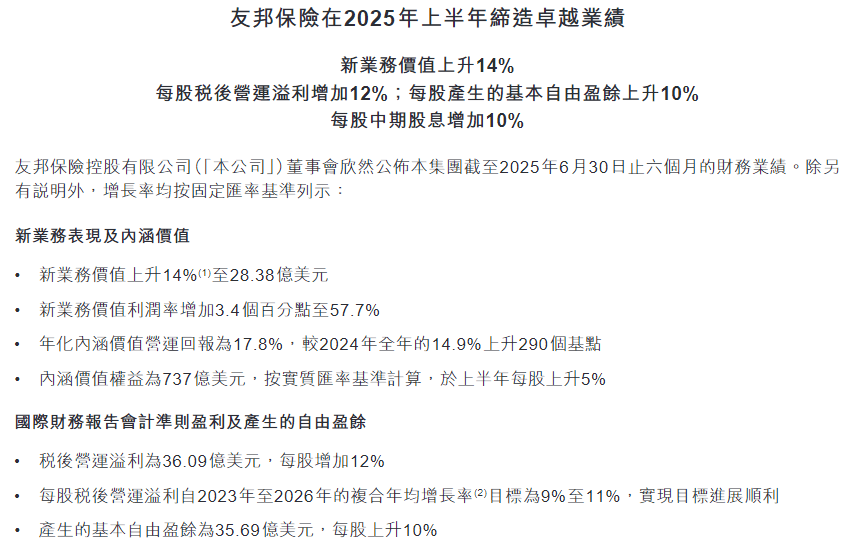
Core Viewpoint - AIA Group reported a 14% year-on-year increase in new business value for the first half of 2025, reaching $2.838 billion, indicating resilience in its operations across the Asia-Pacific region despite challenges in investment performance and a decline in net profit [1][3][6]. Financial Performance - New business value increased by 14% to $2.838 billion, with 13 out of 18 markets showing positive growth [1][3]. - New business value margin improved by 3.4 percentage points to 57.7%, reflecting the company's ability to select high-value business and pricing advantages [1][3]. - After-tax operating profit grew by 6% to $3.609 billion, with earnings per share increasing by 12% [5][6]. - However, net profit fell sharply by 23.5% to $2.534 billion, primarily due to significant investment pressures [2][6]. Market Dynamics - In mainland China, annualized new premiums decreased by 7%, and new business value contracted by 4% after adjustments for market fluctuations [2][10]. - Despite the decline in new premiums, the new business value margin in China rose to 58.6%, indicating a focus on high-value products [10][12]. - The company’s total weighted premiums in mainland China reached $6.774 billion, a 14% increase year-on-year [8][10]. Strategic Developments - AIA has been expanding its market presence, with significant growth in new business value in regions entered since 2019, which increased by 36% [10]. - The company has made strategic adjustments in its product offerings, shifting focus towards participating insurance products to navigate low-interest-rate challenges [10][11]. - AIA's management restructuring aims to enhance strategic focus, with key appointments made in early 2025 [11][12]. Investment Management - AIA has established an asset management subsidiary to improve investment efficiency and address challenges posed by low investment returns [11][12]. - The company aims for a 40% compound annual growth rate in new business value from new regions by 2030, highlighting ambitious growth targets [12].

为什么我不看空债券?
表舅是养基大户· 2025-08-21 13:30
Core Viewpoint - The article discusses the current state of the bond market amidst fluctuations in the stock market, emphasizing a long-term low interest rate environment and its implications for investment strategies in bonds and equities [1][2]. Group 1: Bond Market Analysis - The bond market experienced a decline, with 30-year government bonds dropping over 3 basis points, influenced by the cooling stock market and external interventions affecting bond futures [1][2]. - The article argues that the low interest rate environment is expected to persist, suggesting that there is no significant upward pressure on interest rates in the medium to long term [4][6]. - It highlights that government bonds saw a substantial increase in issuance, with a reported 7.656 trillion yuan in new government bonds in the first half of the year, marking a year-on-year growth of 21.3% [8][12]. Group 2: Investment Strategies - The article advises investors to align their investment choices with their risk tolerance, suggesting that low-risk funds should consider short-term bond funds and fixed-income products as viable options [15]. - It emphasizes maintaining a balanced portfolio between stocks and bonds, indicating that a diversified approach remains a cost-effective strategy [16]. - The article also encourages embracing high-quality equity investments in a low interest rate environment, while recognizing the challenges in identifying and diversifying quality stocks [16]. Group 3: Market Trends and Insights - The article notes the ongoing volatility in the Hong Kong stock market, particularly highlighting the decline of Meituan's stock, which has reached a new low for the year [19]. - It discusses the launch of a new technology-focused ETF by Huaxia, aimed at capturing opportunities in the tech sector amidst market fluctuations [21][22]. - The article concludes with a mention of a global asset allocation strategy that remains open for investment, despite recent market downturns [25].

早盘直击 | 今日行情关注
申万宏源证券上海北京西路营业部· 2025-08-21 02:01
Group 1 - The current market is in a primary upward trend, with a strong bullish atmosphere and high willingness to hold stocks [1] - Key driving factors include loose liquidity and a low interest rate environment, attracting increasing attention and recognition from investors towards the capital market [1] - There is a diverse range of market hotspots, including previously favored sectors like semiconductors and newly emerging targets such as the liquor industry [1] Group 2 - A structural differentiation among individual stocks is noted, with some experiencing high reversals after rapid surges, indicating potential risks [1] - The driving factors for the current market trend remain unchanged, suggesting continued potential for capital inflow and an optimistic outlook for future market trends [1] - Investors are advised to actively respond to the current market, combining fundamental and technical analysis to identify suitable investment targets [1]

低利率突围:投资实力打底,产品创新为尊,新华红运季三款分红险热销中
Sou Hu Cai Jing· 2025-08-19 15:17
Core Viewpoint - The article emphasizes the growing popularity of dividend insurance as a solution for consumers seeking stable returns in a low-interest-rate environment, highlighting the strong performance of Xinhua Insurance in this sector [1][2][3]. Group 1: Market Context - The past three years have seen a decline in life insurance guaranteed interest rates from 3.5% to 2.0%, reducing the appeal of traditional insurance products [2]. - Bank wealth management products have frequently broken net asset value, and money market fund annualized returns have dropped below 1.5%, leading consumers to seek alternatives [2][3]. - With the breakdown of rigid repayment, investors are left with limited "risk-free" options, primarily government bonds and deposits, which do not cover the real costs of education, retirement, and wealth transfer [2]. Group 2: Dividend Insurance Mechanism - Dividend insurance offers a unique mechanism that aligns with consumer demands by providing a guaranteed interest rate while allowing for potential growth through annual dividends based on the company's performance [3][4]. - This product can smooth out returns during market fluctuations through special reserves, making it an optimal solution for both consumers and insurance companies in a low-interest environment [3][4]. Group 3: Xinhua Insurance Performance - Xinhua Insurance's average dividend realization rate for 2024 is reported at 152%, with 56 out of 59 products achieving a realization rate of 100% or more [6][8]. - The company has maintained an average total investment return of 5.13% from 2014 to 2024, with a projected 2024 comprehensive investment return of 8.5% [8][12]. - Xinhua Insurance's solvency ratios are robust, with a solvency adequacy ratio consistently above 200%, ensuring the company can meet its future dividend commitments [8]. Group 4: New Product Launch - Xinhua Insurance has launched three flagship dividend insurance products under the "Xinhua Red Fortune Season," targeting wealth transfer, quality retirement, and lifelong cash flow [10][11]. - The products are designed to address key consumer concerns in a low-interest and aging society, providing a comprehensive wealth management solution [11][12]. - The "Shengshi Glory Smart Win" life insurance product features a steadily increasing coverage amount, while the "Shengshi Anying" pension insurance allows for flexible retirement income [10][11]. Group 5: Strategic Focus - Xinhua Insurance has elevated service to a strategic level, integrating health and wellness services with its insurance offerings, creating a competitive edge in the market [9][12]. - The company aims to transform its investment strength into tangible products and services that meet customer needs, reinforcing its position as a leader in the dividend insurance sector [12][13].

当前市场的三条主线
表舅是养基大户· 2025-08-19 13:24
Core Viewpoint - The article discusses the current market dynamics in A-shares and H-shares, highlighting the differences in investor behavior and market performance between the two, driven by factors such as low interest rates, external economic conditions, and structural imbalances in capital supply and demand [1][6][20]. Market Performance - A-shares continue to show strong performance with nearly 60% of stocks rising, while the overall market capitalization remains above 2.5 trillion [1]. - The financing balance reached a net buy of 39.3 billion, marking the third highest single-day net buy since September 24, indicating strong market enthusiasm [2]. - The brokerage sector saw significant inflows, with the two largest securities ETFs net buying over 1.1 billion, leading to a rally in brokerage stocks [4]. A-shares vs H-shares - A-shares are characterized by a strong influx of capital, leading to bullish market sentiment, while H-shares are experiencing volatility with less decisive capital inflows [5][6]. - The net buying of southbound funds in H-shares was significantly lower at 1.4 billion compared to the previous record of 36 billion, indicating a retreat of short-term trading funds [4][6]. Main Investment Themes - The first main theme is the unprecedented low interest rate environment, which is driving capital into the stock market. Key interest rates, such as the one-year fixed deposit rate, have fallen below 1% [9][10]. - The second theme is the external economic environment, particularly the decline of the US dollar index, which has positively influenced global risk assets, including A-shares [12][14]. - The third theme is the structural imbalance in capital supply and demand, leading to overheating in certain sectors like small-cap stocks and convertible bonds [20][21]. Company Earnings - Several key companies in the Hong Kong market reported earnings that exceeded expectations, with Xiaomi's second-quarter operating profit reaching 13.4 billion, significantly above the forecast of 10.4 billion [27][28]. - The performance of major internet companies like Tencent and Xiaomi remains strong, contributing to the growth of related ETFs [28]. Investment Recommendations - The article suggests monitoring the trends related to the three main themes to gauge future market movements, particularly the low interest rate environment, external economic conditions, and regulatory attitudes towards capital markets [22].


对话浦发银行金融市场总监薛宏立:金融市场业务经营要有穿越周期的视野,建立“双重防波堤”思维
Xin Lang Cai Jing· 2025-08-19 12:00
Group 1: Gold Market Insights - Despite significant gains in gold prices reflecting positive factors, there remains potential for further increases due to global political fragmentation and economic imbalances [1][6] - The volatility of gold prices is expected to increase as prices rise, influenced by geopolitical tensions and economic uncertainties [1][6] - The demand for gold is driven by its anti-inflation properties amid high inflation in the US and increased purchases by central banks in emerging economies [6] Group 2: Interest Rates and Economic Transition - The continuous decline in China's interest rate center is attributed to the transition of the economic structure towards high-quality growth, reducing reliance on debt-driven expansion [7][9] - Low interest rates are beneficial for lowering government debt financing costs, providing more room for fiscal policy implementation, and supporting economic transformation [9] - The current low interest rate environment in China contrasts with high rates in the US and Europe, highlighting a divergence in monetary policy cycles [9] Group 3: Financial Market Strategies - Commercial banks need to adopt a "gold market mindset" and establish a dual defense strategy to manage assets and liabilities effectively [2][10] - The importance of financial market operations is expected to increase, with banks focusing on enhancing trading capabilities and customer service to drive growth [10] - Banks are encouraged to innovate in risk management and investment strategies to adapt to changing market conditions and enhance their service offerings [11] Group 4: Currency and Exchange Rate Management - The RMB has shown resilience against depreciation during trade disputes, with a current exchange rate of approximately 7.18 against the USD, supported by structural adjustments in foreign trade [7][8] - Commercial banks are actively promoting risk-neutral strategies and providing a range of foreign exchange hedging products to help businesses manage currency risks [8] - The RMB's stable performance is influenced by both internal adjustments in trade structure and external factors such as US trade policies [7] Group 5: Bond Market Innovations - The Shanghai Pudong Development Bank (SPDB) is actively involved in the development of the bond market's "technology board," focusing on innovative financing solutions for technology-driven enterprises [12][14] - SPDB has successfully issued various pioneering technology innovation bonds, contributing to the financing of key sectors such as information technology and biotechnology [13][14] - The bank's efforts in the offshore bond market align with national strategies to enhance the international influence of RMB-denominated bonds and support enterprises in global expansion [15]