债券投资

Search documents
中加基金权益周报︱月初资金转松,二永债收益率明显回落
Xin Lang Ji Jin· 2025-07-08 07:12
Market Overview and Analysis - The primary market saw the issuance of government bonds, local bonds, and policy financial bonds amounting to 280.1 billion, 72.1 billion, and 161.0 billion respectively, with net financing of 199.9 billion, 21.6 billion, and 155.0 billion [1] - Non-financial credit bonds had a total issuance of 208.2 billion, with a net financing amount of 84.3 billion [1] - One new convertible bond was issued, expected to raise 0.7 billion [1] Secondary Market Review - Interest rates declined last week, influenced by factors such as the lowest funding rates of the year, the return of wealth management funds, reduced government bond issuance, and the stock-bond relationship [2] Liquidity Tracking - The net withdrawal through Open Market Operations (OMO) was 1.4 trillion, but fiscal spending supplemented liquidity, leading to a noticeable easing of funds at the beginning of the month [3] - Anonymous funds dropped to 1.3%, and one-year government stock certificates fell below 1.6% [3] Policy and Fundamentals - The Central Financial Committee emphasized the need for lawful governance of enterprises to curb low-price disorderly competition [4] - The manufacturing PMI for June recorded at 49.7, surpassing expectations and previous values [4] Overseas Market - The U.S. Congress passed the "Great Beauty" tax reduction bill, and non-farm employment numbers for June exceeded expectations [5] - The S&P 500 rose by 1.7% over the week, while the 10-year U.S. Treasury yield increased by 6 basis points [5] Equity Market - The A-share market saw most broad-based indices rise, driven by strong bank sector performance and favorable news in the innovation drug sector [6] - The Wind All A index increased by 1.22%, the CSI 300 rose by 1.54%, and the ChiNext surged by 1.50% [6] - Daily average trading volume decreased to 1.44 trillion, with a weekly average trading volume drop of 130.2 billion [6] - As of July 3, 2025, the total financing balance for All A reached 1,846.38 billion, an increase of 19.847 billion compared to June 26, marking nine consecutive trading days of net growth [6] Bond Market Strategy Outlook - The government bond supply pressure remains high in Q3, and the overall liquidity is expected to remain loose to support government bond issuance and stabilize growth [7] - Economic growth risks are increasing due to weakened export demand, a downturn in the real estate cycle, and reduced support from new policies [7] - Current bond investments have a high probability of success, but the potential for returns depends on the realization of fundamental expectations [7] - Convertible bonds face supply-demand contradictions, with liquidity remaining relatively loose, but the convertible bond index has reached new highs, indicating a need for careful selection of underlying assets [7]
全市场首批科创债ETF来了!如何把握配置机遇?深度解码创新机遇与挑战
Zhong Guo Ji Jin Bao· 2025-07-07 00:34
日前,公募基金市场迎来重磅新品,首批10只科创债ETF获批。科创债自2021年试点以来,发行不断提 速,正处于快速扩容阶段。截至目前,交易所市场共有科创债1273只,余额超1.3万亿元。 如此快速发展的科创债市场蕴含着怎样的投资机遇?首批科创债ETF的推出有何深远意义?本期《投资 热点说》邀请到鹏华基金现金投资部基金经理张羊城、王中兴,深度解析全市场首批科创债ETF的创新 机遇与挑战。 访谈金句 张羊城:我们建议投资者在配置时关注以下几点:第一,要理解这类ETF的风险收益特征。第二,要关 注成交价格与净值的关系。第三,保持中长期视角。 王中兴:科创债ETF的推出为投资者提供了兼具稳健收益与政策红利的资产配置新选择,既能作为组合 的信用底仓,也可在特定市场环境下发挥收益增强作用。 张羊城:科创债ETF的管理既要"像指数基金一样精确",也要"像信用债基金一样谨慎",还要"像ETF产 品一样高效",需要我们在投研、风控、交易、运营四个层面都高度协同。 在指数成分券的筛选上,核心筛选标准在于"科创属性":指数编制规则的核心是定义"科技创新公司 债"。这通常依据交易所发布的科创债指引,对发行人所属行业(如高新技术、战略 ...
平安债券ETF三剑客交投活跃,公司债ETF(511030)多空胶着,国债ETF5至10年(511020)红盘上扬,机构:紧密关注央行资金面行为
Sou Hu Cai Jing· 2025-07-04 05:33
Group 1 - The company bond ETF (511030) has seen a net value increase of 13.28% over the past five years, with the latest price at 106.09 yuan as of July 2, 2025 [1] - The company bond ETF has reached a new high in scale at 21.826 billion yuan, with a net inflow of 9.48 billion yuan over the last five trading days, averaging 1.90 billion yuan per day [1] - The national debt ETF for 5 to 10 years (511020) has increased by 0.05%, with a five-year net value increase of 20.35% [1] Group 2 - On July 1, the secondary trading of interest rate bonds showed significant buying from rural commercial banks (+56.3 billion yuan), while other banks and brokerages showed net selling [2] - The central bank is expected to maintain a loose monetary policy in July, with limited adjustment risks for interest rate bonds, indicating a narrow fluctuation range [2] - The three main members of the Ping An Fund bond ETF include the company bond ETF (511030), national development bond ETF (159651), and national debt ETF for 5 to 10 years (511020), covering various bond types to assist investors in navigating the bond market cycle [2]
债券型ETF新动向不断!首批科创债ETF快速“通关”,存量规模已破3800亿
Bei Jing Shang Bao· 2025-07-03 14:20
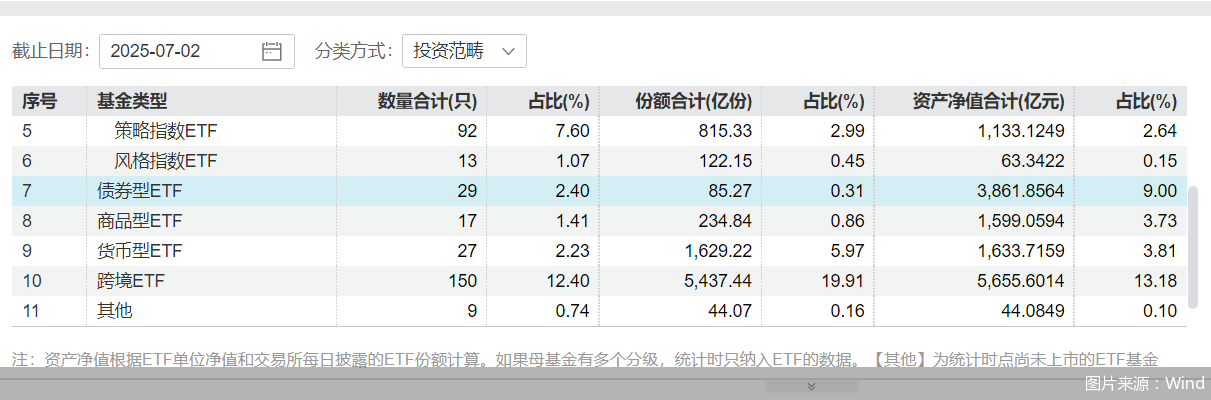
Core Viewpoint - The approval of the first batch of 10 Science and Technology Innovation Bond ETFs marks a significant development in the bond ETF market, which has seen rapid growth in 2023, surpassing 380 billion yuan in total scale, with over 60% of net inflows in the ETF market attributed to bond ETFs [1][6][9]. Group 1: Approval and Launch of Science and Technology Innovation Bond ETFs - The first batch of 10 Science and Technology Innovation Bond ETFs has been officially approved, with a swift approval process of only half a month from the submission of materials [1][3]. - The fund managers of these ETFs have announced that the issuance will start on July 7, with a maximum fundraising scale of 3 billion yuan for each product [4]. - The ETFs will track various indices, including the China Securities AAA Technology Innovation Company Bond Index and the Shanghai Stock Exchange AAA Technology Innovation Company Bond Index [3][4]. Group 2: Growth of Bond ETFs - The total scale of bond ETFs has rapidly exceeded 380 billion yuan, with a significant year-on-year growth of 146.03% as of the end of the first quarter of 2023 [6][9]. - As of July 2, the bond ETF market consists of 29 products, and if the new Science and Technology Innovation Bond ETFs are successfully launched, the total will increase to 39 [6]. - The average annual return of bond ETFs has been stable, with 15 out of 29 products achieving returns exceeding 1% this year [9]. Group 3: Market Dynamics and Investor Sentiment - The growth of bond ETFs is driven by several factors, including their trading advantages, increased demand for safe-haven assets, and policy support [8]. - The bond ETF market has become a new focus for investors, with net inflows accounting for over 60% of total ETF net inflows this year [9]. - The Science and Technology Innovation Bond ETFs are expected to provide investors with convenient tools for allocating high-quality technology innovation company bonds [5][10].

既然股票长期收益率是最高的,那还有必要投资黄金和债券吗?
雪球· 2025-07-03 08:00
Core Viewpoint - The article emphasizes the importance of understanding risks associated with stock investments, highlighting that while stocks may offer higher long-term returns compared to gold and bonds, they also come with significant risks that investors often overlook [2][3]. Group 1: Stock Market Returns and Risks - Over the past 20 years, the annualized return of the CSI 300 index was 7.91%, but it experienced a maximum drawdown of 72.3%. In comparison, the NASDAQ 100 had an annualized return of 14.34% with a maximum drawdown of 53.71% [4]. - The volatility of global stock markets is significant, and while the CSI 300 may show strong gains in certain years, it is often followed by substantial corrections and risks [5]. - Many investors lack the capacity to endure large fluctuations in stock prices, leading them to sell at a loss before recovering from downturns [7]. Group 2: Performance Comparison with Bonds and Gold - In the past decade, gold achieved an annualized return of 13.03%, while the CSI 300 had an annualized return of -1.8%. Over the last three years, the annualized return of Chinese bonds was 4.93%, significantly outperforming the CSI 300's -3.63% [8]. - Stock returns are tied to corporate earnings, which can be adversely affected by economic downturns, industry changes, and policy shifts. During such times, bonds and commodities may perform better due to their low correlation with stocks [8]. Group 3: Investor Behavior and Market Realities - The actual returns for investors differ from theoretical stock market returns, largely due to individual investor behavior. Many investors mistakenly believe they can easily buy low and sell high, which is often an illusion created by hindsight [9]. - Historical trends indicate that only 20% of investors possess the necessary knowledge and strategies to achieve long-term profits, while 80% do not, leading to negative returns [10]. Group 4: Investment Strategy and Asset Allocation - A balanced investment strategy that includes stocks, bonds, and commodities can enhance risk-adjusted returns. For example, a portfolio consisting of 60% stocks, 30% bonds, and 10% gold showed a cumulative return of over 100% in the past seven years, with a maximum drawdown of only 7.67% [10][12]. - The proposed investment allocation includes 60% in equity funds, 30% in bond funds, and 10% in commodity funds, which can effectively reduce overall portfolio volatility and improve long-term performance [12][14].

日本6月27日当周净买进国外债券 1828亿日元,前值 6155亿日元。
news flash· 2025-07-02 23:52
Group 1 - The net purchase of foreign bonds by Japan for the week ending June 27 was 182.8 billion yen, a significant decrease from the previous value of 615.5 billion yen [1]
开售进入倒计时,首批科创债ETF正式获批
Guo Ji Jin Rong Bao· 2025-07-02 14:36
Core Viewpoint - The first batch of 10 Science and Technology Innovation Bond ETFs has received approval and will soon be available for sale, indicating strong market interest in these new financial products [1][3][4]. Group 1: Product Overview - The first batch of Science and Technology Innovation Bond ETFs includes products from major public fund companies such as Huaxia, Fuguo, and E Fund, among others [1][3]. - These ETFs were approved in less than half a month after being submitted, highlighting the regulatory support for innovative financial products [1][3]. - The ETFs track different indices, including the China Securities AAA Technology Innovation Company Bond Index and the Shanghai Securities AAA Technology Innovation Company Bond Index, which will affect the range of underlying securities [3]. Group 2: Market Context - There is a high level of interest from institutional investors in Science and Technology Innovation Bond ETFs, reflecting a demand for investment in this sector [4]. - Since May, there has been a series of supportive measures for technology innovation, which has positively impacted the bond market, with a total issuance of approximately 756.5 billion yuan in Science and Technology Innovation Bonds in the first five months of the year, a 76.4% increase year-on-year [6]. Group 3: Future Outlook - The introduction of Science and Technology Innovation Bond ETFs is expected to channel more funds into technology innovation, supporting R&D, project construction, and mergers and acquisitions [6]. - The liquidity and trading activity of Science and Technology Innovation Bonds are expected to improve, with ongoing policy support likely leading to continued issuance and expansion of indices [7]. - The bond market is anticipated to experience a downward trend in interest rates, creating favorable conditions for mid-to-high-grade credit bonds [7].
债券投资热度不减: 银行资产荒下的攻守道
Zhong Guo Zheng Quan Bao· 2025-07-01 20:30
Core Insights - The data from the central bank indicates that banks are increasingly investing in bonds as a response to pressure on their asset side, particularly for small and medium-sized banks [1][3] - The bond investment balance for medium-sized banks has risen for 11 consecutive months, reaching 46.41 trillion yuan by the end of May, with an increase of 3.6 trillion yuan this year [1] - Large banks have also seen a continuous increase in bond investments for 13 months, with a balance of 49.54 trillion yuan by the end of May, up by 2.65 trillion yuan this year [1][2] Investment Trends - The bond investment balance for major national banks reached 40.39 trillion yuan by the end of May [2] - The current market is characterized by "low interest rates and high volatility," leading to a decline in asset yields [2] - Some banks are shifting from a simple holding strategy to a more diversified approach that includes trading to capture market opportunities [2][5] Challenges in Traditional Banking - Traditional banking operations are under pressure, with the speed of loan interest rate declines not keeping pace with asset yield declines, creating challenges for banks [3] - The mismatch in deposit and loan growth rates has reached a five-year peak, particularly affecting small and medium-sized banks [3][4] - The ongoing decline in deposit rates aims to reduce operational costs and alleviate profit pressures [3] Regulatory and Market Considerations - Bond investments play a crucial role in liquidity management for banks, which must meet regulatory liquidity requirements [2][4] - The investment in bonds, especially government and local bonds, is seen as a safer option with lower capital requirements [4] Performance and Future Outlook - Investment income has significantly supported banks' operating performance, with over 90% of A-share listed banks reporting positive growth in investment income [5] - The relationship between bond and traditional banking operations is complementary, with bond investments helping to offset challenges in loan growth during economic downturns [5][6] - Future strategies for small and medium-sized banks include enhancing local market engagement, innovating products, and improving risk management capabilities [6]

宝城期货资讯早班车-20250630
Bao Cheng Qi Huo· 2025-06-30 02:53
Report Industry Investment Rating There is no information provided regarding the report industry investment rating. Core Viewpoints - The Chinese economy shows mixed signals with some indicators stable and others facing challenges. The manufacturing PMI improved slightly in May, while PPI continued to decline, and industrial enterprise profits were under pressure. Fiscal policy is expected to play a more active role in the second half of the year, and the bond market is generally optimistic in July. The stock market presents structural opportunities, especially in certain sectors like innovation drugs and AI - related areas [2][14][22][33] - Global trade is affected by the US "equivalent tariff" policy, which has drawn strong opposition from China. International geopolitical events also impact commodity markets, such as the situation in the Middle East affecting the oil market, and Canada's digital service tax on US tech companies causing trade frictions [3][15] - The gold market has long - term upward potential but is subject to significant short - term volatility due to Trump's unpredictable policies. The copper market has seen shortages outside the US due to import investigations, and the lithium market continues its downward trend [5][6] Summary by Directory 1. Macro Data - GDP in Q1 2025 grew at a 5.4% year - on - year rate, the same as the previous quarter and slightly higher than the same period last year. The manufacturing PMI in May was 49.5%, up 0.5 percentage points from April, while the non - manufacturing PMI was 50.3%, down 0.1 percentage points from April. Social financing scale, M0, M1, M2, and other monetary indicators showed different trends, and industrial enterprise profits in January - May decreased by 1.1% year - on - year [1] - The trade balance in May showed exports growing by 4.8% year - on - year and imports declining by 3.4% year - on - year. The CPI was - 0.1% year - on - year, and the PPI was - 3.3% year - on - year [1] 2. Commodity Investment Reference Comprehensive - China will release June PMI data on June 30. The fiscal policy is expected to accelerate the implementation of existing policies in the second half of the year, and incremental policies may be introduced. The US "equivalent tariff" policy has been strongly opposed by China, and domestic refined oil prices may rise on July 1 [2][3] - The Fed's preferred inflation indicator, the core PCE price index, rose 2.7% year - on - year in May, slightly exceeding market expectations. Personal consumption and income declined, and the Fed may cut interest rates twice this year, with the first cut possibly in September [4] Metals - In May, the upstream physical gold demand weakened seasonally, and the gold出库 volume of the Shanghai Gold Exchange decreased by 35% month - on - month. Gold prices have been oscillating at a high level recently, and there is long - term upward potential. The copper market outside the US is facing shortages, and the price of battery - grade lithium carbonate has fallen below 60,000 yuan/ton [5][6] Coal, Coke, Steel, and Minerals - Canada imposed a 50% tariff on steel imports from non - free - trade - agreement countries. The iron ore market may face negative feedback in the future due to factors such as the end of export rush and unstable domestic demand [8] Energy and Chemicals - China's first national - level continental shale oil demonstration area in Xinjiang reached a record high daily output. The Haifa refinery in Israel has partially resumed production. The ICE Brent crude oil speculators reduced their net long positions, and OPEC+ may discuss increasing production in July [10] Agricultural Products - China decided to conditionally resume the import of aquatic products from some regions of Japan. Argentine exporters have declared 6.1 million metric tons of soybeans and their derivatives for external sales in June [11] 3. Financial News Compilation Open Market - On June 27, the central bank conducted 525.9 billion yuan of 7 - day reverse repurchase operations, with a net investment of 364.7 billion yuan. This week, 2.0275 trillion yuan of reverse repurchase will mature [13] Key News - The central bank's monetary policy committee suggested strengthening policy regulation. The fiscal policy will focus on implementing existing policies and may introduce incremental policies. The Sino - US trade teams are in close communication, and China will approve eligible export applications, while the US will cancel some restrictive measures [14] - From January to May, the total profit of national industrial enterprises above the designated size was 2.72 trillion yuan, a year - on - year decrease of 1.1%. The total revenue of state - owned enterprises was 32.81 trillion yuan, a year - on - year decrease of 0.1%, and the total profit was 1.65 trillion yuan, a year - on - year decrease of 2.8% [16] - The bond market is generally positive, with most yields of major interest - rate bonds in the inter - bank market declining. The exchange - traded bond market had some bonds rising and falling, and the convertible bond market also showed different trends. Overseas, European and US bond yields generally increased [22][24][25] Exchange Market - The on - shore RMB against the US dollar closed at 7.1690 on June 30, down 6.0 basis points from the previous trading day. The US dollar index fell 0.04% in New York trading [26] Research Report Highlights - CITIC Securities believes that the RMB exchange rate may maintain a low - volatility state in the short term. The current active equity products are over - allocated in stocks and under - allocated in bonds, and future products may increase the allocation of equity assets with similar bond attributes [27] - Huatai Macro points out that the impact of tariffs on industrial enterprise profits is emerging, and there is still great uncertainty in tariff policies after July 9. Guosheng Fixed Income suggests maintaining a long - term position in bonds and seizing the bull market after the end of the quarter [28][29] Today's Reminders - On June 30, 241 bonds will be listed, 38 bonds will be issued, 67 bonds will make payments, and 617 bonds will pay principal and interest [30] 4. Stock Market Key News - Starting from June 30, the share transaction fee in the Hong Kong market will be adjusted from 0.002% to 0.0042% of the transaction amount, which is beneficial for reducing small - scale transaction costs and optimizing institutional investors' trading strategies [31] - In the first half of this year, hot topics such as innovative drugs, humanoid robots, and the Beijing Stock Exchange drove the market. The performance of funds investing in innovative drugs was outstanding, while AI - themed funds had poor performance. The Hong Kong stock market's financing was booming, and the A - share market showed an upward trend last week [32][33] - Some institutions believe that the stock market will present structural opportunities during the interim report season. AI and military industries are expected to be the focus of structural opportunities in the third quarter, and new consumption and innovative drugs may rebound after June 30 [33][34]
公募基金总规模再创新高!固收类产品依旧吸金
券商中国· 2025-06-27 04:36
Core Viewpoint - The total net asset value of public funds in China reached a record high of 33.74 trillion yuan as of the end of May 2025, reflecting a month-on-month increase of 0.62 trillion yuan, or 1.89% [1][3]. Fund Categories Summary - **Stock Funds**: The net asset value of stock funds increased slightly, with a total of 4.58 trillion yuan. The A-share market showed a positive trend, with the Shanghai Composite Index rising by 2.09% in May [4][5]. - **Mixed Funds**: The number of mixed funds decreased by 7 in May, leading to a 0.87% decline in total shares and a 0.38% drop in net asset value [6]. - **Bond Funds**: Bond funds continued to attract investment, with net asset value increasing by 2.91% to 6.78 trillion yuan. The issuance of new bond funds was strong, with 20 new funds raising a total of 36.21 billion yuan [2][8][9]. - **Money Market Funds**: Money market funds saw a significant increase of over 400 billion yuan in May, benefiting from a declining interest rate environment [10]. - **QDII Funds**: Despite a 2.84% decrease in shares, QDII funds experienced a net asset value growth of 1.59%, supported by strong performances in overseas markets [7].