
出海

Search documents
泓德基金:上周A500ETF成明显增量资金来源之一
Xin Lang Cai Jing· 2025-12-23 08:10
上周A股延续高位震荡,股指涨跌不一,万得全A微跌0.15%,日均成交量维持在1.7万亿元附近,春季 行情启动前或会维持震荡阶段。临近年底,两融资金表现渐趋谨慎,而ETF特别是A500ETF成为上周明 显的增量资金来源之一,截至2025年12月19日,万得数据显示,全市场A500ETF规模约2450亿元,近一 周资金净流入在300亿左右。 港股方面,上周港股市场出现回调,恒生指数和恒生科技分别下跌1.1%和2.8%。泓德基金表示,现阶 段港股市场内部资产仍然处于分化阶段,今年一季度到三季度部分涨幅较大且尚未消化充分的部分港股 资产还需要进一步消化压力。 12月15日,国家统计局发布了11月份国民经济运行情况,泓德基金分析,今年以来国民经济延续了稳中 有进的发展态势,顶压前行、向新向优发展,展现强大韧性和活力。同时在另一方面,生产强于消费, 外需优于内需的局面仍然延续。 股市常被视为国民经济的晴雨表,今年以来各行业板块的涨跌表现,也清晰地印证了这一规律。其中, 与新质生产力、人工智能、出海等方向紧密相关的行业板块表现尤为突出,平均涨幅超过30%;而主要 依赖内需的食品饮料、房地产、建筑等板块,则整体走势相对低迷。 ...
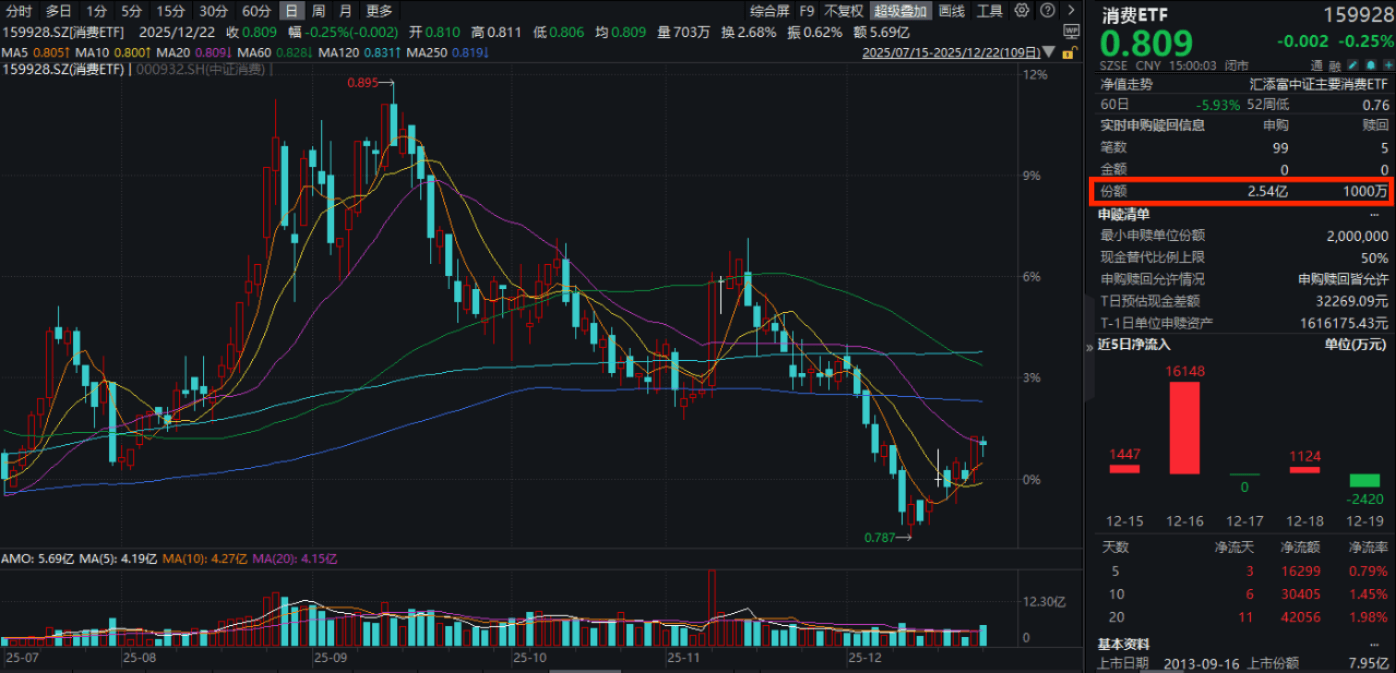
“零关税”红利,海南封关掀高潮!消费ETF(159928)逆市获得2.44亿份巨额净申购!港股通消费50ETF(159268)微涨喜提两连阳!
Sou Hu Cai Jing· 2025-12-22 10:02
Group 1: Market Overview - The A-share market has shown a comprehensive recovery, with the consumption ETF (159928) experiencing a slight decline of 0.25% but achieving a total trading volume of 569 million yuan [1] - The consumption ETF (159928) has seen a net subscription of 24.4 million units throughout the day, accumulating over 420 million yuan in the last 20 days, indicating strong investor interest [1] - As of December 19, the latest scale of the consumption ETF (159928) has exceeded 21.1 billion yuan, leading its peers in the same category [1] Group 2: Hainan Market Dynamics - Hainan local stocks have surged following the official launch of the Hainan Free Trade Port's full island closure on December 18, with Sanya's duty-free sales reaching 118 million yuan on the first day [3] - The Sanya International Duty-Free City recorded over 36,000 visitors, a year-on-year increase of over 60% [3] - The Hong Kong Stock Connect Consumption 50 ETF (159268) saw a slight increase of 0.42%, with a trading volume exceeding 30 million yuan [3] Group 3: Consumption Sector Valuation - The consumption ETF (159928) has a TTM price-to-earnings ratio of 19.4, placing it in the 3.13% percentile over the past decade, indicating it is cheaper than 97% of the historical time frame [5] - Seasonal trends in Q4 suggest a potential shift in market style towards undervalued sectors, particularly in December [5] Group 4: Future Consumption Trends - The focus on "expanding domestic demand" has been emphasized by high-level policies, prioritizing consumer demand as a key component of domestic growth strategies [7] - The anticipated increase in residents' net transfer payments and potential reforms in initial distribution may drive consumer spending in the coming years [7] - Historical examples from Japan and the U.S. indicate that periods of rising household income correlate with increased service and new-type consumption [7] Group 5: Investment Opportunities - The market is shifting towards a dual narrative of "physical demand" and "consumption-side policies," suggesting a more stable investment approach amid macroeconomic uncertainties [8] - Key investment themes include industrial resources benefiting from AI and global manufacturing recovery, as well as sectors like aviation, hotels, and food and beverage that are poised for recovery [9] - The consumption landscape is expected to see a deepening of consumer stratification, with high-net-worth individuals shifting towards more rational consumption patterns while the mass market focuses on cost-effective options [10][11] Group 6: Structural Opportunities - The consumption sector is likely to experience a focus on essential needs and low-cost emotional comfort, with demand for basic necessities remaining resilient [11] - Companies with global expansion strategies may mitigate domestic demand fluctuations, particularly in sectors like seasoning and snack foods targeting emerging markets [12] - The consumption ETF (159928) is characterized by its resilience across economic cycles, with top holdings including major liquor brands and agricultural firms [13]

上证180ETF指数基金(530280)涨近1%,机构建议关注三条主线
Xin Lang Cai Jing· 2025-12-22 02:26
Core Viewpoint - The recent adjustments in the market have provided investors with opportunities to strategically position themselves for the upcoming "cross-year" market trends, particularly focusing on growth and dividend styles [2]. Group 1: Market Performance - As of December 22, 2025, the Shanghai 180 Index (000010) increased by 0.65%, with notable gains from stocks such as Tuojing Technology (688072) up by 6.39%, China Duty Free Group (601888) up by 6.27%, and Zijin Mining (601899) up by 4.95% [1]. - The Shanghai 180 ETF Index Fund (530280) rose by 0.58%, with the latest price reported at 1.21 yuan [1]. Group 2: Investment Recommendations - The report from China International Capital Corporation (CICC) suggests focusing on three main investment themes: 1. **Growth in AI Technology**: The AI sector is expected to transition into industrial applications, with opportunities in computing power, optical modules, and cloud computing infrastructure, particularly favoring domestic companies. Applications to watch include robotics, consumer electronics, smart driving, and software [2]. 2. **External Demand**: Companies with overseas expansion strategies are seen as reliable growth opportunities, particularly in sectors like home appliances, engineering machinery, commercial buses, power grid equipment, gaming, and non-ferrous metals [2]. 3. **Cyclical Reversal**: Attention is recommended on sectors nearing improvement in supply-demand dynamics or benefiting from policy support, such as chemicals, aquaculture, and new energy [2]. Group 3: Seasonal Trends and Market Catalysts - According to Huatai Securities, the upcoming spring market is anticipated to show positive momentum, driven by potential catalysts such as foreign capital position adjustments post-Christmas, the dense disclosure period for annual reports starting mid-January, and possible reserve requirement ratio cuts in January [3]. - The Shanghai 180 ETF closely tracks the Shanghai 180 Index, which comprises 180 large-cap, liquid stocks from the Shanghai market, reflecting the overall performance of core listed companies [3].






消费板块迎来补涨 “出海”成为机构布局重要考量因素
Zheng Quan Shi Bao Wang· 2025-12-21 23:38
人民财讯12月22日电,临近岁末,A股市场风格悄然生"变"。"慢牛"行情之风从科技板块吹向消费与零 售,在科技股集体抵达阶段性高位后,此前相对滞涨的消费板块迎来一轮补涨。不过,这波行情呈现鲜 明特征:领涨个股中鲜见公募基金重仓身影,而被机构集中持有的白酒等板块仍显疲软。 在经历长期调整后,以白酒、乳业为代表的传统消费板块,被多位基金经理视为震荡市中的"防御性选 择";而新消费领域则呈现高景气与高估值并存的局面,筛选具备持续"护城河"的标的成为关键。与此 同时,"出海"尤其是深耕欧美市场的能力,正成为机构布局消费股时愈发重要的考量因素。 ...
"出海"主题点燃消费股 相关ETF获资金净申购
Zheng Quan Shi Bao· 2025-12-21 22:59
临近岁末,A股市场风格悄然生"变"。"慢牛"行情之风从科技板块吹向消费与零售,在科技股集体抵达 阶段性高位后,此前相对滞涨的消费板块迎来一轮补涨。不过,这波行情呈现鲜明特征:领涨个股中鲜 见公募基金重仓身影,而被机构集中持有的白酒等板块仍显疲软。 在经历长期调整后,以白酒、乳业为代表的传统消费板块,被多位基金经理视为震荡市中的"防御性选 择";而新消费领域则呈现高景气与高估值并存的局面,筛选具备持续"护城河"的标的成为关键。与此同 时,"出海"尤其是深耕欧美市场的能力,正成为机构布局消费股时愈发重要的考量因素。 消费板块年末"冲刺" 新旧消费均有机遇 在消费板块长期调整后,白酒主要指数已经阴跌了近五年,多名基金经理认为当前估值已回归合理区 间,形成"天然"的安全边际。此外,也有研报指出,当前市场短期或进入宽幅震荡阶段,前期滞涨方向 表现会更好,对应到本轮即为高股息及消费板块。 国泰基金基金经理李海认为,作为顺周期领域的核心板块,其盈利稳定性强、抗风险能力突出,在市场 波动中具备显著的防御属性,成为资金长期配置的重要选择。 李海认为,经历了前几年的震荡调整,传统消费板块估值进一步下降,但行业竞争格局在不断改善, ...
“出海”主题点燃消费股 相关ETF获资金净申购
Zheng Quan Shi Bao· 2025-12-21 18:09
Group 1 - The A-share market is experiencing a shift from a "slow bull" trend in technology stocks to a rebound in the consumer and retail sectors, with traditional consumption stocks like liquor and dairy being viewed as defensive choices in a volatile market [1][4] - Recent policies aimed at boosting domestic demand have led to a significant rebound in consumer and retail stocks, with companies like Baida Group seeing a weekly increase of 51.59% and others like Joy Home and Shanghai Jiubai also experiencing substantial gains [2][3] - Despite the recent rally, the consumer sector has underperformed during the "technology bull" years, with many actively managed funds holding consumer stocks facing double-digit declines this year [2][3] Group 2 - Analysts believe that traditional consumption stocks have reached a reasonable valuation after a prolonged decline, providing a natural safety margin, while the competitive landscape is improving for leading companies [4][5] - The outlook for both traditional and new consumption sectors is optimistic, with traditional consumption expected to benefit from a recovering economy and rising household incomes [5][6] - The "outbound" strategy is becoming increasingly important for consumer stocks, particularly those focusing on the European and American markets, which are seen as key drivers of global consumption demand [6][7]
小鹏第三个海外本地化生产项目落地马来西亚;阿里云与爱诗科技达成全栈AI合作|36氪出海·要闻回顾
36氪· 2025-12-21 13:35
Group 1 - Xiaopeng Motors has launched its third overseas localized production project in Malaysia, following projects in Indonesia and Austria, with plans for mass production by 2026 to serve the ASEAN right-hand drive market [5] - Alibaba Cloud has signed a full-stack AI cooperation agreement with Aishi Technology to enhance AI video generation capabilities, leveraging Alibaba's cloud infrastructure and AI services [5] - SF Middle East has signed a cooperation agreement with Oman Asyad Group to enhance cross-border transportation and logistics collaboration [6] Group 2 - Li Auto has officially entered the markets of Egypt, Kazakhstan, and Azerbaijan, launching its L-series models to meet local luxury market demands [6] - The Singapore Land Transport Authority has awarded contracts for 660 electric buses, with Chinese companies like BYD and Yutong winning bids [8] - Temu is accelerating its expansion into the Swiss market, attracting dozens of local merchants to join its platform [7] Group 3 - The sales of Chinese television brands on AliExpress have surged by 300% over the past year, with Xiaomi leading in sales during overseas shopping events [9] - Dunhuang.com announced new regulations for shipping to Saudi Arabia, requiring compliance with new address labeling rules starting January 1, 2026 [9] - CATL has secured a 6.2 GWh energy storage order in Southeast Asia, with plans to supply a large-scale solar power project in Indonesia [10] Group 4 - Mixue Ice Cream has opened a store in Los Angeles and is expanding its overseas presence, with plans to increase its global store count to 53,014 by June 2025 [10] - The autonomous driving company Baixiniu has completed a new round of financing to accelerate its market expansion and technology development [11] - Galaxy General Robotics has raised over 3 billion yuan in a new financing round, enhancing its global market presence [11] Group 5 - Oculab has completed a $30 million Series B financing to advance its dual-specificity antibody eye drug into clinical trials in the US and China [12] - Chinese autonomous driving companies are increasingly focusing on emerging markets, particularly in the Middle East and Southeast Asia [13] - China's energy storage companies have seen a significant increase in overseas orders, with a 246% year-on-year growth in the first half of 2025 [14] Group 6 - Trade with Belt and Road Initiative countries has exceeded 21 trillion yuan, accounting for over half of China's total foreign trade, with a notable export growth rate of 11.3% [14] - Argentina has eliminated small import tariffs, leading to a 237% increase in online packages from Chinese e-commerce platforms [14]





今日财经要闻TOP10|2025年12月21日
Xin Lang Cai Jing· 2025-12-21 12:14
Group 1 - SpaceX responded to misleading reports regarding the safety of its flights, emphasizing that public safety is always its top priority during flight tests [1][10] - The company stated that all incidents involving spacecraft debris were managed within pre-coordinated control areas established by the U.S. Space Force and the FAA [1][10] - SpaceX criticized the media for relying on anonymous sources and non-scientific analyses, asserting that its safety management tools are well-established and effective [1][10] Group 2 - Longjiang Securities reported that China has become the second country after Germany to approve L3 autonomous driving vehicles for road use, marking a significant step towards mass production [3][12] - The approval of the first batch of L3 vehicles is expected to accelerate the commercialization of autonomous driving technology and benefit the entire industry chain [3][12] - The report suggested investment opportunities in intelligent driving algorithm providers, related hardware suppliers, and Robotaxi operating platforms [3][12][13] Group 3 - Morgan Stanley's Liu Mingdi identified four key themes for investment in 2026, including "anti-involution," AI, overseas expansion, and consumption, with real estate as a potential theme [5][15] - The "anti-involution" theme focuses on sectors with strong growth prospects, such as batteries and photovoltaics, and industries closely tied to the macroeconomy [5][15] - Liu emphasized that AI infrastructure capital expenditure is expected to grow, benefiting Chinese suppliers, and highlighted the importance of energy storage, photovoltaics, and batteries in the AI infrastructure sector [5][15] Group 4 - The Chinese fireworks and firecrackers association supported Shanxi province's decision to shift from a complete ban to a scientific management model for fireworks, allowing for limited use [8][18] - This change reflects a balance between cultural needs and safety governance, aiming to preserve traditional customs while managing safety risks effectively [8][18] Group 5 - RRP Semiconductor in India saw its stock price surge over 55,000% in 20 months, becoming a "meme stock" despite having negative revenue and minimal operational capacity [9][19] - The stock's rise is attributed to network speculation and a growing retail investor base in India, as there are few listed semiconductor companies available for investment [9][19] Group 6 - The Mexican proposal to impose tariffs on Chinese goods has prompted a strong response from China, which is prepared to take various countermeasures if the proposal is enacted [10][20] - China is aware of the complexities behind Mexico's proposal, particularly the pressure from the U.S. to align with its tariff policies [10][20] - The Chinese government maintains that it will protect its rights and interests, indicating a readiness to respond if the tariff proposal proceeds [10][20]






“蚂蚁阿福”冲上苹果应用总榜第三;Temu跃居英国电商访问量第三丨Going Global
创业邦· 2025-12-21 10:33
Key Insights - Temu has rapidly climbed to become the third most visited e-commerce site in the UK, gaining 8 million new users in one year, with a monthly visit count of 28.4 million as of May, indicating strong market penetration [5][6][7] - Xiaomi, TCL, and Hisense have collectively increased their sales on AliExpress by 300% year-on-year, positioning the platform as a core part of their international strategy [8][9] - Ant Group's AI health app "Antifufu" has surged to the third position on the Apple App Store, with over 15 million monthly active users and a compound growth rate of 83% [11][12][14] - The first overseas store of Mixue Ice Cream has opened in Los Angeles, offering competitively priced products, marking a significant step in its global expansion strategy [15][16][20] - MiniMax is set to become the world's first publicly listed company focused on AGI, having passed the Hong Kong Stock Exchange hearing, with a projected market growth from $189 billion in 2023 to $4.8 trillion by 2033 [23][24] - Xiaomi's new open-source model MiMo-V2-Flash has been highlighted for its efficiency and competitive edge, ranking among the top two global open-source models [25][27] - Elon Musk's net worth has reached $700 billion, following a court ruling that reinstated the value of his Tesla stock options, significantly impacting his overall wealth [30][32] - SpaceX is preparing for an IPO, with a potential valuation of $1.5 trillion, and has entered a "quiet period" to comply with regulatory requirements [40][41] - OpenAI is in talks with Amazon for a potential investment of at least $10 billion, which would elevate its valuation to over $500 billion, while also planning to adopt Amazon's AI chips [44][45]

3倍牛股,液冷龙头逼近千亿
Ge Long Hui· 2025-12-21 08:05
Core Viewpoint - The A-share market has shown a fluctuating bottoming trend since December, but specific segments, particularly Invec's stock, have demonstrated remarkable independent performance, with a significant price increase of 26.9% in just 15 trading days [1][2]. Group 1: Stock Performance and Market Dynamics - Invec's stock has surged nearly threefold over the past six months, approaching a market capitalization of 100 billion [4]. - The ongoing and accelerating upward trend indicates that the capital market is affirming a new industrial trend [5]. - The recent price acceleration is attributed to market rumors regarding Google's factory audit and a substantial increase in the shipment target for TPU chips [8]. Group 2: Industry Catalysts and Trends - The "year-end acceleration" in stock performance is unusual, as institutions typically prefer to secure profits at year-end [7]. - Invec is no longer viewed merely as a temperature control equipment manufacturer but is now seen as a key player in the AI computing infrastructure, particularly in the liquid cooling segment [11]. - The shift towards liquid cooling technology is becoming a necessity due to the increasing power consumption of high-performance chips, with Nvidia's latest chips exceeding 1000W [13][14]. Group 3: Market Expectations and Growth Potential - The market logic suggests that liquid cooling is the next big opportunity, similar to the previous boom in optical modules [17]. - The demand for liquid cooling components is expected to grow significantly, with projections indicating that the penetration rate for AI training servers will rise from 15% in 2024 to 80% by 2027 [15]. - Invec's unique full-chain self-research and production capabilities position it favorably within the global AI computing supply chain [18]. Group 4: Competitive Landscape - Invec is the only A-share company covering the entire liquid cooling supply chain, from CDU to liquid cooling servers [21]. - Competitors include major players like 3M and domestic companies such as Shenyang Environment and Gaolan Co., which are also entering the liquid cooling market [20]. - The competitive landscape is intensifying, with various domestic firms challenging international counterparts in the liquid cooling sector [20]. Group 5: Financial Performance and Future Outlook - Invec's revenue has grown significantly since its listing, with a projected revenue of 4.5 billion in 2024, reflecting a 40.19% year-on-year increase [24]. - The company's liquid cooling revenue is still in the early stages, indicating potential for substantial growth in the future [27]. - The current high price-to-earnings ratio of nearly 180 times reflects optimistic market expectations, but it also poses risks if order fulfillment does not meet projections [28].

