量化交易

Search documents
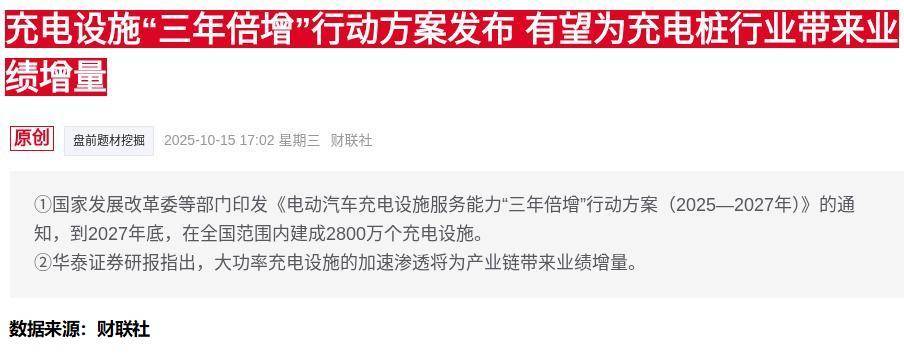
三年倍增计划下,机构早已暗中布局!
Sou Hu Cai Jing· 2025-10-19 16:43
Group 1 - The core message of the news is the announcement by the National Development and Reform Commission to build 28 million charging piles by 2027, which has sparked interest among investors in related stocks [1] - The "Three-Year Doubling Action Plan" includes ambitious targets of 300 million kilowatts of public charging capacity and a demand for 80 million electric vehicles, indicating significant growth potential in the sector [3] - Historical trends show that retail investors often miss out on gains during rapid market movements, as seen in the 2025 new energy market surge, where stocks like Colin Electric and Chuling Information experienced significant price increases after long periods of stagnation [3][4] Group 2 - The analysis emphasizes the importance of capital utilization, suggesting that investors who rotate through multiple stocks tend to achieve higher returns compared to those who hold onto a few stocks [4] - The behavior of stocks such as Wujin Stainless Steel, Colin Electric, and Chuling Information demonstrates a pattern of long-term consolidation followed by sharp price increases, indicating underlying market dynamics [6][8] - Key strategies for investors include focusing on tracking capital flows, understanding institutional buying signals, and utilizing quantitative tools for better decision-making [10][11]


牛市三大铁律:90%散户都错了!
Sou Hu Cai Jing· 2025-10-19 07:00
Core Insights - The article emphasizes the importance of quantitative trading methods over traditional technical analysis, highlighting that market dynamics are constantly changing while the behavior of funds remains consistent [1][6][7] Group 1: Investment Principles - Principle One: Actively manage investments rather than waiting; the market can change rapidly, and the cost of trial and error is low during a bull market [1] - Principle Two: Focus on actual performance rather than popular trends; even in hot sectors, a significant percentage of stocks may decline [1][2] Group 2: Behavioral Finance - Attention Bias: Retail investors often get distracted by popular concepts and overlook stocks with real institutional interest [2] - Behavioral Responses: Emotional reactions to market movements, such as panic selling or anxiety over others' gains, can lead to poor decision-making [2] Group 3: Institutional Support - The presence of institutional investment is crucial; stocks with active institutional support tend to perform better despite market fluctuations [4][6] - Case Study: A stock that appeared to be in a bearish pattern was actually experiencing institutional accumulation, leading to an 80% increase in value [6] Group 4: Market Dynamics - The Chinese economy is on the rise, but investors must actively seek out suitable quantitative tools to capitalize on this growth [7]

A股:今晚8000万股民,又要睡不着觉了,不出意外,下周剧本是这样的!
Sou Hu Cai Jing· 2025-10-18 22:22
Market Overview - The Shanghai Composite Index closed at 3839.76 points, down nearly 2%, while the Shenzhen Composite Index and ChiNext Index fell by 3.04% and 3.36% respectively, with nearly 5,000 stocks in the market declining and only about 600 stocks managing to close in the green [1] - The market experienced a sudden downturn in the afternoon after a relatively stable morning, particularly affecting technology-related sectors such as semiconductors, communication equipment, and software services, with some stocks dropping over 10% [1] Factors Influencing Market Movement - The market decline is attributed to multiple factors, including external adjustments in overseas markets and uncertainties in macroeconomic expectations, which increased the demand for risk aversion [1] - Internally, short-term trading funds took the opportunity to sell at high positions, compounded by panic selling from shareholders, leading to a concentrated selling pressure [1] - On Friday, the net outflow of main funds exceeded 130 billion yuan, a significant figure not seen in recent months, indicating a strong selling pressure despite high trading volumes [1] Future Market Outlook - The market is likely to continue the downward trend into the next week, facing initial selling pressure, especially from short-term investors who may choose to exit during any minor rebounds [2] - If no new funds enter the market promptly, the index may struggle to stabilize in the short term; however, once panic selling reaches a certain level, external funds may step in to buy at lower prices, potentially leading to a rebound [2] - Historical patterns suggest that such sharp declines often lead to a temporary emotional low in the market, but if the fundamentals remain unchanged, funds may reassess risks and returns after the panic subsides [2] Sector Performance - The technology sector has been particularly weak, with significant declines in major stocks, while defensive sectors like gas and precious metals showed some resilience, although not enough to offset the overall market decline [1] - Financial stocks, after being heavily sold off, could rebound if positive stimuli or capital inflows occur, potentially driving short-term index recoveries [2]

A50期指大幅拉升!A股下周大盘,会大幅反弹吗
Sou Hu Cai Jing· 2025-10-18 17:12
Core Viewpoint - The recent market decline has shattered retail investors' expectations of a bull market, with significant capital outflows observed while institutions increase long positions in stock index futures, raising questions about market sentiment and panic selling [1][3][5]. Market Trends - A50 index futures showed significant fluctuations, impacting A-share movements, with historical data indicating a correlation between A50 performance and A-share opening trends [3][7]. - A total of 201.7 billion yuan was net withdrawn from A-shares over three days, with a single-day outflow of 132.9 billion yuan, indicating a substantial capital flight [3][11]. Institutional Behavior - Institutions have increased long positions in stock index futures by 2,247 contracts, suggesting a potential divergence in market sentiment amid rumors of upcoming regulatory meetings [5][19]. - The A50 index futures trading volume has decreased significantly, accounting for less than 15% of the total A-share trading volume in 2024, indicating a decline in its influence on A-share pricing [15][17]. Technical Analysis - The market has been oscillating above the 3,800-point level for eight weeks, with significant resistance noted around the 3,900-4,000 point range [5][7]. - Current market indicators suggest a potential downward trend, with expectations of the Shanghai Composite Index possibly breaking below 3,774 points [13][15]. Investor Sentiment - Retail investor sentiment is increasingly polarized, complicating market dynamics, with many reacting emotionally to A50 index fluctuations without understanding the underlying causes [17][19]. - Experienced investors are advised to monitor various indicators, including trading volume and market trends, rather than solely focusing on A50 index futures [19][21].

ETF火热说明基民化正在加速
Bei Jing Shang Bao· 2025-10-15 16:07
Group 1 - The core viewpoint of the articles highlights the surge in ETF fund subscriptions driven by investor optimism towards the A-share market and the shift of retail investors towards becoming fund investors due to the challenges they face in direct stock trading [1][2][3] - The transition of retail investors to fund investors is seen as a necessary evolution, as they lack the professional knowledge required for complex market analysis and company research, making ETF funds an attractive option with potentially higher expected returns [1][2] - The increase in retail investors becoming fund investors is expected to enhance the professionalism and stability of investments, reduce individual investment risks, and improve the overall structure of market investors, leading to more rational pricing and reduced irrational market fluctuations [2][3] Group 2 - The rapid growth of ETF funds reflects an accelerated trend of retail investors becoming fund investors, which presents new investment opportunities while also imposing new demands on market development and regulation [3] - The influx of funds into ETF funds may lead to challenges in fund management and operation due to the rapid growth of some funds, necessitating careful selection by investors to avoid blindly following trends [2][3] - The articles emphasize the importance of creating a healthy, stable, and orderly capital market environment as the market adapts to the increasing presence of retail investors in fund investments [3]
侃股:ETF基金火热说明基民化正在加速
Bei Jing Shang Bao· 2025-10-15 12:12
Group 1 - The core viewpoint of the articles highlights the surge in ETF fund subscriptions driven by investor optimism towards the A-share market and the shift of retail investors towards becoming fund investors, which is seen as a necessary transition in the current investment environment [1][2][3] - The increase in retail investors transitioning to fund investors is attributed to their lack of professional knowledge and the rising proportion of quantitative trading, making it more challenging for them to operate independently [1][2] - The favorable market conditions, including steady economic recovery and policy support, have made the A-share market resilient, positioning ETFs as a convenient tool for investors to share in market gains [1][2] Group 2 - The acceleration of retail investors becoming fund investors is expected to enhance the professionalism and stability of investments, reducing individual investment risks by leveraging the expertise of professional fund managers [2][3] - The shift towards fund investing is anticipated to optimize the investor structure in the market, increasing the proportion of institutional investors, which leads to more rational pricing and reduced irrational market fluctuations [2][3] - Potential challenges include the rapid growth of some ETF fund sizes due to increased capital inflow, which may complicate fund management and operations, necessitating careful selection by investors [2]
半导体、芯片、人形机器人杀跌,“牛市旗手”会不会补涨?高手这样看
Mei Ri Jing Ji Xin Wen· 2025-10-14 09:16
Market Overview - On Tuesday, A-shares opened high but closed low, with significant declines in the semiconductor, chip, and humanoid robot sectors, leading to a drop of 4.26% in the Sci-Tech 50 index and 3.99% in the ChiNext index [1] - A total of 1,734 stocks rose while 3,554 stocks fell, indicating a bearish market sentiment [1] Competition Insights - The 75th session of the simulated stock trading competition has started, running from October 9 to October 17, with a simulated capital of 500,000 yuan [1][3] - Cash rewards for the competition include 688 yuan for the first place, 188 yuan for the second to fourth places, and 88 yuan for the fifth to tenth places, with additional rewards for monthly performance [3] Sector Opportunities - Analysts are optimistic about the brokerage sector, which is currently undervalued with dynamic price-to-earnings ratios around 10 times [4] - Forecasts suggest that the net profit of the securities industry could reach 67.2 billion yuan by Q3 2025, representing a year-on-year increase of 87%, while the net profit for the first three quarters of 2023 is expected to be 180 billion yuan, up 55% [4] - The brokerage industry's net income from brokerage services is projected to be 136.5 billion yuan for the first three quarters, an increase of 82.5% year-on-year [4] Investment Tools - Participants in the competition will receive free access to the "Fire Line Quick Review" for six trading days, which provides insights into market trends and investment logic [6] - The "Fire Line Quick Review" is designed to help traders stay updated on market events and company analyses [6]

债市应对低利率挑战专辑丨新形势下利率走势与债券投资机遇
Xin Lang Cai Jing· 2025-10-14 00:24
Core Viewpoint - Bond investment is shifting from "trend dividends" to "structural dividends" due to the resonance of the current economic cycle, policy tools, and market sentiment [1] Recent Interest Rate Trends - Economic cycle determines the upper limit of interest rates, with China's manufacturing PMI at 49.5% and PPI declining by 3.3% year-on-year, indicating weak internal and external demand [2] - Monetary policy is reshaping the formation mechanism of interest rate centers, with a total of 9 reserve requirement ratio cuts and a cumulative reduction of 80 basis points in the 7-day reverse repurchase rate since January 2021 [3] - Market sentiment is lowering the lower limit of interest rates, with significant fluctuations driven by investor sentiment and geopolitical factors, leading to short-term interest rate volatility [4] Future Investment Opportunities - The rise of quantitative trading is transforming bond trading from automation to intelligence, with a focus on data-driven trading models [5][6] - The layout of green and technology innovation assets is becoming crucial, with green bond issuance reaching 2.5 trillion yuan and technology innovation bonds seeing an average cost of 3.2% [7] - The cross-border bond market is expanding, with the issuance of dim sum bonds in Hong Kong reaching 1.2 trillion yuan, a 27% increase year-on-year, and a significant return on Chinese dollar bonds [8] Market Outlook and Innovative Development - The offshore bond market is expected to expand, enhancing Shanghai's role as an international financial center and facilitating cross-border financing [9][10] - The REITs market is rapidly developing, with a total market value exceeding 200 billion yuan and annualized dividend yields stable at 3%-5% [11][12] - The variety of floating rate bonds is increasing, with a current stock of approximately 605.4 billion yuan, representing only 0.38% of the bond market [13] Conclusion - The bond market is in a complex phase of multi-factor resonance, with macroeconomic expectations, policy goals, and market sentiment contributing to underlying market volatility [14]

万峰证券推出合规量化交易系统 布局金融科技新赛道
Xin Lang Cai Jing· 2025-10-12 03:28
Core Insights - Wan Feng Securities has officially launched its self-developed quantitative trading system WFLH, which has been approved by the Hong Kong Securities and Futures Commission, marking a significant advancement in the company's fintech strategy [1] - The system is designed for professional investors and high-net-worth clients, focusing on trade execution services while ensuring compliance with regulatory requirements [1][2] - The growth of quantitative trading in Hong Kong's securities market is notable, with algorithmic trading accounting for approximately 28% of total market turnover by the end of 2023, an increase of 3 percentage points from the previous year [2] Company Developments - The WFLH system adheres to the Securities and Futures Ordinance and includes comprehensive risk control features and operational logging mechanisms [1] - The system employs a modular architecture with core modules for trade execution, risk monitoring, and data management, supporting complex quantitative trading strategies [1] - Wan Feng Securities emphasizes risk prevention in its system design, incorporating real-time monitoring and alert mechanisms, with all trading instructions undergoing multiple compliance verifications [1][2] Industry Trends - The application of new technologies such as artificial intelligence and big data is transforming service models in the securities industry, with quantitative trading being a key area of fintech application [2][3] - The Hong Kong Securities and Futures Commission has been enhancing regulatory frameworks to keep pace with the growth of algorithmic trading, having released the "Guidelines on Algorithmic Trading" to further regulate the sector [2] - The company plans to continue optimizing its technology systems in accordance with regulatory requirements, with quarterly updates focused on improving system performance and risk control measures [2][3] Talent Development - Wan Feng Securities has established a dedicated fintech team with members possessing a dual background in finance and technology, and plans to collaborate with universities and research institutions for cutting-edge research in fintech [3] - The launch of the quantitative trading system reflects Hong Kong's ongoing exploration of digital transformation paths that align with its characteristics as an international financial center [3]
当美联储遇上量化交易:一场不对称战争
Sou Hu Cai Jing· 2025-10-11 10:08
Core Insights - The recent list of candidates for the Federal Reserve Chair reveals complex implications for global monetary policy, with potential shifts in liquidity management and market dynamics [2][7]. Group 1: Federal Reserve Candidates - Current Vice Chair Bowman represents policy continuity, while Waller is a traditional monetary policy expert, and Reed from BlackRock carries Wall Street influence [2]. - The nomination of economic advisor Hassett indicates unprecedented political influence over the Federal Reserve [2][7]. - Historical transitions in Federal Reserve leadership have consistently led to significant changes in monetary policy, highlighting the importance of candidate perspectives on quantitative easing [7]. Group 2: Market Dynamics - The current market rally is primarily liquidity-driven, with a significant disparity between index performance and individual stock movements, leading to a phenomenon termed "double slap" market [2][3]. - Over 40% of stocks have underperformed the index despite the Shanghai Composite Index rising by over 700 points since April 2025, indicating a disconnect between broader market trends and individual stock performance [2][3]. - Institutional investment patterns reveal that while some stocks show strong rebounds, the absence of institutional support can lead to a lack of sustained momentum [5]. Group 3: Investment Strategies - Investors are advised to focus on data-driven analysis rather than traditional technical indicators, as the market operates on complex liquidity dynamics [7][8]. - Establishing a robust data radar to track capital flows is essential for navigating market noise and identifying genuine trends [7]. - Acknowledging the critical role of liquidity in both U.S. and domestic markets is vital for investment decision-making, as liquidity ultimately dictates market movements [7][8].