
关税

Search documents
X @外汇交易员
外汇交易员· 2025-07-11 14:12
Trade Relations - Trump may discuss tariffs with Brazil at some point [1] - Brazil is not obligated to continue using the US dollar for trade [1] - Brazil is interested in creating a trade currency for international trade [1] - Brazil advocates for countries to trade in their own currencies [1] - Brazil calls on world leaders to reduce reliance on the US dollar in international trade [1]
消费者因关税焦虑转“观望”,6月NRF美国零售增速意外“踩刹车”
智通财经网· 2025-07-11 13:44
Core Insights - The latest retail sales report from the National Retail Federation (NRF) indicates a slowdown in retail sales growth in June due to consumer concerns, marking the first monthly decline since February [1] - The seasonally adjusted total retail sales excluding automobiles and gasoline decreased by 0.33% month-over-month in June, while year-over-year sales still grew by 3.19% [1] - Core retail sales (excluding auto dealers, gas stations, and restaurants) also saw a month-over-month decline of 0.32% in June, with a year-over-year increase of 3.36% [1] Monthly Performance - The overall retail sales for the first half of the year increased by 4.66% year-over-year, while core retail sales rose by 4.93% [2] - The June decline is the first since February, when both total and core retail sales fell by 0.22% compared to January [2] Consumer Behavior - Matthew Shay, CEO of NRF, noted that long-term uncertainties surrounding the economy, tariffs, and trade policies are causing consumers to adopt a "wait-and-see" approach regarding household budgets [1] - Despite the economic slowdown, consumers still have the capacity to spend on necessities, but their psychological outlook is being affected [1] Category Performance - In June, seven categories experienced year-over-year growth, with digital products, sporting goods stores, and health and personal care stores leading the way [2] - Only one category showed month-over-month growth, while the rest declined [2] - Specific category performance includes: - Digital products: Seasonally adjusted month-over-month growth of 0.26% and a year-over-year surge of 24.11% [2] - Health and personal care stores: Seasonally adjusted month-over-month decline of 0.31% and year-over-year growth of 3.47% [3] - General merchandise stores: Seasonally adjusted month-over-month decline of 0.15% and year-over-year growth of 3.18% [4] - Food and beverage stores: Seasonally adjusted month-over-month decline of 0.13% and year-over-year growth of 2.59% [5] - Electronics and appliance stores: Seasonally adjusted month-over-month decline of 1.03% and year-over-year growth of 2.43% [6] - Furniture and home furnishings stores: Seasonally adjusted month-over-month decline of 1.04% and year-over-year decline of 1.14% [7] - Building materials and garden supplies stores: Seasonally adjusted month-over-month decline of 0.76% and year-over-year decline of 5.33% [8]
巴西财政部官员梅洛:巴西是主要的咖啡和橙汁出口国。关税可能增加国内市场的供应,并产生通缩效应。
news flash· 2025-07-11 13:07
Group 1 - Brazil is a major exporter of coffee and orange juice [1] - Tariffs may increase domestic market supply and create a deflationary effect [1]
美国对铜征50%重税!中国难逃冲击
Jin Tou Wang· 2025-07-11 10:54
Group 1 - The US has decided to impose a 50% tariff on copper imports, significantly impacting global copper trade dynamics [1] - China, as the largest copper consumer, relies heavily on imports, with 94% of its copper needs met through foreign sources [1] - The tariff is expected to primarily affect Chile, Canada, and Mexico, which are major suppliers to the US [1] Group 2 - Copper is viewed as a leading economic indicator, with price fluctuations potentially signaling economic growth or recession [2] - China's refined copper imports have remained stable, with a 7.4% year-on-year increase in copper ore and concentrate imports in the first five months of the year [2] - China's refined copper production has increased significantly, reaching 1.36 million tons last year, a 4.1% increase from the previous year [2]
突发!全线大跌,特朗普关税威胁
Zhong Guo Ji Jin Bao· 2025-07-11 10:32
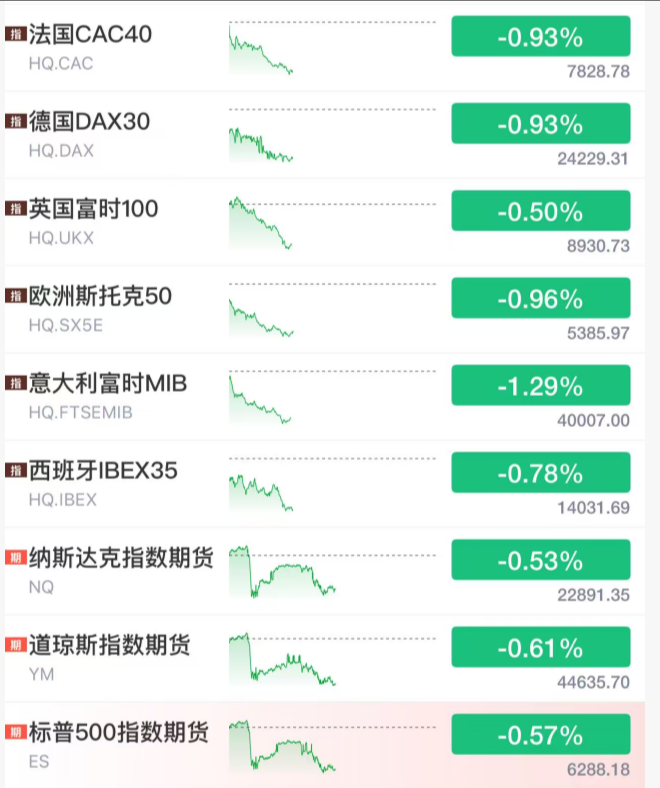
Group 1 - European stock markets experienced a decline, with the Italian FTSE MIB index falling approximately 1.3% and dropping below 40,000 points. The Euro Stoxx 50 index, German DAX index, French CAC40 index, and UK FTSE 100 index also saw declines of about 1%, 1%, 0.93%, and 0.5% respectively [1][2] - Concerns over tariffs were a significant factor behind the collective drop in European stock markets, as President Trump announced plans to impose blanket tariffs of 15% or 20% on most trading partners [2][3] - Trump indicated that the current standard for blanket tariffs is 10%, and he expressed confidence that these tariffs would be well-received, despite the potential negative impact on the stock market and inflation [3][4] Group 2 - The U.S. Labor Statistics indicated that inflation has eased since the COVID-19 pandemic but remains above 2.3%. Trump dismissed concerns raised by the CEO of Hasbro regarding potential price increases for toys due to tariffs, suggesting that domestic production would mitigate such price hikes [5][6] - Trump sent letters to 22 countries establishing tariff rates, including a 50% tariff on imports from Brazil and copper imports, with plans for implementation next month. This action is part of a broader strategy that has yet to yield any formal trade agreements [5][6] - The EU, as the largest trading partner of the U.S., imported over $600 billion worth of goods from the U.S. last year, while Canada imported over $400 billion. The EU is prepared to implement over $100 billion in retaliatory tariffs targeting goods from Republican-controlled states [6]

锡周报报告-20250711
Zhong Hang Qi Huo· 2025-07-11 10:02
Report Industry Investment Rating - Not provided in the content Core Viewpoints of the Report - The Fed's latest meeting minutes show differences among members regarding future prospects, mainly due to different expectations of tax impacts on inflation. The initial jobless claims in the US have decreased for four consecutive weeks, reaching the lowest level in two months, while continuing claims remain at the highest level since the end of last year. Some Fed officials believe that two interest rate cuts within the year are most likely, and the impact of tariffs on prices is milder than expected, boosting market risk appetite. Domestically, tin smelters face raw material supply pressure, with the resumption of production in the Wa State of Myanmar still uncertain. Recently, tin prices have adjusted, and smelters are holding firm on prices, with few transactions. Traders' quotes follow the market, and the willingness of downstream buyers to take delivery has increased, with overall market trading performing well. Tin prices are expected to maintain a volatile pattern [5]. Summary by Relevant Catalog Report Summary - The Fed's meeting minutes reveal differences among members on future prospects, mainly due to different inflation expectations influenced by taxes. US initial jobless claims have dropped for four consecutive weeks, hitting a two - month low, while continuing claims are at a high since late last year. Some Fed officials see two potential rate cuts this year, and tariff impacts on prices are milder than expected, enhancing market risk preference. Domestically, tin smelters face raw material supply pressure, and the resumption in Myanmar's Wa State is uncertain. Tin prices have adjusted, smelters are holding prices, and trading is sluggish. Traders' quotes follow the market, and downstream buying interest has increased, with overall trading performing well [5]. Multi - Empty Focus - Bullish factors: The resumption rhythm of tin mines in Myanmar's Wa State is still uncertain; overseas inventories have declined; the US dollar index remains at a low level [7]. - Bearish factors: The consumer end is in the industry's off - season, and the production schedule of photovoltaic modules has significantly decreased [7]. Data Analysis - **Supply and demand balance**: In April 2025, global refined tin production was 29,800 tons, consumption was 30,400 tons, with a supply shortage of 600 tons. From January to April 2025, production was 119,400 tons, consumption was 111,700 tons, with a supply surplus of 7,700 tons. In April 2025, global tin ore production was 27,600 tons, and from January to April, it was 103,700 tons [9]. - **Price and basis**: This week, tin futures prices remained volatile. The basis of Shanghai tin was - 1,810 yuan/ton, changing from premium to discount; the LME tin premium was 22.21 dollars/ton, changing from discount to premium [12]. - **Smelter operating rate**: Recently, the weekly operating rates of refined tin smelters in Yunnan and Jiangxi have been slightly rising. As of this week, the combined operating rate of the two provinces reached 53.97%. Yunnan smelters face tight tin ore supply, and although the operating rate rose slightly by 4.13% this week, it is still far below the level in Q4 2024. Jiangxi smelters rely on waste tin recycling, but poor terminal consumption has led to a decline in recycling volume and increased production costs. It is expected that the operating rates of smelters in the two regions will remain low in July [15]. - **Import data**: In May 2025, China's tin ore imports were 13,400 tons (equivalent to about 6,518 metal tons), a month - on - month increase of 36.39% and a year - on - year increase of 59.84%. From January to May, the cumulative import volume was 50,200 tons, a cumulative year - on - year decrease of 36.51%. In May, China's tin ingot imports were 2,076 tons, a month - on - month increase of 84.04% and a year - on - year increase of 225.9%. From January to May, the cumulative import volume was 9,584 tons, a cumulative year - on - year increase of 38.48%. In May, refined tin exports were 1,770 tons, a month - on - month increase of 8.19%. From January to May, the cumulative export volume was 9,584 tons, a year - on - year increase of 38.48%, with imports and exports basically balanced [18][24]. - **Production data**: In May 2025, domestic refined tin production was 14,670 tons, a month - on - month decrease of 0.3% and a year - on - year decrease of 8.34%. From January to May, the cumulative production was 72,900 tons, a cumulative year - on - year decrease of 0.75%. It is expected that in June 2025, domestic refined tin production will be around 13,800 tons [21]. - **Automobile industry data**: In June 2025, China's new energy vehicle production and sales were 1.268 million and 1.329 million respectively, with year - on - year increases of 26.4% and 26.7%. From January to June, production and sales were 6.968 million and 6.937 million respectively, with year - on - year increases of 41.4% and 40.3%. In June, China's total automobile exports were 592,000, a month - on - month increase of 7.4% and a year - on - year increase of 22.2% [27]. - **Solder industry data**: In May, the solder operating rate was 72.4%, a month - on - month decrease of 4.3% and a year - on - year decrease of 5.1%. The operating rates of large, medium, and small solder enterprises all decreased [30]. - **Inventory data**: The latest LME tin inventory is 2,015 tons, reaching the lowest level in nearly two years. As of the week of July 4, Shanghai Futures Exchange tin inventory increased by 3.49% to 7,198 tons [34]. 后市研判 - Tin prices will maintain a volatile pattern [36]
中辉有色观点-20250711
Zhong Hui Qi Huo· 2025-07-11 09:32
1. Report Industry Investment Ratings No specific industry investment ratings are provided in the report. 2. Core Views of the Report - Gold is expected to trade in a high - level range. The dual - easing policy and central bank gold purchases support the price, with a long - term bullish outlook due to uncertainties [1][2][3]. - Silver is likely to experience a strong - level oscillation. The dual - easing environment supports silver demand, but it is significantly influenced by the prices of base metals and gold [1]. - Copper is predicted to oscillate. In the short term, there may be a correction due to demand verification risks, but in the long run, it is still favored as a strategic resource [1][5][6]. - Zinc is expected to rebound. In the short term, it will test the previous high, but in the long term, supply exceeds demand, presenting short - selling opportunities [1][7][8]. - Lead is under pressure. Supply increases in July, and weak downstream consumption leads to inventory accumulation and price rebound pressure [1]. - Tin is facing pressure on its rebound. Supply has not fully recovered, but consumption has entered the off - season, and inventory has been accumulating [1]. - Aluminum is expected to rebound and then decline. The off - season is approaching, and demand is weakening, while production capacity remains high [1][9][10]. - Nickel is under pressure on its rebound. Inventory pressure persists, and downstream consumption is in the off - season [1][11][12]. - Industrial silicon is expected to rebound. Cost support exists, but high inventory restricts the upward space [1]. - Polysilicon is likely to trade in a high - level range. Policy expectations and positive price feedback in the industrial chain support its strength, but prices are high and volatile [1]. - Lithium carbonate is under pressure. The supply - demand contradiction remains unresolved, and it will mainly trade in a range, with attention on the 65,000 resistance [1][13][14]. 3. Summary by Related Catalogs Gold - **Market Review**: Tariff risks have temporarily subsided. Monetary easing and central bank gold purchases support the price [2]. - **Basic Logic**: Most Fed officials support interest rate cuts. Russia has increased its gold holdings, and the long - term trend of dual - easing and global order reshaping supports the long - term bullish view of gold [3]. - **Strategy Recommendation**: Gold may experience short - term adjustments, but the US dollar is in a medium - term weak trend. Gold has strong support around 760, and long - term investment opportunities can be considered [4]. Silver - **Market Review**: Not explicitly stated, but it is influenced by the dual - easing environment and the prices of other metals [1]. - **Basic Logic**: The dual - easing policy supports silver demand, and high tariffs increase friction costs for some products [1]. - **Strategy Recommendation**: Pay attention to the pressure at the previous high and control positions, with a price range of [8800 - 9075] [1]. Copper - **Market Review**: US copper has been trading in a high - level range, while LME copper and SHFE copper have stopped falling and rebounded [5]. - **Industrial Logic**: The supply of copper concentrates remains tight, and electrolytic copper production has increased. Global visible inventory is at a low level, but high prices suppress demand, and terminal consumption has entered the off - season [5]. - **Strategy Recommendation**: In the short term, beware of demand verification risks, but expect limited downside. Buy on dips after corrections. In the long term, be optimistic about copper due to the tight global copper mine supply [6]. Zinc - **Market Review**: SHFE zinc has oscillated and rebounded, testing the previous high [7]. - **Industrial Logic**: The supply of zinc mines is abundant, and processing fees are rebounding. Domestic inventory has slightly increased, and downstream galvanizing enterprises' performance is lower than in previous years [7]. - **Strategy Recommendation**: In the short term, zinc may test the previous high due to various factors, but in the long term, supply exceeds demand. Look for short - selling opportunities, with a price range of [22000 - 22600] for SHFE zinc and [2700 - 2800] for LME zinc [8]. Aluminum - **Market Review**: Aluminum prices have rebounded under pressure, and alumina has rebounded and then declined [9]. - **Industrial Logic**: For electrolytic aluminum, production capacity remains high, and demand is weakening in the off - season. For alumina, overseas bauxite imports are high, and short - term supply is tight due to some enterprise maintenance [10]. - **Strategy Recommendation**: Consider short - selling opportunities for SHFE aluminum on rebounds, paying attention to inventory changes. Alumina is expected to trade in a low - level range [10]. Nickel - **Market Review**: Nickel prices have rebounded and then declined, and stainless steel has also declined [11]. - **Industrial Logic**: Overseas nickel ore prices are weakening, and domestic production may decline. Nickel supply - demand improvement is limited, and inventory is accumulating. Stainless steel production cuts have eased inventory pressure, but consumption is still weak in the off - season [12]. - **Strategy Recommendation**: Consider short - selling opportunities for nickel and stainless steel on rebounds, paying attention to stainless steel production cut trends, with a price range of [118000 - 122000] for nickel [12]. Lithium Carbonate - **Market Review**: The main contract LC2509 has slightly reduced positions and traded weakly in a range [13]. - **Industrial Logic**: The supply - demand contradiction remains unresolved, and inventory is at a new high. Downstream demand shows an off - season non - weak phenomenon, but supply changes are in line with expectations [13]. - **Strategy Recommendation**: Trade in a high - level range in the short term, paying attention to the 65,000 resistance, with a price range of [63600 - 64600] [14].
【黄金期货收评】特朗普再掀关税风暴 沪金日内上涨0.49%
Jin Tou Wang· 2025-07-11 08:35
Group 1 - The Shanghai gold futures closed at 773.56 CNY per gram on July 11, with a daily increase of 0.31% and a trading volume of 217,649 contracts [1] - The spot price of gold in Shanghai was quoted at 770.70 CNY per gram, indicating a discount of 2.86 CNY per gram compared to the futures price [1] - U.S. President Trump is considering imposing tariffs of 15%-20% on goods that fail to reach an agreement within a 90-day suspension period, which is an increase from the previously announced 10% [1] Group 2 - The Shanghai gold price increased by 0.07% to 771.70 CNY per gram, while silver rose by 1.45% to 9,014 CNY per kilogram [2] - The number of initial jobless claims in the U.S. was reported at 227,000, marking a decline for four consecutive weeks and the lowest level in two months [2] - Federal Reserve officials indicated the possibility of interest rate cuts in July, with significant uncertainty surrounding the policy outlook due to rising inflation concerns linked to the U.S. fiscal deficit and Trump's tariff threats [2]
越南VN指数涨近2%,报道称越南对特朗普20%的关税感到惊讶,寻求更低的关税。
news flash· 2025-07-11 07:34
越南VN指数涨近2%,报道称越南对特朗普20%的关税感到惊讶,寻求更低的关税。 ...