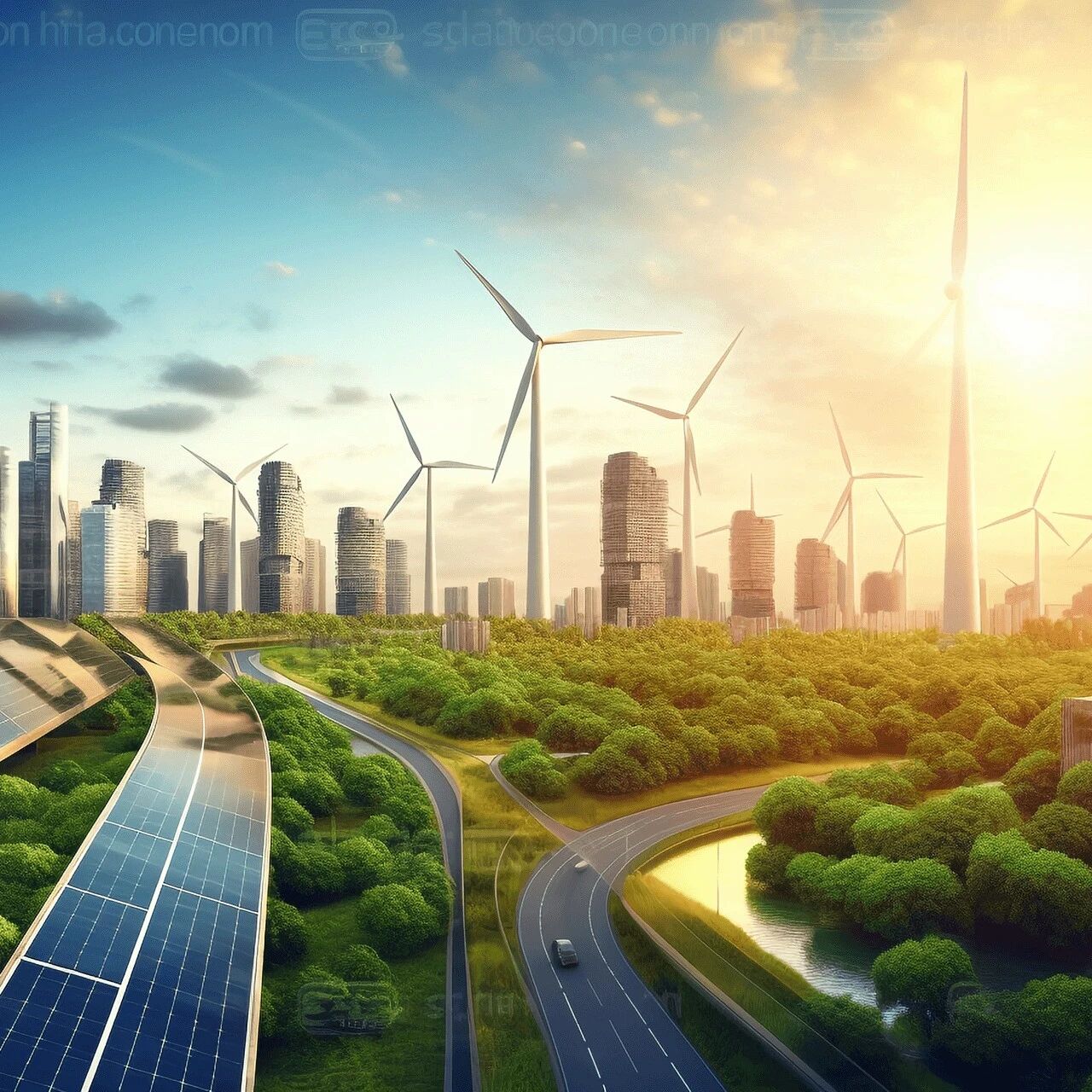
新型能源体系

Search documents
从超临界二氧化碳 看绿色新山东
Sou Hu Cai Jing· 2026-01-30 01:03
Group 1 - The core viewpoint of the article emphasizes the importance of establishing a new energy system guided by the "dual carbon" strategy during the 2026 Shandong Two Sessions [1] - The government work report highlights the need to develop new productive forces tailored to local conditions, indicating a focus on innovation and sustainability [1] Group 2 - A cutting-edge technology's industrialization has become a hot topic among representatives at the provincial meetings, suggesting a strong interest in advancing technological development [1]

中石油、国家电网“油电联姻”新进展
Sou Hu Cai Jing· 2026-01-29 15:43
Core Viewpoint - The acquisition of 100% equity of Yingda Futures by Zhongyou Capital for 1.129 billion yuan marks a significant step in the collaboration between China National Petroleum Corporation (CNPC) and State Grid Corporation of China, enhancing Zhongyou Capital's financial capabilities and aligning with the broader energy transition goals of both companies [1][2]. Group 1: Acquisition Details - Zhongyou Capital announced plans to acquire 100% equity of Yingda Futures for 1.129 billion yuan, with the transaction approved by the State-owned Assets Supervision and Administration Commission [1]. - The acquisition price represents an 8.3% premium over Yingda Futures' net asset value of approximately 1.043 billion yuan as of March 2025 [1]. - The transfer of 3.79 million A-shares (3.00% of total shares) from CNPC to State Grid Yingda Group is also part of this transaction, pending regulatory approval [1]. Group 2: Strategic Implications - For State Grid Yingda, divesting the non-core asset Yingda Futures aligns with its strategy to streamline operations [2]. - The acquisition allows Zhongyou Capital to complete its financial license portfolio, enhancing its capabilities in hedging and risk management related to its core oil and gas business [2]. - Zhongyou Capital's diverse financial interests include stakes in various financial institutions, which will be bolstered by this acquisition [2]. Group 3: Industry Context - The collaboration between CNPC and State Grid has intensified since last year, with significant investments aimed at developing a new energy system [3]. - Predictions indicate that China's oil consumption may peak around 2025, prompting CNPC to transition towards a comprehensive energy supplier model that includes oil, gas, and renewable energy [3]. - CNPC aims to achieve a balanced energy portfolio by 2035, with a focus on clean energy generation exceeding 20 billion kilowatt-hours in 2025 [4].

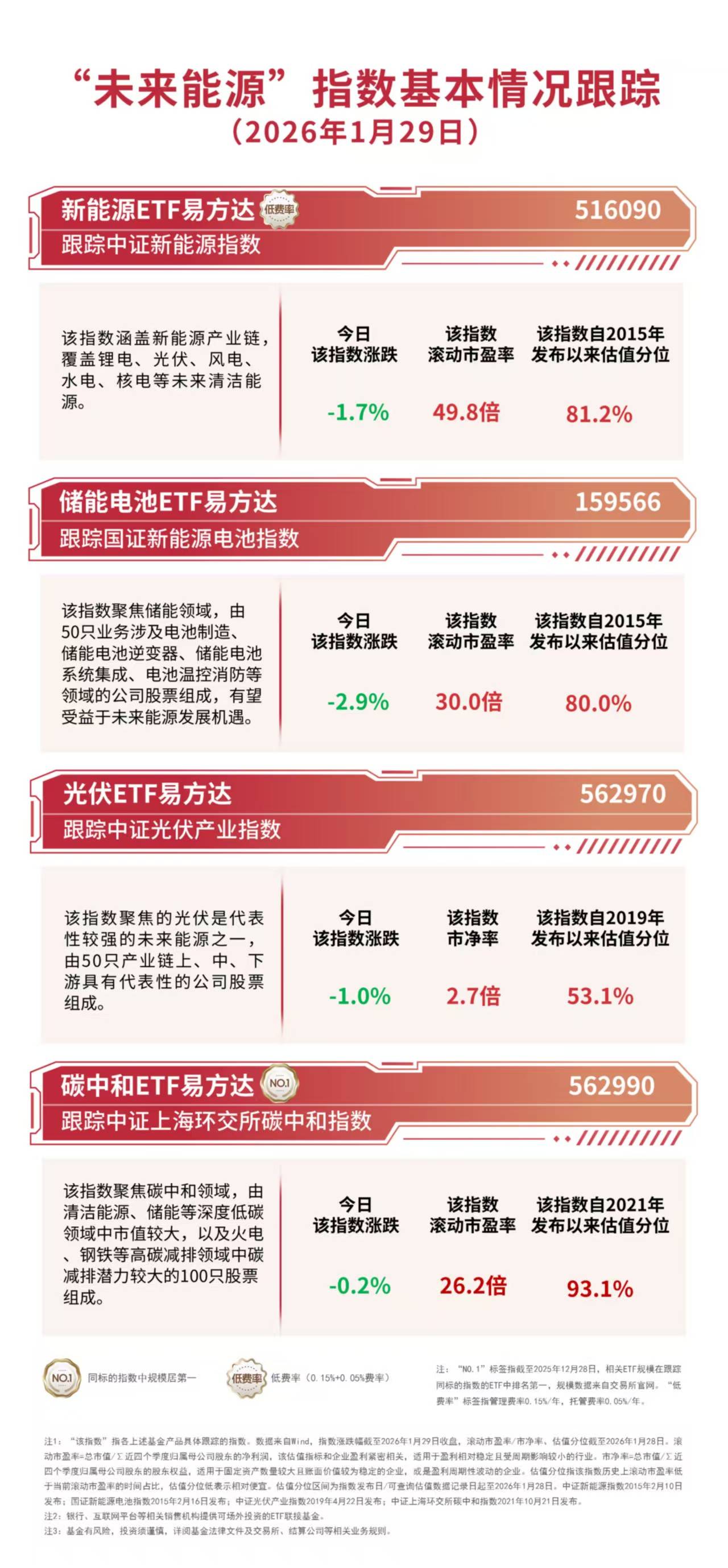
新能源板块集体回调,资金逆势加码,储能电池ETF易方达(159566)全天净申购近1亿份
Sou Hu Cai Jing· 2026-01-29 11:03
Group 1 - The core viewpoint of the article indicates a decline in various indices related to carbon neutrality and renewable energy, with the China Carbon Neutrality Index down by 0.2%, the China Photovoltaic Industry Index down by 1.0%, the China New Energy Index down by 1.7%, and the National New Energy Battery Index down by 2.9% [1] - Despite the decline in these indices, there is a notable increase in investment, as evidenced by the nearly 100 million net subscriptions to the E Fund Energy Storage Battery ETF (159566) throughout the day [1] - Huatai Securities emphasizes the importance of accelerating the construction of a new energy system during the 14th Five-Year Plan, focusing on the development of new energy storage and the construction of smart grids, which suggests a positive outlook for the renewable energy sector and the electrification rate [1] Group 2 - The article highlights that companies in the energy storage, wind power, and grid sectors are expected to continue benefiting from the ongoing developments in renewable energy [1]
中国能建(601868):深度研究:“四新”转型求变,积极布局新型能源体系建设
East Money Securities· 2026-01-28 13:29
Investment Rating - The report maintains a "Buy" rating for the company [5] Core Insights - The company is positioned as a leader in energy construction, actively transitioning towards new energy systems, focusing on hydrogen and energy storage [4][27] - The company has a robust order backlog, with total orders amounting to 28,135 billion yuan, approximately six times its expected revenue for 2024 [4][21] - The new energy sector is expected to grow significantly, with the company projecting a 6.7% increase in new energy contract value for 2025 [4][25] Summary by Sections 1. Company Overview and Performance - The company, China Energy Construction (601868), is a global leader in energy infrastructure, with a strong presence in traditional energy sectors and a significant market share in hydropower [13] - Revenue has shown steady growth, increasing from 183.82 billion yuan in 2014 to 436.71 billion yuan in 2024, with a CAGR of 9.0% [19] - The company reported a revenue of 3,235.44 million yuan and a net profit of 315.6 million yuan for the first three quarters of 2025, reflecting a year-on-year growth of 9.6% in revenue but a decline of 12.4% in net profit [19] 2. New Energy System Development - The importance of new energy systems is increasing, driven by national energy security and carbon neutrality goals [28][31] - The company is strategically investing in hydrogen and energy storage, with significant policy support and a growing market for hydrogen applications across various industries [41][50] - By 2035, China's clean energy generation capacity is expected to reach 3.6 billion kilowatts, with a substantial increase in hydrogen production projects [41][47] 3. Financial Projections - The company forecasts net profits of 85.2 billion yuan, 93.6 billion yuan, and 100.1 billion yuan for 2025, 2026, and 2027 respectively, indicating growth rates of 1.4%, 9.9%, and 7.0% [5][6] - The projected P/E ratios for 2026 are 12.14, 11.05, and 10.33 for the years 2025, 2026, and 2027 respectively, suggesting a potential valuation uplift as the new energy transition progresses [5][6]

杭燃集团2026“为城为民”十件实事发布
Hang Zhou Ri Bao· 2026-01-28 02:33
Core Viewpoint - Hangzhou Gas Group is committed to enhancing urban gas services, expanding comprehensive energy solutions, and strengthening technological empowerment, focusing on public needs and safety improvements in 2026 [1][2] Group 1: Infrastructure and Service Improvements - The company plans to upgrade 15 kilometers of old gas pipeline infrastructure throughout the city in 2026 [1] - Aiming to convert 300 small business users from gas cylinders to pipelines, the company will also replace smart gas meters to achieve full coverage in the main urban area and 90% coverage in the western region [1] - Starting February, the gas installation package for small business users will increase from 16 cubic meters per hour to 25 cubic meters, expediting the construction process and reducing costs [1] Group 2: Community Engagement and Safety - The company will conduct 110 gas safety classes and provide support for the elderly, including safety checks and free services for at least 50 households [2] - Plans to complete gas supply for 2,380 households in 10 old communities throughout the year [2] - The company will implement an online service evaluation system for high-frequency services starting in August, allowing users to track service progress via a mobile app from December [2] Group 3: Energy Transition and Sustainability - Hangzhou Gas Group aims to achieve a liquefied natural gas (LNG) refueling volume of 18,000 tons in 2026 and plans to add a hydrogen refueling station and a methanol refueling station [2] - The company will conduct 80 community safety volunteer activities and promote smart kitchen concepts, offering discounts on gas appliances for elderly individuals and free installation of laser gas alarms [2]

杭燃集团 今年要干这些实事
Mei Ri Shang Bao· 2026-01-28 02:33
为了深化一站式营商服务,今年杭燃集团在降低用户燃气报装成本上"下功夫"。比如,扩大优惠政 策覆盖范围,2月起,小工商用户新建燃气工程报装套餐标准由每小时16立方米提升至每小时25立方 米,工程施工周期也将提速20%,通过加快内部流程来缩短工商用户通气周期。 此外,杭燃集团将加速构建新型能源体系,2026年LNG(液化天然气)汽车加注量达1.8万吨,并 计划新增一座加氢站,构建以市域、城区为中心、辐射半径达50公里的加氢网络,投运一座甲醇加注 站,拓展甲醇车辆的应用场景。 1月27日,杭燃集团连续第十年推出"为城为民"十件实事,围绕做优城市燃气、做大综合能源、做 强科技赋能,给老百姓带来更多幸福感。 增强城市燃气管网供气的安全性与稳定性依然是今年工作的重中之重,杭州市燃气集团党委委员、 副总经理袁麟表示,全年完成全市老旧燃气管网(含立管)改造15公里;持续破解老旧小区用气难题, 完成全市10个老旧小区2380户通气;智能燃气表更换实现主城区全覆盖,市域西部达到90%。 "'一老一小'是我们关注的重点群体,今年计划举办110场燃气安全课堂活动,向青少年普及燃气安 全基础知识,并持续开展'银龄'结对帮扶活动,全年新 ...

能源早新闻丨全球最大规模,全面投产!
中国能源报· 2026-01-27 22:32
Industry News - The National Energy Administration has established seven standardization technical organizations, including the Power Safety Governance Standardization Technical Committee [2] - In 2025, the hotline platform received 24,468 complaints, primarily related to electricity installation, power outage repairs, and meter measurement [2] - National market regulatory authorities have investigated 1,169 illegal cases related to power banks, ensuring product quality and safety [3] - China has successfully developed a superconducting magnet with a magnetic field strength of 35.6 Tesla, marking a global record in high-temperature superconducting applications [3] - The China Electric Power Research Institute has achieved large-scale application of high-performance transformer protection technology, enhancing the safety of ultra-high voltage and high-voltage direct current projects [3] - Beijing aims to achieve an external green electricity supply of 65 billion kilowatt-hours by 2030 as part of its green transformation strategy [4] - Hainan Province has announced major offshore wind power projects for 2026, with a total investment of 71.75 billion yuan [4] - Qinghai Province plans to produce 16.9 million tons of lithium carbonate in 2025, representing a 25.3% increase, and will focus on developing the "salt lake+" industry [5] Corporate News - The global largest compressed air energy storage project has been fully commissioned, providing significant support for the construction of a new power system in China [8] - Electric Power Investment Corporation expects a net profit of 3 billion to 3.5 billion yuan in 2025, reflecting a year-on-year growth of 187.37% to 235.26% due to major asset restructuring [8]

江西深化实施项目带动战略 “十五五”期间计划完成投资超6万亿元
Zhong Guo Xin Wen Wang· 2026-01-27 07:59
Core Insights - Jiangxi Province plans to invest over 10 trillion yuan in more than 10,000 major projects during the "14th Five-Year Plan" period, with an investment target exceeding 6 trillion yuan [1][2] - The province's GDP has reached 3.6 trillion yuan, with per capita GDP surpassing 11,200 US dollars, indicating significant economic growth [1] - Jiangxi's industrial output value has reached 1.19 trillion yuan, with the electronics and non-ferrous metals industries each exceeding 1 trillion yuan, solidifying its status as a new industrial powerhouse [1] Investment Strategies - The Jiangxi Development and Reform Commission will enhance project-driven strategies to stabilize total investment, optimize structure, stimulate vitality, and improve efficiency, aiming to expand domestic demand comprehensively [2] - Infrastructure development will focus on improving transportation capabilities, with plans to construct key railways and highways, targeting over 6,000 kilometers of railway and 8,400 kilometers of highways by 2030 [2] Energy and Water Infrastructure - Jiangxi aims to accelerate the construction of a new energy system, with plans to add over 18 million kilowatts of new energy capacity during the "14th Five-Year Plan" period [2] - The province will enhance its water security by constructing major water conservancy projects and developing a modern water network, aiming for a comprehensive water safety improvement [2]
中金:长线资金仍有高息配置需求 公用事业板块建议关注三条主线
智通财经网· 2026-01-27 00:35
Group 1 - The market is shifting towards growth styles and thematic investment opportunities as it approaches 2026, with public utility sector attention declining due to weak fundamentals [1] - Long-term funds still have a high demand for dividend yields, and there are trading opportunities in regional stocks despite the overall market trend [1] Group 2 - The garbage power generation industry is successfully transforming its operations, focusing on improving existing assets and enhancing cash flow, which boosts dividend capabilities [2] - Nuclear power assets in South China are expected to stabilize in profitability, with a significant production phase expected during the "14th Five-Year Plan" [2] - There is a continued high demand for dividend yields, particularly in thermal power and Hong Kong utilities, as long-term funds seek high-dividend investment opportunities [2] Group 3 - The new energy system is evolving, with a focus on green electricity consumption and application, accelerating grid construction, which promotes high-quality industry development [3] - The green electricity sector is expected to recover from its low point, with improved cash flow opportunities for leading companies in wind power and operational capabilities [3] - Supportive policies for regulatory power sources are being implemented, marking a critical development period for pumped storage and electrochemical energy storage [3]
中金2026年展望 | 公用事业:宽松降价周期淘沙见金
中金点睛· 2026-01-27 00:09
Core Viewpoint - The market is shifting towards growth styles and thematic investment opportunities as it enters 2026, with public utility sectors experiencing reduced attention due to weak fundamentals and style transitions. However, long-term funds still have a demand for high-yield allocations, and there are trading opportunities in regional stocks [1]. Group 1: Investment Themes - Theme 1: Profitability and Cash Flow Gradually Released, Stable Industry Landscape - The waste-to-energy sector has successfully transformed operations, focusing on improving existing assets and enhancing efficiency, leading to improved cash flow and dividend capabilities [4]. - In the nuclear power sector, the release of electricity price risks in South China is expected to stabilize profitability, with a steady contribution of profit increments as new units are put into operation during the "14th Five-Year Plan" [4][21]. - Theme 2: Continued Demand for High Dividend Yields, Focus on Strong Payment Capabilities - With ongoing interest rate cuts abroad and a low domestic interest rate environment, long-term funds are still seeking stable growth and attractive dividend yields, particularly in thermal power, waste-to-energy, and Hong Kong public utilities [4][23]. - Theme 3: Growth Directions in the New Energy System - The transition to a new power system continues, focusing on green electricity consumption and application, with accelerated grid construction promoting high-quality industry development. The sector is expected to recover from its fundamental low point, with a focus on leading companies in wind power and energy storage [5][24]. Group 2: Market Dynamics and Trends - The overall power supply is expected to remain relatively loose as significant power generation capacity is added, with a projected total installed capacity of approximately 3,840 GW by the end of 2025, reflecting a 15% year-on-year increase [9]. - The electricity consumption elasticity coefficient is showing signs of weakening, with the growth in electricity demand primarily driven by the tertiary sector and residential contributions, while the secondary sector's growth lags behind industrial value-added growth [6][7]. - The electricity price trend indicates a downward pressure, with expected reductions in most provinces, particularly in South China and East China, where the price decline may reach 3 cents per kilowatt-hour [12][13]. Group 3: Regulatory and Policy Environment - The "14th Five-Year Plan" emphasizes the need to reduce energy consumption and carbon emissions, with targets set to lower energy intensity by 13.5% and carbon emissions intensity by 18% [7]. - The market mechanism for electricity pricing is being optimized, with a shift towards a more market-driven approach, including the cancellation of administrative pricing mechanisms and the acceleration of spot market development [17][42]. - The focus on green energy applications and the establishment of supportive policies for energy storage and renewable energy consumption is expected to enhance the stability and reliability of power supply [15][52].