通货膨胀

Search documents
150万兑1美元!伊朗货币汇率创纪录低点,月度通胀率攀升至60%
Sou Hu Cai Jing· 2026-01-28 04:47
高达60%的通胀率意味着民众的储蓄和购买力被快速侵蚀,基本生活品价格飞涨,社会不满情绪可能随之积累。通胀已成为伊朗经济最严峻的挑战之一,严 重影响了社会稳定。 在国际经济和地缘政治的复杂漩涡中,伊朗的货币体系正经历一场剧烈的风暴。 汇率崩跌与恶性通胀交织,使伊朗普通民众的生活和经济活动承受着巨大压力。 这次货币危机的背后,是多重长期和短期因素的叠加冲击。从根本上看,伊朗经济长期遭受严厉的国际制裁,特别是石油出口这一经济命脉受到严格限制, 导致其外汇收入锐减,美元储备捉襟见肘。这是其货币持续贬值的结构性原因。 近期,紧张的地缘政治局势进一步打击了市场信心,加剧了资本外流和本国货币的抛售压力。伊朗新任中央银行行长对此的表态"外汇市场正遵循其自然规 律",这被媒体解读为,官方在当前压力下可能暂时缺乏或不愿动用有限储备进行强力干预,采取了相对放任的态度。 严重的通货膨胀则与货币贬值形成恶性循环。里亚尔的大幅贬值直接推高了所有进口商品和原料的成本,而国内生产又因各种限制难以快速替代,导致物价 全面飙升。 1月27日,多家国际货币追踪网站的数据显示,伊朗货币里亚尔兑美元的汇率跌至前所未有的历史低点,达到150万里亚尔兑换 ...


The ASX Today: XJO fairly resilient against 3.8% inflation scare; US Fed decision tonight a Wall Street risk
The Market Online· 2026-01-28 04:26
We got the latest CPI inflation read for Australia today, and it came in hotter than expected at 3.8% in the 12mth to December CY2025; trimmed mean or core inflation is lower, too, at 3.3% but still sticky, and outside the target band.Listen to the HotCopper podcast for in-depth discussions and insights on all the biggest headlines from throughout the week. On Spotify, Apple, and more.So what does that mean for us investors? Well, it’s looking like Australia is going to take one big backwards step and raise ...

经济学家预测撒哈拉以南非洲经济增长将放缓
Shang Wu Bu Wang Zhan· 2026-01-28 04:20
Core Viewpoint - The World Economic Forum's report indicates that economic growth in Sub-Saharan Africa is expected to slow down due to geopolitical uncertainties and ongoing trade and investment tensions [1] Economic Growth Expectations - The proportion of respondents expecting moderate economic growth in 2026 has decreased from 57% to 47% [1] - Conversely, the proportion of respondents anticipating weak economic growth has increased from 29% to 40% [1] Contributing Factors - The report highlights that a significant reason for the sluggish economic growth is the increasing debt burden, which poses a threat to the financial ecosystem in the region [1] - Other factors such as artificial intelligence (AI), inflation, and consumer prices are not expected to significantly alter the overall economic landscape [1]
人民币升值破7,中美GDP会再度缩小差距吗?
Sou Hu Cai Jing· 2026-01-28 01:21
Group 1 - The economic gap between China and the United States has been significant, with China attempting to surpass the U.S. as the world's largest economy, a feat that has been attempted by other nations in the past but ultimately failed [1] - In 1987, China's GDP was only 0.27 trillion USD compared to the U.S. GDP of 4.86 trillion USD, marking a gap of 18 times [1] - By 1998, China's GDP surpassed 1 trillion USD for the first time, reducing the gap to one-ninth of the U.S. GDP [3] Group 2 - China's entry into the WTO in 2001 marked the beginning of a "golden decade" for its economy, with GDP growth rates consistently in double digits, reaching over 6 trillion USD by 2010 [3] - In 2020, despite the global pandemic, China's economy grew by 2.3%, with a GDP of 15 trillion USD, which was 71.2% of the U.S. GDP [5] Group 3 - After the pandemic, the U.S. implemented aggressive monetary policies, leading to significant inflation, while China's nominal GDP growth stagnated, resulting in a GDP of 18.27 trillion USD in 2023, only 66.9% of the U.S. GDP [7] - The depreciation of the Chinese yuan and U.S. inflation have been key factors in the widening GDP gap, with the yuan depreciating over 10% on average [9] Group 4 - Predictions indicate that the yuan will appreciate to around 6.7 by the end of 2026, which could lead to a nominal GDP of approximately 20 trillion USD for China, positioning it as the second country to surpass this threshold [13] - The ongoing trend of yuan appreciation and higher actual GDP growth rates in China compared to the U.S. suggests that the GDP ratio between the two countries may return to over 70% [15] Group 5 - By purchasing power parity, China's GDP surpassed that of the U.S. in 2014, and projections indicate it will continue to grow, potentially exceeding 40 trillion international dollars by 2025, which would be 33% higher than the U.S. [17]

Here's What Investors Need to Know Ahead of the Fed's Rate Decision
Barrons· 2026-01-27 23:08
Here's What Investors Need to Know Ahead of the Fed's Rate DecisionCONCLUDED[The Fed Holds Interest Rates Steady. Powell Steers Clear of Politics.]Last Updated:---1 day ago# Here's What Investors Need to Know Ahead of the Fed's Rate DecisionBy[Nicole Goodkind]Federal Reserve Chair Jerome Powell. (Somodevilla/Getty Images)The Federal Reserve will almost certainly leave [interest rates unchanged on Wednesday] and hold its benchmark policy rate in a range of 3.5% to 3.75% after policymakers wrap up their two-d ...
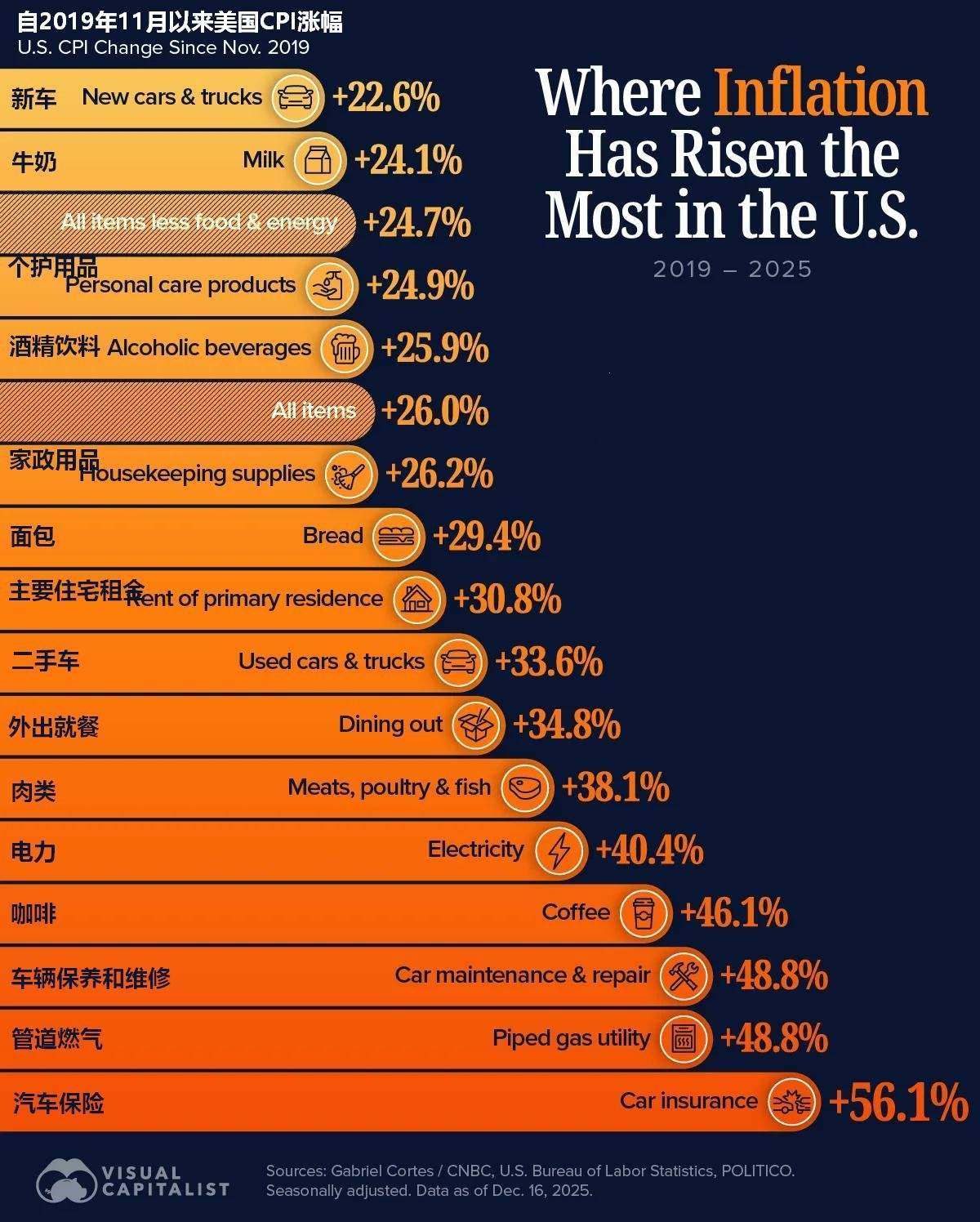
过去5年美国整体物价上涨26%!汽车保费涨幅56.1%居首,燃气价格涨48.8%,电价涨超40%,外出就餐价格涨近35%
Ge Long Hui· 2026-01-27 13:55
Group 1 - The core point of the article highlights significant price increases in various sectors, with auto insurance prices leading at a rise of 56.1% due to higher vehicle prices, repair costs, and more severe claims [2] - Vehicle maintenance and repair costs follow closely with an increase of 48.8%, reflecting rising labor costs and parts prices [2] - Energy and food prices continue to exert pressure on households, with pipeline gas service prices rising by 48.8% and electricity prices increasing by over 40% [2] Group 2 - Dining out prices have surged nearly 35%, while specific food items such as coffee (46.1%), meat (38.1%), and bread (29.4%) have seen price increases significantly above the overall inflation rate [2] - Major residential rents have increased by 30.8%, contributing to the overall cost of living pressures faced by households [2]
报告:美联储会议或因新主席提名在即而失色
Sou Hu Cai Jing· 2026-01-27 07:46
Core Viewpoint - The upcoming Federal Reserve meeting may soon be overshadowed by President Trump's imminent nomination of a new Federal Reserve Chair, which is expected to spark a significant debate on inflation [1] Group 1: Federal Reserve and Economic Outlook - The new Federal Reserve Chair will require Senate confirmation, leading to discussions about inflation [1] - There is a brewing risk of severe deflation due to falling rents, housing prices, and low oil prices, which may necessitate a significant reduction in the key interest rate by at least 1% [1]
分析师:按通胀算白银价格只到历史峰值约一半 但不会贸然追逐涨势
Ge Long Hui A P P· 2026-01-26 23:16
格隆汇1月27日|Investinglive分析师Adam Button指出,考虑到通货膨胀因素,1980年(亨特兄弟操纵 白银期间)银价的峰值相当于如今的约195美元/盎司,这或许就是多头所期望的目标价位,目前交易价 格仍约为其在亨特兄弟操纵白银期间所达到的"实际"价值的一半。目前,我不会贸然追逐白银的涨势, 因为这种抛物线式的走势很难把握。但对于那些已经做多的投资者来说,最好的做法往往是坚定持有, 或者在途中逐步获利了结。对于今天盘后发生的任何事情,我都会保持警惕,因为可能会出现保证金上 涨的情况,而且经纪商可能会开始限制交易权限。 ...
How many rate cuts in 2026? These mounting pressures will put the Fed at a crossroads this year
Yahoo Finance· 2026-01-26 17:04
By design, the group of officials voting on interest rates is going to look a lot different this year.Fed policymakers have a direct line to your wallet . Their decisions help shape everything from mortgage rates and home equity lines of credit (HELOCs), to personal loans, credit card rates and car loans. They’re also the reason savers have enjoyed historic returns on savings accounts and certificates of deposit (CDs) for four years. Here’s an inside look at all of the shifting forces that could alter how m ...
瑞银展望2026美国经济:一旦AI泡沫破裂衰退概率将达50%,市场低估了6月前降息的可能性
Sou Hu Cai Jing· 2026-01-26 07:48
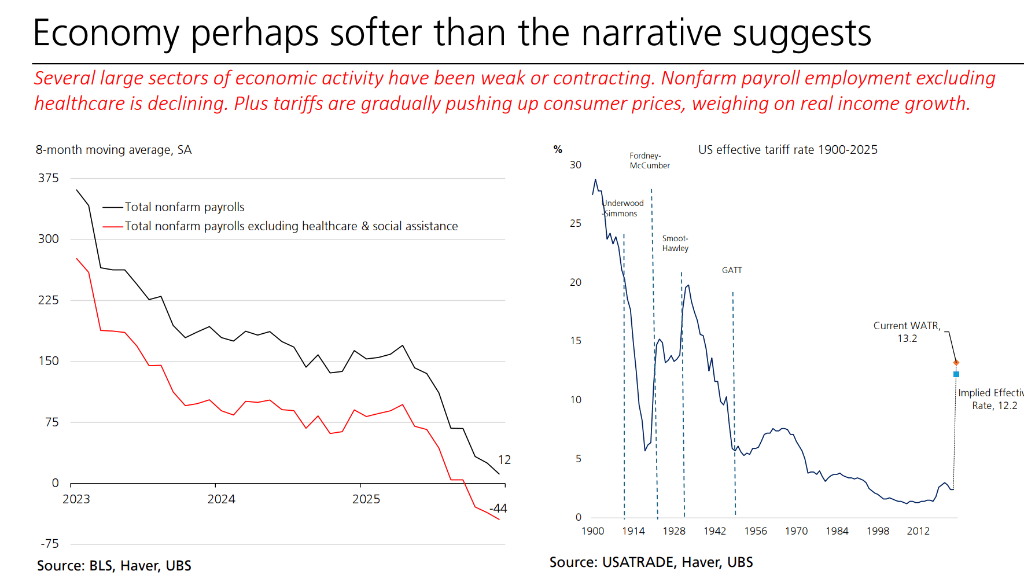
Group 1 - UBS reports that despite strong overall economic data, growth sources are extremely narrow, with most of the real economy in a state of weakness or contraction, except for the AI and technology sectors [1][5] - The labor market expansion has significantly slowed, with actual employment shrinking when excluding the healthcare sector [1][6] - The current asset prices are based on the dual pillars of sustained AI investment and strong consumption from the wealthy, leading to a warning that any downturn in AI investment could trigger a recession with a 50% probability [3][15] Group 2 - UBS forecasts that the Federal Reserve will face a dilemma between maintaining independence and rescuing the labor market, predicting two rate cuts of 25 basis points each in 2026, bringing the target federal funds rate to 3.00% to 3.25% [4] - The market currently underestimates the likelihood of a rate cut in March, with only about 16% probability priced in, while UBS believes the chances are higher due to potential labor report weaknesses [4] - Political pressures are mounting on the Federal Reserve, which may lead to delays in necessary rate cuts to avoid perceptions of yielding to political influence [4] Group 3 - The growth of the U.S. economy is heavily reliant on AI-related investments, with a 17% increase in AI-related equipment investment over the past four quarters, while other equipment investments have declined by 1% [5] - Non-residential structure investment has contracted for six consecutive quarters, and residential investment has declined in four of the last five quarters [5] - The wealth distribution is increasingly polarized, with stock market wealth reaching a record 37% of total household wealth, benefiting high-income groups while others face inflation and stagnant real incomes [5] Group 4 - The labor market has deteriorated significantly, with an average monthly decrease of 41,000 jobs in the private sector when excluding healthcare and social assistance [6] - Broader labor utilization indicators are rising, indicating a more severe weakness in the labor market than headline data suggests [6] - Current employment growth is below the breakeven point needed to maintain stable unemployment rates, highlighting the extent of labor market weakness [6] Group 5 - Tariff policies are creating significant macroeconomic headwinds, with the weighted average tariff rate (WATR) rising to 13.2%, effectively imposing a 1.1% tax on GDP [10] - This has led to a rebound in inflation from 2.61% in April 2025 to 2.91% in August 2025, with expectations of inflation peaking in summer 2026 before gradually declining [10] - Tariffs are expected to significantly hinder real GDP growth in 2025 and 2026, limiting the Federal Reserve's policy options [10] Group 6 - Fiscal policy is expected to provide short-term support amid weak private sector demand, with a projected surge in personal tax refunds of approximately $50 to $60 billion due to the implementation of the "One Big Beautiful Bill" [11] - This fiscal stimulus is anticipated to shift from negative to positive in 2026, providing a bottom support for economic expansion despite underlying weaknesses [11] - UBS believes that as long as fiscal support continues, the economy is unlikely to collapse immediately [11]