
全国统一大市场

Search documents
VC/PE周报 | 千亿半导体龙头做LP;阿里投了家清华系AI公司
Mei Ri Jing Ji Xin Wen· 2025-06-16 12:19
Group 1: Government Investment Fund Regulations - Gansu Province has issued guidelines to strictly control the establishment of government investment funds, emphasizing that these funds should not be set up for the purpose of attracting investment [2][3] - The guidelines promote the optimization and integration of existing funds, with a focus on unified management and avoiding duplication in the same industry or sector [2][3] - The policy reflects a shift from broad capital attraction to a focus on operational efficiency and quality in industry cultivation, aiming to leverage government investment funds for better industry guidance [3] Group 2: Private Equity Market Developments - Goldman Sachs Asset Management is seeking to raise over $14.2 billion for its new S Fund, indicating strong interest in the secondary private equity market [4] - The secondary market is expected to see a total trading volume of $185 billion by 2025, driven by liquidity challenges faced by many limited partners (LPs) [4] - Major firms like Blackstone and Carlyle are also actively engaging in the secondary market, highlighting its importance as an exit channel for private equity investments [4] Group 3: Venture Capital Innovations - Junlian Capital has launched Beijing's first technology innovation bond with a registered scale of 500 million yuan, aimed at supporting long-term investments in technology [5][6] - The introduction of the "technology board" in the bond market is expected to enhance funding channels for venture capital institutions, facilitating investments in early-stage and hard technology [5][6] - The successful issuance of technology innovation bonds by firms like Dongfang Fuhai indicates a growing trend in financing for venture capital institutions [6] Group 4: Corporate Investments - Zhongwei Company announced its participation in establishing a private equity fund with a target size of 1.5 billion yuan, focusing on the semiconductor and related strategic emerging sectors [7] - The fund plans to allocate over 80% of its investments to upstream and downstream enterprises in the integrated circuit industry, aligning with Zhongwei's core business [7] - This focused investment strategy aims to strengthen the supply chain and capture emerging technology trends while minimizing cross-industry risks [7] Group 5: AI and Biotechnology Investments - Insilico Medicine has completed a Series E financing round, raising approximately $123 million, reflecting strong investor interest in the AI-driven biopharmaceutical sector [8][9] - The investment highlights China's competitive edge in AI drug development, with local government and investment platforms strategically positioning themselves in this hard technology field [8][9] - The funding will support Insilico's efforts in drug discovery across various therapeutic areas, showcasing the integration of AI and automation in pharmaceutical innovation [8][9] Group 6: Smart Manufacturing Investments - Xiaomi has invested in Danikel Automation Technology, setting a record for single financing in the automatic feeding and intelligent tightening sector [9] - This investment is part of Xiaomi's broader strategy to deepen its involvement in smart manufacturing, providing technological synergies for its automotive business [9] - The record-breaking financing reflects strong market expectations for domestic high-end equipment replacement opportunities [9] Group 7: AI Infrastructure Investments - Alibaba Cloud has led a multi-million yuan Series A financing round for SiliconFlow, a company focused on general artificial intelligence infrastructure [10][11] - SiliconFlow aims to address high AI computing costs with innovative technologies, positioning itself as a key player in the AI industry [10][11] - The investment underscores the growing competition in AI infrastructure and the strategic importance of companies that can reduce AI deployment costs for enterprises [10][11]
银河证券每日晨报-20250616
Yin He Zheng Quan· 2025-06-16 02:54
Key Insights - The report emphasizes the transformative impact of artificial intelligence (AI) on China's economy, predicting an average increase of approximately 1.3% in total factor productivity (TFP) from 2025 to 2035 due to AI advancements, which could contribute an additional 14.8% to GDP by 2035 [1] - The report highlights the ongoing challenges in the real estate market, indicating that the adjustment period has entered its fourth year, with significant inventory issues persisting despite government efforts to stabilize the market [11][12] - The report discusses the need for a new supply-side reform that adapts to the current economic landscape, moving beyond traditional methods to address structural issues and promote high-quality development [7][8] Macro Insights - The report notes that the Producer Price Index (PPI) has experienced negative growth for 32 months, indicating a prolonged period of deflationary pressure that has not been seen since previous economic crises [2] - It suggests that the current economic environment necessitates a comprehensive approach to stimulate domestic demand, with a focus on balancing supply and demand to achieve sustainable growth [4][5] - The report outlines the importance of addressing the structural overcapacity and "involution" competition in various industries, advocating for a more market-oriented approach to capacity reduction [15][19] Real Estate Sector - The report identifies the critical need for inventory reduction in the real estate sector, emphasizing that the current high levels of unsold properties pose a significant challenge to market stabilization [12][13] - It discusses the government's "three red lines" policy aimed at curbing debt expansion in the real estate sector, which has led to a prolonged adjustment phase [11] - The report suggests that a more proactive government role is necessary to facilitate the clearing of excess inventory and stabilize the housing market [14] Industry Dynamics - The report highlights the competitive pressures in the automotive and renewable energy sectors, noting that many companies are engaged in "involution" competition, which undermines market stability and profitability [21][22] - It emphasizes the need for industries to innovate and adapt to avoid the pitfalls of excessive competition and to promote sustainable growth [24][25] - The report advocates for the establishment of a unified national market to enhance resource allocation and reduce local protectionism, which has historically led to inefficiencies [26][27]
“散装”与“整装”(人民论坛)
Ren Min Ri Bao· 2025-06-15 21:45
Core Viewpoint - The recent popularity of the Jiangsu Province city football league, referred to as "Su Super," highlights the competitive yet collaborative spirit among the 13 cities in Jiangsu, showcasing both regional pride and economic strength [1][2]. Group 1: Regional Competition and Collaboration - The phrase "scattered" emphasizes the unique strengths of each city, while "integrated" signifies the importance of collaboration, leading to a healthy competitive environment that stimulates economic vitality across Jiangsu [2][3]. - Jiangsu's cities, such as Nanjing in digital economy and Suzhou in smart manufacturing, have all entered the top 100 cities by GDP in China, demonstrating the province's collective economic prowess [2]. Group 2: Development Strategies - Jiangsu's development model reflects a gradient approach, with "Southern Jiangsu leading, Central Jiangsu rising, and Northern Jiangsu catching up," fostering deep industrial collaboration and integration into the new development landscape [2][3]. - The concept of "scattered" and "integrated" serves as a framework for understanding the balance between regional uniqueness and collective growth, essential for enhancing county economies and promoting regional integration [3]. Group 3: National Economic Context - The challenges faced by China's economy, such as regional resource disparities, highlight the need for a rational layout of industries, where distinctive strengths can be combined to create a cohesive economic structure [3]. - The successful integration of various regional economies into a unified market is crucial for achieving high-quality development, as illustrated by the collaborative efforts in the Yangtze River Delta and other regions [3].
持续放大宏观政策效能
Jing Ji Ri Bao· 2025-06-13 20:57
Group 1: Economic Recovery and Growth - The implementation of proactive macro policies has led to continuous improvement in both manufacturing and non-manufacturing sectors, with enterprises maintaining stable confidence in market development [1][2] - From January to April, profits of industrial enterprises above designated size increased by 1.4% year-on-year, indicating a recovery trend [1] - In May, the manufacturing production index rose by 0.9 percentage points, returning to the expansion zone, with a business activity expectation index of 52.5% [1] Group 2: Investment and New Growth Drivers - New momentum in production activities is growing rapidly, with significant increases in high-tech industry investments, such as information services (40.6%), computer and office equipment manufacturing (28.9%), and aerospace manufacturing (23.9%) from January to April [2] - The new orders index for high-tech manufacturing remained above 52% for several months, indicating sustained expansion [2] Group 3: Service Sector Recovery - The service sector has shown notable recovery, particularly in tourism and dining during the "May Day" holiday, with business activity indices in transportation and accommodation sectors also in the expansion zone [2] - The business activity expectation index for most service enterprises is at 56.5%, reflecting continued optimism about market development [2] Group 4: Policy Measures and Structural Reforms - Continuous implementation of economic stabilization policies aims to expand domestic demand and strengthen the domestic economy, utilizing proactive fiscal and moderately loose monetary policies [3] - Efforts to enhance enterprise efficiency include fostering new quality productivity and promoting the integration of technological and industrial innovation [3] Group 5: Market Reforms and Opening Up - Comprehensive reforms are being pursued to promote high-level opening up and transition from a large to a strong domestic market, including the establishment of a unified national market and removal of market access barriers [4] - Initiatives to create a national trading platform system and enhance cross-regional trade cooperation are underway [4]
全国医保“一盘棋”:异地就医免垫付首季减负469亿元
Hua Xia Shi Bao· 2025-06-12 08:58
Core Viewpoint - The cross-provincial medical treatment direct settlement policy has significantly improved the reimbursement process for patients, reducing the financial burden and streamlining the healthcare experience [2][4][11]. Group 1: Policy Impact - As of the first quarter of 2025, the cross-provincial direct settlement system has benefited 70.75 million insured individuals, reducing out-of-pocket expenses by 46.992 billion yuan, marking increases of 37.97% and 11.44% respectively compared to the same period in 2024 [2][7]. - The number of cross-provincial designated medical institutions reached 651,600, an increase of 0.77 million or 1.19% from the end of 2024 [7][8]. - The direct settlement for inpatient services accounted for 3.6389 million cases, reducing personal payments by 36.537 billion yuan, with growth rates of 11.92% and 5.68% respectively [7][8]. Group 2: Technological Advancements - The establishment of a unified national medical insurance information platform has facilitated seamless cross-provincial medical treatment settlements, ending the previous fragmented system [3][8]. - Patients can now complete the reimbursement process using electronic medical insurance credentials or social security cards, significantly reducing the need for physical paperwork and in-person visits [8][9]. Group 3: Regional Innovations - Various provinces have implemented innovative service models, such as automatic registration and immediate settlement for cross-provincial medical treatment, enhancing accessibility for patients [9][10]. - In Yunnan, the "Medical Insurance Market Day" initiative has improved access to services in remote areas, leading to a more than 40% increase in cross-provincial outpatient settlements in the first quarter of 2025 [10]. Group 4: Future Implications - The reforms in cross-provincial medical treatment not only alleviate financial burdens but also promote the free movement of labor and resources across regions, supporting the construction of a unified national market [11].


市场准入壁垒加速破除
Jing Ji Ri Bao· 2025-06-11 22:14
Core Viewpoint - The release of the "Negative List for Market Access (2025 Edition)" signifies a further relaxation of market access restrictions in China, promoting a unified national market and enhancing market access efficiency [1][2]. Group 1: Market Access Reforms - The negative list system is a significant decision by the central government, serving as a foundational institutional arrangement for building a unified national market [2]. - The number of items on the negative list has been reduced from 151 in 2018 to 106, representing a reduction of approximately 30%. National management measures have decreased from 486 to 469, while local management measures have dropped from 36 to 20 [2][3]. - The new version of the negative list features lower entry barriers and greater intensity, with the removal of 8 national access restrictions and the cancellation of 17 local licensing measures [3]. Group 2: Impact on New Industries - The inclusion of "Civil Unmanned Aerial Vehicle Operation Qualification Certificate Issuance" in the management list aims to regulate the low-altitude economy and boost enterprise confidence [4]. - The government has been actively optimizing the market access environment for new industries, with initiatives in regions like Hainan and Shenzhen to support innovative projects such as commercial space launch sites and international trading platforms for electronic components [4]. Group 3: Challenges and Future Directions - Despite progress, challenges remain with existing barriers such as "glass doors" and "spring doors" that hinder the full realization of a "non-prohibited, immediate access" market environment [7]. - The government is undertaking actions to eliminate unreasonable market access barriers and establish long-term mechanisms for addressing these issues [7]. - The "non-prohibited, immediate access" principle is crucial for fostering a fair market environment, particularly benefiting private enterprises and enhancing their participation in major national projects [7].
让“地方味道”成为乡村经济新引擎
Xiao Fei Ri Bao Wang· 2025-06-11 03:05
Group 1 - The Ministry of Industry and Information Technology has announced the first batch of 39 local specialty food industries, marking a new stage in the development of China's specialty food industry, highlighting the government's emphasis on the "taste economy" and the intention to boost rural economies through traditional food culture [1] - The selected local specialty food industries will receive multiple supports including policies, funding, and technology, aiming to transform from "local specialties" to "industrial chains" and to encourage local governments to integrate resources and talent to promote local specialties on a broader stage [2] - The development of local specialty foods is not just about strengthening specific products but also about revitalizing the entire rural ecosystem, creating a full industrial chain that includes agriculture, processing, packaging, transportation, e-commerce, and tourism [2] Group 2 - With the advancement of a unified national market, local flavors should not be limited to geographical labels but should aim for broader markets, leveraging e-commerce platforms and digital supply chains to reach national and global audiences [3] - Local governments are encouraged to develop systematic industrial plans around specialty foods, strengthen quality standards, and promote talent return and youth entrepreneurship, enhancing the market competitiveness of local foods with unique cultural and natural attributes [3] - The focus on local specialty food industries is not only beneficial for the food sector but also represents a deeper implementation of rural revitalization strategies, transforming "specialty" into "normalcy" and "local flavor" into "value" [3]
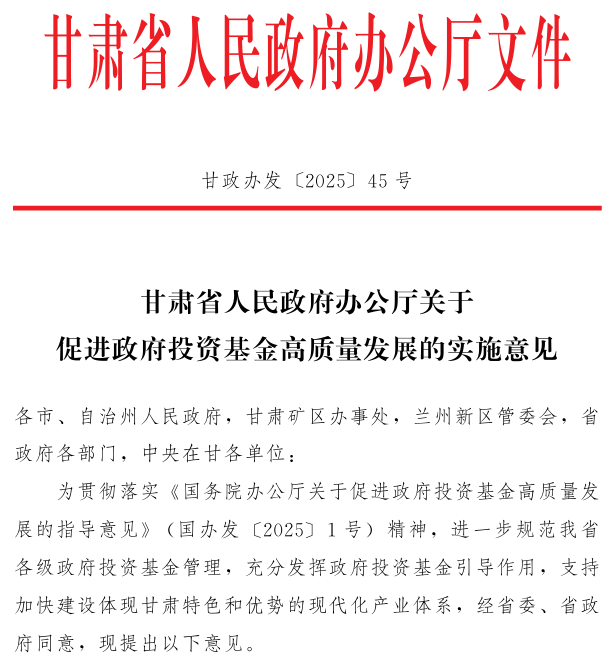
甘肃:严控新设基金,不以招商引资为目的设立政府投资基金
Sou Hu Cai Jing· 2025-06-10 08:51
Core Viewpoint - The Gansu Provincial Government has issued implementation opinions to promote the high-quality development of government investment funds, emphasizing the need for careful evaluation and approval processes for fund establishment, as well as the importance of avoiding redundant investments and ensuring effective fund management [1][4][5]. Group 1 - The government investment funds should have a reasonable duration and act as long-term and patient capital to adjust across cycles [4]. - Funds established by the government must undergo thorough evaluation and adhere to approval procedures, with provincial or municipal funds requiring local government approval [4][5]. - New government investment funds at the county level should be strictly controlled, with proposals needing approval from the municipal government if the county has sufficient financial resources [4]. Group 2 - All levels of government investment funds must prevent redundant investments and disorderly competition to avoid overcapacity and low-level repeated construction [4]. - New funds established by municipalities or counties must be reported to the provincial finance department for record-keeping [4]. - The same government should not establish multiple funds in the same industry or field, but funds can support the same project in a market-oriented manner [4]. Group 3 - Funds lacking industrial foundation or resource endowment should enhance effectiveness through optimized investment directions and market-oriented exits [5]. - Fiscal departments at all levels are responsible for the unified management of government investment funds, with strict controls on new fund establishments [5]. - It is prohibited for governments to finance through illegal debt, and there should be no new hidden local government debts [5]. Group 4 - A mechanism for error tolerance centered on compliance responsibility exemptions is encouraged to enhance the investment enthusiasm of fund managers [5]. - Regulatory responsibilities should be performed in accordance with laws and regulations, without administrative interference in daily fund management and investment decisions [5].
做好建设现代化经济体系这篇大文章——学习《习近平经济文选》第一卷
Jing Ji Ri Bao· 2025-06-10 00:15
Group 1: Modern Economic System - The modern economic system is an organic whole composed of various interconnected social and economic activities, involving multiple aspects such as industrial development, technological innovation, regional coordination, green development, and market system construction [1][2] - The construction of a modern economic system is both a significant theoretical proposition and a major practical task, as discussed in multiple writings in the first volume of "Xi Jinping's Economic Works" [1][2] Group 2: Green Development - Accelerating the green transformation of economic and social development is a crucial strategy for addressing resource and environmental issues in China, with significant achievements in recent years [2][3] - The concept of "lucid waters and lush mountains are invaluable assets" has become deeply ingrained in society, forming a resource-saving and environmentally friendly green development system as part of the modern economic framework [2][3] Group 3: Development Philosophy - The need for a new development philosophy is emphasized, particularly the importance of green development in achieving harmony between humanity and nature, which is essential for sustainable economic growth [3][4] - The integration of economic growth with environmental protection is highlighted as a key requirement for modern construction, promoting a harmonious coexistence between human development and natural ecosystems [4][5] Group 4: Technological Innovation - Technological innovation is positioned as the primary driving force for development and a strategic support for building a modern economic system, with a focus on advancing green productivity [11][12] - The importance of aligning the innovation chain with the industrial chain is stressed, particularly in tackling key core technologies to enhance national competitiveness [13][19] Group 5: Regional Coordination - The significance of regional coordinated development is underscored as a vital component of the modern economic system, addressing the long-standing issue of regional disparities in resource endowments and development levels [15][16] - Recent strategies have led to noticeable improvements in regional coordination, with specific initiatives aimed at enhancing economic competitiveness and promoting balanced development across different areas [16][18] Group 6: Integration of Digital and Real Economies - The deep integration of the real economy and digital economy is identified as an essential requirement for high-quality economic development, with a focus on enhancing the intelligence and digitalization of the real economy [19][20] - Emphasis is placed on fostering advanced manufacturing clusters and promoting technological platform construction to support the integration of digital and real economies [21][22]
强化监管,着力整治乱象(评论员观察) ——为民营经济营造更好发展环境③
Ren Min Ri Bao· 2025-06-09 22:00
Group 1 - The core viewpoint emphasizes the necessity of both internal innovation and external regulation to enhance the private economy's development [1] - The market regulatory authority is focusing on eliminating non-compliant fees and conducting strict compliance reviews to prevent the introduction of problematic policies [1] - The judicial department is working on regulating law enforcement personnel to prevent corruption and ensure qualified individuals are in charge of enforcement [1] Group 2 - The government is implementing a series of laws and regulations to optimize the business environment, including the Fair Competition Review Regulations and the Private Economy Promotion Law [2] - There is a call for regulatory bodies to avoid both excessive and insufficient actions, promoting a balanced approach to oversight [2] - The example of "Hangzhou Six Little Dragons" illustrates effective government support for businesses through practical services and funding [3] Group 3 - Efforts are being made to revise laws to combat "involution" competition and ensure fair market practices, including addressing issues like malicious price comparisons and false advertising [4] - The government is actively engaging with platform companies to ensure they fulfill their social responsibilities and protect the rights of workers [4] - Continuous improvement of market rules is essential to correct market failures and ensure the private economy progresses along the right path [4]