智能化

Search documents
“主动安全系统龙头”瑞立科密今日登陆深交所
Zhong Zheng Wang· 2025-09-30 01:51
Core Viewpoint - 瑞立科密 successfully listed on the Shenzhen Stock Exchange, raising a total of 19.04 billion yuan through its IPO, exceeding its initial fundraising target by 2.34 billion yuan [1] Group 1: Company Overview - 瑞立科密 specializes in the research, production, and sales of core components related to active safety systems for motor vehicles, with key products including electronic braking systems and intelligent driving products [2][3] - The company has maintained steady growth in revenue and net profit, with a projected revenue of 1.55 billion to 1.73 billion yuan for the first nine months of 2025, representing a year-on-year growth of approximately 13.82% to 27.04% [2] Group 2: Market Position - 瑞立科密 holds a leading position in the commercial vehicle active safety system sector, with its pneumatic electronic braking products ranking first in production and sales for ten consecutive years from 2014 to 2023 [3] - The company has established partnerships with major domestic commercial vehicle manufacturers and has expanded its market presence internationally, exporting to Europe and the United States [3] Group 3: R&D and Technological Advantages - The company has developed proprietary active safety systems over 20 years, holding 459 authorized patents, including 58 invention patents, and has a dedicated R&D team comprising over 15% of its workforce [4] - 瑞立科密 has received multiple awards for its technological advancements, including national and provincial recognitions for its contributions to the automotive industry [4] Group 4: Fundraising and Future Plans - The funds raised from the IPO will be allocated to the construction of a smart manufacturing headquarters, a research and development center, and information technology projects, totaling an investment of 15.22 billion yuan [5] - The company aims to enhance its production capacity, R&D capabilities, and overall information technology level, positioning itself to capitalize on trends in automotive electrification and intelligence while expanding into passenger and motorcycle markets [5]
2025年中国立式吸尘器行业发展历程、产业链、市场规模、重点品牌及未来前景展望:家庭清洁便捷化需求显著,推动立式吸尘器规模超百亿元[图]
Chan Ye Xin Xi Wang· 2025-09-30 01:28
Core Insights - The upright vacuum cleaner market in China is experiencing significant growth, driven by rising living standards and changing consumer attitudes towards home cleanliness, with a market size projected to grow from 3.96 billion yuan in 2019 to 10.8 billion yuan by 2024, representing a compound annual growth rate (CAGR) of 22.22% [1][10] - The industry is characterized by a competitive landscape with both foreign and domestic brands, including major players like Dyson, Philips, and local brands such as Midea and Haier [5][11] Industry Overview - Upright vacuum cleaners are electric-powered cleaning tools primarily composed of motors, centrifugal fans, filters, and attachments, with power ratings typically ranging from 400 to 1000W or higher [3] - The application areas include carpets, vehicle interiors, and general household cleaning [3] Industry Development History - The upright vacuum cleaner industry in China has evolved through several stages: initial development from 1950-1960, transformation from 1970-1980, and rapid growth from 2000 to present [5] - Key milestones include the introduction of the first household vacuum cleaner in China in 1986 and the innovation of cordless vacuum cleaners by brands like Dyson in the 2010s [6] Industry Value Chain - The value chain consists of upstream raw materials and components, midstream manufacturing, and downstream sales channels, including supermarkets, specialty stores, and e-commerce platforms [6] Current Market Size and Growth - The overall vacuum cleaner market in China is projected to grow from 19.8 billion yuan in 2019 to 43.2 billion yuan by 2024, with a CAGR of 16.89% [9] Competitive Landscape - The market is divided into foreign brands, domestic strong brands, and numerous smaller brands, with foreign brands holding a significant market share due to their technological advancements and brand reputation [10][11] - Domestic brands like Midea and Haier are gaining traction by leveraging local market knowledge and distribution channels [10] Future Trends - The industry is moving towards increased intelligence, with products integrating various sensors and smart algorithms for enhanced user experience [14] - Customization is becoming a key focus, with companies offering tailored solutions for diverse cleaning needs [15] - Personalization in design and user interaction is also emerging as a significant trend, catering to different consumer preferences [16]




研判2025!中国离心风机行业发展历程、产业链、市场规模、重点企业及未来前景展望:节能政策与工业升级驱动,离心风机市场规模达164.8亿元[图]
Chan Ye Xin Xi Wang· 2025-09-30 01:21
Core Viewpoint - The centrifugal fan industry in China is experiencing significant growth, driven by industrialization, energy-saving policies, and increasing demand across various sectors, with the market expected to expand from 10.7 billion yuan in 2020 to 16.48 billion yuan in 2024, reflecting a compound annual growth rate (CAGR) of 11.4% [1][7]. Industry Overview - Centrifugal fans are essential mechanical devices that increase gas pressure and are widely used in industries such as power, cement, petrochemicals, coal, mining, and environmental protection [1][3]. - The industry is characterized by a diverse range of manufacturers and a broad market space, with a trend towards consolidation and increased market concentration favoring companies with core technologies and brand advantages [1][7]. Market Size and Growth - The centrifugal fan market in China is projected to grow from 10.7 billion yuan in 2020 to 16.48 billion yuan in 2024, with a CAGR of 11.4% [1][7]. - The global centrifugal fan market is expected to increase from 3.929 billion USD in 2020 to 5.308 billion USD in 2024, with a CAGR of 7.81% [7]. Industry Chain - The upstream of the centrifugal fan industry includes raw materials and components such as steel, fiberglass, and motors, while the midstream involves manufacturing, and the downstream encompasses applications in various sectors like steelmaking and wastewater treatment [6][7]. Competitive Landscape - The global centrifugal fan market features intense competition among major players, including Howden, Greenheck Fan Corporation, and Alstom, while key Chinese companies include Jintongling, Shuangjian, and Shandong Zhangqiu Fan [8][9]. - Jintongling Technology Group focuses on R&D and innovation, with a diverse product range and significant revenue growth projected [9]. - Shandong Zhangqiu Fan has over 50 years of experience and has established a strong market presence, with revenue growth expected [9]. Development Trends - The centrifugal fan industry is moving towards high efficiency and energy-saving technologies, driven by national policies and user demand for lower operational costs [10]. - Smart technology integration is becoming a key driver for transformation, enabling real-time monitoring and predictive maintenance [11][12]. - Low-noise design is increasingly important for enhancing competitiveness and user experience, with manufacturers focusing on acoustic performance improvements [13].


雷军“两个大学生学费账单”:造车1050亿+芯片135亿?
Sou Hu Cai Jing· 2025-09-29 23:07
Core Insights - Lei Jun, the founder of Xiaomi, expressed the significant financial pressure of supporting two university students, which metaphorically refers to the company's investments in electric vehicles and chip development [2][25] - As of April 2025, Lei Jun's net worth reached $43.5 billion, primarily due to the recovery of Xiaomi's stock price and the delivery of the SU7 model [3] - Xiaomi's total investment in its automotive venture has exceeded 105 billion yuan, with plans to invest an additional 30 billion yuan in 2025 alone [13][15] Investment in Automotive Sector - Xiaomi's automotive project has incurred a total investment of 105 billion yuan over five years, with a single-year plan for 2025 to invest 30 billion yuan [13][15] - The SU7 model's development costs alone surpassed 30 billion yuan, and the automotive division reported a quarterly loss of 1.8 billion yuan despite achieving a revenue of 20.6 billion yuan in Q2 2025 [15] - Xiaomi's automotive strategy aims for a sales target of 300,000 units annually, emphasizing the importance of substantial investment in technology and product quality [15][25] Investment in Chip Development - Xiaomi's chip development has seen an investment of over 13.5 billion yuan in 2023, with a projected budget of over 6 billion yuan for 2025 [22] - The cost of developing the 3nm flagship processor "Xuanjie O1" reached $1 billion per iteration, highlighting the high stakes involved in chip manufacturing [22] - The chip division's R&D expenses accounted for 18% of total R&D spending in 2023, with a team of over 2,500 engineers [22] Strategic Vision and Market Position - Lei Jun's annual speeches have become a significant platform for Xiaomi's strategic narrative, focusing on innovation and product launches [9][12] - The company aims to leverage its existing smartphone user base to drive growth in both the automotive and chip sectors, creating a synergistic effect [21] - Xiaomi's commitment to long-term investment in high-tech sectors reflects a broader trend in Chinese enterprises striving for technological advancement and industry upgrades [25]

中国五矿携旗下9家上市公司亮相深交所 增强矿产资源保障能力 多维度提升投资者回报
Zhong Guo Zheng Quan Bao· 2025-09-29 22:55
Core Viewpoint - China Minmetals Corporation emphasizes "resources" as its primary strategy and aims for high-end, intelligent, and green development through technological innovation [1][2][4] Group 1: Company Overview - China Minmetals, established in 1950, is a state-owned enterprise directly managed by the central government, focusing on metal minerals and has developed a full industry chain including exploration, construction, operation, processing, trade, logistics, R&D, and financial capital [2] - As of mid-2025, China Minmetals has total assets of nearly 1.5 trillion yuan and reported revenue of 381.1 billion yuan [2] Group 2: Resource Development and Supply Chain - The company is enhancing its resource security capabilities, with significant increases in resources for copper, lead-zinc, nickel, cobalt, tungsten, tin, and antimony expected in 2024 [2] - China Minmetals has formed the China Salt Lake Group with Qinghai Province to accelerate the construction of a world-class salt lake industry base [2] Group 3: Technological Innovation and Industry Upgrading - The company is leveraging its national-level R&D platforms to foster strategic emerging industries in areas such as metal materials, special materials, equipment manufacturing, digital economy, and energy conservation [4] - China Minmetals has 10 national-level champion enterprises, 20 specialized "little giant" enterprises, and 14 "double hundred" enterprises [4] Group 4: Investment and Shareholder Relations - The company is committed to enhancing the value of its listed companies and optimizing investor return mechanisms, including sustainable profit distribution policies and encouraging cash dividends [6] - China Minmetals plans to improve investor relations management through various activities such as roadshows and open days to enhance communication and transparency [6] Group 5: Specific Company Initiatives - Minmetals Resources, a flagship platform for overseas base metal development, holds significant copper and zinc resources and is optimistic about exploration and resource expansion [3] - The Las Bambas copper mine is expected to produce 400,000 tons of copper in 2025, positioning it as Peru's largest copper mine and among the top ten globally [3]
我国形成世界上规模最大水利基础设施体系(权威发布·高质量完成“十四五”规划)
Ren Min Ri Bao· 2025-09-29 22:30
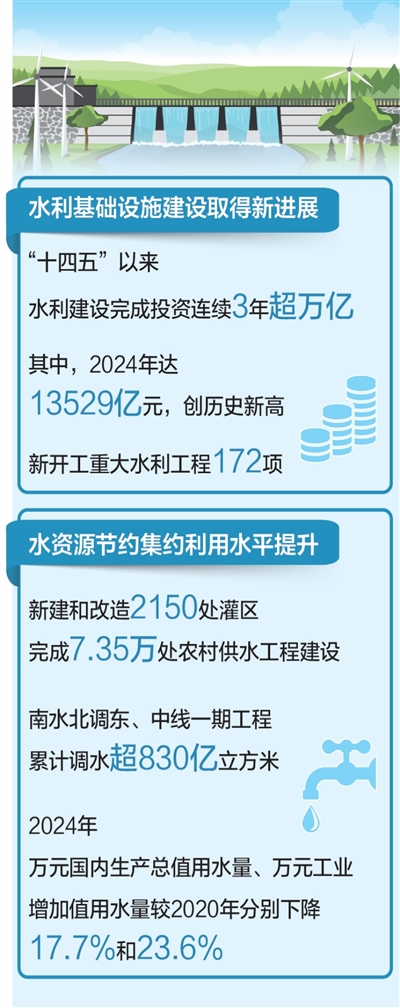
Core Insights - The Chinese government has made significant progress in water conservancy development during the "14th Five-Year Plan" period, enhancing flood safety, water supply security, food security, and ecological safety [4][5]. Investment and Infrastructure - Water conservancy construction investment has exceeded 1 trillion yuan for three consecutive years, reaching a historical high of 1.3529 trillion yuan in 2024, with a total expected investment of 5.4 trillion yuan during the "14th Five-Year Plan," which is 1.6 times that of the "13th Five-Year Plan" [5]. - A total of 172 major water conservancy projects have commenced since the beginning of the "14th Five-Year Plan," with 95,000 reservoirs, 200 large and medium-sized water diversion projects, and 6,924 large and medium-sized irrigation areas completed by the end of 2024 [5]. Disaster Management and Water Resource Allocation - The proportion of flood disaster losses to GDP has decreased from 0.28% during the "13th Five-Year Plan" to 0.18% during the "14th Five-Year Plan" [5]. - The national water network coverage is expected to reach 80.3% by the end of this year, with significant projects like the South-to-North Water Diversion and other major water diversion projects enhancing water resource allocation [6]. Water Conservation and Efficiency - Water resource utilization has improved, achieving zero growth in total water consumption despite economic growth, with water usage per unit of GDP and industrial output decreasing by 17.7% and 23.6% respectively compared to 2020 [7]. - The area of effective irrigation has increased to 6.38 million hectares, with unconventional water utilization reaching 25.1 billion cubic meters [7]. Agricultural Support and Rural Water Supply - The government has focused on modernizing irrigation systems and ensuring rural water supply, with a target of 96% for rural tap water coverage by the end of the "14th Five-Year Plan" [8]. - The construction of 30 major water diversion and key water source projects has been prioritized to support food production in major grain-producing areas [8]. Ecological Restoration and Soil Conservation - The area affected by soil erosion in the Loess Plateau has been reduced by over half, with significant measures taken to improve vegetation and soil conservation [11]. - The ecological environment of rivers and lakes has improved, with a focus on restoring flow in historically dried rivers and enhancing ecological water flow standards [10].
中国五矿携旗下9家上市公司亮相深交所
Zhong Guo Zheng Quan Bao· 2025-09-29 20:46
Core Viewpoint - China Minmetals Corporation emphasizes "resources" as its primary strategy and aims for high-end, intelligent, and green development through technological innovation [1][2] Group 1: Business Overview - China Minmetals, established in 1950, is a state-owned enterprise directly managed by the central government, focusing on metal minerals and has developed a full industry chain covering exploration, construction, operation, smelting, trade, logistics, R&D, and financial capital [1] - As of mid-2025, China Minmetals has total assets of nearly 1.5 trillion yuan and reported revenue of 381.1 billion yuan [1] Group 2: Resource Assurance and Development - The company is enhancing its resource assurance capabilities, with significant increases in resources for copper, lead-zinc, nickel, cobalt, tungsten, tin, and antimony expected in 2024 [2] - China Minmetals has formed the China Salt Lake Group with Qinghai Province to accelerate the construction of a world-class salt lake industry base, with Salt Lake Co. becoming the ninth listed subsidiary [2] - Minmetals Resources, a flagship platform for overseas base metal development, holds 18.6 million tons of copper and 11.9 million tons of zinc resources, positioning it as a leading global producer [2] Group 3: Technological Innovation and Development - The company is focusing on technological innovation as a core driver, leveraging national-level R&D platforms to foster strategic emerging industries in metal materials, special materials, equipment manufacturing, digital economy, and energy conservation [3] - China Minmetals boasts 10 national-level manufacturing champions, 20 specialized "little giant" enterprises, and 14 "double hundred" enterprises [3] Group 4: Business Diversification and Upgrading - The metallurgical construction sector is aligning with new industrialization and urbanization, while trade logistics is developing a comprehensive model integrating resources, trade, logistics, and services [4] - Financial capital aims to optimize business structure with a focus on technology, green, and industrial finance [4] - Zhongtung High-tech is promoting the high-end, intelligent, and green transformation of the non-ferrous metal industry, with significant production increases expected post-technical upgrades [4] Group 5: Investor Relations and Value Creation - China Minmetals is committed to enhancing the value creation and realization of its listed companies, focusing on improving company quality, optimizing investor return mechanisms, and enhancing investor relations management [5][6] - The company plans to support listed companies in developing sustainable profit distribution policies and encourage cash dividends and share buybacks to boost investor confidence [6] - Efforts will be made to improve communication with investors through various engagement activities, enhancing information disclosure quality and market recognition [6]

至境L7杀到 别克“反击”新势力
Bei Jing Shang Bao· 2025-09-29 13:28
Core Viewpoint - SAIC-GM Buick's new high-end electric vehicle sub-brand "Zhijing" has launched its flagship sedan, Zhijing L7, marking its entry into the competitive electric sedan market against new energy vehicle startups [2][3]. Group 1: Product Launch and Market Positioning - The Zhijing L7 was officially launched on September 28, with five models priced between 169,900 and 215,900 yuan [2]. - The Zhijing brand was introduced in April, with its first model, the "Shijia," positioned as a luxury MPV targeting the million-yuan segment [2]. - The entry of Zhijing L7 into the sedan market is seen as a strategic move to compete with established players and new entrants in the electric vehicle sector [2][3]. Group 2: Technical Specifications and Features - Zhijing L7 is classified as a C-class mid-large sedan, with dimensions of 5032mm in length, 1952mm in width, and 1500mm in height, while its pricing places it in the B-class segment [3]. - The vehicle features the "Zhenlong" range extender system, which includes a 252kW electric drive and a 1.5T hybrid engine, achieving a combined fuel consumption of just 0.5 liters per 100 kilometers [3]. - The pure electric range of Zhijing L7 is 302 kilometers, with a total range of 1420 kilometers, and it supports fast charging from 30% to 80% in just 18 minutes [3]. Group 3: Competitive Landscape and Market Trends - The hybrid vehicle market has seen significant growth, with sales reaching 3.46 million units in the first eight months of the year, a year-on-year increase of 22.8% [3]. - Companies like Li Auto, which have successfully entered the hybrid market, have reported improved sales and profitability, indicating a trend that attracts more manufacturers to this segment [3]. Group 4: Technological Advancements - Zhijing L7 incorporates Buick's "Xiaoyao Zhixing" driver assistance system and is the first to feature the Momenta R6 flywheel model based on end-to-end reinforcement learning [4]. - The vehicle is equipped with Qualcomm's latest SA8775P chip, providing 72 TOPS of AI computing power for an enhanced user experience [4]. - The development of Zhijing L7 reflects a shift in SAIC-GM's strategy, with increased autonomy and efficiency in product development, as well as more frequent communication with General Motors headquarters [4].
傅成玉:要在第四次工业革命中占先,中国亟待一个关键改变
财富FORTUNE· 2025-09-29 13:05
Core Viewpoint - The article emphasizes the divergence in energy policies between China and the United States, highlighting China's advantages in the clean energy sector amidst the U.S. retreat from global climate agreements [1][6]. Group 1: Trends and Transformations - The future is characterized by two major trends: green low-carbon transformation and intelligentization, which are expected to dominate the coming decades [4]. - China is positioned to lead in these trends due to its advanced status in renewable energy and smart technologies, as well as its comprehensive industrial application scenarios [5]. Group 2: U.S. Policy Impact - The U.S. withdrawal from the Paris Agreement is viewed as a temporary and localized impact on global climate efforts, with the expectation that the U.S. will eventually need to re-engage in green and low-carbon economies [6][7]. - The article critiques the U.S. approach under Trump's administration as regressive, suggesting that the country has missed opportunities for industrial revitalization and sustainable development [7]. Group 3: Challenges in China's Energy Sector - Despite the clear path towards green transformation, China's renewable energy sector faces challenges such as price competition and overcapacity [7]. - The article identifies "opportunism" among Chinese enterprises as a root cause of overcapacity, where companies seize fleeting opportunities without long-term strategy [8]. - It also highlights the need for a shift from low-price competition to a focus on high quality and cost-effectiveness to avoid self-destructive practices in the industry [9]. Group 4: Infrastructure and Industrial Adjustment - The current industrial and infrastructure systems in China are based on the previous three industrial revolutions, which are inadequate for the demands of the fourth industrial revolution [9]. - The article argues for a change in mindset regarding energy infrastructure, advocating for distributed energy systems that align with modern energy consumption patterns rather than large centralized power plants [9].

东营海事局破解黄河口客运航线水深动态探测难题
Qi Lu Wan Bao Wang· 2025-09-29 11:50
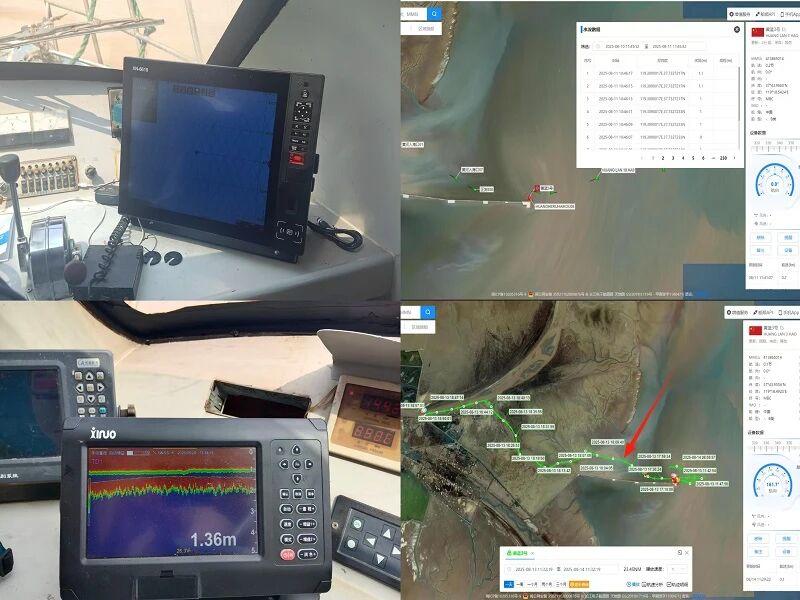
Core Viewpoint - The Dongying Maritime Bureau is implementing an intelligent monitoring system to address the challenges of rapidly changing water depth at the Yellow River estuary, ensuring safe navigation for passenger ships while enhancing data accuracy and reliability [1][4]. Group 1: Intelligent Monitoring System Development - The Dongying Maritime Bureau is focusing on real-time, precise, and intelligent monitoring of water depth by integrating signal foundations, equipment, and multi-party collaboration [1][3]. - The bureau is actively constructing 5G communication bases and other signal stations in key areas to minimize signal blind spots, facilitating stable real-time data transmission [3][4]. Group 2: Data Collection and Verification - The implementation of the MIBT system, intelligent depth measuring devices, and mobile 5G repeaters on emergency vessels allows for high-frequency data collection, with measurements being transmitted every 2 seconds [3]. - A three-way verification mechanism involving drones, smart devices, and manual checks has been established to ensure data reliability, with measurement errors controlled within 0.1 meters [3][4]. Group 3: Safety and Regulatory Enhancements - The intelligent monitoring system enables comprehensive safety assessments of the Yellow River passenger routes, particularly during peak travel periods, ensuring navigation safety [4]. - The system not only addresses water depth measurement challenges but also supports dual objectives of safety regulation and tourism development, contributing to ecological protection and high-quality development in the Yellow River basin [4][5]. Group 4: Future Optimization Plans - The Dongying Maritime Bureau plans to enhance the effectiveness of the intelligent monitoring system by deepening the application of AI in data analysis for automatic risk warnings and dynamic assessments of navigation capacity [4]. - Regular maintenance and calibration of smart devices will be conducted to ensure long-term stability and reliability of monitoring data [5].