能源转型

Search documents
端牢能源饭碗 加快绿色转型
Xin Hua She· 2025-09-25 23:15
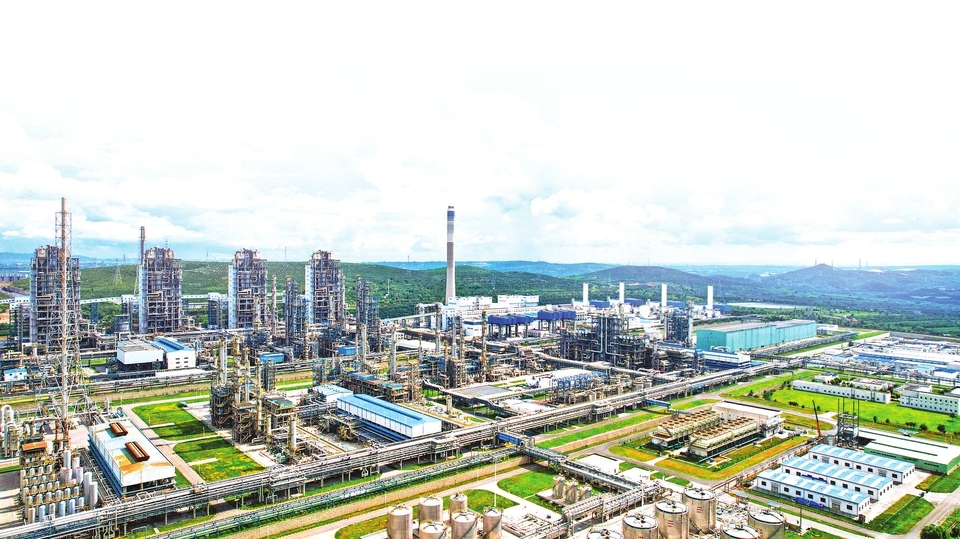
Group 1: Energy Transition and Development - Shanxi province is focusing on ensuring energy supply while promoting a green and low-carbon transition, as emphasized by President Xi Jinping during his visits in 2022 and 2023 [3] - The province aims to build a new energy system that includes wind, solar, and hydrogen energy, alongside coal [3] Group 2: Technological Advancements in Coal Mining - Shanxi is enhancing coal supply quality through intelligent construction and green mining practices, with 298 intelligent coal mines and 55 green mining pilot projects established by the end of August [5] - The establishment of a national AI application pilot base in the coal sector aims to further promote the intelligent upgrade of coal mines [5] Group 3: High-Value Coal Products - Shanxi is working to elevate coal products from basic fuels to high-value products, with companies like Lu'an Chemical Group transforming coal into high-value oil products through advanced processes [6] - The province has built 12 national-level major innovation platforms and numerous provincial laboratories to support technological breakthroughs in clean coal utilization [6] Group 4: Renewable Energy Growth - Since the 14th Five-Year Plan, renewable energy has become the main source of new installed capacity and generation in Shanxi, with an increase of 43.09 million kilowatts in renewable capacity over the past five years [9] - The share of renewable energy in Shanxi's total electricity generation has improved from 1/7 to 1/4, with renewable and clean energy installations now accounting for 54.4% of total capacity [10] Group 5: Green Electricity Parks - Shanxi has expanded its green electricity parks from 3 to 13, converting green advantages into development advantages for industrial transformation and green industry clustering [12] - Companies in green electricity parks benefit from reduced electricity costs and enhanced competitiveness due to direct supply of green electricity [11] Group 6: Market Reforms and Flexibility - Shanxi is implementing market reforms to enhance the flexibility of its power system, with over half of coal-fired power units undergoing flexibility upgrades to accommodate renewable energy [16] - The province has established a power spot market, which has been updated to its 15th version, promoting efficient and transparent market operations [16] Group 7: Overall Energy Strategy - Shanxi is transitioning from a traditional energy province to a new comprehensive energy base, focusing on low-carbon development and the integration of various energy sources [17]

联合国气候变化峰会举行 各方点赞中国新一轮国家自主贡献
Yang Shi Xin Wen Ke Hu Duan· 2025-09-25 23:09
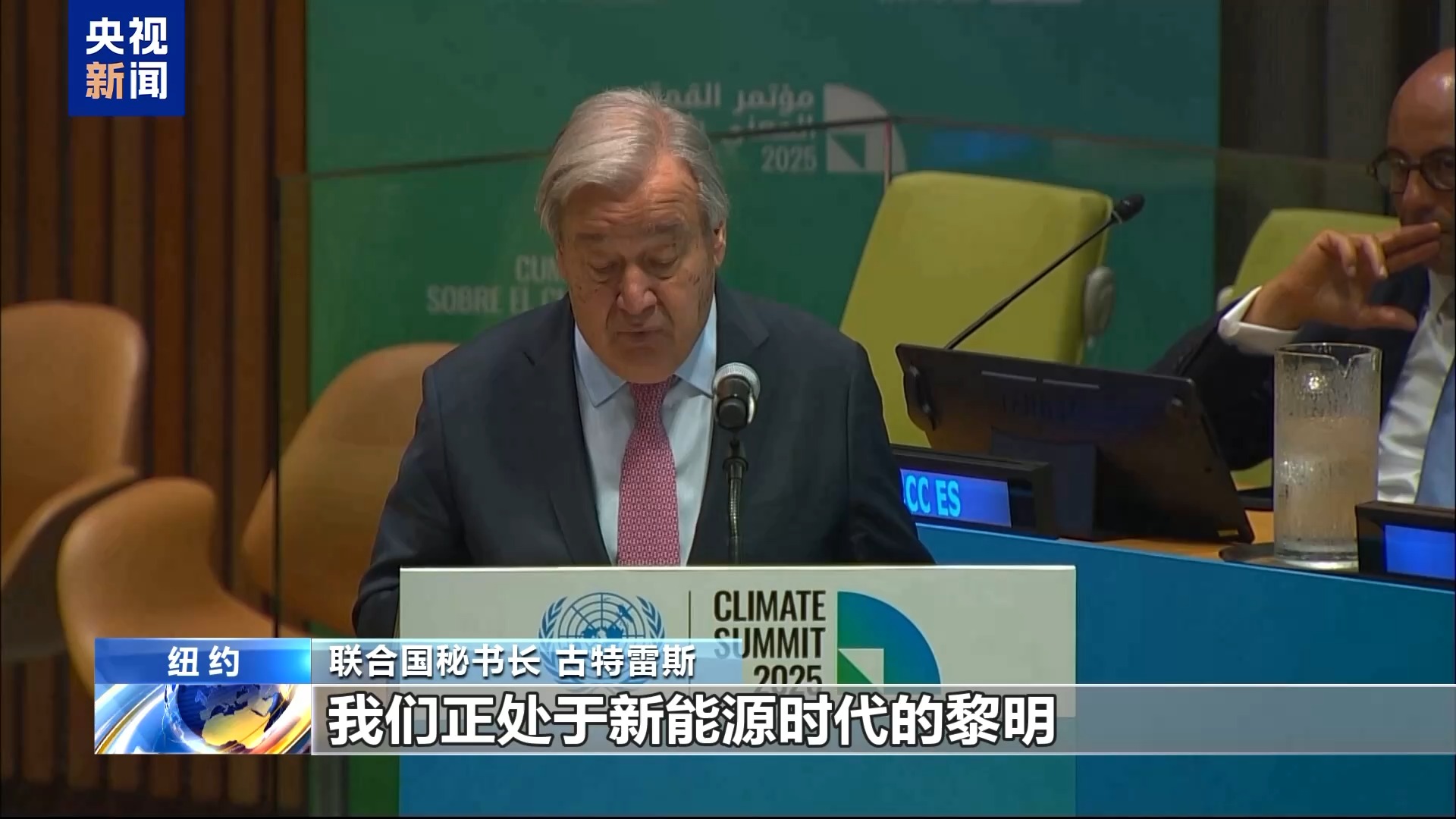
Group 1 - The 80th United Nations General Assembly continues with discussions on global issues, including climate change [1][11] - The UN Climate Change Summit was held on September 24, co-hosted by UN Secretary-General António Guterres and Brazilian President Lula, emphasizing the need for accelerated global action to limit temperature rise to within 1.5°C [4][6] - Guterres outlined five key areas for action: energy transition, methane reduction, forest protection, heavy industry emissions reduction, and climate justice, calling for a credible plan to raise $1.3 trillion annually for climate funding [4][6] Group 2 - China received positive evaluations for its new round of Nationally Determined Contributions (NDCs), having achieved its 2030 wind and solar energy targets six years ahead of schedule [6] - China committed to specific goals for reducing carbon emissions and increasing the share of non-fossil energy consumption by 2035, reflecting its significant progress in energy transition and carbon reduction [6][8] - Brazilian President Lula expressed satisfaction with China's commitments, highlighting its substantial advancements in energy transition and carbon emissions reduction [8][10]
2025《财富》世界500强峰会在广州举行
财富FORTUNE· 2025-09-25 15:46
Core Insights - The 2025 Fortune Global 500 Summit was held in Guangzhou, focusing on how companies can achieve sustainable growth through innovation and collaboration amid global economic uncertainties [1][5] - The total revenue of the listed companies reached $41.7 trillion, accounting for over one-third of global GDP, with a year-on-year growth of 1.8% [1] - The profit margin of the top ten companies includes three from the semiconductor and electronics sectors, highlighting the importance of high-tech industries [3] Group 1 - The summit emphasized the need for dialogue and cooperation to navigate the "atypical cycle" of the global economy [3][5] - Discussions included leveraging AI to enhance innovative productivity and addressing the energy transition's progress and long-term outlook [5][9] - The summit aimed to help companies enhance resilience and discover opportunities in uncertain environments [6] Group 2 - China had 130 companies on the Fortune Global 500 list, with a diverse industry representation including automotive, healthcare, new materials, finance, e-commerce, and construction [7] - Guangzhou has attracted significant foreign investment, with over 362 Fortune Global 500 companies investing in more than 2,000 projects [7] - The city's foreign trade imports and exports grew by 15.5% in the first half of the year, despite a complex global economic situation [7]

英国石油(BP.US)放弃今年石油需求见顶预测,预计需求持续增长至2030年
智通财经网· 2025-09-25 13:19
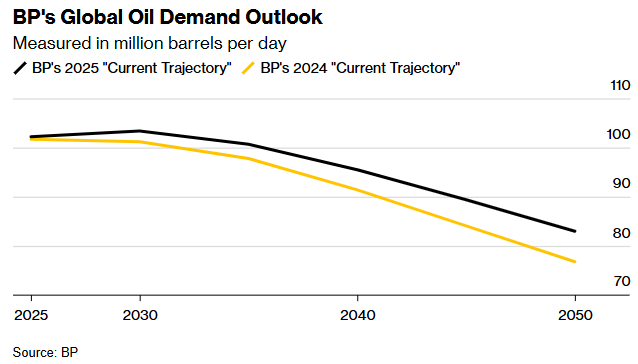
Group 1 - The core viewpoint of the article is that BP has revised its oil demand forecast, indicating that peak oil demand may not occur until 2030, contrary to previous predictions [1][3] - BP's annual Energy Outlook report highlights that factors such as consumption growth in emerging markets, slow energy efficiency improvements, geopolitical tensions, and continued use of petrochemical products will contribute to sustained oil demand [1][3] - The company anticipates that daily oil consumption will reach 103.4 million barrels in five years, up from 102.2 million barrels this year [1] Group 2 - BP's chief economist Spencer Dale and his team project that if current trends continue, daily oil demand could increase by 6 million barrels by 2035 [3] - The company expects oil demand to start declining around 2035, returning to current levels [4] - BP's outlook aligns with a broader industry trend, as the International Energy Agency is also preparing a report indicating that oil and gas demand will continue to grow beyond this decade [5] Group 3 - BP estimates that under the current development path, oil demand will remain significant after 2035, with daily consumption projected to be around 83 million barrels by 2050, an increase from last year's estimate of 75 million barrels [5] - The company believes that natural gas demand will grow during this period, primarily driven by LNG imports in Asia, with the U.S. and the Middle East as major suppliers [5] - A new uncertainty factor is the demand from data centers, which BP estimates will account for about 10% of global electricity demand growth and 40% of U.S. electricity demand growth by 2035 [5] Group 4 - Despite BP's significant investments in renewable energy in recent years, these projects have resulted in losses, prompting a strategic shift back to oil and gas [6] - The report emphasizes that the application of biofuels, hydrogen, and carbon capture technologies depends on government policies, with BP and Shell recently canceling plans for biofuel plants in Europe [6]

(经济观察)2035年新目标彰显中国能源转型雄心
Zhong Guo Xin Wen Wang· 2025-09-25 12:50
中国"十四五"时期非化石能源消费比重目标是20%。中国国家能源局局长王宏志此前透露,去年该比重 已经达到了19.8%,今年预计可以超额完成目标。 中新社北京9月25日电 (记者 王梦瑶)《巴黎协定》达成10周年之际,中国宣布新一轮国家自主贡献目 标。此间专家认为,这意味着中国能源转型将持续发力,彰显应对气候变化的责任担当。 上述目标中明确:到2035年,中国非化石能源消费占能源消费总量的比重达到30%以上,风电和太阳能 发电总装机容量达到2020年的6倍以上、力争达到36亿千瓦。 作为世界上最大的能源消费国,中国在保障能源安全的前提下完成这一目标需要艰苦努力,但有底气兑 现承诺。 李昇认为,中国具备实现新目标的产业基础、技术优势与市场规模。完整的产业链、领先的技术和持续 创新能力为未来发展提供坚实保障。 当前,单边主义、保护主义倾向不断显现,国际政治博弈加剧,使得气候变化领域的政治色彩一再强 化,各国应对气候变化的互信和努力遇到冲击。中国提出2035年国家自主贡献目标,也进一步彰显大国 担当。 电力规划设计总院党委书记胡明指出,中国仍处于发展阶段,人均能源消费尚未达到经济合作与发展组 织(OECD)国家平均水 ...
端牢能源饭碗 加快绿色转型——构建新型能源体系的山西实践
Xin Hua She· 2025-09-25 12:22
Group 1: Energy Transition and Development - Shanxi province is tasked with ensuring energy supply and promoting energy transition, focusing on clean and low-carbon development of coal [1] - The province aims to build a new energy system by integrating wind, solar, and hydrogen energy alongside coal [1] - As of August, Shanxi has established 298 intelligent coal mines and 55 green mining pilot projects to enhance coal supply quality [2] Group 2: Technological Innovations - Shanxi has built 12 national-level major innovation platforms and numerous provincial laboratories to drive technological advancements in energy [3] - Breakthroughs in clean coal utilization technologies, such as rapid peak regulation for coal-fired power plants, have been achieved [3] - Companies in Shanxi are transforming coal into high-value products, such as nylon fibers and sodium-ion battery materials [3] Group 3: Renewable Energy Growth - Since the 14th Five-Year Plan, renewable energy has become the main source of new installed capacity in Shanxi, with a 4309 MW increase in capacity over five years [5] - The proportion of renewable energy in Shanxi's total power generation has improved from 1/7 to 1/4, indicating a significant shift towards green energy [5] - Shanxi's renewable and clean energy installed capacity now accounts for 54.4% of total capacity, leading the nation in green electricity export [5] Group 4: Green Power Parks - Shanxi is developing low-carbon and zero-carbon parks that integrate green electricity with various industries, enhancing competitiveness through direct supply [6] - The number of green power park pilot projects has expanded from 3 to 13 this year, showcasing the province's commitment to industrial transformation [6] Group 5: Market Reforms and Flexibility - Shanxi is implementing market reforms to enhance the flexibility of its power system, allowing for better integration of renewable energy sources [8] - The establishment of virtual power plants has enabled companies to adjust their electricity usage based on market prices, optimizing energy consumption [8][9] - Over half of Shanxi's coal-fired power units have undergone flexibility upgrades to support renewable energy integration [9]
恒信证券|全球第二大铜矿发生的事故 令供应紧张的市场雪上加霜
Sou Hu Cai Jing· 2025-09-25 11:59
Incident Overview - The global second-largest copper mine recently experienced a production accident affecting key facilities, leading to a halt in part of its capacity [3] - This mine accounts for nearly 5% of global copper supply, and its production disruption is expected to significantly impact global copper availability [3] Current Market Conditions - The copper market has been facing tight supply-demand dynamics, with prices showing strong performance in recent years [4] - The recent accident exacerbates the already strained market conditions, further intensifying supply-demand conflicts [4] Price and Market Reaction - Following the accident news, international copper prices surged, with LME copper prices rising over 3%, reaching a near-term high [5] - Domestic copper futures in China also strengthened, approaching their recent peak [5] Industry Chain Reactions - Upstream mining companies may gain higher bargaining power, with unaffected mines likely to increase exports in the short term [9] - The smelting sector faces raw material shortages due to potential reductions in concentrate supply, which may compress smelting profit margins [9] - Downstream manufacturing sectors, particularly in electric cables, batteries, and appliances, will see increased costs due to rising copper prices, impacting project investment returns [9] Future Outlook - Short-term copper price trends will heavily depend on the recovery timeline of the affected mine; prolonged downtime could widen the global supply gap [10] - Medium-term demand from renewable energy and infrastructure projects will continue to reinforce copper's strategic importance [10] - However, significant short-term price increases may lead downstream industries to delay orders or seek alternative materials, potentially suppressing demand [10] Summary - The accident at the global second-largest copper mine heightens concerns over tight copper supply, with immediate price impacts and challenges across the industry chain [11] - Copper's strategic value in energy transition remains strong, but increased market volatility necessitates preparedness from investors and companies [11]

美联储降息后,最利好的资产出现了?
大胡子说房· 2025-09-25 11:24
Core Viewpoint - The article highlights the significant rise in silver prices, which have outperformed gold this year, driven by both investment demand and industrial usage, particularly in renewable energy sectors [1][2]. Group 1: Silver Market Dynamics - Silver has seen a year-to-date increase of 48% as of mid-September, surpassing gold's performance, with a peak price of $42.96 per ounce, the highest in 14 years [1]. - The silver market is characterized by a strong physical trading component, as many traders require silver for production, leading to higher liquidity and potential for market squeezes compared to gold [2]. - The ongoing energy transition and increasing demand for solar panels and electric vehicles are expected to significantly boost silver demand, contributing to a supply shortage for the fifth consecutive year [2]. Group 2: Economic Context and Future Outlook - The article draws parallels between the rising prices of silver and gold, attributing this to investor fears of a potential collapse of the U.S.-led global debt economy, which may manifest as currency devaluation rather than outright defaults [3][4]. - The current global financial landscape is described as being in a state of transition, with the dollar's dominance waning and precious metals like gold and silver serving as temporary hard currencies during this shift [4]. - Predictions suggest that silver prices could rise to over $60 per ounce in the coming years, especially following the Federal Reserve's decision to lower interest rates [2][5].

中国制造助力伊朗能源突围!7GW太阳能合作项目照亮阳光之国
Sou Hu Cai Jing· 2025-09-25 10:14
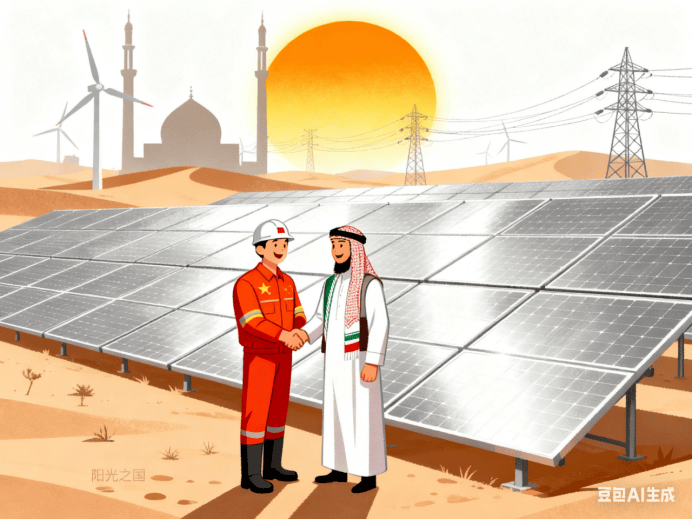
伊朗电力短缺问题源于多重因素叠加。2025年夏季,伊朗全国电力需求峰值已攀升至79,800兆瓦,而实 际发电能力仅63,000-64,000兆瓦,缺口高达15,000兆瓦以上,且这一数字预计将持续扩大。 结构性失衡是核心问题。伊朗电力行业过度依赖天然气发电,占比高达90%,而可再生能源仅占全国发 电量的1%。 这种单一能源结构使得电力系统极为脆弱。去年冬季,当居民取暖导致天然气需求激增时,发电厂燃料 供应不足,引发连锁性停电。 能源浪费加剧了供应压力。据世界银行和国际能源署统计,伊朗每年有180亿立方米天然气被放空燃 烧,还有70亿立方米在输配管网中泄漏。同时,伊朗的能源消耗强度位居世界第一,传输和消费过程中 的能源损失率高达60%。 作为世界第二大天然气储量国,伊朗却多年来深受电力短缺困扰,去年冬季每日天然气缺口高达2.6亿 立方米,导致全国50%的工业园区停止运营。 面对这一能源悖论,伊朗正将目光投向太阳能,并与中国签署了史上最大的可再生能源设备采购协议。 伊朗德黑兰的街头,每隔一天就会停电两小时,商店被迫点起蜡烛营业,交通信号灯失效引发拥堵,这 是2025年夏季伊朗电力短缺的真实写照。 01 伊朗电力短 ...

dbg markets:黑金骤断,Grasberg矿难引爆全球铜市完美风暴
Sou Hu Cai Jing· 2025-09-25 10:09
Core Viewpoint - The recent disaster at Freeport-McMoRan's Grasberg mine has triggered significant supply concerns in the copper market, leading to a sharp increase in copper prices and a reevaluation of market dynamics [2][4][5] Group 1: Incident Overview - On September 8, a mudslide at the Grasberg mine resulted in the loss of two workers and left five missing, causing substantial damage to infrastructure [2] - The Grasberg mine contributes 3.2% of global copper supply and 70% of Freeport's gold production, making its operational halt critical [2] - Following the incident, copper prices surged by 4% to $4.825 per pound, while Freeport's stock fell by 8% [2] Group 2: Market Reactions - Traders reacted instinctively to the supply disruption, with significant price movements observed across the market [4] - Goldman Sachs characterized the event as a "black swan," predicting a potential copper supply loss of 500,000 tons over the next 12-15 months, which could escalate to 2 million tons if recovery is delayed [4] - The current inventory structure is problematic, with 60% of global visible inventory locked in North America due to tariffs, limiting alternative sourcing options for Asian buyers [4] Group 3: Broader Supply Chain Implications - Other mines, such as Peru's Constancia and Panama's Cobre Panama, are also facing operational challenges, contributing to a tightening copper market [5] - Citigroup and Bank of America have raised their 2025 copper price forecasts to $5.2 per pound, an 18% increase from earlier predictions [5] - Freeport has revised its production guidance for 2026 down by 35%, indicating a prolonged recovery timeline that may extend to 2027 for full capacity restoration [5] Group 4: Impact on Industries - The copper supply shortage poses a significant challenge for manufacturers focused on global energy transition, as electric vehicles and wind farms require substantial copper [5] - If the supply gap persists for two years, the electric vehicle sector alone could consume an additional 300,000 tons of refined copper, equivalent to 40% of global tradable inventory [5] Group 5: Market Sentiment and Future Outlook - The capital markets are beginning to reassess the gap between green demand and brown supply, with significant inflows into copper mining ETFs and rising credit default swap rates for Freeport [6] - Analysts highlight that this operational disruption is the most severe for Freeport in 30 years, emphasizing the tangible risks posed by ESG factors and community conflicts [6] - The incident has exposed vulnerabilities in the global metal supply chain, raising concerns about potential systemic risks in the market [7]