
安倍经济学

Search documents
大摩谈“高市早苗交易”:政策立场已转向温和保守,财政不会搞MMT,加息预期或降温
Hua Er Jie Jian Wen· 2025-10-06 03:06
Core Viewpoint - The election of Kishi Sanae as the leader of the Liberal Democratic Party (LDP) positions her as a potential first female Prime Minister of Japan, with a shift towards a more moderate and conservative policy stance, alleviating investor concerns about extreme fiscal expansion and pressure on the Bank of Japan [1][2]. Policy Stance - Kishi has moved from a hardline stance to a more pragmatic approach to gain support within the LDP, avoiding previous statements on cutting consumption tax or opposing interest rate hikes [2][3]. - Her campaign emphasized "responsible expansionary fiscal policy," focusing on strategic fiscal mobilization to address social issues, which contrasts with the extreme fiscal expansion associated with Modern Monetary Theory (MMT) [2][3]. Economic Policy Influences - Kishi's economic policies are influenced by former advisor Honda Yoshihiro, incorporating traditional measures such as refundable tax credits and the elimination of temporary gasoline taxes [3]. - Concerns regarding consumption tax cuts and increased financial income tax are deemed exaggerated, suggesting that fiscal sustainability risks may not be as significant as perceived [3]. Monetary Policy Alignment - Kishi respects the independence of the Bank of Japan, indicating that the government sets fiscal and monetary policy goals while the Bank decides on the best monetary policy tools [4]. - Her economic views align with Bank of Japan Governor Ueda Kazuo, both expressing caution regarding the impact of U.S. tariffs and recognizing that current inflation is primarily driven by supply-side factors [4][6]. Tax Policy Outlook - Kishi has indicated that cutting consumption tax is not a priority, and the likelihood of increasing financial income tax in the short term is low [5]. - Any potential increase in financial income tax would depend on achieving a 2% inflation target, rather than being implemented immediately [5]. Key Policy Focus Areas - Kishi's administration will prioritize national security, domestic investment, and structural reforms, with a strong emphasis on "economic security" [7][8]. - Plans include increasing defense spending to 2% of GDP by FY2027, promoting investment in critical sectors like AI and semiconductors, and establishing a Foreign Investment Review Committee [8].
刚刚,暴涨超1800点!
Zheng Quan Shi Bao Wang· 2025-10-06 03:05
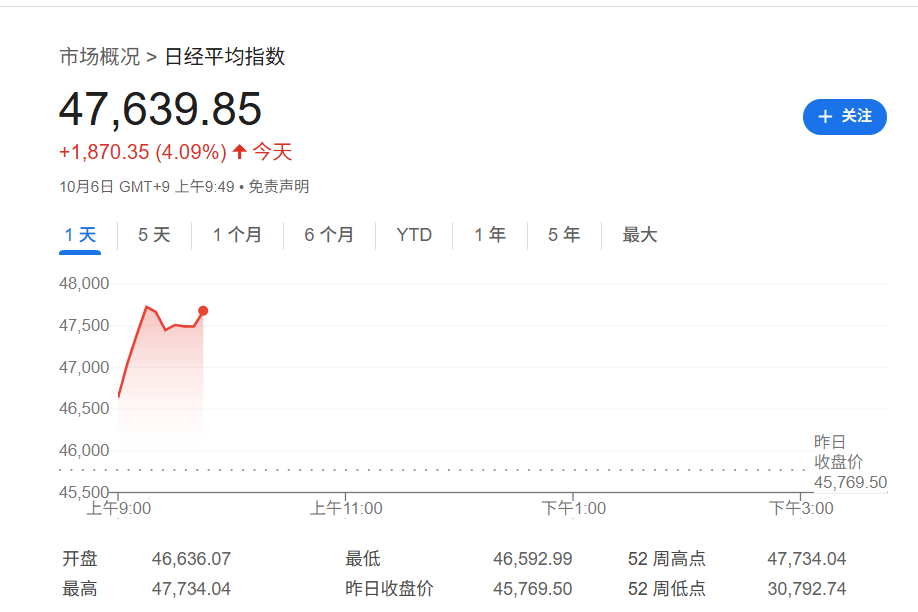
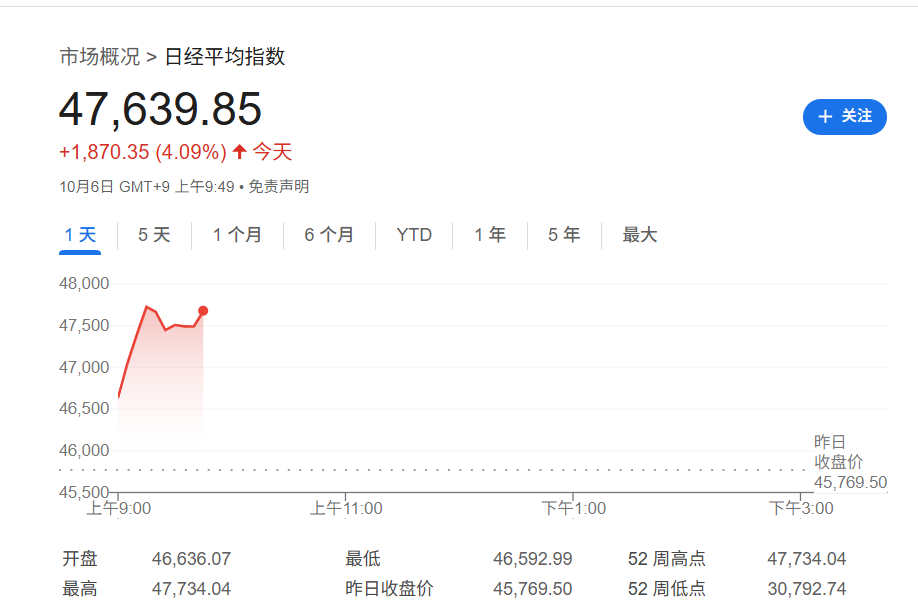
Group 1: Japanese Stock Market Surge - The Nikkei 225 index surged over 1800 points, an increase of more than 4%, reaching a historical high of 47627 points on October 6 [1][2] - Notable individual stock performances included Mitsubishi Heavy Industries and Nippon Steel, both rising over 12%, while several other major companies saw increases of 5% to 10% [2] - The market reacted to the election of Sanae Takaichi as the first female Prime Minister of Japan, who is seen as a proponent of expansionary fiscal policies [2][3] Group 2: Economic Policies and Concerns - Takaichi's economic stance contrasts sharply with that of her predecessor, Shigeru Ishiba, particularly regarding "Abenomics," with a focus on economic growth through tax cuts and government investment [3] - Concerns arise regarding Japan's debt, which exceeds 250% of GDP, raising fears of potential financial risks if fiscal expansion continues [3] - Takaichi's victory introduces uncertainty in monetary policy, as she has previously avoided clear stances on interest rate hikes, which may lead the Bank of Japan to adopt a wait-and-see approach [3] Group 3: Gold Price Surge - Gold prices reached a new historical high, with spot gold hitting $3920.77 per ounce, reflecting a nearly 50% increase this year [4][5] - The rise in gold prices is attributed to increased demand for safe-haven assets amid ongoing U.S. government shutdowns and economic uncertainties [4][5] - The U.S. government shutdown has delayed key economic data releases, further complicating the economic outlook and influencing investor behavior towards gold [5][6]
高市早苗料接任日本首相 策略师:利好股市 利空日元
智通财经网· 2025-10-06 02:45
Core Viewpoint - The election of Sanae Takaichi as the new president of Japan's ruling Liberal Democratic Party (LDP) is expected to lead to her becoming Japan's first female Prime Minister, with a focus on fiscal expansion and maintaining loose monetary policy, which may positively impact the stock market while putting pressure on the yen [1][2]. Group 1: Market Reactions and Expectations - The Nikkei 225 index rose by 4.15% to 47,669.06 points, marking its first time above 47,000 points, while the Tokyo Stock Exchange index also saw significant gains [1]. - Analysts from Goldman Sachs noted that Takaichi's policies could refocus attention on defense spending and normalization of the Bank of Japan's policies, potentially leading to a positive market reaction and some weakening of the yen [2]. - Homin Lee from Lombard Odier highlighted that the Tokyo Stock Exchange index might experience positive price movements due to expectations of pro-growth policies under Takaichi's leadership [2]. Group 2: Sector Impacts - Donghoon Han from Matthews International Capital Management indicated that Takaichi's government may implement meaningful structural reforms, benefiting sectors such as technology, construction, and infrastructure, while the nuclear industry could gain from her support for restarting and building nuclear power plants [3]. - Analysts from Citigroup noted that the initial market reaction to Takaichi's preference for expansionary fiscal policy and continued monetary easing could lead to a weaker yen and bonds, while stock prices may have limited upside due to already high valuations [3][4]. Group 3: Indicators to Watch - Key indicators to monitor include negotiations with opposition parties, the new cabinet lineup, and initial cabinet approval ratings, as successful management in these areas could drive domestic demand expansion and entrenched inflation, supporting long-term growth in the Japanese stock market [4].
“早苗经济学”:“安倍经济学”的2.0版本?
Hua Er Jie Jian Wen· 2025-10-06 02:34
Core Insights - The unexpected victory of Sanae Takaichi as the new president of Japan's ruling Liberal Democratic Party signals the introduction of a new economic policy framework known as "Takaichi Economics" [1] - This policy is perceived as a continuation of former Prime Minister Shinzo Abe's "Abenomics," but with a stronger emphasis on fiscal expansion [1][3] - Market participants are closely monitoring the implications of this political shift on Japan's monetary policy, fiscal discipline, and yen exchange rate [1] Economic Policy Framework - "Takaichi Economics" is structured around three main pillars, reminiscent of "Abenomics" [2] - The first pillar focuses on enhancing national crisis management capabilities and promoting economic growth [3] - The second pillar advocates for expansionary fiscal policies, emphasizing the need to raise taxes and utilize existing government funds to avoid increasing Japan's national debt [3] - The third pillar clarifies that the government will be responsible for monetary policy, while the Bank of Japan retains autonomy in selecting specific policy tools [3] Central Bank Policy Outlook - The policy stance of Takaichi aligns with that of Bank of Japan Governor Kazuo Ueda, both recognizing the current inflation as cost-push rather than demand-driven [4] - Nomura Securities maintains its forecast that the Bank of Japan will raise interest rates in January 2026, with a potential pause thereafter [4] - However, there are uncertainties; a rapid depreciation of the yen or a stock market rally could lead to an earlier rate hike, while fiscal expansion could hinder rate increases [4] Yen Exchange Rate Outlook - The yen is expected to face short-term selling pressure, with the dollar-yen exchange rate potentially testing the critical level of 150 [5][6] - The sustainability of the yen's weakness will depend on Takaichi's public statements regarding the independence of the central bank [7] - Any signals perceived as attempts to curb or prevent interest rate hikes could lead to further depreciation of the yen [7] Upcoming Political Events - Takaichi is expected to be nominated as Prime Minister around October 15 [8] - A significant diplomatic event is the anticipated visit of U.S. President Donald Trump from October 27 to 29, focusing on trade agreements, including Japan's $550 billion foreign direct investment [8] - The new government is expected to draft a supplementary budget for fiscal year 2025 in late November, which will reveal the actual scale of fiscal expansion [8]

日元重挫、日股大涨!市场开启“高市早苗交易”,应对“安倍经济学”回归
Sou Hu Cai Jing· 2025-10-06 02:05
Core Viewpoint - The Japanese financial market is rapidly pricing in the potential return of "Abenomics" following the election of new Prime Minister Kishi Takaichi, who is expected to implement large-scale fiscal stimulus and ultra-loose monetary policy [1][9]. Group 1: Market Reactions - The Nikkei 225 index surged over 4%, marking its largest single-day gain in months, while the Topix index rose by 3% [1]. - The Japanese yen weakened significantly against the US dollar by 1.5%, approaching the critical level of 150, and the yen also hit a historical low against the euro [3]. Group 2: Economic Policy Expectations - Takaichi's economic policies are closely aligned with "Abenomics," emphasizing fiscal expansion and a right-leaning political stance, with a commitment to maintaining loose monetary policy [8][9]. - Takaichi has proposed measures to address inflation, including increased subsidies to local governments and the possibility of lowering the consumption tax [9]. Group 3: Market Sentiment and Predictions - Investors are preparing for potential fiscal expansion under Takaichi, with expectations that her policies will favor stocks but may introduce volatility in the bond and foreign exchange markets [12]. - The victory of Takaichi was unexpected for many investors who anticipated a more fiscally conservative approach from her competitor, Kizuna Koizumi [10]. Group 4: Bond Market Implications - Despite the positive sentiment in the stock market, the bond market faces pressure due to concerns over increased government debt from larger fiscal spending [13]. - Analysts warn that without a "safety net" for the issuance of additional Japanese government bonds, there could be selling pressure in the bond market, leading to a steeper yield curve [13]. Group 5: Future Considerations - The ascension of Takaichi opens a new trading paradigm, with market participants closely monitoring how she balances growth stimulation with long-term government debt control and her influence on the Bank of Japan's future policy direction [14].

日元日债重挫、日股大涨!市场开启“高市早苗交易”,应对“安倍经济学”回归
Hua Er Jie Jian Wen· 2025-10-06 01:13
Core Viewpoint - The election of Sanae Takaichi, a protégé of the late former Prime Minister Shinzo Abe, is leading to expectations of a return to "Abenomics," characterized by large-scale fiscal stimulus and ultra-loose monetary policy, which is rapidly influencing Japan's financial markets [1][9]. Group 1: Market Reactions - Following Takaichi's election, the Nikkei 225 index surged over 4%, marking its largest single-day gain in months, while the Topix index rose by 3% [1]. - The Japanese yen weakened significantly against the US dollar by 1.5%, approaching the critical level of 150, and the yen also hit a historical low against the euro [3]. Group 2: Economic Policy Expectations - Takaichi's economic policy is heavily influenced by "Abenomics," advocating for fiscal expansion and a close alignment between government and the Bank of Japan, with a focus on demand-driven economic growth [9][10]. - She has expressed strong opposition to interest rate hikes by the Bank of Japan, which has led analysts to revise their expectations regarding potential rate increases in October [9]. Group 3: Investment Strategies - Investors are actively engaging in the "Takaichi trade," anticipating that her policies will weaken the yen, boost the stock market, and lead to a significant rise in long-term Japanese government bond yields [8][12]. - The market is preparing for potential fiscal expansion, with expectations that Takaichi will prioritize economic growth over strict fiscal discipline [10]. Group 4: Bond Market Implications - Despite the positive stock market response, the bond market faces pressure due to concerns that increased fiscal spending will necessitate more government bond issuance, raising Japan's debt burden [11]. - Analysts warn that without a "safety net" accompanying the issuance of new Japanese government bonds, there could be selling pressure on bonds, leading to a steeper yield curve [12].
热点问答丨高市早苗执政将给日本经济带来什么影响
Xin Lang Cai Jing· 2025-10-05 06:47
Core Viewpoint - The election of former Economic Security Minister Sanae Takaichi as the president of Japan's ruling Liberal Democratic Party positions her as a potential first female Prime Minister, amidst Japan's economic challenges including fiscal and monetary policy dilemmas, sluggish growth, and international competitiveness issues [1]. Fiscal Policy - Takaichi advocates for expansionary fiscal policies, aiming to double Japan's economic size within ten years through tax cuts, economic stimulus, and government investment, contrasting sharply with the outgoing Prime Minister Shigeru Ishiba's focus on stability and wealth distribution [1][2]. - Concerns arise regarding Japan's debt exceeding 250% of GDP, raising fears that continued fiscal expansion could lead to financial risks [1]. Monetary Policy - Takaichi has not clearly defined her stance on monetary policy during the election, previously opposing interest rate hikes, and emphasizes the need for collaboration between the government and the Bank of Japan to achieve demand-driven growth supported by rising wages and corporate profits [3][4]. - Market analysts suggest that her victory introduces uncertainty into monetary policy, potentially delaying interest rate hikes as the Bank of Japan may adopt a wait-and-see approach until new government policies are clarified [4]. Trade Relations - Takaichi stated she would not immediately alter the existing Japan-U.S. trade agreement but would address any issues that do not align with Japan's interests through diplomatic channels [5]. - The trade agreement, which includes a 15% tariff on nearly all Japanese exports to the U.S. and a commitment from Japan to invest $550 billion in the U.S., has been criticized for not adequately reflecting Japan's positions, indicating that negotiations may continue under her leadership [6]. - Analysts believe Takaichi's conservative political stance and experience in U.S.-Japan relations may facilitate her handling of bilateral trade issues, although uncertainties remain regarding the execution of the trade agreement and related investments [6].
经济热点问答丨高市早苗将给日本经济带来什么影响
Xin Hua Wang· 2025-10-05 06:36
Group 1: Economic Impact of New Leadership - The election of former Economic Security Minister Sanae Takaichi as the potential first female Prime Minister of Japan comes amid multiple economic challenges, including fiscal and monetary policy dilemmas, sluggish economic growth, and insufficient international competitiveness [1] - Takaichi's stance on fiscal expansion contrasts sharply with the outgoing Prime Minister Shigeru Ishiba, who advocates for a more stable economic policy focused on wealth distribution rather than growth [1][2] - Takaichi aims to double Japan's economic scale within ten years through tax cuts, economic stimulus, and government investment, emphasizing the importance of economic growth [1] Group 2: Fiscal Policy Concerns - Japan's debt exceeds 250% of its GDP, raising concerns among market participants about the risks associated with continued fiscal expansion and potential issuance of government bonds [2] - Chief Economist Tomohisa Ishikawa highlights the need for Takaichi's expansionary fiscal policy to balance economic growth with fiscal health, warning of the risks involved [2] Group 3: Monetary Policy Implications - Takaichi has not clearly articulated her monetary policy stance, differing from other candidates who support gradual interest rate hikes, and previously opposed rate increases [3][4] - Market analysts suggest that Takaichi's preference for loose monetary policy may delay the Bank of Japan's interest rate hikes, as the new government's policies become clearer [4] - The Bank of Japan has shown a hawkish stance, with discussions about raising policy rates, but the transition in leadership may introduce uncertainty regarding the pace of rate increases [4] Group 4: Japan-U.S. Trade Relations - Takaichi has stated that she will not immediately modify the existing Japan-U.S. trade agreement but is open to renegotiation if the terms do not align with Japan's interests [5][6] - The trade agreement includes a 15% tariff on nearly all Japanese exports to the U.S. and a commitment from Japan to invest $550 billion in the U.S., which has raised concerns among Japanese experts about the adequacy of the terms [6] - Analysts believe Takaichi's familiarity with U.S.-Japan relations may facilitate her handling of trade issues, although uncertainties remain regarding the execution of the trade agreement and related investments [6]
日本或迎首位女首相,分析称日元可能贬值
2 1 Shi Ji Jing Ji Bao Dao· 2025-10-04 16:11
Group 1 - The core point of the article is the election of Sanna Takichi as the new president of the Liberal Democratic Party (LDP) in Japan, which positions her to potentially become the first female Prime Minister of Japan [1][4][5] - The election process involved two rounds of voting, with Takichi receiving 185 votes against her opponent, Agriculture Minister Shinjiro Koizumi, who garnered 156 votes [1][4] - Analysts suggest that despite her victory, Takichi will face significant challenges in governance due to the LDP's minority status in the Diet, complicating the passage of reforms and budget approvals [1][5][6] Group 2 - Takichi is known for her advocacy of maintaining loose monetary policy and expansionary fiscal measures, aligning her with the legacy of "Abenomics" [1][9] - Market expectations indicate a potential depreciation of the yen and a steepening of the Japanese government bond yield curve following her election [8][9] - The Japanese economy is currently grappling with high inflation, currency fluctuations, and rising commodity prices, which will pose challenges for Takichi's administration in balancing public spending and fiscal sustainability [5][10] Group 3 - Takichi's economic agenda includes proposals to eliminate the consumption tax on food, raise the tax-free income threshold, and strengthen scrutiny of foreign investments [9] - The article highlights the potential risks associated with her policies, including the possibility of increasing Japan's already high debt-to-GDP ratio and the implications for long-term economic stability [9][10] - The upcoming temporary Diet session in mid-October will be crucial for Takichi as she seeks to secure her position as Prime Minister amid a fragmented political landscape [5][6]

日本或迎首位女首相 “安倍经济学”继承者将把经济带向何方?
2 1 Shi Ji Jing Ji Bao Dao· 2025-10-04 14:23
Core Viewpoint - The election of Sanae Takaichi as the new president of the Liberal Democratic Party (LDP) in Japan is expected to lead to her becoming the first female Prime Minister, but her administration may face significant challenges due to the party's minority status in the Diet [1][3][4]. Group 1: Election Results and Implications - Sanae Takaichi won the LDP presidential election with 185 votes, defeating her opponent, Agriculture Minister Shinjiro Koizumi, who received 156 votes [1][2]. - The election was characterized by a lack of majority support in the first round, leading to a second round where Takaichi's strong local support played a crucial role in her victory [2][3]. - Analysts suggest that Takaichi's leadership may struggle with political maneuvering due to the LDP's minority status in the Diet, complicating the passage of reforms and budgets [1][3][4]. Group 2: Economic Policies and Market Reactions - Takaichi is seen as a proponent of "Abenomics," advocating for continued monetary easing and expansionary fiscal policies, which may lead to a depreciation of the yen and a steepening of the Japanese government bond yield curve [1][5][6]. - The market has already begun to reflect expectations of Takaichi's policies, with the Nikkei 225 index reaching new highs and sectors like defense and semiconductors anticipated to benefit [6][7]. - However, there are concerns about the long-term risks associated with her economic policies, particularly given Japan's high debt-to-GDP ratio of 263%, which could lead to increased inflation and potential downgrades in sovereign ratings [6][7]. Group 3: Challenges Ahead - Takaichi faces three main challenges: reforming the LDP to regain public trust, navigating the complexities of minority governance, and ensuring economic stability amid rising inflation and fiscal pressures [4][6]. - The need for collaboration with opposition parties is critical for Takaichi to secure legislative support, especially in a political landscape characterized by a "double minority" situation [3][4]. - The balance between stimulating the economy and maintaining fiscal sustainability will be crucial for her administration's longevity and effectiveness [4][6][7].