
扩内需

Search documents
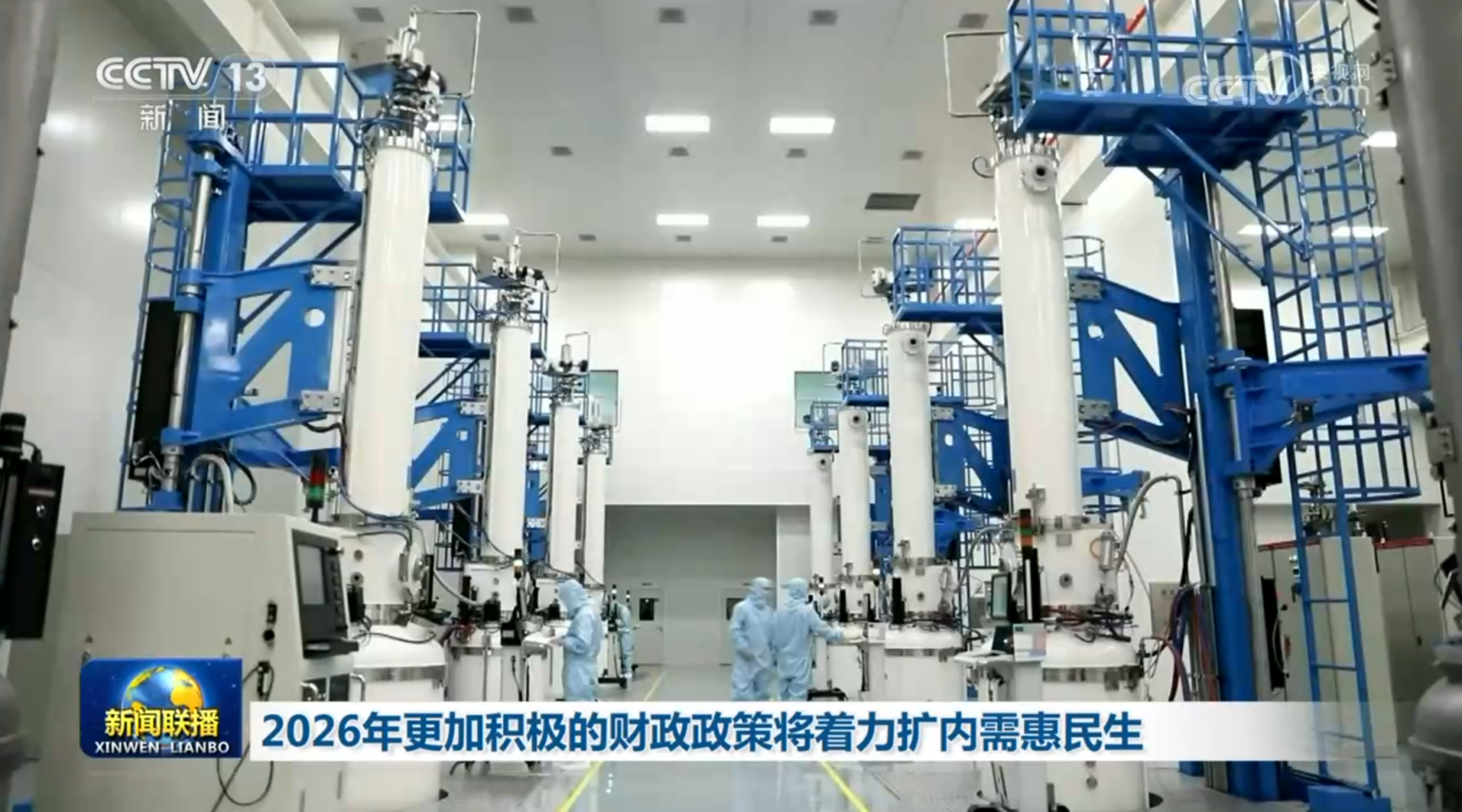
2026年更加积极的财政政策将着力扩内需惠民生
Yang Shi Wang· 2025-12-29 12:41
Group 1 - The core viewpoint is that China will implement a more proactive fiscal policy in 2026 for the second consecutive year, focusing on expanding domestic demand, optimizing structure, increasing momentum, and benefiting people's livelihoods [1][3] - The fiscal expenditure will be expanded to ensure necessary spending, optimize the government bond tool mix, and improve the efficiency of transfer payment funds [1][3] - The policy aims to support the construction of a strong domestic market, boost consumption, and implement special actions to stimulate consumption [3] Group 2 - There will be an active expansion of effective investment, with increased funding for key areas such as new productive forces and comprehensive human development [3] - The fiscal policy will also support the deep integration of technological innovation and industrial innovation, promote urban-rural integration, and enhance regional collaboration [3] - The focus will be on strengthening social welfare and promoting a comprehensive green transformation of economic and social development, enhancing economic development momentum and public well-being [3]

钢材年报:政策主导方向,需求决定空间
Fo Shan Jin Kong Qi Huo· 2025-12-29 02:53
Report Industry Investment Rating No relevant content provided. Core Viewpoints of the Report - The steel market in 2026 is expected to revolve around "demand structure change", "supply regulation", and "cost support". The market will show a weak and volatile trend with limited upside and downside space, restricted by demand increment on the upside and supported by cost and supply regulation on the downside [1][2]. - Policy will significantly influence the end - use flow of steel. Coil demand may maintain a certain growth rate, infrastructure will provide a cushion, while the real - estate construction sector will remain weak [1]. - Supply regulation aims to guide steel towards high - value - added products, and steel mills face the challenge of reducing production while maintaining profits in the over - capacity stage. Supply is expected to slightly decline [2]. - Cost support depends on the "anti - involution" trend in the coal industry and the price support of iron ore. Iron ore prices may decline in 2026 [2]. Summary by Directory 1. Market Review 1.1 Three Keywords - **Weak demand for finished products**: In 2025, real - estate construction demand was weak, and infrastructure's demand - increasing effect on building materials was limited. Although manufacturing and exports provided some support, they couldn't make up for the real - estate demand gap, restricting the upside of steel, iron ore, and coking coal prices [7]. - **Anti - involution policy**: It dominated the second - half trend of the black - sector market, especially in the coal sector. Policy changes led to significant price fluctuations in coking coal and coke [8]. - **Tariff trade war**: Sino - US trade frictions mainly affected the indirect export of coils, intensifying market fluctuations in the black sector [8]. 1.2 Policy Review - Steel - related policies in 2025 focused on "promoting upgrading + stabilizing growth + anti - involution", while coal - related policies emphasized "anti - involution + safety + supply guarantee + clean and efficient utilization". In 2026, steel policies will continue to promote high - end development and "anti - involution" implementation needs attention [11][12]. 1.3 Market Recap - **January - February**: Before and after the Spring Festival, demand was weak. Steel winter - storage willingness was low. After the festival, construction resumption was delayed, and steel prices were under pressure. Coal prices were lowered, while iron ore prices were firm due to shipping disruptions [14]. - **March - May**: The domestic demand peak season was below expectations, and export trade frictions intensified. Steel prices dropped, and coal prices declined significantly, while iron ore prices were relatively stable [15]. - **June - July**: Coal supply tightened, and the "anti - involution" policy pushed the black - sector market to rebound. Steel prices increased under cost support [16]. - **August - October**: The "anti - involution" policy expectations fluctuated, and the "Golden September and Silver October" expectations were disappointed. Steel continued to accumulate inventory, and steel mill profits were compressed [17]. - **November - December**: Coal prices fluctuated due to supply - side disturbances. Steel supply, demand, and inventory were all weak, with limited fundamental contradictions [18]. 2. Fundamental Analysis 2.1 Steel Terminal Demand - **Real estate**: In 2025, real - estate investment, sales, and other data continued to decline. Policies aimed at stabilizing the market, but property sales and investment are expected to decline in 2026, reducing steel demand in real - estate construction [20][28]. - **Infrastructure**: By October 2025, infrastructure investment turned negative year - on - year due to local fiscal constraints and the use of special bonds for debt repayment. In 2026, infrastructure investment is expected to have limited growth [29][39]. - **Manufacturing and indirect export**: Manufacturing's demand for steel increased, driven by the "Two New" policies. However, due to consumption front - loading, the growth rate of steel demand in manufacturing may slow down in 2026 [40][49]. - **Direct export**: As of November 2025, steel exports increased, mainly through "price - for - volume" strategy. In 2026, exports are expected to increase slightly, and exports will develop towards high - value - added and compliant products [54][58]. - **Steel demand forecast**: In 2026, the total demand for crude steel is expected to be 9.84 billion tons, a slight decrease from 2025. Different scenarios (optimistic, neutral, and pessimistic) have different demand forecasts [59][60]. 2.2 Steel Supply - In 2025, steel supply was in a situation of high capacity and weak demand. Crude steel and pig iron production decreased, while steel production increased. Supply is expected to be adjusted according to policy and profit changes in 2026 [62]. 2.3 Steel Inventory - In 2025, the inventory pressure of rebar was relatively low, with high - level inventory in winter - storage and then continuous de - stocking. The hot - rolled coil inventory increased in the second half of the year and had relatively high pressure [69][72]. 2.4 Steel Supply - Demand Summary - Supply is mainly affected by policy regulation and steel mill profits. In 2026, crude steel supply is expected to tighten, and different supply - demand scenarios are predicted [73]. 3. Outlook for 2026 3.1 Market Outlook - The steel market in 2026 will be influenced by demand structure change, supply regulation, and cost support. It is expected to show a weak and volatile trend [74][75]. 3.2 Strategy Recommendations - **Single - side trading**: Focus on short - selling at high points in the range [3]. - **Arbitrage**: Consider spread trading at the upper and lower limits of the rebar - hot - rolled coil spread, and pay attention to the opportunity of going long on rebar/hot - rolled coil and short on iron ore [3]. - **Options**: Sell call options at the upper limit of the price range [3].
国泰海通|食饮:白酒探底,乳制品国产替代有望加速
国泰海通证券研究· 2025-12-28 14:49
Investment Recommendations - Focus on growth as the main line, emphasizing turning point opportunities under supply and demand clearing [1] - Prioritize targets with price elasticity and those expected to clear inventory [1] - Structural high growth in beverages, with attention to undervalued high dividend stocks [1] - Growth targets in snacks and food raw materials [1] - Beer sector outlook [1] - Stable performance in condiments, with livestock capacity reduction and recovery in food service expected [1] Baijiu Industry - The baijiu industry has accelerated its bottoming process since Q3 2025, with financial statement clearing helping to reduce channel inventory pressure [1] - By 2026, leading brands like Moutai and Wuliangye are expected to see price declines that could stimulate sales, achieving volume and price balance [1] - Recent macroeconomic and policy developments are positively catalyzing consumer sector expectations, with baijiu being a pro-cyclical asset [1] - The sector's valuation is relatively low, and the dividend yield is attractive, suggesting that stock prices may bottom out ahead of fundamentals under policy guidance [1] Dairy Industry - The recent temporary anti-subsidy measures on EU dairy products by the Ministry of Commerce are expected to accelerate domestic substitution in dairy products, particularly cheese and cream [1] - This policy is likely to increase milk consumption and accelerate the industry cycle reversal [1]

国际航线旅客周转亮眼,海外电商双十二GMV激增
GOLDEN SUN SECURITIES· 2025-12-28 08:15
Investment Rating - Maintain "Buy" rating for the transportation sector [5] Core Views - The international passenger turnover for October and November 2025 is expected to grow by 12.9% and 14.3% year-on-year compared to the same months in 2019, indicating a recovery in demand [1][2] - The average economy class ticket price for the New Year holiday in 2026 is projected to be 597 RMB, reflecting a 1.1% decrease from 2024 and a 6.7% increase from 2025 [1][2] - The logistics sector is benefiting from explosive growth in overseas e-commerce, with TikTok Shop's GMV in Southeast Asia increasing by 2.7 times during the "12.12" promotion [1][3] Summary by Sections Weekly Insights and Market Review - The transportation sector index rose by 1.37%, underperforming the Shanghai Composite Index by 0.51 percentage points [1][19] - The top three performing sub-sectors were shipping, public transport, and logistics, with increases of 4.70%, 4.65%, and 1.96% respectively [1][19] Air Travel - From January to November 2025, civil aviation passenger turnover reached 12,865.80 billion person-kilometers, a 19.6% increase compared to the same period in 2019 [2][12] - Domestic routes saw a 25.6% increase, while international routes grew by 3.6% [2][12] - The aviation sector is expected to maintain a positive outlook due to low supply growth and recovering demand, with a focus on business travel and international flight recovery [2][12] Shipping and Ports - The oil and dry bulk freight rates are experiencing a decline, with VLCC rates significantly dropping due to seasonal factors and lower-than-expected January loading volumes [3][13] - The dry bulk shipping index continues to fall, with a focus on the impact of new iron ore production and geopolitical developments [3][14] - The LNG transportation market is anticipated to follow a different cycle compared to larger vessels, with new projects in hydrogen production [3][16] Logistics - The logistics sector is focusing on two investment themes: overseas expansion driven by e-commerce growth and internal competition management amid slowing industry growth [3][17] - The express delivery volume showed a modest increase of 1.6% year-on-year in December, indicating a competitive landscape where leading companies are expected to gain market share [3][17]






宏观和大类资产配置周报:本周沪深300指数上涨1.95%-20251227
Bank of China Securities· 2025-12-27 12:06
Macro Economic Overview - The macroeconomic report indicates that the Shanghai Composite Index rose by 1.95% this week, with the asset allocation sequence favoring stocks over commodities, bonds, and cash [1][4] - The central economic work conference emphasized the need to stabilize investment and address the "price stagnation" issue, highlighting fixed asset investment as a core solution [3][22] Asset Performance Review - The Shanghai Composite Index increased by 1.95%, while the Shanghai 300 stock index futures rose by 2.46%. In contrast, coking coal futures fell by 0.72% and iron ore contracts decreased by 0.06% [2][13] - The annualized yield of Yu'ebao increased by 1 basis point to 1.04%, and the ten-year government bond yield rose by 1 basis point to 1.84% [2][46] Asset Allocation Recommendations - The report maintains the asset allocation order as stocks > commodities > bonds > cash, with a focus on the implementation of incremental policies [3][4] - The report suggests that the demand for fixed investment remains crucial in addressing the issue of "price stagnation," with real estate investment continuing to drag down fixed asset investment performance [3][24] Sector Insights - The report highlights that the industrial product prices are influenced by fluctuations in international commodity prices and domestic investment shortfalls, particularly in the coal mining and washing industry [3][28] - The automotive sector is noted for a decline in wholesale and retail sales, with a year-on-year drop of 9% and 11% respectively, indicating a potential for recovery driven by policies aimed at expanding domestic demand [38][44] Key Economic Indicators - The report mentions that the GDP for 2024 was finalized at 13,480.66 billion yuan, reflecting a growth rate of 5.0% compared to the previous year [6][26] - The report also tracks high-frequency data, indicating a decrease in the operating rates of major steel mills and a decline in social inventory of construction materials [28][29]
万亿级政府融资担保支持稳就业:1亿担保可稳就业800人
Di Yi Cai Jing· 2025-12-27 03:19
Core Viewpoint - The Chinese government is focusing on utilizing its trillion-level financing guarantee resources to stabilize employment, particularly through the support of small and micro enterprises, which are crucial for job creation [1] Group 1: Government Financing Guarantee - The Ministry of Finance and other departments issued guidelines to enhance the role of government financing guarantees in supporting employment and entrepreneurship [1] - The financing guarantee system aims to increase its contribution to employment stabilization and domestic demand expansion [1] Group 2: Support for Small and Micro Enterprises - Small and micro enterprises face challenges such as limited collateral and weak creditworthiness, leading to difficulties in obtaining financing [1] - Government financing guarantees serve as an important policy tool to assist small and micro enterprises in overcoming financing obstacles [1] Group 3: Impact on Employment - It is estimated that every 1 billion yuan in guarantees can stabilize employment for over 800 individuals [1] - The financing guarantee industry has supported over 5.7 million small and micro enterprises, stabilizing approximately 59 million jobs [1] - The average guarantee fee rate for cooperating institutions has decreased to below 1%, while the comprehensive financing cost for small enterprises has dropped to below 5% [1]
专访|国家金融与发展实验室主任张晓晶:制定实施城乡居民增收计划,政策重心转向城乡共享与结构优化
Zhong Guo Jing Ying Bao· 2025-12-26 06:45
Core Viewpoint - The "Urban and Rural Residents Income Increase Plan" emphasizes a systematic approach to income growth, focusing on reducing urban-rural disparities and improving income distribution through institutional arrangements, responding to the current demand for expanding domestic consumption and promoting spending [1][2]. Policy Signals - The shift from "promoting resident income growth" to a concrete "income increase plan" indicates a transition from abstract goals to actionable policies, highlighting a stronger execution orientation and accountability [2]. - The explicit mention of "urban and rural residents" reflects a comprehensive consideration of income structure, moving the focus from merely increasing average income to addressing income inequality and ensuring shared development outcomes [2]. Relationship Between Income Increase and Domestic Demand - There is an intrinsic consistency between "resident income increase" and "expanding domestic demand," where income levels directly influence consumption patterns and willingness [3]. - Enhancing income is fundamental for sustainable domestic demand, as it creates a self-reinforcing cycle of income, consumption, employment, and further income [3][4]. Implementation Strategies - The income increase plan requires a coordinated approach across various policies, including employment, income distribution, fiscal, social security, financial, and regional policies [6][7]. - Employment policies should focus on stabilizing and expanding job opportunities, particularly in labor-intensive and modern service sectors, while ensuring job stability through regular support measures [6]. - Income distribution policies must enhance labor remuneration's share in initial distribution, improve minimum wage standards, and ensure that wage growth aligns with productivity [6][7]. Pathways for Income Increase - Increasing wage income through targeted industrial policies that direct resources to sectors with high employment potential, while ensuring wage growth mechanisms are in place [8]. - Enhancing human capital returns through vocational training aligned with industry needs, particularly for low-skilled workers and those in transition [9]. - Improving operational and property income by reforming land use policies and optimizing the business environment for small enterprises [9]. - Strengthening social security systems to provide a safety net for low-income groups, thereby indirectly increasing disposable income and consumption capacity [10].
国盛宏观熊园:各部委各地学习中央经济工作会议“划重点”
Xin Lang Cai Jing· 2025-12-25 02:28
Core Viewpoint - The recent learning and communication of the Central Economic Work Conference's spirit by various departments and regions is an important window for tracking the implementation of the conference's spirit, revealing more details and actionable measures [2] Group 1: Policy Implementation - Various departments are focusing on the "stability while seeking progress, improving quality and efficiency" principle, with clear directions and highlighted priorities such as expanding domestic demand, strengthening technology, promoting reform, and stabilizing real estate [3][5] - The central government is expected to continue "leveraging" with specific scales to be determined at the 2026 National Two Sessions, emphasizing proactive measures and reasonable acceleration of fund disbursement [4][6] - Departments are prioritizing support for expanding domestic demand, utilizing various funds, and continuing to support "two new" and "two heavy" initiatives, including fostering trillion-level new consumption growth points [6][7] Group 2: Financial and Monetary Policies - The Ministry of Finance and the central bank are maintaining a "more proactive fiscal policy" and "moderately loose monetary policy," with a focus on maintaining necessary fiscal deficits and debt levels [6][8] - The central bank may consider lowering reserve requirements and interest rates in the first quarter of 2026, along with introducing more structural tools [2][4] - There is an emphasis on accelerating fiscal spending and issuing special bonds to support consumption and investment [6][7] Group 3: Industry and Innovation - There is a strong focus on industrial transformation, self-control, and innovation leadership, with initiatives to promote technology finance and the construction of international technology innovation centers in key regions [7][8] - The government is pushing for reforms to create a unified market, enhance the development of the private economy, and deepen state-owned enterprise reforms [8][9] Group 4: Risk Management - The financial system is focused on preventing risks, particularly in the real estate sector, while ensuring support for both residents and real estate companies [9][10] - Measures are being taken to stabilize the stock market and promote long-term investments, including accelerating reforms in the Sci-Tech Innovation Board and piloting commercial real estate REITs [10][11] Group 5: Local Implementation - Various regions are adapting the central economic work conference's spirit to their local contexts, emphasizing proactive measures and specific actionable tasks, with a focus on ensuring a good start for the 14th Five-Year Plan [13][14] - Local governments are expected to detail their plans and measures in the upcoming local two sessions in January 2026, with a strong emphasis on innovation and openness [13][14]
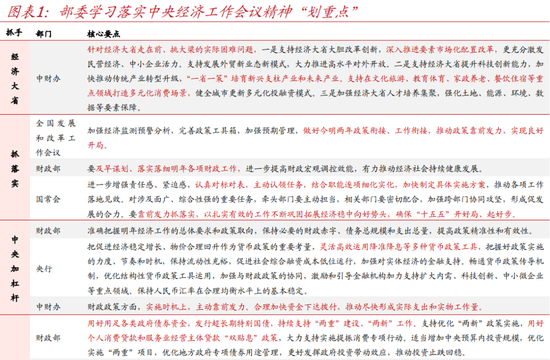
各部委各地学习中央经济工作会议“划重点”【国盛宏观熊园团队】
Xin Lang Cai Jing· 2025-12-24 16:47
Core Viewpoint - The recent learning and dissemination of the Central Economic Work Conference's spirit by various departments and regions is a crucial window for tracking the implementation of the conference's directives, revealing more details and actionable measures. There are several highlights and new proposals, including a focus on proactive measures, accelerating fund disbursement, supporting new consumption growth points, and emphasizing real and substantial growth without exaggeration [2][3][11]. Group 1: Overall Direction - All parties are refining their deployment around the Central Economic Work Conference's principle of "seeking progress while maintaining stability and improving quality and efficiency," with clear directions and highlighted priorities such as expanding domestic demand, strengthening technology, promoting reform, and stabilizing real estate [3][11]. - The emphasis is on policies that "act proactively" to ensure a good start to the year [3][11]. Group 2: Departmental Deployment - Each department has made detailed deployments based on their functional positioning, with the Central Financial Office providing the most comprehensive interpretation of the conference's spirit, revealing specific tasks and details [4][12]. - Signal 1: The continuation of "central leverage" is confirmed, with specific scales to be determined at the 2026 National Two Sessions, emphasizing proactive measures and reasonable acceleration of fund disbursement [4][12]. - Signal 2: Multiple departments will prioritize expanding domestic demand, utilizing various funds, and supporting "two new" and "two heavy" projects, with new focuses on cultivating trillion-level new consumption growth points and increasing investment in consumption infrastructure and livelihood projects [4][12][13]. Group 3: Industry Focus - Signal 3: There is a strong focus on industrial transformation, self-control, and innovation leadership, promoting the expansion and efficiency of technology finance, particularly in the Beijing-Tianjin-Hebei and Yangtze River Delta regions [5][14]. - Signal 4: The emphasis on reform includes advancing a unified market, combating "involution," and stabilizing the private sector, with more details on fiscal and tax reforms to be discussed in the upcoming National Fiscal Work Conference [6][15]. Group 4: Risk Management and Market Stability - Signal 6: There is a strict adherence to the "no explosion" bottom line for risk prevention, balancing the needs of residents and real estate companies, and reiterating the principles for debt resolution while increasing financial and fiscal support [8][17]. - Signal 7: Efforts to stabilize the stock market will continue, promoting the narrative of the Chinese stock market and accelerating reforms in the Sci-Tech Innovation Board and commercial real estate REITs [9][18]. Group 5: Local Implementation - Many regions have begun to learn and convey the spirit of the Central Economic Work Conference, tailoring key tasks to local conditions, with a focus on proactive measures and concrete actions, particularly in the lead-up to the January 2026 local two sessions [10][23]. - Localities like Zhejiang and Hainan are emphasizing innovation and openness, respectively, while ensuring that actionable measures are taken to support economic growth [10][23][24].
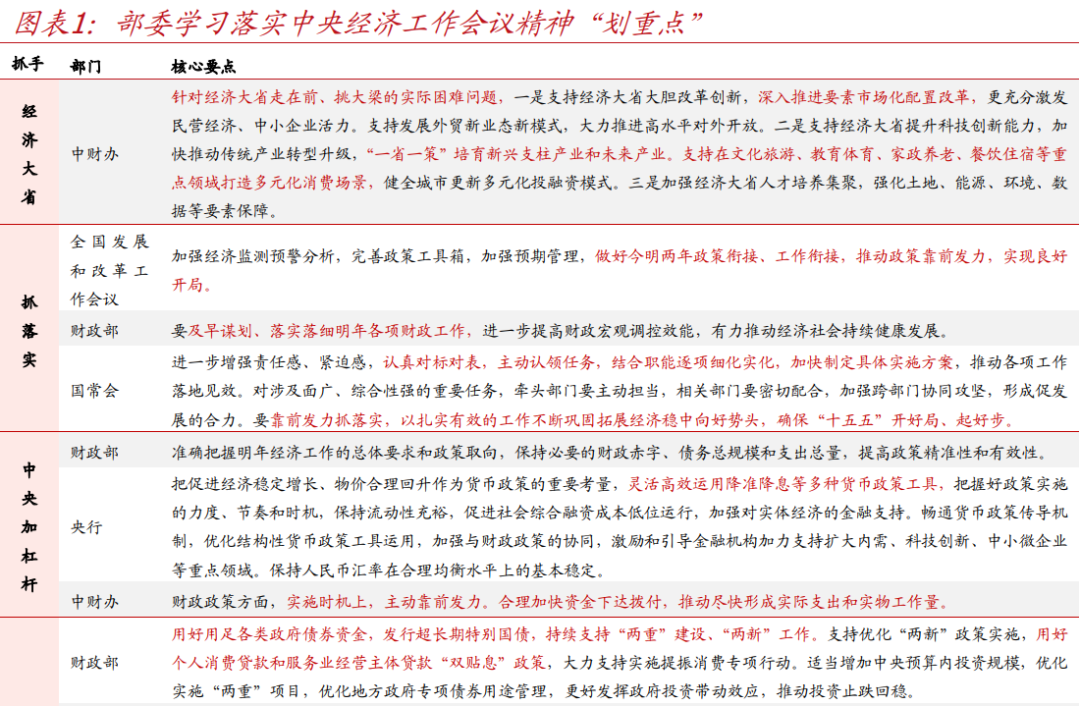
各部委各地学习中央经济工作会议“划重点”
GOLDEN SUN SECURITIES· 2025-12-24 14:18
Group 1: Policy Implementation - Various departments are refining their implementation of the Central Economic Work Conference's spirit, focusing on "stability while seeking progress" and "quality improvement" as the main themes[3] - Emphasis on accelerating the disbursement of funds and implementing major projects ahead of schedule to ensure a strong start in 2026[2] - The central government plans to maintain a necessary fiscal deficit and debt scale, with the overall fiscal deficit expected to be similar to that of 2025[4] Group 2: Economic Growth Strategies - Aiming to cultivate new consumption growth points worth trillions, with increased investment in consumer infrastructure and social welfare projects[6] - The government is focusing on expanding domestic demand, supporting "two new" and "two heavy" projects, and implementing the "15th Five-Year Plan" major projects[6] - The central bank may consider lowering reserve requirements and interest rates in the first quarter of 2026 to stimulate economic activity[2] Group 3: Risk Management and Market Stability - A commitment to prevent financial risks, ensuring that no major defaults occur, particularly in the real estate sector[10] - The government is taking measures to stabilize the real estate market while balancing the needs of residents and property companies[10] - Continuous efforts to promote the stock market narrative and attract long-term investments, including reforms in the Sci-Tech Innovation Board and commercial real estate REITs pilot programs[10]