春季躁动行情

Search documents
银河证券:市场进入跨年布局关键窗口 关注元旦前后小躁动行情
Xin Lang Cai Jing· 2025-12-21 10:52
Core Viewpoint - The market is expected to continue a volatile structural trend in the short term due to seasonal liquidity tightening and fluctuating overseas monetary policy expectations, with rapid sector rotation [1] Group 1 - The A-share market is entering a critical window for year-end layout as 2026 approaches, which is the starting year of the "14th Five-Year Plan" [1] - Attention is drawn to the small fluctuations in the market around New Year's Day, indicating potential short-term trading opportunities [1] - The release of policy dividends is anticipated to be relatively early, with structural opportunities concentrated in sectors that resonate with policy guidance and industry prosperity [1] Group 2 - The upcoming spring market rally is expected to be promising, driven by the structural opportunities identified [1]
机构论后市丨市场进入跨年布局关键窗口,关注元旦前后小躁动行情
Di Yi Cai Jing· 2025-12-21 09:51
短期关注防御性板块配置机会,同时布局明年政策红利与产业景气方向。(1)主线一:全球百年未遇 之大变局加速演进,国内经济底层逻辑转向新质生产力,人工智能、具身智能、新能源、可控核聚变、 量子科技、航空航天等"十五五"重点领域值得关注。(2)主线二:反内卷政策温和推进,供需结构优 化叠加价格回升预期带动下,制造业、资源板块盈利修复路径清晰。(3)辅助线一:扩大内需政策导 向下消费板块迎来布局窗口。(4)辅助线二:出海趋势将带动企业盈利空间进一步打开。 ②光大证券:市场有望震荡上行,关注成长及消费两个方向 光大证券指出,历史来看,A股市场中几乎每年都存在"春季躁动"行情。本周三市场的强力上涨或许标 志着2026年跨年行情已经开启。一方面,政策有望持续发力,经济增长有望保持在合理区间,进一步夯 实资本市场繁荣发展的基础。另一方面,政策红利释放,有望提振市场信心,进一步吸引各类资金积极 流入。政策有望持续发力,叠加各类资金有望积极流入,市场有望震荡上行。 A股后市怎么走?看看机构怎么说。 沪指本周累计涨0.03%,深证成指累计跌0.89%,创业板指跌2.26%。A股后市怎么走?看看机构怎么 说: ①银河证券:市场进入跨 ...
策略周专题(2025年12月第3期):春季行情哪些方向值得期待?
EBSCN· 2025-12-20 11:21
Group 1 - The A-share market has shown signs of recovery this week, with the Shanghai Composite Index rising due to favorable policy implementation and improved market sentiment. The Shanghai 50 Index performed the best with a gain of 0.3%, while the Sci-Tech Innovation 50 Index saw a decline of 3.0%. The overall valuation of the entire A-share market is at the 85.7 percentile since 2010 [1][11][12] - The retail, non-bank financial, and beauty care sectors performed relatively well this week, with respective gains of 6.7%, 2.9%, and 2.9%. In contrast, the electronics, power equipment, and machinery sectors lagged behind, with declines of 3.3%, 3.1%, and 1.6% [1][13][19] Group 2 - Historically, the A-share market experiences a "spring rally" almost every year, driven by factors such as abundant liquidity at the year's end and optimistic policy expectations. Since 2012, there have been 13 instances of this rally, excluding 2022 [2][19] - Key catalysts for the spring rally include adjustments in monetary policy by the central bank, the release of important economic data, and significant meetings. These events provide new operational logic and upward momentum for the market [2][19][20] Group 3 - During the "spring rally" period from 2012 to 2025 (excluding 2022), major broad indices like the CSI 1000 and ChiNext Index had average gains of 21.0% and 20.7%, respectively. The TMT and advanced manufacturing sectors also performed well, with average gains of 22.2% and 21.3% during the same period [3][21][24] - Specific industries such as computers, non-ferrous metals, and machinery showed strong performance during the "spring rally," with average gains of 24.7%, 23.9%, and 22.7%, respectively [21][26] Group 4 - The 2026 cross-year market is expected to begin, with policies likely to continue supporting growth and various funds expected to flow into the market. This week, a strong market rally may indicate the start of this cross-year trend, particularly following a period of lackluster performance [4][29][30] - The central economic work conference has outlined a focus on maintaining a stable economic environment and promoting domestic demand, which is expected to bolster market confidence and attract long-term capital inflows [28][30] Group 5 - The growth and consumption sectors are highlighted for investment focus, with TMT and advanced manufacturing historically showing greater elasticity during the "spring rally." The current market environment suggests that the consumption sector may also attract attention due to its relatively low performance this year [5][35][42] - The consumption sector has lagged in performance this year, making it a potential target for "missed opportunity" funds. Recent performance indicates that sectors like retail and beauty care are beginning to show stronger gains [5][42][45]
东莞证券财富通每周策略-20251219
Dongguan Securities· 2025-12-19 10:34
Market Overview - The market experienced a rebound this week, with the Shanghai Composite Index slightly rising by 0.03%, while the Shenzhen Component Index and ChiNext Index both fell by 0.89% and 2.26% respectively. The market initially declined due to weak domestic economic data and expectations of interest rate hikes by the Bank of Japan, but later stabilized and briefly surpassed 3900 points before retreating [1][3][14]. Economic Data Analysis - Economic data for November showed a general slowdown, indicating weak internal growth momentum. The industrial value added for November grew by 4.8% year-on-year, down 0.9 percentage points from the previous value. Fixed asset investment from January to November decreased by 2.6% year-on-year, with manufacturing investment growing by only 1.9% [10][11]. - Retail sales for November increased by only 1.3% year-on-year, a decline of 1.6 percentage points from the previous value, primarily affected by weak commodity retail performance [10][11]. Financial Indicators - The total social financing in November was 2.49 trillion yuan, an increase of 160 billion yuan year-on-year, but new RMB loans amounted to only 390 billion yuan, a decrease of 190 billion yuan year-on-year, marking the fifth consecutive month of decline [11][12]. - The M2 money supply grew by 8% year-on-year, while the M1 money supply increased by 4.9%, indicating a decrease in the liquidity of funds and weak demand for real financing [12]. Policy Outlook - The report anticipates that expanding domestic demand and promoting consumption will be key focuses of future policies, especially in light of the ongoing economic transition and external uncertainties. The necessity and possibility of "timely strengthening" monetary policy have increased, with expectations for further easing measures such as reserve requirement ratio cuts and interest rate reductions [10][12][14]. Investment Recommendations - The report suggests focusing on sectors such as finance, non-ferrous metals, food and beverage, machinery, and TMT (Technology, Media, and Telecommunications) for potential investment opportunities [15].
【机构策略】2026年A股跨年配置行情有望提前启动
Sou Hu Cai Jing· 2025-12-19 01:20
Group 1 - A-shares are experiencing a mixed performance with major indices showing divergence, and the Shanghai Composite Index is expected to maintain a range-bound movement supported by key levels [1] - The market is anticipated to improve liquidity and trading activity due to institutional reallocation and capital inflow as the year-end approaches, potentially initiating a spring rally [1] - The focus in the short term is on the selection of the new Federal Reserve chair and the implementation of domestic monetary and fiscal policies, with geopolitical risks easing [1] Group 2 - The market is influenced by hawkish signals from the Federal Reserve, which dampens expectations for interest rate cuts, leading to adjustments in U.S. stock indices [2] - The technology sector, which had previously rebounded, is currently underperforming, and there is a recommendation to control positions in the short term [2] - In the medium to long term, factors such as improved corporate performance, increased household savings entering the market, and global liquidity easing are expected to support a "slow bull" market for A-shares in 2026 [2]
收盘丨A股三大指数震荡分化,银行板块午后发力
Di Yi Cai Jing· 2025-12-18 07:18
Market Overview - The total trading volume in the Shanghai and Shenzhen markets reached 1.66 trillion yuan, a decrease of 155.7 billion yuan compared to the previous trading day [1][6] - The A-share indices showed mixed performance, with the Shanghai Composite Index rising by 0.16%, while the Shenzhen Component Index and the ChiNext Index fell by 1.29% and 2.17%, respectively [1][2] Sector Performance - The consumer sector showed strength, particularly in retail, which led the gains [2] - Aerospace stocks experienced significant activity, with several stocks hitting the daily limit up, including Shengyang Technology, Tianjian Technology, and Shenjian Co., among others [2][3] - The lithium battery sector saw a decline, with notable drops in stocks such as Huasheng Lithium and Haike New Source [4][5] Capital Flow - Main capital inflows were observed in the aerospace, banking, and pharmaceutical sectors, while there were outflows from consumer electronics, securities, and semiconductors [8] - Specific stocks that attracted net inflows included Kaimete Gas, Zhaoyi Innovation, and China Satellite, with inflows of 770 million yuan, 723 million yuan, and 667 million yuan, respectively [8] - Conversely, stocks like Industrial Fulian, Ningde Times, and Yingweike faced significant sell-offs, with outflows of 2.443 billion yuan, 1.360 billion yuan, and 1.203 billion yuan, respectively [8] Institutional Insights - CICC suggests that the recent market pullback may provide a good opportunity for positioning ahead of the market trends expected in the first half of 2026 [10] - Huashan Securities notes that historically, January following a significant A-share rise tends to exhibit high volatility, indicating that the initiation of a spring rally remains to be observed [10] - Everbright Securities anticipates that the index will continue to exhibit a range-bound oscillation pattern [10]





中证A500ETF单日合计净流入超111亿元,A500ETF华泰柏瑞、A500ETF南方强势吸金
Ge Long Hui· 2025-12-18 02:09
Group 1 - The core viewpoint of the news highlights significant inflows into the A500 ETF market, indicating strong investor interest and potential market momentum [1] - On December 17, a total net inflow of 111.07 billion yuan was recorded across 40 ETFs tracking the CSI A500 index, showcasing robust market activity [1] - The A500 ETF from Huatai-PineBridge saw a net inflow of 32.83 billion yuan on the same day, with a cumulative inflow of 114.88 billion yuan for December, bringing its total size to 377.8 billion yuan [1] - The A500 ETF from Southern also experienced a substantial net inflow of 26.32 billion yuan, with a total of 117.56 billion yuan for December, resulting in a size of 331.5 billion yuan [1] - Other notable ETFs, including Guotai CSI A500 ETF and GF A500 ETF, each received over 10 billion yuan in net inflows, indicating widespread interest in this segment [1] Group 2 - Huazhong Securities suggests that the recent surge in broad-based ETFs reflects a growing expectation for market stabilization, although confirmation of a spring rally is still pending [2] - Historical analysis indicates that January following a significant rise in the A-share market often experiences high volatility, with notable fluctuations observed in previous years [2] - The report notes that in years where the Shanghai Composite Index increased by over 10%, the subsequent January typically saw significant market volatility, raising questions about the potential for a spring rally [2]
大盘反攻,中证A500ETF成交额放量,关注更多人布局的中证A500ETF(159338)
Sou Hu Cai Jing· 2025-12-18 02:07
Core Viewpoint - The A-share market experienced a significant rebound on December 17, with the trading volume of the CSI A500 ETF reaching 52.575 billion yuan, which is three times the combined trading volume of the CSI 300 ETFs at 16.95 billion yuan. The market is expected to consolidate and prepare for a spring rally, supported by global liquidity easing and positive domestic macro policies [1]. Group 1: Market Performance - The top five CSI A500 ETFs led the market with a total trading volume of 45.291 billion yuan, while four leading CSI 300 ETFs had a combined trading volume of 8.08 billion yuan [1]. - The overall trading volume for all A500 ETFs reached 52.575 billion yuan, significantly outpacing the CSI 300 ETFs' total of 16.95 billion yuan [1]. Group 2: Future Outlook - The market is anticipated to perform well in the coming year due to favorable conditions such as global liquidity easing, positive domestic macro policy statements, and geopolitical dynamics [1]. - Investors are encouraged to use broad-based products like the CSI A500 ETF (159338) and adopt a "technology + dividend" barbell strategy for asset allocation [1].
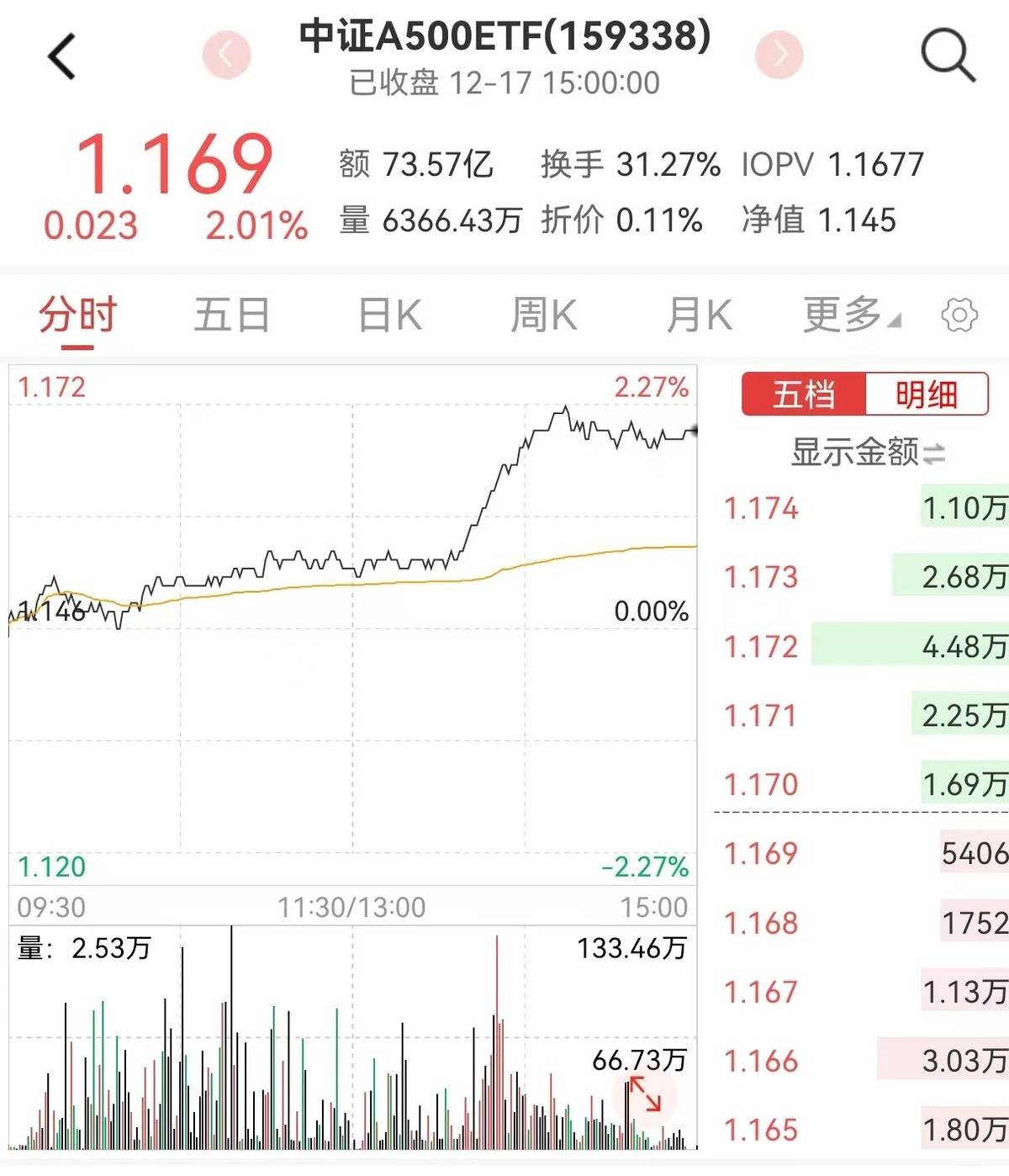
午后神秘资金出手,A股上演大反攻!A500ETF等宽基ETF出现天量成交,券商股和保险股也大幅异动,市值超2000亿元的券商龙头一度逼近涨停
Jin Rong Jie· 2025-12-17 10:11
此外,A500ETF也出现天量成交。 截至收盘,5只A500ETF领跑市场,合计成交额达452.91亿元,其中,华泰柏瑞A500ETF成交额达141.18 亿元,华夏A500ETF以97.54亿元次之,南方、国泰、易方达旗下A500ETF成交额紧随其后。排名第6的 是华泰柏瑞沪深300ETF,全天成交50.79亿元,4只头部沪深300ETF合计成交额为80.8亿元。 | A500ETF华泰柏瑞 | 1.234 | 1.90% | 141.18亿 | | --- | --- | --- | --- | | 图 563360 | | | | | A500ETF基金 | 1.161 | 1.75% | 97.54亿 | | ■ 512050 | | | | | A500ETF南方 | 1.215 | 1.93% | 80.61亿 | | ■ 159352 | | | | | 中证A500ETF | 1.169 | 2.01% | 73.57亿 | | 159338 | | | | | 沪深300ETF | 4.699 | 1.71% | 50.79亿 | | 胜 510300 | | | | | 创业板ETF | ...

A股缩量调整,沪指逼近3800点,短线何时企稳?
Sou Hu Cai Jing· 2025-12-17 00:43
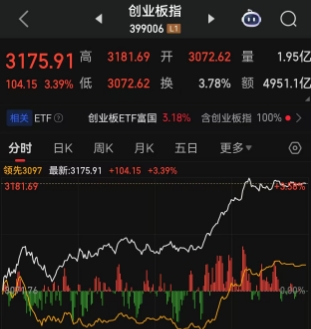
周二A股继续缩量调整,沪指已接近3800点。 12月16日,截至收盘,上证综指跌1.11%,报3824.81点;科创50指数跌1.94%,深证成指跌1.51%,创业板指跌2.1%。沪深两市成交总额进一步降至 17242亿元。 港股方面周二同步回撤,尤其是午后,恒生科技指数跌幅突然加大,恒生指数跌幅扩大至2%,最终收跌1.54%,恒生科技指数一度跌超2.5%,最终 收跌1.74%。 而对于港股市场,华泰柏瑞基金指出,美联储后续降息路径不确定性的提升引发美债利率上行,叠加近在眼前的日央行议息会议目前有较高概率加 息25基点,若加息落地,可能导致借日元投资港股的资金回流日本,或令港股在外部流动性上缺乏支撑。 但前述券商投顾也表示,由于沪指60分钟及120分钟级别有macd底背离结构,再跌后又将和11月21日一样出现短中期情绪冰点共振现象,所以再跌 后容易迎来情绪面修复,届时要观察修复力度及具体K线形态来判断是否止跌企稳,求稳的投资者最好再耐心等一等。 外部情绪传导与内部资金止盈的双重冲击 对于市场近期表现低迷,广发基金分析道,其原因或在于外部情绪传导与内部资金止盈的双重冲击。一是上周五至本周一美股AI科技股大跌,市 ...