
铝代铜

Search documents
铜价涨至万元关口,中国家电业掀起空调“铝代铜”变革
Jin Rong Jie· 2025-12-11 11:24
Core Viewpoint - Driven by the historic high copper price exceeding $10,000 per ton, China, the largest air conditioning producer and consumer, is accelerating a significant "aluminum replacing copper" supply chain revolution under top-level design guidance. This move addresses raw material cost pressures and is crucial for the safety and future competitiveness of a trillion-yuan industry [1]. Group 1: Market and Policy - The surge in copper prices is the most direct trigger for this transformation, severely impacting the profit margins of downstream manufacturing. "Aluminum replacing copper," with material costs around one-fourth of copper, has emerged as an attractive cost-reduction solution [2]. - National policies provide clear guidance for this technological path, with the "Implementation Plan for High-Quality Development of the Aluminum Industry (2025-2027)" identifying "aluminum tubes for heat exchangers in refrigerators and air conditioners" as a key focus area for "using aluminum to save copper" [2]. Group 2: Industry Actions - The industry is responding quickly and collaboratively, with key standards being developed to establish unified and reliable technical specifications for "aluminum replacing copper." A standard for aluminum tube fin-type heat exchangers has already been published, while two additional standards are in preparation [3]. - The revision of the national standard for heat exchangers in air conditioners is underway, which will provide national-level endorsement for product performance and safety. Major companies and research institutions are collaborating on this standard revision, with a new round of discussions expected in January 2026 [3]. Group 3: Technical Challenges and Corporate Strategy Differentiation - "Aluminum replacing copper" is not merely a material substitution; it presents significant technical challenges due to aluminum's inferior thermal conductivity and higher linear expansion coefficient, which impose new requirements on heat exchanger design, manufacturing processes, and long-term reliability [4]. - Domestic air conditioning leaders exhibit differentiated strategies: companies like Midea have actively promoted research since 2012, while others like Gree and Changhong have opted for a more cautious approach, focusing on enhancing copper technology instead of fully launching replacement plans [5]. Group 4: Industry Outlook - The profound significance of "aluminum replacing copper" lies in helping the Chinese air conditioning industry escape the dilemma of "increased production without increased revenue." The industry faces a growing contradiction between expanding capacity and slowing domestic demand, necessitating a shift from price competition to value competition driven by technological innovation [6]. - Whether embracing aluminum or optimizing copper technology, the ultimate goal is to address user pain points through substantial innovation, enhancing product efficiency, intelligence, and health attributes, thereby building differentiated high-end competitiveness [6].
亚太科技(002540) - 2025年12月11日投资者关系活动记录表
2025-12-11 10:12
Company Overview - The company was established in 2001 and listed on the Shenzhen Stock Exchange in 2011. As of mid-2025, total assets reached CNY 8.023 billion [2] - It is a key supplier in the automotive thermal management and lightweight system components materials sectors, focusing on high-end aluminum alloy material substitution and innovation in various emerging fields [2] Sales Pricing Strategy - The pricing model for aluminum products is based on "aluminum ingot price + processing fee," with the ingot price referencing the monthly average of high and low prices from the Shanghai Nonferrous Metals Exchange [3] Profit Distribution - For the 2024 fiscal year, the company distributed CNY 247.15 million in cash dividends, amounting to CNY 2.00 per 10 shares [4] - For the first half of 2025, the distribution was CNY 123.44 million, at CNY 1.00 per 10 shares [4] Capacity Expansion and Development - The company is actively expanding its production capacity in emerging sectors, including: - 2 million sets of high-strength aluminum system components for new energy vehicles annually - 12 million lightweight aluminum parts for automobiles annually - 14,000 tons of high-efficiency aluminum tubes for home air conditioning annually - 100,000 tons of high-end aluminum-based materials for green electricity annually [5] Acquisition of Foreign Companies - On July 29, 2025, the company approved the acquisition of 100% equity in Alunited France SAS and Alunited Denmark A/S for €1.53 million, followed by an additional €1.47 million for operational capital [6] Establishment of Shanghai Branch - The Shanghai branch was established to enhance competitiveness in automotive, aerospace, robotics, and automation sectors, with registration completed in November 2025 [7] Future Development Outlook - The company anticipates new opportunities driven by global sustainable development policies and industrial upgrades, focusing on energy-efficient and low-consumption innovations in automotive thermal management systems [7] - The ongoing transformation in the automotive industry towards electrification and lightweighting presents both challenges and opportunities, with the company positioned to leverage its advantages in these areas [7]

美的、海尔、小米等联手:推动“铝代铜”标准落地、禁止互相恶意攻击
Di Yi Cai Jing· 2025-12-11 07:35
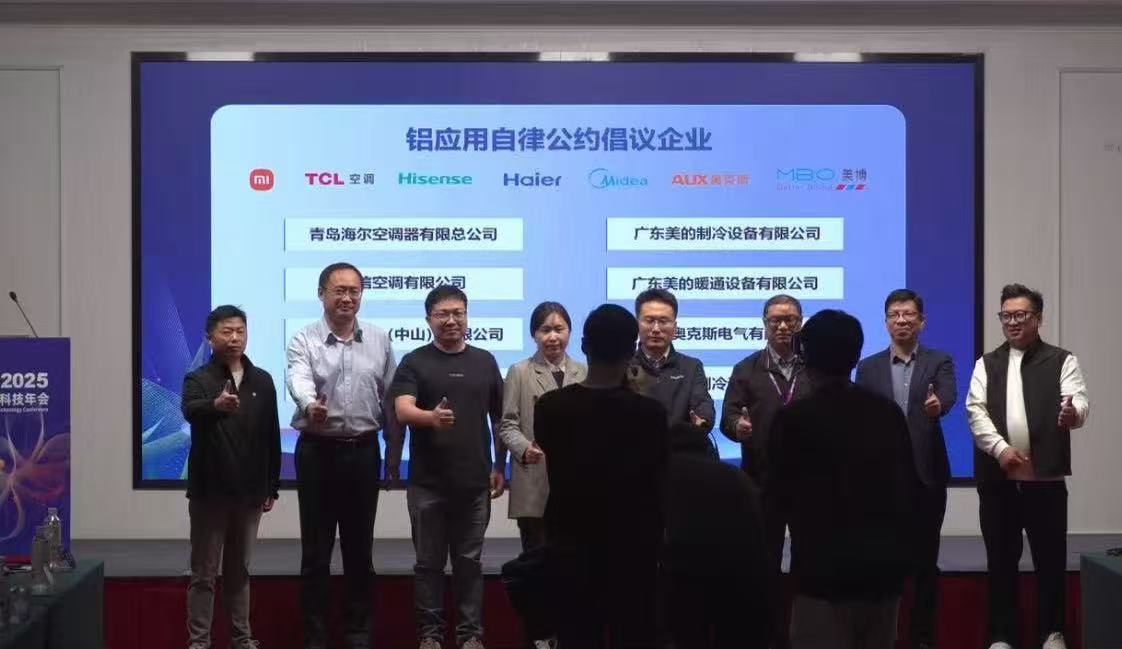
Core Insights - China's air conditioning industry is accelerating the adoption of aluminum instead of copper due to rising copper prices, with a focus on establishing relevant standards to ensure the safety of this billion-dollar industry [2][3] Group 1: Industry Developments - The China Refrigeration Society has released a group standard for the construction of aluminum tube fin heat exchanger production lines for room air conditioners, with additional standards for aluminum heat exchanger raw material requirements and production line construction currently being developed [2] - A national standard related to "aluminum instead of copper" for room air conditioners is under revision, with major companies like Gree, Midea, Haier, and Xiaomi participating in the discussions [2][3] - The China Household Electrical Appliances Research Institute has expanded its research group on aluminum applications in air conditioning to 19 members, including leading air conditioning manufacturers and related material companies [2] Group 2: Technical Challenges and Proposals - The demand for copper in household air conditioning is significant, with 10.7% of China's copper consumption in 2023 attributed to this sector, amounting to approximately 1.723 million tons, with 80% of this copper being imported [3] - There are three main challenges in adopting aluminum heat exchangers: high corrosion resistance technology issues, lack of standardized testing methods, and consumer biases against aluminum [3][4] - The Ministry of Industry and Information Technology has outlined a plan to support the development of aluminum applications in air conditioning and refrigeration, emphasizing the need for high corrosion resistance technology [4] Group 3: Industry Collaboration and Standards - Major air conditioning companies have signed a self-regulation agreement to promote aluminum heat exchangers, ensuring scientific communication about their benefits and preventing misleading claims [4] - The establishment of a standard system for aluminum heat exchangers is a priority, with a focus on addressing corrosion resistance and manufacturing capabilities [4]




东吴证券:从周期波动到红利稳健 电解铝企业今年将完成红利资产转变
智通财经网· 2025-12-08 02:08
Core Viewpoint - The report from Dongwu Securities suggests focusing on high-dividend stocks in the electrolytic aluminum sector, which are expected to increase profit margins and dividend ratios by 2026, driven by further interest rate cuts from the Federal Reserve and a synchronized global economic recovery [1] Group 1: Cost and Profit Dynamics - The decline in costs has become a significant investment logic, with profits shifting from upstream alumina to the smelting sector as aluminum prices rise. By November 2025, the profit level for China's electrolytic aluminum industry is projected to exceed 4,500-5,000 yuan per ton, with further profit expansion expected in 2026 due to ongoing cost improvements and rising aluminum prices [2] Group 2: Supply and Demand Trends - The growth of domestic electrolytic aluminum supply is peaking, with a projected production capacity of 47.769 million tons and an operational capacity of 44.135 million tons by November 2025. The growth rate of aluminum production is expected to slow to 1.14% in 2026, down from a compound annual growth rate of 3.48% from 2020 to 2024. Structural changes in demand are anticipated, with the share of aluminum used in construction decreasing from 29% in 2021 to 21% in 2025, while transportation and power sectors will see increases [3] Group 3: Global Supply Risks - The global electrolytic aluminum supply faces risks of stagnation, with potential new effective capacity estimated at 2.461 million tons from Q4 2025 to Q4 2026. After accounting for expected production cuts, the actual contribution to global production in 2026 is projected to be only 860,000 to 1.25 million tons, indicating a growth rate of just 1.2% to 1.7%. The copper-aluminum price ratio suggests that aluminum prices may be influenced by rising copper prices, providing a dual benefit for the aluminum industry [4] Group 4: Transition to Dividend Assets - The electrolytic aluminum sector is undergoing a transition from being a cyclical stock to a dividend asset, with a shift from "incremental competition" to "stock optimization" since 2021. As capital expenditures decline, the industry is expected to maintain high profit levels, providing sufficient cash flow for improving balance sheets and enabling sustainable dividends, leading to an increase in overall dividend yields in the electrolytic aluminum sector [5]

周专题:12月出口排产韧性强于内销,关注铜价上涨影响
HUAXI Securities· 2025-11-30 14:27
Investment Rating - The industry rating is "Recommended" [6] Core Insights - December production data shows that the export decline for air conditioners has narrowed, with total production for air conditioning, refrigeration, and washing machines at 30.18 million units, a year-on-year decrease of 14.1% [13] - Domestic sales for air conditioners decreased by 29.9% year-on-year, while exports fell by 11.4% [13] - Refrigerator domestic sales decreased by 6.2% year-on-year, but exports increased by 0.7% due to improved conditions following new US-China tariff negotiations [14] - Washing machine domestic sales decreased by 2% year-on-year, with exports down by 0.9% [14] - Rising copper prices may have limited short-term impacts, but could accelerate industry reshuffling and push for higher product value [15][17] Summary by Sections Production Data - Air Conditioners: Domestic sales down 29.9%, exports down 11.4% [13] - Refrigerators: Domestic sales down 6.2%, exports up 0.7% [14] - Washing Machines: Domestic sales down 2%, exports down 0.9% [14] Copper Price Impact - Copper prices have risen, with LME three-month copper at $9,920 per ton as of November 17, 2025 [15] - Copper costs account for approximately 22-25% of air conditioning production [15] - The increase in copper prices may lead to industry consolidation and a shift towards aluminum alternatives [17] Company Announcements - Kangping Technology announced a share transfer involving a 51% stake in Lingchen Collection, with an assessed value of 530 million yuan [18]
价格创纪录新高,“金属之王”进入超级周期
Xin Lang Cai Jing· 2025-11-29 02:01
Core Viewpoint - Copper is experiencing unprecedented demand and price increases, driven by its essential role in the transition to clean energy and AI infrastructure, leading to a global "copper rush" [1][4][10]. Group 1: Price Trends and Market Dynamics - The A-share copper sector has risen over 73% this year, with LME copper prices reaching a record high of $11,210 per ton [1]. - Domestic copper futures have surpassed 87,000 yuan per ton, indicating strong market sentiment and price resilience [1]. - Analysts predict that copper prices will continue to rise due to fundamental support and market dynamics [1][9]. Group 2: Demand Drivers - Over 65% of global copper is used in electrical applications, making it irreplaceable in various sectors, particularly in the electrical industry [1]. - The shift towards clean energy and AI is creating a "demand triangle" focused on AI infrastructure, green energy transition, and grid upgrades, significantly increasing copper consumption [4][6]. - IEA forecasts that copper usage in data centers could reach between 250,000 to 550,000 tons by 2030, representing 1%-2% of global copper demand [4]. Group 3: Supply Constraints - IEA warns of a potential global copper supply gap exceeding 30% by 2035, with current mining reserves only sufficient for 40 more years [6]. - The discovery rate of new copper resources has sharply declined, with only 14 new deposits found in the last decade [7]. - Major copper mines are facing production cuts due to various disruptions, leading to a projected supply shortfall of 150,000 tons by 2025 [7][8]. Group 4: Global Competition and Strategic Moves - Countries are implementing strategies to secure copper resources, with the US including copper in its critical minerals list for the first time [10]. - Japan is preparing to invest in copper mining projects in Pakistan due to concerns over supply shortages [10]. - Indian government aims to increase copper demand fivefold by 2047, indicating a long-term strategic focus on self-sufficiency [10]. Group 5: Corporate Strategies - Major mining companies like BHP, Rio Tinto, and Vale are expanding their copper operations to capitalize on the growing demand [12][15]. - Zijin Mining has become the fourth-largest copper producer globally, with plans to increase production significantly by 2028 [16][17]. - China Molybdenum is also focusing on copper production in the Democratic Republic of Congo, with ambitious growth targets [17]. Group 6: Industry Challenges - China's copper industry faces high import dependence, with over 80% of copper ore sourced from abroad [18]. - The rising copper prices are squeezing profit margins for downstream copper processing companies, leading to operational challenges [20]. - Companies are exploring financial instruments and alternative materials, such as aluminum, to mitigate the impact of rising copper prices [21].


有色普涨
Bao Cheng Qi Huo· 2025-11-28 11:04
Report Industry Investment Rating - Not provided in the content Core Views - **Copper**: Today, Shanghai copper increased in volume and its main contract price reached the 87,500 yuan mark, while LME copper hit the $11,000 mark. Despite the stabilization and rebound of the US dollar index, non - ferrous metals strengthened collectively, with a strong bullish sentiment in the market. Domestically, the social inventory of electrolytic copper has been decreasing this week, and the spot premium has strengthened, supporting the copper price. Technically, continuous attention should be paid to the long - short battle at the $11,000 mark of LME copper [5]. - **Aluminum**: Shanghai aluminum oscillated upwards today, with a slight increase in open interest, and its main contract price reached the 21,600 yuan mark. The US dollar index oscillated and stabilized, while non - ferrous metals rose across the board, creating a good bullish atmosphere. Domestically, the social inventory of electrolytic aluminum has been decreasing since this week, supporting the aluminum price. In the short term, the aluminum price rebounded with the non - ferrous metal sector, but the change in open interest was small, indicating low capital attention [6]. - **Nickel**: Today, the nickel price soared in the morning and then declined, oscillating narrowly above 117,000 yuan during the day. Although non - ferrous metals rose across the board, the nickel price performed relatively weakly. The spot premium of nickel decreased slightly. Against the backdrop of the strong performance of the non - ferrous metal sector, the liquidation of previous short positions may keep the nickel price in a relatively strong oscillation [7]. Summary by Related Catalogs 1. Industry Dynamics - **Copper**: Using aluminum instead of copper in air - conditioning products can significantly reduce manufacturing costs, especially for the price - sensitive mid - and low - end markets. Major air - conditioning brands have jointly issued an industry standard for aluminum substitution of copper. Rising copper prices may further promote the implementation of this substitution in the domestic air - conditioning industry [9]. - **Aluminum**: JPMorgan Chase expects that due to the attractiveness of rising copper prices, combined with the overall market balance and the short - term risk of supply decline, the aluminum price is expected to approach $3,000 per ton in Q1 2026. However, Indonesia has a vast aluminum supply channel, and its production capacity growth is about to reach a critical point in 2026. This emerging supply growth trend may eventually offset the rise in aluminum prices, but this impact will not be apparent until 2026 and the following years. On November 27, Mysteel's electrolytic aluminum social inventory was 590,000 tons, a decrease of 14,000 tons from Monday [10][11]. - **Nickel**: On November 28, the price of SMM1 electrolytic nickel was 117,000 - 122,000 yuan/ton, with an average price of 119,500 yuan/ton, a rise of 500 yuan/ton from the previous trading day. The mainstream spot premium quotation range of Jinchuan 1 electrolytic nickel was 4,700 - 4,800 yuan/ton, with an average premium of 4,750 yuan/ton, a rise of 100 yuan/ton from the previous trading day. The spot premium and discount quotation range of domestic mainstream brand electrowon nickel was - 100 - 300 yuan/ton [12]. 2. Related Charts - **Copper**: The report provides charts on copper basis, domestic visible inventory of electrolytic copper (social inventory + bonded area inventory), LME copper cancelled warrant ratio, overseas copper exchange inventory, SHFE warrant inventory, etc [13][14][15]. - **Aluminum**: The report includes charts on aluminum basis, monthly spread, domestic social inventory of electrolytic aluminum, overseas exchange inventory of electrolytic aluminum (LME + COMEX), SHFE - LME ratio, aluminum bar inventory, etc [24][26][31]. - **Nickel**: The report presents charts on nickel basis, LME inventory and cancelled warrant ratio, LME nickel trend, SHFE inventory, nickel ore port inventory, etc [37][39][40].
铜的期货价格近日每吨突破一万美元,预计明年空调价格有上涨压力
Di Yi Cai Jing· 2025-11-25 01:53
Group 1: Copper Price Trends - Copper prices are currently at historical highs, with LME futures reaching $10,800 per ton on November 24, and peaking at $11,200 per ton at the end of October, marking the highest level since May 2024. Goldman Sachs forecasts copper prices to range between $10,000 and $11,000 in the next two years due to supply constraints and increased demand from AI applications [1][2] - The closure of Indonesia's Grasberg copper mine due to landslides has contributed to a year-on-year increase of 3.94% in LME copper prices in September, while domestic copper prices in China have also reached annual highs [1] Group 2: Impact on Air Conditioning Industry - Rising copper prices have significantly increased production costs for air conditioning manufacturers, with costs expected to rise by approximately 8% since April. However, due to intense market competition, air conditioning prices have not been able to increase correspondingly, which may impact industry profits [2][3] - The air conditioning industry is facing a new round of market reshuffling, with larger companies benefiting more from national subsidy policies, while smaller firms are under increased pressure and shifting towards exports. The rising costs may accelerate this reshuffling process [3] Group 3: Material Substitution Trends - The high copper prices are prompting discussions about substituting aluminum for copper in air conditioning components. The technology for using aluminum and steel in various parts has been maturing for about a decade, and the industry is expected to continue developing standards for the reliability and corrosion resistance of aluminum components [3]
铜价大幅抬升家电生产成本
Di Yi Cai Jing· 2025-11-24 10:21
Group 1 - Copper prices are currently at historical highs, with LME copper futures reaching $10,800 per ton on November 24, and a peak of $11,200 per ton at the end of October, marking the highest level since May 2024 [2] - The rise in copper prices is attributed to supply constraints and increased demand from sectors like AI, with Goldman Sachs predicting prices will range between $10,000 and $11,000 in the coming years [2] - The closure of Indonesia's Grasberg copper mine due to landslides has contributed to a year-on-year increase of 3.94% in LME copper prices in September, impacting the production expectations of air conditioning manufacturers [4] Group 2 - The increase in copper prices has led to a significant rise in production costs for air conditioning companies, which typically see copper accounting for 22%-25% of their costs [4] - Despite rising costs, air conditioning prices may not increase immediately due to competitive market conditions, with potential price adjustments possibly not reflecting until 2026 [4] - The air conditioning industry is undergoing a new round of restructuring, with larger companies benefiting from national subsidies while smaller firms face increased pressure, potentially accelerating market consolidation [5] Group 3 - The high copper prices are expected to exert upward pressure on air conditioning prices next year, prompting discussions about substituting aluminum for copper in components [5] - The use of alternative metals like aluminum and steel in refrigeration components has been developing for about a decade, with technology becoming increasingly mature [5] - China, as the largest air conditioning manufacturer globally, is actively following advancements in aluminum substitution technology, with plans to establish product standards based on reliability and corrosion resistance [5]
铝价飙升浅析:绿色革命驱动下的全球供应链重构与投资机遇
Xin Lang Cai Jing· 2025-11-22 00:52
Core Insights - The aluminum market is undergoing a fundamental restructuring due to the acceleration of global energy transition, with aluminum becoming a strategic resource, leading to a new price paradigm characterized by high prices and limited supply [1][2][3] Global Aluminum Supply Chain Restructuring - Resource nationalism and capacity transfer are reshaping the global aluminum supply chain, with Guinea holding 26% of global bauxite reserves and Australia 12%, while China only holds 2% [1][2] - The concentration of bauxite resources leads to a significant disparity in production, with Guinea accounting for 29% of global output [2] - By 2025, China's electrolytic aluminum capacity is nearing its ceiling at 4,445 million tons, while overseas projects are expected to add over 1 million tons of capacity from 2026 to 2028 [3][4] Global Aluminum Consumption Structure Analysis - Traditional sectors like construction are declining, while new sectors such as electric vehicles (EVs) and photovoltaics are experiencing explosive growth, with EV aluminum consumption increasing by 30% [5][6] - The average aluminum usage in pure electric vehicles is 283 kg per vehicle, significantly higher than traditional vehicles [6] - By 2040, global aluminum demand is projected to reach 163.7 million tons, a 67.3% increase from 2018 levels [7] Trade Policies and Market Dynamics - The U.S. has significantly increased aluminum import tariffs to 50%, leading to a sharp decline in imports, particularly from Canada, which previously supplied 58% of U.S. aluminum [8][9] - China is adapting by increasing exports through third countries to circumvent tariffs, with exports of unwrought aluminum and aluminum products rising by 19.7% year-on-year [10] Price Trends and Future Predictions - Aluminum prices have shown a strong upward trend, with LME prices reaching $2,880 per ton, driven by tight supply and robust demand from sectors like EVs and solar energy [11][12] - Various institutions predict continued price increases, with estimates for 2025 ranging from $2,850 to $3,500 per ton, reflecting a tightening market [12][13] Future Trends and Strategic Recommendations - The aluminum industry is shifting towards a green transition, with a focus on recycled aluminum, which has a recovery rate of over 95% and significantly lower production emissions [14][15] - Companies are encouraged to invest in green technologies and diversify markets to mitigate risks associated with trade barriers and supply chain vulnerabilities [16]