
AI服务器

Search documents
博杰股份:2026年AI服务器测试业务预期乐观,N客户设备需求量预计达小四位数
2 1 Shi Ji Jing Ji Bao Dao· 2026-01-12 11:15
Core Viewpoint - The company expresses optimism regarding revenue growth in the AI server testing business, particularly driven by significant capital expenditure expectations from major clients like Amazon, Google, and Microsoft, excluding client N [1] Group 1: Revenue Expectations - The company anticipates a high revenue contribution from AI server testing equipment in the third quarter, primarily from clients G and M [1] - The company holds an optimistic outlook for revenue in the AI server testing sector through 2026 [1] Group 2: Client Demand and Deliveries - Equipment supplied to client N is expected to achieve mass delivery by the first half of 2026, with anticipated demand in the low four-digit range [1] - Collaborative projects with client N will gradually encompass various testing stations, including ICT and FCT functional aging [1]

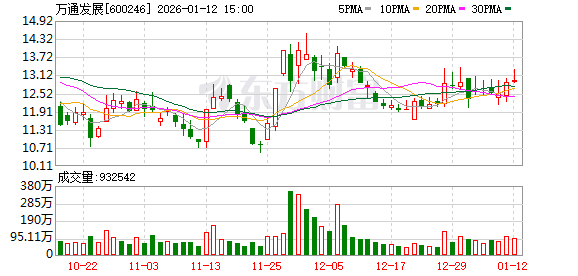
万通发展:去年四季度的小批量订单是客户正式订单,用于商用
Mei Ri Jing Ji Xin Wen· 2026-01-12 10:17
Core Viewpoint - The company has confirmed that small batch orders from customers in the fourth quarter of last year are now formal commercial orders for use in AI servers and storage servers, with early adopters primarily focused on the AI server sector [2]. Group 1 - The company received small batch procurement agreements from three customers and has completed board production with nine customers [2]. - The main application scenarios for the company's products are AI servers and storage servers [2]. - Early adopters of the company's products are mainly concentrated in the AI server field [2].


地缘政策催化叠加供需缺口,稀有金属ETF(562800)交易活跃
Jin Rong Jie· 2026-01-12 03:50
Group 1 - The core viewpoint of the news highlights the significant rise in the rare metals sector, driven by supply-demand imbalances and geopolitical influences, leading to increased market activity and price surges [1][2] - As of January 12, the Shanghai Composite Index rose by 0.72%, while the CS Rare Metals Index increased by 0.31%. Notable individual stocks such as Northern Rare Earth and Ganfeng Lithium saw gains exceeding 2% [1] - The Rare Metals ETF (562800) experienced a 0.59% increase, with a trading volume of 360 million yuan and a turnover rate of 7.51%. Over the past six months, the fund has risen by 86.79%, and by 109.79% over the past year [1] Group 2 - Recent developments indicate that some state-owned enterprises in China have halted new rare earth sales agreements with Japanese companies, further emphasizing the strategic value of rare earths amid new export controls announced by the Ministry of Commerce [2] - The China Securities Rare Metals Theme Index shows lithium and rare earths as the top two weighted components, reflecting the core market dynamics of the sector [2] - The current management fee for the Rare Metals ETF (562800) is 0.50% annually, with a custody fee of 0.10% annually, providing investment opportunities for those without stock accounts through linked funds [2]
锡周报:供给小幅收缩叠加下游补库,锡价快速反弹-20260110
Wu Kuang Qi Huo· 2026-01-10 13:34
1. Report Industry Investment Rating - No relevant content provided. 2. Core Viewpoints of the Report - This week, tin prices rebounded significantly due to the recovery of risk appetite in commodities, the upward resonance of the non - ferrous sector, the weak supply of refined tin caused by the reduction of scrap in Jiangxi, and the replenishment of raw material inventory by downstream tin enterprises. The tin market supply and demand maintained a tight balance, and it is expected that tin prices will likely fluctuate at a high level in the short term [11][13]. 3. Summary According to Relevant Catalogs 3.1. Weekly Assessment and Strategy Recommendation - Cost side: In November 2025, the import of tin concentrates in China increased significantly, and the shortage of raw material supply was alleviated. The import volume of tin ore and concentrates was 15,099 tons, a month - on - month increase of 29.81% and a year - on - year increase of 24.42%. The imports from Myanmar and the Democratic Republic of the Congo showed different trends [12]. - Supply side: The operating rate of smelters in Yunnan remained high at 87.09% this week, with limited room for further improvement due to tight raw material supply. Jiangxi was affected by the shortage of scrap supply, with tight crude tin supply and low refined tin output [11][12]. - Demand side: Although the demand for consumer electronics entered the traditional off - season at the end of the year, the operating rate of tin solder enterprises remained stable supported by orders from emerging fields. Downstream enterprises adopted a low - inventory strategy, and spot procurement was mainly for rigid demand [11][12]. 3.2. Futures and Spot Market - No relevant content for summary other than the presentation of graphs about the basis of Shanghai tin main contract and LME tin premium (0 - 3). 3.3. Cost Side - The presentation of graphs about China's monthly tin ore production, tin ore imports, tin concentrate prices, and tin concentrate processing fees, but no specific data analysis and summary content provided. 3.4. Supply Side - The presentation of graphs about domestic refined tin monthly production, domestic recycled tin monthly production, tin production and operating rate in Yunnan and Jiangxi, refined tin export and import profits, domestic refined tin imports, and Indonesia's refined tin imports and exports, without specific data analysis and summary content. 3.5. Demand Side - China's semiconductor sales growth rate rebounded slightly, and global semiconductor sales maintained high growth. Graphs about the output of various downstream products such as computers, smartphones, home appliances, photovoltaic products, etc., and the operating rate of downstream solder enterprises and domestic tin apparent consumption were presented, but no specific data analysis and summary content provided [44]. 3.6. Supply - Demand Balance - The presentation of graphs about China's social inventory and LME inventory, without specific data analysis and summary content.
内存价格创历史新高 商家喜忧参半
Zheng Quan Shi Bao· 2026-01-09 00:33
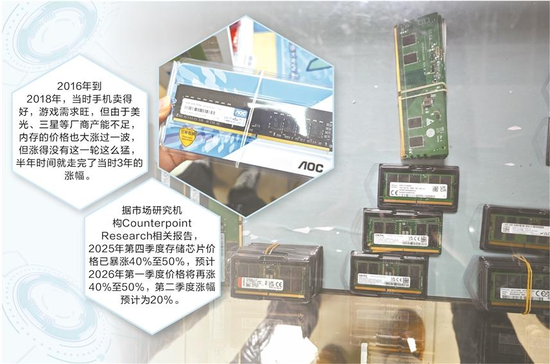
Core Viewpoint - The memory market in Shenzhen's Huaqiangbei has entered a "super bull market" since the second half of 2025, with prices for various memory modules rising significantly, surpassing historical highs from 2018 [1][3] Group 1: Price Trends - Memory prices have increased dramatically, with some products seeing price hikes of over 200%, such as a 32GB DDR5 memory module that rose from 700 yuan to over 2500 yuan [2][3] - The price of consumer-oriented memory products is expected to remain high due to supply constraints, with predictions of further increases of 15% or more in the first quarter of 2026 [6][7] Group 2: Market Sentiment - Many merchants in Huaqiangbei express mixed feelings about the price surge; while higher prices lead to increased profit margins, a significant drop in sales volume poses a challenge [4][5] - Some shops report a decline in sales by over 90%, indicating that non-essential consumers are reducing purchases of computer components due to high memory prices [5] Group 3: Supply Chain Dynamics - The surge in memory prices is attributed to AI servers consuming production capacity from major manufacturers like Samsung and Micron, leading to shortages in consumer memory products [6][7] - Analysts predict that the ongoing shift in production focus towards high-capacity memory for AI applications will keep supply tight for consumer-grade DDR4 and DDR5 products [6][7] Group 4: Broader Market Impact - The rising memory prices are expected to impact downstream markets, including smartphones and automotive sectors, with potential BOM cost increases of up to 15% for certain smartphone models [7] - The automotive industry is particularly affected, as it competes for memory components with AI and computing sectors, leading to increased cost pressures [7]
“每天都在创新高”!实探深圳华强北内存市场,狂热与忐忑并存,商家喜忧参半
Xin Lang Cai Jing· 2026-01-09 00:20
Core Viewpoint - The memory market has entered a "super bull market" since the second half of 2025, with prices of various memory modules generally increasing by over 200%, surpassing historical highs from 2018 [1][4][12] Price Trends - Prices for memory modules, such as DDR4 and DDR5, have seen significant fluctuations, with some products experiencing price increases of 1 to 4 times [3][11] - A specific example includes a 32GB Acer Predator DDR5 memory module that rose from 700 yuan to over 2500 yuan within six months [3][11] - The most intense price increases occurred between September and October of the previous year, with an average increase of about 40% during that period [3][12] Market Dynamics - The core component of memory modules, storage chips, is currently in a "super bull market," driving further price increases [4][12] - Major manufacturers like Samsung, Micron, and SK Hynix are reallocating production capacity to high-end storage for AI servers, leading to a shortage in consumer-grade memory products [7][15] - Analysts predict that storage chip prices will increase by 40% to 50% in Q4 2025 and again in Q1 2026, with a subsequent 20% increase expected in Q2 2026 [4][12] Sales and Profitability - Despite rising prices leading to higher profits per order, many retailers are experiencing a significant decline in sales volume, with some reporting drops of over 90% [5][13] - Retailers have adjusted their profit margins from below 5% to between 5% and 10% due to price increases, but overall profits remain stable [5][13] - The demand for computer assembly has sharply declined, impacting businesses that rely on selling memory and other components [6][14] Impact on Downstream Markets - The rising prices of memory are expected to affect downstream markets, including smartphones, computers, and the automotive industry [8][16] - The automotive sector, in particular, is facing significant cost pressures from memory prices, which could lead to increased costs for consumers [8][16] - Analysts suggest that the impact of rising memory prices may extend throughout the consumer electronics ecosystem, potentially increasing BOM costs by up to 15% for certain smartphone models [8][16]

【点金互动易】服务器液冷+脑机接口,公司拟并购企业服务英伟达、英特尔等算力巨头,产品包括UQD、光模块冷板等服务器液冷核心硬件
财联社· 2026-01-08 00:40
Group 1 - The article emphasizes the importance of timely and professional information analysis in investment decision-making, focusing on extracting investment value from significant events and analyzing industry chain companies [1] - The company is involved in server liquid cooling and brain-computer interface technologies, planning to acquire enterprises that serve major computing giants like Nvidia and Intel, with products including UQD and optical module cold plates [1] - The company has developed self-researched chips for AI server power supplies, and its 8-inch silicon carbide power device chip production line is now operational, achieving a monthly production capacity of 10,000 6-inch silicon carbide power semiconductor chips [1]

芯碁微装:AI服务器对高阶PCB的需求激增,推动上游设备加速向高密度、高精度方向升级
Zheng Quan Ri Bao Wang· 2026-01-07 13:10
Core Viewpoint - The demand for high-end PCBs in AI servers is surging, leading to an accelerated upgrade of upstream equipment towards high density and high precision [1] Company Summary - The company has successfully implemented laser direct imaging (LDI) equipment in mass applications across high-layer boards and packaging substrates [1] - Current order schedules are tight, and the company is fully organizing production to meet demand [1] - The company is optimizing production processes and reallocating resources to ensure timely and high-quality order delivery [1]

全球存储,飞奔去月球?
Xin Lang Cai Jing· 2026-01-07 11:39
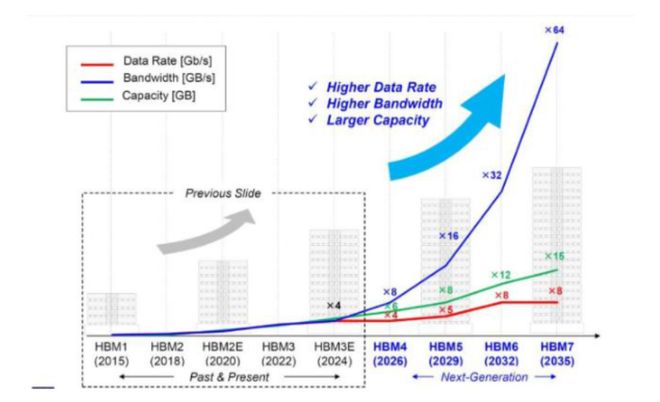
Group 1 - The core viewpoint of the article highlights the booming demand in the storage market, driven by advancements in technology and increasing needs for high-performance storage solutions [2][5][9] - The CES conference showcased significant developments in storage technology, particularly with SK Hynix unveiling its next-generation HBM4 chip, which is expected to dominate the market by 2026 [5][8] - Major storage stocks in the U.S. saw substantial gains following positive market sentiment, with SanDisk rising by 28%, Western Digital by 17%, Micron by 10%, and Seagate Technology by 14% [3][4] Group 2 - SK Hynix and Samsung Electronics are planning to increase server DRAM prices by 60% to 70% in Q1 2026, indicating strong market dynamics and potential price hikes across the board [8][9] - The competition between SK Hynix and Samsung Electronics is intensifying, with Samsung projected to surpass SK Hynix in storage chip revenue by Q3 2025, achieving $19.4 billion [9] - The Asia-Pacific Select ETF has significant holdings in both Samsung Electronics and SK Hynix, with recent performance showing a 145% return for Samsung and a 300% return for SK Hynix over the past year [11][12]
长江有色:7日锡价大涨 高价抑制采购现货交投清淡
Xin Lang Cai Jing· 2026-01-07 08:58
Core Viewpoint - The recent surge in tin prices is attributed to a combination of macroeconomic factors, supply-demand dynamics, and industry trends, indicating a strong market sentiment and geopolitical risk premium [1][2]. Group 1: Price Movement - The Shanghai tin contract 2602 experienced a significant increase, opening at 348,300 CNY/ton, reaching a high of 364,240 CNY/ton, and closing at 359,050 CNY/ton, marking an increase of 18,180 CNY or 5.33% [1]. - The average price of 1 tin in the Changjiang market rose by 15,200 CNY from the previous day, with current prices ranging from 356,500 CNY/ton to 358,500 CNY/ton [1]. Group 2: Supply and Demand Dynamics - The supply side is characterized by a significant decline in Myanmar's tin production, which has dropped by 87% from its peak in 2018, and a projected 85% decrease in exports to China from January to October 2025 [2]. - Global tin inventories are at historical lows, with LME stocks at only 5,420 tons, creating a challenging supply gap [2]. - On the demand side, while traditional electronics are in a seasonal downturn, the explosive growth in AI server construction and photovoltaic installations is driving a surge in demand for high-grade tin solder and welding materials [2]. Group 3: Industry Performance - Leading companies in the tin industry are showing strong performance, with Tin Industry Co. reporting a 35.99% increase in net profit for the first three quarters of 2025, entering the top 500 listed companies in China [2]. - Other companies like Huaxi Nonferrous and Zijin Mining are also experiencing significant stock price increases and strategic resource collaborations, reflecting the industry's high growth potential [2]. Group 4: Market Characteristics - The current spot market is exhibiting characteristics of "high price with low trading volume," where high prices are significantly suppressing downstream purchasing intentions, leading to transactions primarily driven by rigid demand [3]. Group 5: Short-term Price Forecast - Short-term tin prices are expected to maintain a high oscillation range of 350,000 to 359,000 CNY/ton, with potential corrections if Myanmar's production exceeds expectations or macroeconomic policies change [4].
