价值投资

Search documents
陈光明对话霍华德 马克斯实录
Zhong Guo Ji Jin Bao· 2025-07-11 03:12
Group 1: Core Insights - The dialogue emphasizes the importance of holding or increasing positions in Chinese assets for potential long-term returns [1][2] - The discussion highlights the need for a long-term investment mindset, akin to a farmer's approach, rather than a hunter's mentality [2][15] - The conversation reflects optimism about China's long-term growth potential, especially in the context of global investment [2][10] Group 2: Market Cycles and Economic Conditions - The U.S. stock market's valuation is questioned, with a notable disparity between its market capitalization and GDP contribution [3][5] - The impact of U.S. trade policies on global markets is discussed, with a focus on the volatility caused by tariff announcements [5][6] - The dialogue suggests that the fundamental value of companies remains stable despite market price fluctuations [2][5] Group 3: Innovation and Investment Opportunities - The emergence of Chinese companies like DeepSeek is seen as a sign of competitive capability in technology sectors [7][9] - The discussion points to the potential underestimation of many Chinese enterprises, indicating a broader trend of innovation across various industries [8][10] - The conversation underscores China's robust and efficient supply chains, which contribute to its innovation landscape [10] Group 4: Value Investing Practices - Value investing principles are consistent globally, but the assessment of intrinsic value can vary by market [11][12] - The dialogue highlights the challenges of evaluating intrinsic value in the Chinese market due to its volatility and shorter business cycles [11][12] - The importance of patience and long-term commitment in value investing is reiterated, especially in the face of market fluctuations [14][15] Group 5: Navigating Uncertainty - The discussion acknowledges the persistent uncertainty in global markets and the need for investors to adapt [13][14] - Historical context is provided, noting that external factors have increasingly influenced market conditions over the past two decades [13] - The dialogue emphasizes the necessity of maintaining a long-term perspective to navigate market volatility effectively [14][15]
陈光明对话霍华德•马克斯实录
中国基金报· 2025-07-11 02:51
Core Viewpoint - Holding or increasing positions in Chinese assets is expected to yield continuous returns, as optimism about China's long-term development potential is gradually emerging among global investors [2][3]. Group 1: Macroeconomic and Market Cycles - The uncertainty in the global market has increased since the election of President Trump, leading to more divided opinions on the direction of the U.S. economy [5]. - The U.S. stock market's total market capitalization accounts for 50% of the global total, while its GDP only represents about 25% [5]. - Despite some skepticism regarding U.S. international engagement, the fundamental factors supporting U.S. investment remain strong [5]. Group 2: Responding to Market Volatility - Market reactions to Trump's tariff announcements led to significant declines across various asset classes, including stocks and traditional safe havens like bonds and gold [7]. - During market downturns, opportunities arise to acquire undervalued assets, as seen by the capital deployment by Oaktree Capital during April's market weakness [7][8]. - The internal value of quality companies remains stable despite price fluctuations, which presents opportunities for value investors [8]. Group 3: Innovation in China - The emergence of companies like DeepSeek highlights China's competitive capabilities in attractive sectors such as AI, challenging existing monopolies [10]. - China's innovation landscape is robust, with significant advancements in technology and pharmaceuticals, distinguishing it from Japan's prolonged stagnation [12]. - The complete and efficient industrial chain in China continues to evolve, presenting long-term investment opportunities [13]. Group 4: Practicing Value Investing - Value investing principles are universally applicable, focusing on buying below intrinsic value for returns, but the assessment of intrinsic value can vary by market [15]. - The volatility in emerging markets like China can enhance value investment returns if managed correctly [16]. - The psychological challenges of investing in volatile markets require investors to resist emotional impulses and maintain a disciplined approach [16]. Group 5: Facing Uncertainty - The past five years have been particularly challenging for investors due to heightened uncertainty from various global events [18]. - Long-term commitment to investment strategies is more effective than attempting to time the market [19]. - Maintaining caution during bull markets and being opportunistic during bear markets can lead to successful investment outcomes [21].


仲量联行:二季度北京办公楼市场相对平稳
Zhong Zheng Wang· 2025-07-11 00:18
Group 1 - The core viewpoint of the report indicates that the Beijing office market remained relatively stable in Q2 2025, with technology companies leading in leasing activities, enhancing market liquidity and boosting confidence in the commercial real estate sector [1] - Domestic buyers continue to show strong interest in retail and office assets in Beijing, driven by the value gap effect of quality assets in core business districts and the ongoing release of self-use demand from enterprises, which is expected to optimize the supply-demand structure in the long term [1] - The high-end residential market saw significant growth in both supply and sales volume in the first half of the year, with approximately 3,300 new luxury apartments supplied in Q2, surpassing the total supply for the entire year of 2024, and Q2 sales reached about 2,100 units, marking the highest quarterly sales in the past two years [1] Group 2 - The monetary policy, including interest rate cuts in May, has created a relatively loose credit environment for the residential market, with expectations of a significant increase in new home transaction volumes compared to the previous year due to favorable market conditions and price advantages for buyers [2]

现在买入银行是49年加入国军吗?
集思录· 2025-07-10 14:01
现在买入银行是49年加入国军吗? Beter 顶多是48年加入国军,离49年还有一年呢。 gobidaozhao 只有1个银行品种,可以大胆买、放心买、满仓买,不需要考虑48、49、50年: 浦发转债!!! lichang1019 上涨是价值回归赶紧买,下跌是分红提高赶紧买,银行赢麻了。 周期为王 哥,我买了两三个月,大清就亡了? 最多亏2.13% 特别提醒:据此操作、输赢责任自负!!! myloue 买银行如果用价值投资和吃股息想法,一定会套个五六年。这几年的涨幅看起来也就一倍, 但是这算其他股票,相当于五六倍。其他明牌股票涨五六倍你敢买吗。 kkqq999 这些问题,价值派是给不了答案的,就算套了,他们也会说:我是买来吃息的,不关心涨 跌,就算跌三五年,我也无所谓。 所以,如果你买入银行股是希望靠上涨赚钱的,应该问技术派。 地理科代表 @白石子999 单从银行本身看,前期涨的太多了,回调正常。但我想的是,未来稳定币出来以 后,会不会冲击或者取代银行的地位? 巴菲特开始清仓美国银行股了。 美国的这个稳定币法案严重利空金融股(银行,支付公司) pppppp 过几周确定破位后,就是国军了; 趋势下行,需要较大的 ...

陈光明对话霍华德·马克斯:不测宏观、锚定价值,看好中美长期投资潜力
Hua Er Jie Jian Wen· 2025-07-10 12:23
Core Insights - The discussion between Howard Marks and Chen Guangming focuses on the current global economic situation, investment strategies, and market opportunities [1][3][4] - Marks expresses optimism about the U.S. economy, stating it remains in a "sustained good state" despite trade policy uncertainties introduced by Trump [1][2][8] - Both Marks and Chen emphasize the importance of intrinsic value in investment decisions, advocating for a long-term, patient approach to investing [1][2][12] Group 1: U.S. Economic Outlook - Marks believes the U.S. economy is vibrant and continues to perform well, despite the volatility caused by Trump's trade policies [2][8][10] - Chen agrees that the U.S. remains a highly rewarding investment destination for the coming decades, dismissing notions of the end of "American exceptionalism" [2][10] - The recent downgrade of U.S. Treasury bonds is viewed as having minimal practical implications, with the default probability only slightly increasing from 0.5% to 1% [2][17] Group 2: Investment Philosophy - Marks emphasizes that investment decisions should start with the assessment of the investment target rather than macroeconomic predictions [12][28] - Both Marks and Chen advocate for maintaining composure during market volatility and focusing on long-term value creation [12][39] - Chen highlights the need for investors to resist emotional impulses, especially in a volatile market environment [27][39] Group 3: Chinese Market Insights - Chen points out that many Chinese companies may be undervalued, citing the example of DeepSeek as a sign of China's potential in technology and innovation [1][21][24] - Marks acknowledges that the U.S. does not monopolize technological advancements, recognizing China's competitive capabilities in sectors like AI [21][22] - Chen expresses optimism about China's long-term economic strength and the potential for significant returns from investments in Chinese companies [24][28] Group 4: Market Volatility and Investment Strategy - Marks and Chen agree that market volatility can create opportunities for value investors, particularly during downturns [12][20][31] - Chen notes that during periods of uncertainty, it is crucial to focus on companies that continue to generate cash flow and maintain intrinsic value [14][27] - Marks stresses the importance of understanding that market fluctuations often exaggerate the perceived changes in company fundamentals [34][39]
七翻身?!A股站上3500!牛市旗手异动,百亿银行ETF继续新高!地产久违爆发,159707盘中猛涨4%
Xin Lang Ji Jin· 2025-07-10 12:02
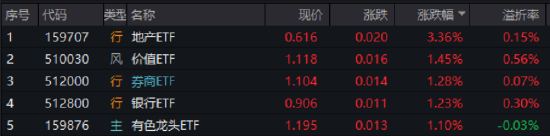
Core Viewpoint - The A-share market has seen a significant rally, with the Shanghai Composite Index breaking through the 3500-point mark, driven primarily by the financial sector, particularly banks and brokerages [1][11]. Financial Sector Performance - The financial sector, including brokerages and banks, has been a major contributor to the market's rise, with the Broker ETF (512000) and Bank ETF (512800) both gaining over 1.2% [1][11]. - The Broker ETF (512000) saw a trading volume of 8.14 billion yuan, indicating active trading [13]. - Major banks, including the four state-owned banks, have reached historical highs, with the Bank ETF (512800) also hitting new records [11][19]. Real Estate Sector Developments - The real estate sector experienced a notable surge, with the Real Estate ETF (159707) rising over 3%, driven by positive sentiment and potential policy support from upcoming government meetings [1][6]. - The Central 800 Real Estate Index, which the Real Estate ETF tracks, has a current price-to-book (PB) ratio of only 0.7, indicating significant room for valuation recovery [8][22]. - Analysts predict that the second half of the year may present strong opportunities for the real estate sector, with various supportive policies expected to be implemented [8][19]. Market Sentiment and Future Outlook - Market analysts suggest that the current environment resembles the bullish sentiment seen at the end of 2014, particularly with the broker sector's performance [5]. - The upcoming political bureau meeting is anticipated to provide further clarity and potential support for the market, particularly in the real estate sector [8][15]. - The overall market is expected to continue its upward trajectory, contingent on further economic recovery and supportive policies [19][23].
4月巨大波动时刻果断出手!陈光明与霍华德·马克斯最新对话谈到很多共识
聪明投资者· 2025-07-10 11:56
Core Viewpoint - The key to investment lies in the ability to objectively assess true value, and when market fluctuations cause prices to deviate from value, investors should capitalize on these fluctuations rather than being swayed by them [1][55][56]. Group 1: Market Sentiment and Investment Strategy - During periods of market volatility, such as the significant fluctuations in April, both Howard Marks and Chen Guangming acknowledged that their institutions actively bought into the market, taking advantage of the opportunity to acquire undervalued assets [2][17][58]. - Chen emphasized the importance of maintaining a calm and courageous approach during turbulent times, focusing on the intrinsic value of companies rather than being influenced by market price movements [19][60]. - Marks highlighted that true returns come from the long-term compounding growth of excellent companies, rather than short-term market predictions driven by emotions [1][64]. Group 2: U.S. Market and Economic Outlook - Marks discussed the current state of the U.S. economy, noting that while it remains vibrant, there are concerns regarding the sustainability of the "American exceptionalism" narrative due to recent policy changes and market volatility [10][12][11]. - He pointed out that the U.S. stock market's total market capitalization represents 50% of the global total, while its GDP accounts for only about 25%, indicating a potential overvaluation from a valuation perspective [5]. - Despite concerns, Marks believes that the U.S. remains a highly attractive destination for investment, with a strong likelihood of continued returns over the coming decades [13][12]. Group 3: China Market Potential - Chen expressed optimism about the Chinese market, suggesting that the recent developments, such as the emergence of DeepSeek, indicate that global investors are beginning to recognize China's long-term growth potential [36][49]. - He noted that the perception of China as an uninvestable market was a classic case of emotional overreaction, and those who maintained their positions during this period have seen positive returns [57][58]. - Chen highlighted that the intrinsic value of Chinese companies has not significantly changed despite market fluctuations, and he believes that the long-term competitiveness of China is on the rise [50][49]. Group 4: Value Investment Principles - Both Marks and Chen emphasized that value investing is a practical science focused on assessing true value, with the principle of buying below intrinsic value to achieve investment returns [52][55]. - Chen pointed out that while the fundamental principles of value investing are universal, the practice may differ across markets due to varying stability and predictability of intrinsic value [53]. - Marks reiterated the importance of focusing on value itself rather than being swayed by market emotions, advocating for a disciplined approach to investing [81][82].
银行股扛旗冲关,沪指重回3500点!这次有何不同?
Ge Long Hui· 2025-07-10 06:53
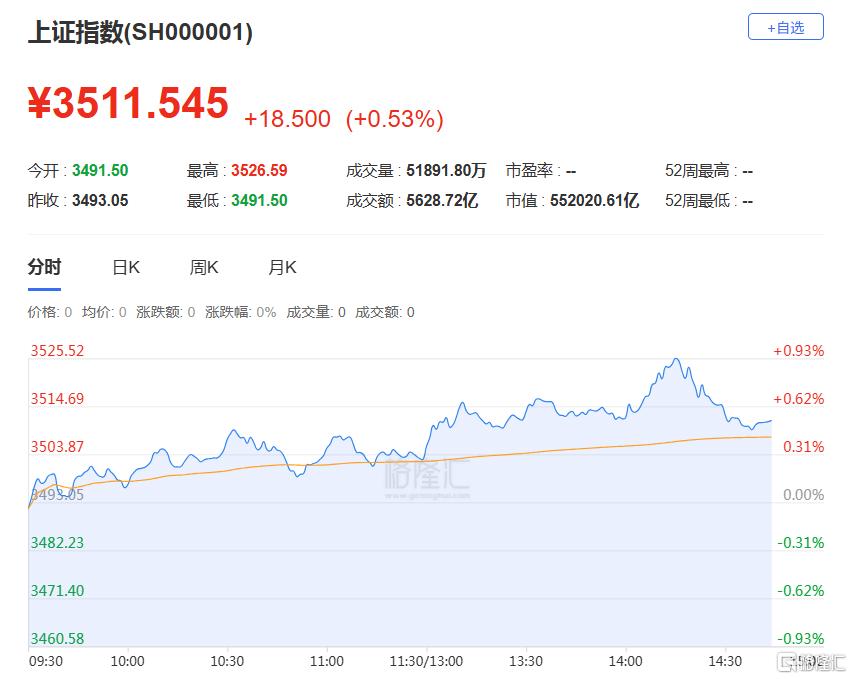
Market Overview - The A-share market has recently reached a critical point, with the Shanghai Composite Index breaking through 3500 points, marking a new high since November 8, 2024, before closing at 3493 points [1] - On the following day, the index rose by 0.53%, closing at 3511.545 points [2] Historical Context - The A-share market has crossed the 3500-point threshold multiple times in the past 15 years, with significant instances in 2007, 2015, 2021, and 2024, each followed by varying market trends [4][5] - The current situation in July 2025 is characterized by a strong market rally, driven by monetary policy stimulus and substantial capital inflows [4] Market Drivers - Unlike previous surges, the current breakthrough is primarily driven by heavyweight stocks, particularly in the financial sector, with major banks reaching historical highs [6] - The banking sector index has shown a remarkable increase of over 60% in 2024, outperforming the Nasdaq's 38% rise during the same period [6] Volume and Support - The trading volume during the recent breakthrough has not reached historical highs, with the market's trading volume at 1.5 trillion yuan, significantly lower than the 3.45 trillion yuan recorded on October 8, 2024 [9] - This indicates a lack of sufficient volume support for the current breakthrough, raising questions about its sustainability [9] Policy and Industry Trends - The recent market movements are supported by positive policy signals, including tax incentives for foreign investors and regulations aimed at guiding funds towards value investments [10] - The technology sector has emerged as a key focus, with government policies encouraging investment in advanced manufacturing and digital economy sectors [11] Market Response to Policies - The market has shown a notable response to "anti-involution" policies, particularly in the photovoltaic industry, which has shifted from price competition to technology competition [12] - This contrasts with the previous market dynamics observed during the October 2024 breakthrough, where macroeconomic policies were the primary focus [12] Institutional Perspectives - Various securities institutions suggest that the market is currently in a bullish cycle, but caution against short-term volatility risks [14] - Analysts emphasize the importance of fundamental improvements for sustained market growth, with a focus on sectors like military, new energy, and AI-related industries [14]
ETF盘中资讯|高股息猛攻,银行领涨,价值ETF(510030)大涨1.45%!机构:红利板块有望受到更多资金的青睐
Sou Hu Cai Jing· 2025-07-10 05:39
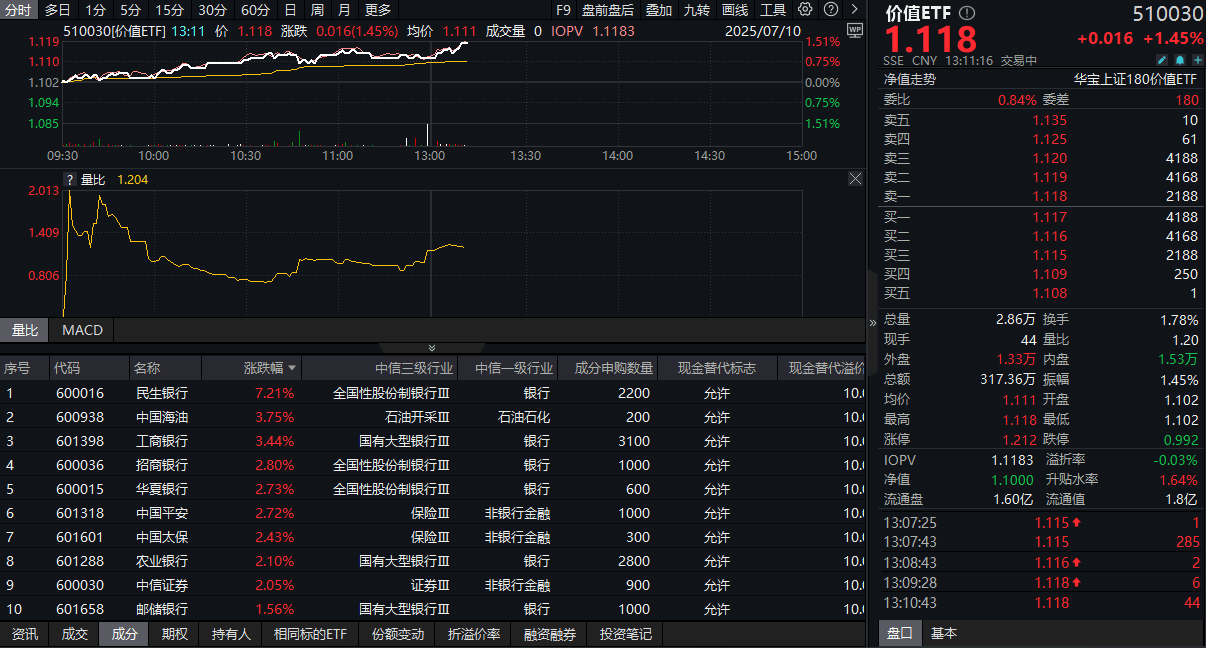
Core Viewpoint - High dividend stocks continue to perform strongly, with a focus on "high dividend + low valuation" large-cap blue-chip stocks in the value ETF (510030), which saw a price increase of 1.45% as of the report time [1]. Group 1: Market Performance - The value ETF (510030) opened with fluctuations and rose by 1.45%, with a trading price of 1.119 as of 13:11 [2]. - The 180 Value Index has outperformed major A-share indices, with a year-to-date increase of 7.44%, compared to the Shanghai Composite Index's 4.22% and the CSI 300 Index's 1.44% [3][4]. Group 2: Stock Performance - Key stocks in the banking and non-banking financial sectors showed significant gains, with Minsheng Bank soaring over 7%, and China National Offshore Oil Corporation and Industrial and Commercial Bank of China both rising over 3% [1]. - Other notable stocks included China Ping An, China Merchants Bank, and Huaxia Bank, each increasing by over 2% [1]. Group 3: Investment Insights - The current valuation of the 180 Value Index is at a price-to-book ratio of 0.85, indicating a favorable long-term investment opportunity [4]. - Analysts suggest that in the current uncertain global environment, investors may prefer dividend assets due to their stable cash flow and high dividend yields, which are expected to attract more capital in the medium to long term [4][5].






中证价值指数,投资价值如何?|第393期精品课程
银行螺丝钉· 2025-07-09 19:20
Core Viewpoint - The article discusses the historical performance and current valuation of the China Securities Value Index, its suitability for investment, and available index funds for investors [1]. Group 1: Index Types - A-shares indices are categorized into four main types: broad-based indices, strategy indices, industry indices, and thematic indices [5][6][7][8][9]. - Strategy indices are built on broad-based indices and utilize specific investment strategies, catering to diverse investor needs [7]. - Industry indices focus on stocks within specific sectors, while thematic indices relate to specific themes like technology and renewable energy [8][9]. Group 2: Value Strategy Indices - The article highlights six mainstream strategies within value indices, including low volatility, growth, and quality strategies, with a focus on the value strategy originating from Benjamin Graham [10][12]. - Common value strategy indices include the CSI 300 Value Index, which selects stocks based on low price-to-earnings and price-to-book ratios [11][12]. Group 3: China Securities Value Index - The China Securities Value Index, established on December 8, 2017, selects 100 stocks with low valuations and a historical return on equity (ROE) of at least 12% [15][16][17]. - The index employs an equal-weighting methodology, making it unique among value strategy indices [15]. Group 4: Historical Performance - The China Securities Value Index has outperformed the CSI 300 Index over the long term, with returns of 8.51% compared to the CSI 300's 4.72% from August 2011 to June 2025 [24][25][26]. - The article emphasizes the effectiveness of value investing in the A-share market [25]. Group 5: Valuation Metrics - Historical valuation data indicates that the index's price-to-earnings ratio is generally higher than its price-to-book ratio, suggesting that price-to-book may be a more reliable metric in certain conditions [29][30]. - The article notes that valuation percentiles are just one reference for assessing valuation levels, as value indices consider multiple factors [32]. Group 6: Index Funds - The article mentions that the scale of index funds related to the China Securities Value Index is relatively small, totaling less than 10 billion yuan, which is less than 1% of the A-share stock fund market [38]. - The article also discusses the average price-to-earnings ratios of stocks being added and removed from the index during adjustments [39]. Group 7: Conclusion - The value strategy index, rooted in Graham's principles, has evolved to include quality metrics like ROE to mitigate risks associated with low valuation traps [41]. - The China Securities Value Index has consistently outperformed the CSI 300 Index, reinforcing the long-term viability of value investing in the A-share market [41].