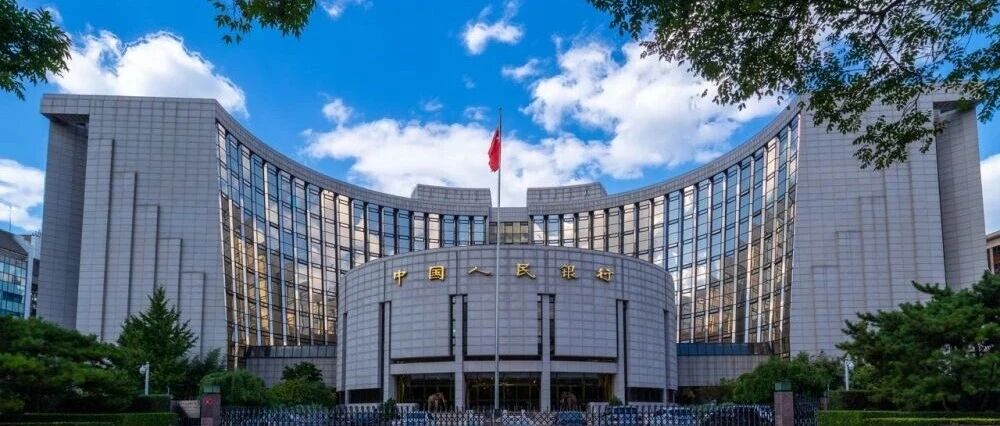
货币政策

Search documents
央行最新发布!前11月社融增量超33万亿,信贷投放提质换挡
Sou Hu Cai Jing· 2025-12-12 11:26
Core Viewpoint - The People's Bank of China reported that the social financing scale increased by 33.39 trillion yuan in the first eleven months of 2025, which is 3.99 trillion yuan more than the same period last year, indicating a supportive monetary policy environment for high-quality economic development [1] Financial Statistics - As of the end of November, the year-on-year growth rate of social financing stock was 8.5%, unchanged from the previous month; M2 growth rate was 8%, down 0.2 percentage points month-on-month; M1 growth rate was 4.9%, down 1.3 percentage points month-on-month [1] - The increase in social financing scale was supported by government bond net financing, corporate bonds, and equity financing [1][3] Government Bonds and Direct Financing - Government bond net financing reached 13.15 trillion yuan in the first eleven months, accounting for nearly 40% of the increase in social financing [3] - The total new government debt for the year was set at 11.86 trillion yuan, an increase of 2.9 trillion yuan from last year, which has positively impacted the social financing scale [3] Credit Quality Improvement - In the first eleven months, RMB loans increased by 15.36 trillion yuan, with a year-on-year growth rate of 6.4% as of the end of November [5] - The growth rates of inclusive small and micro loans and medium to long-term loans for the manufacturing sector were 11.4% and 7.7%, respectively, both higher than the overall loan growth rate [5] Loan Pricing and Economic Indicators - The average interest rate for newly issued corporate loans was approximately 3.1%, down about 30 basis points year-on-year, while the average interest rate for personal housing loans was also around 3.1%, down about 3 basis points year-on-year [6] - The consumer price index (CPI) rose by 0.7% year-on-year in November, while the producer price index (PPI) fell by 2.2% year-on-year but increased by 0.1% month-on-month [6]
【招银研究|政策】开局之年,提质增效——2025年中央经济工作会议学习体会
招商银行研究· 2025-12-12 11:17
Core Viewpoint - The Central Economic Work Conference held on December 10-11, 2025, outlines the economic work for 2026, emphasizing a balanced approach to domestic economic work and international trade, with a focus on expanding domestic demand and optimizing supply to achieve effective qualitative improvement and reasonable quantitative growth [1] Group 1: Work Tone - The conference adopts a pragmatic and positive tone, affirming that the main economic goals for 2025 will be met, with an expected GDP growth rate of 5% [2] - It acknowledges persistent challenges in economic development, including external environmental changes, domestic supply-demand imbalances, and risks in key areas [3] Group 2: Macroeconomic Policy - The macroeconomic policy will maintain strength and enhance effectiveness, with a focus on both existing and new policies [5] - Fiscal policy will be more proactive, with a projected fiscal deficit rate of 4% for 2026, corresponding to a deficit scale of 5.85 trillion, an increase of 190 billion from 2025 [7] - Monetary policy will remain moderately loose, prioritizing economic stability over inflation, with expectations for a 50 basis point reduction in reserve requirement ratios [9] Group 3: Key Work Areas - The conference identifies eight key work areas, with "expanding domestic demand" as the top priority, focusing on increasing residents' income and optimizing supply [10] - Innovation-driven policies will see significant changes, including the establishment of a comprehensive education and technology talent development plan [12] - Emphasis on green transformation and addressing risks in key areas, particularly in real estate and local government debt [14][15]


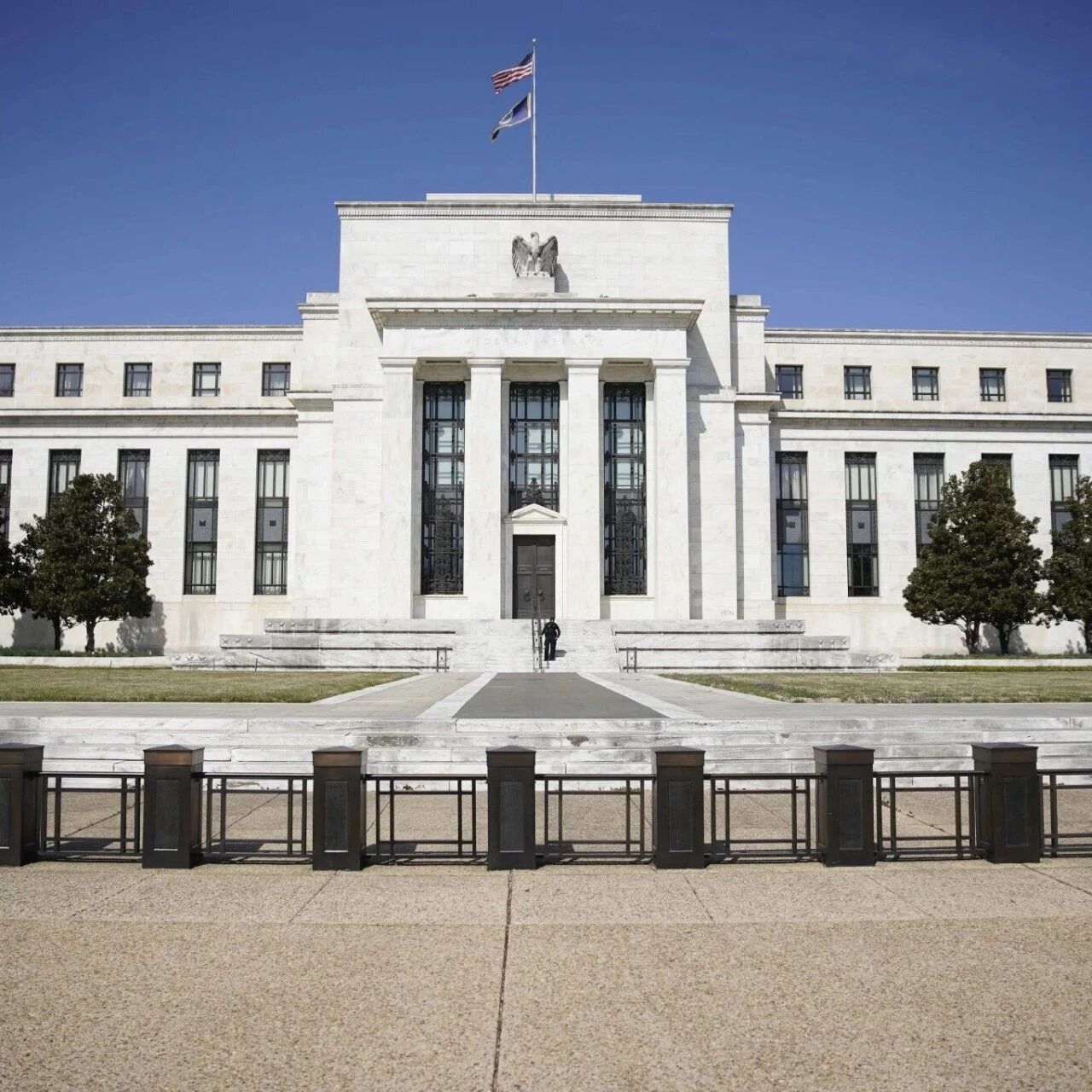
美联储决议全文:降息25个基点,30天内购买400亿国库券
美股研究社· 2025-12-12 11:07
Core Viewpoint - The Federal Reserve has lowered the benchmark interest rate by 25 basis points to a range of 3.50%-3.75%, marking the third consecutive meeting of rate cuts, while also indicating a cautious approach to future monetary policy adjustments [4][6]. Group 1: Interest Rate Decision - The Federal Reserve's decision to cut the federal funds rate is based on a moderate expansion of economic activity, a slowdown in job growth, and rising unemployment rates [6][7]. - The long-term goal remains to achieve maximum employment and a 2% inflation rate, with the committee acknowledging increased risks to employment in recent months [6][7]. - The median dot plot indicates a cumulative rate cut of 25 basis points by 2026 [10]. Group 2: Asset Purchases - The Federal Reserve plans to purchase $40 billion in Treasury securities over the next 30 days to maintain adequate reserve supply [5][21]. - This move is a response to recent volatility in the short-term lending market, which is crucial for the overall financial system [22]. - The expansion of the balance sheet is not part of an economic control strategy but aims to alleviate pressure in the repurchase market by increasing banks' access to reserves [22][23]. Group 3: Economic Outlook and Data Monitoring - Economists express concerns about the potential for rising unemployment and inflation, with upcoming employment data expected to influence future policy decisions [17][18]. - The Federal Reserve is closely monitoring inflation indicators, with the current key inflation metric at 2.8%, above the target of 2% [20]. - The committee is prepared to adjust monetary policy as necessary based on evolving economic conditions and risks [6][21].
11月金融数据出炉:贷款增速趋势性放缓 政府部门加杠杆支撑社融增长
Di Yi Cai Jing· 2025-12-12 11:04
12月12日,央行发布最新数据,M2和社会融资规模增速均保持在较高水平,持续为经济回升向好创造 适宜的货币金融环境。 具体来看,11月末,广义货币(M2)余额336.99万亿元,同比增长8.0%,比上年同期高0.9个百分点, 在上年同期基数提高的背景下,仍保持较高增速;社会融资规模存量440.07万亿元,同比增长8.5%,比 上年同期高0.7个百分点;1-11月,社会融资规模增量为33.39万亿元,同比多3.99万亿元。 综合融资成本持续维持在低位,充分体现了适度宽松的货币政策状态。第一财经从央行获悉,贷款利率 保持在低位水平。11月份企业新发放贷款(本外币)加权平均利率约为3.1%,比上年同期低约30个基 点;个人住房新发放贷款(本外币)加权平均利率约为3.1%,比上年同期低约3个基点。 政府加杠杆支撑社融增长 随着财政赤字率提升,政府债券对社会融资规模的贡献度明显提高。 初步统计,2025年前11个月,社会融资规模增量累计为33.39万亿元,比上年同期多3.99万亿元。其中, 政府债券净融资13.15万亿元,同比多3.61万亿元。 业内专家表示,今年以来,宏观政策加大逆周期调节力度,对提振内需、稳定经济发 ...
央行最新发布!前11月社融增量超33万亿,信贷投放提质换挡
券商中国· 2025-12-12 10:57
12月12日,中国人民银行发布的最新金融统计数据报告显示,经初步统计,2025年前11个月社会融资规模 增量累计为33.39万亿元,比上年同期多增3.99万亿元。11月末,社融存量的同比增速为8.5%,与上月持 平;广义货币(M2)增速8%,环比下降0.2个百分点;反映资金活化程度的狭义货币(M1)增速为4.9%, 环比下降1.3个百分点。 从金融总量表现看,11月末社会融资规模存量、M2增速均保持不低于8%的较高增速水平。"这充分体现了适 度宽松的货币政策状态,为经济高质量发展营造了适宜的金融总量环境。"业内专家表示,今年以来,宏观政 策加大逆周期调节力度,对提振内需、稳定经济发挥了积极作用,也为金融总量合理增长提供了支撑。 11月末,社融规模增量保持较快增长,政府债券净融资、企业债券、股权融资等继续发挥支撑作用;信贷投 放"提质换挡",普惠小微贷款、制造业中长期贷款、科技贷款继续较快增长,增速持续高于全部贷款增速。 只看贷款增长情况越来越难以完整反映金融支持实体经济的成效。前述业内专家表示,社会融资成本低位运 行,说明实体经济融资需求被合理满足;重点领域信贷投放占比提升,说明金融资源供给与实体经济高质量发 ...

央行11月重要金融数据一览:M2同比增长8%,前11个月社融规模增量超去年全年
Sou Hu Cai Jing· 2025-12-12 10:20
Core Viewpoint - The People's Bank of China (PBOC) released the financial data report for November 2025, indicating a moderate growth in monetary supply and social financing, reflecting a moderately accommodative monetary policy [1]. Group 1: Monetary Supply - As of the end of November, the M2 balance reached 336.99 trillion yuan, showing a year-on-year growth of 8%, which is a decrease of 0.2 percentage points from the previous month [1]. - The M1 balance stood at 112.89 trillion yuan, with a year-on-year increase of 4.9%, down 1.3 percentage points from the previous month [1]. - M0 experienced a year-on-year growth of 10.6% [1]. Group 2: Social Financing and Deposits - The cumulative increase in social financing for the first eleven months of 2025 was 33.39 trillion yuan, which is 3.99 trillion yuan more than the same period last year [1]. - In 2024, the total increase in social financing was 32.26 trillion yuan [1]. - During the first eleven months, the increase in RMB deposits was 24.73 trillion yuan, while RMB loans increased by 15.36 trillion yuan [1].
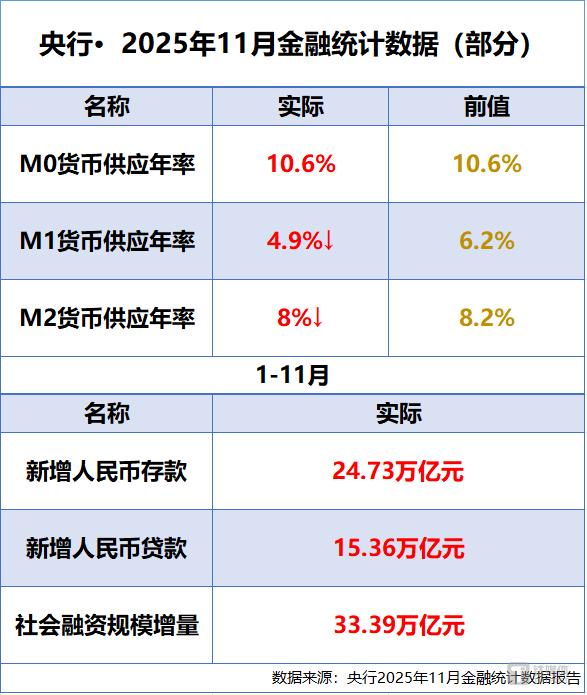
央行最新发布!前11月社融增量超33万亿元!
Sou Hu Cai Jing· 2025-12-12 10:20
Group 1 - The core viewpoint of the article highlights that the social financing scale in China has shown significant growth, with a cumulative increase of 33.39 trillion yuan in the first eleven months of 2025, which is 3.99 trillion yuan more than the same period last year [1] - The year-on-year growth rate of social financing stock was 8.5% at the end of November, maintaining a high growth level, reflecting a moderately loose monetary policy environment conducive to high-quality economic development [1][4] - Government bond net financing and direct financing have been key drivers of social financing growth, with government bond net financing reaching 13.15 trillion yuan, accounting for nearly 40% of the social financing increment [4] Group 2 - The increase in loans has been significant, with a total of 15.36 trillion yuan in new RMB loans in the first eleven months, and the loan balance growth rate at 6.4% at the end of November [7] - The structure of loans shows that inclusive small and micro loans and medium to long-term loans for manufacturing have grown at rates higher than the overall loan growth, indicating increased support for key sectors [7] - The average interest rate for new loans remained at historical low levels, with corporate loans at approximately 3.1%, which is about 30 basis points lower than the same period last year [8] Group 3 - The article notes that the recent macroeconomic policies have effectively promoted a reasonable rebound in prices, with the Consumer Price Index (CPI) rising by 0.7% year-on-year in November [10] - The Producer Price Index (PPI) showed a year-on-year decline of 2.2% but a month-on-month increase of 0.1%, indicating a potential stabilization in price trends [10] - Experts suggest that the long-term conditions for economic growth remain strong, and the monetary and financial conditions are relatively loose, supporting a return of prices to reasonable levels [10]
政策工具箱丰富 央行“组合拳”呵护流动性
Jin Rong Shi Bao· 2025-12-12 10:19
Group 1 - The core viewpoint of the articles emphasizes that China's banking system liquidity remains abundant, which is crucial for stabilizing the macroeconomic landscape and ensuring the healthy operation of financial markets [1] - The People's Bank of China (PBOC) has established a comprehensive set of liquidity management tools to effectively respond to short-term fluctuations caused by fiscal policies and government bond issuances, maintaining overall stability in the money market [1][2] - Recent innovations in liquidity management tools, such as including government bond trading in the monetary policy toolkit and creating two new monetary policy tools to support the capital market, are expected to enhance the effectiveness of liquidity management in China [1] Group 2 - Internationally, central banks utilize various tools for liquidity management, which can be categorized into four levels: intraday liquidity support, daily liquidity supply, temporary liquidity supply, and structural liquidity supply [2] - China's liquidity tool system aligns with the mainstream frameworks in Europe and the U.S., reflecting both international practices and domestic market realities [3] - The management logic of China's liquidity tools is consistent with international practices, focusing on banking institutions as counterparties and using high liquidity, low-risk assets like government bonds for collateral [3]
连续7月加量呵护,权威专家详解央行流动性管理“新范式”
Di Yi Cai Jing· 2025-12-12 10:18
Core Viewpoint - China's liquidity tool system is now relatively complete, covering the range of internationally accepted liquidity tools [1][4] Group 1: Recent Central Bank Actions - On December 12, the People's Bank of China announced a 600 billion yuan reverse repo operation with a six-month term, set to take place on the 15th [1] - This operation represents a net increase of 200 billion yuan, as 400 billion yuan of six-month reverse repos are maturing in December [1] - Earlier, on December 5, the central bank conducted a 1 trillion yuan reverse repo operation for three months, indicating a continuation of liquidity injection for the seventh consecutive month [1] Group 2: Liquidity Management Tools - The central bank has innovated its tools significantly, including incorporating government bond trading into its monetary policy toolbox and creating two new monetary policy tools to support the capital market [2] - Liquidity management tools can be categorized into four levels: 1. Intraday liquidity support for temporary funding needs [2] 2. Daily liquidity supply through regular open market operations [2] 3. Temporary liquidity supply for emergencies, priced above market rates [2] 4. Structural liquidity supply for medium to long-term funding needs [2] Group 3: Comparison with International Standards - China's liquidity tool system aligns with mainstream frameworks in Europe and the U.S., with tools corresponding to international classifications [3] - The management logic of these tools is also consistent with international practices, focusing primarily on banking financial institutions [4] - The pricing of the standing lending facility (SLF) is slightly above the policy rate to balance market demand and prevent excessive reliance on central bank funding [4]
央行最新发布!前11月社融增量超33万亿元!
证券时报· 2025-12-12 10:09
最新发布。 12月12日,中国人民银行发布的最新金融统计数据报告显示,经初步统计,2025年前11个月社会融资(社融)规模增量累计为33.39万亿元,比上年同期多增3.99万 亿元。11月末,社融存量的同比增速为8.5%,与上月持平;广义货币(M2)增速8%,环比下降0.2个百分点;反映资金活化程度的狭义货币(M1)增速为4.9%, 环比下降1.3个百分点。 从金融总量表现看,11月末社会融资规模存量、M2增速均保持不低于8%的较高增速水平。"这充分体现了适度宽松的货币政策状态,为经济高质量发展营造了适宜 的金融总量环境。"业内专家表示,今年以来,宏观政策加大逆周期调节力度,对提振内需、稳定经济发挥了积极作用,也为金融总量合理增长提供了支撑。 11月末,社融规模增量保持较快增长,政府债券净融资、企业债券、股权融资等继续发挥支撑作用;信贷投放"提质换挡",普惠小微贷款、制造业中长期贷款、科 技贷款继续较快增长,增速持续高于全部贷款增速。 只看贷款增长情况越来越难以完整反映金融支持实体经济的成效。前述业内专家表示,社会融资成本低位运行,说明实体经济融资需求被合理满足;重点领域信贷 投放占比提升,说明金融资源供给与 ...