稳定币

Search documents
稳定币行业动态追踪:香港确立稳定币监管主线,有望进一步助力人民币国际化进程
Yuan Da Xin Xi· 2025-07-04 09:25
Investment Rating - The industry investment rating is "Positive" [5] Core Insights - The global stablecoin market is expected to grow explosively from a market cap of $3.95 billion in 2019 to $230.7 billion by 2025, with a compound annual growth rate (CAGR) of 97.0% [11][12] - USDT and USDC dominate the market, holding approximately 86.8% of the total market share, with USDT projected to reach a market cap of $150.3 billion by 2025 and USDC expected to grow to $60.8 billion [11][12] - Hong Kong has established a regulatory framework for stablecoins, which includes licensing, full reserves, timely redemption, strict auditing, and anti-money laundering (AML) measures [17][20] - The introduction of a stablecoin sandbox by the Hong Kong Monetary Authority (HKMA) allows institutions to test their operational plans in a controlled environment [21] Summary by Sections Mainstream Stablecoin Mechanisms and Market Size - USDT and USDC are the two main stablecoins in the U.S., with market shares of 61.3% and 25.5% respectively [8][10] - The market cap of USDT is expected to reach $150.3 billion by 2025, while USDC is projected to grow to $60.8 billion, benefiting from its transparency in reserves [11][12] Hong Kong's Stablecoin Regulation Framework - The U.S. Senate passed the GENIUS Act on June 17, 2024, establishing a regulatory framework for stablecoins, which includes full backing by liquid assets and annual audits for issuers with a market cap over $50 billion [17][18] - Hong Kong's Stablecoin Ordinance was enacted on May 30, 2025, focusing on licensing, reserve management, and compliance with AML and counter-terrorism financing (CFT) regulations [20] Potential for RMB Internationalization - The HKMA's stablecoin sandbox allows for testing in various applications, including payments and supply chain management [21] - Stablecoins offer advantages in cross-border payments, such as low costs and fast transaction speeds, which could enhance the international use of the RMB [25][28]
港股收盘 | 恒指收跌0.64%失守两万四 创新药、光伏股走高 阿里健康领跌蓝筹
Zhi Tong Cai Jing· 2025-07-04 08:52
Market Overview - The Hong Kong stock market opened lower and fell further, with the Hang Seng Index closing down 0.64% at 23916.06 points, with a total turnover of 267.81 billion HKD [1] - The Hang Seng Index dropped 1.52% over the week, while the Hang Seng China Enterprises Index and the Hang Seng Tech Index fell 1.75% and 2.34%, respectively [1] Blue-Chip Stocks Performance - Alibaba Health (00241) led the decline among blue-chip stocks, falling 6.64% to 4.22 HKD, contributing a loss of 3.04 points to the Hang Seng Index [2] - Alibaba announced the pricing of a zero-coupon exchangeable bond totaling 12 billion HKD, with an initial exchange price of 6.23 HKD per share of Alibaba Health, representing a 48% premium over the hedge placement price [2] - Other notable blue-chip movements included Xinyi Solar (00968) rising 4.73% and AIA (01299) falling 4.42% [2] Sector Highlights - Large tech stocks showed mixed performance, with Alibaba and Xiaomi both down over 1%, while Baidu rose 1.48% [3] - Pharmaceutical stocks gained strength, with Rongchang Bio (09995) up 15.01% and several others also showing significant increases [3][4] - The solar energy sector saw a general rise, with Xinyi Energy (03868) up 15% following government support for the industry [5][6] Regulatory and Policy Developments - The National Healthcare Security Administration and the National Health Commission issued measures to support the high-quality development of innovative drugs, including 16 specific initiatives [4] - Citigroup anticipates multiple catalysts for the innovative drug and biotechnology sector by the second half of 2025, including commercial collaborations and favorable pricing environments [4] Cryptocurrency and Stablecoin Trends - The stablecoin sector continued to gain traction, with Guotai Junan International (01788) rising 10.62% as the Hong Kong Monetary Authority prepares to accept license applications for stablecoin operations [6] - The market for stablecoins is expected to expand beyond cryptocurrency trading into broader payment applications, enhancing market scale and trading activity [6] Gold Stocks Performance - Gold stocks experienced weakness, with notable declines in companies like Tongguan Gold (00340) and China Gold International (02099) [7] - Strong U.S. non-farm payroll data has diminished expectations for interest rate cuts, impacting gold prices negatively [7] Notable Stock Movements - XPeng Motors (09868) faced pressure, closing down 6.56% despite the launch of its new G7 model [8] - Data center stocks rose, with Global Data (09698) up 6.09%, driven by increasing demand for AI computing power [8] - Jitu Express (01519) saw a significant rise of 5.49%, supported by positive growth forecasts related to its operations with TikTok Shop [9]

7月4日主题复盘 | RWA再度表现,电力大涨,创新药持续活跃
Xuan Gu Bao· 2025-07-04 08:50
Market Overview - The market experienced fluctuations with mixed results across the three major indices, with the Shanghai Composite Index approaching the 3500-point mark [1] - Bank stocks continued to perform strongly, with over ten stocks including CITIC Bank, Shanghai Pudong Development Bank, and Industrial Bank reaching historical highs [1] - The electricity sector saw significant gains, with stocks like Huayin Power, Shaoneng Co., and Shenzhen Nanshan Electric A hitting the daily limit [1] - Stablecoin concepts remained active, with stocks such as Jingbeifang, Xinyada, and Jinyi Culture also reaching the daily limit [1] - In contrast, solid-state battery concept stocks collectively adjusted, with Xinyu falling over 10% [1] - Overall, more than 4100 stocks in the Shanghai and Shenzhen markets declined, with a total trading volume of 1.45 trillion [1] Hot Topics RWA Concept - The RWA concept saw a significant rise, with Jinyi Culture achieving two consecutive limit-ups, and stocks like Hopu Co. and Hangzhou Garden also hitting the limit [4] - According to reports, some public funds' Hong Kong subsidiaries are actively preparing for stablecoin sandbox testing, which includes key aspects such as issuance, payment, and asset connection [4] - Huaxia Fund (Hong Kong) is involved in this initiative, indicating a growing interest in virtual asset-related products [4][6] Electricity Sector - The electricity sector experienced a notable surge, with Huayin Power achieving three limit-ups in four days, and stocks like Shaoneng Co. and Shenzhen Nanshan Electric A also hitting the limit [7] - Reports indicate that a significant heatwave is expected, with temperatures in many regions reaching historical highs, which is likely to increase electricity demand [7] - Huayin Power announced an expected net profit increase of 175 to 215 million yuan for the first half of the year [7] Pharmaceutical Sector - The pharmaceutical sector remained active, with stocks like Saili Medical achieving four consecutive limit-ups, and others like Weixin Kang and Guangsheng Tang also performing well [9] - Global breakthrough clinical data is driving activity in overseas licensing markets, with research results accelerating [9] - The introduction of the first Class B medical insurance directory is expected to further expand the innovative drug market, supported by new policy measures [9]






暴涨超240%!这家港股公司拟拓展人工智能项目
证券时报· 2025-07-04 08:11
Core Viewpoint - The company Japan Kosei (00627.HK) is planning to establish a joint venture to expand into artificial intelligence projects despite facing consecutive losses in its performance, attracting market attention [1][4]. Group 1: Company Performance - Japan Kosei reported a revenue of 99.7 million yuan in 2024, a year-on-year decline of 59.86% [6]. - The company experienced a net loss attributable to shareholders of 852 million yuan, compared to a loss of 489 million yuan in the previous year [6]. - The board aims to focus on high-potential real estate and land development projects in China and Japan, including undervalued urban redevelopment projects and logistics hubs [6]. Group 2: Joint Venture and Market Reaction - On July 3, Japan Kosei signed a memorandum of understanding with Beijing Yihe Dream Digital Technology Co., Ltd. to explore a potential joint venture in artificial intelligence [4]. - Following the announcement, Japan Kosei's stock price surged, reaching a peak of 1.58 HKD per share, with a maximum increase of over 240% and total trading volume exceeding 3.6 million HKD [3][4]. - The collaboration aims to leverage both companies' competitive advantages and resources to establish a mutually beneficial partnership, potentially diversifying revenue sources and achieving sustainable business growth [5].

“越不服气它就越涨!”浦发、上海、中信银行等多只千亿巨头历史新高!这波行情还能涨多久?
雪球· 2025-07-04 07:55
Market Overview - The Shanghai Composite Index rose slightly by 0.32%, while the Shenzhen Component Index fell by 0.25%, and the ChiNext Index decreased by 0.36%. The North Star 50 Index dropped by 1.08%. The total market turnover was 14,545 billion, an increase of 1,210 billion from the previous day, with over 4,100 stocks declining [1]. Banking Sector Performance - The banking sector showed strong performance, with stocks like Pudong Development Bank, Shanghai Bank, and Jiangsu Bank reaching historical highs. Pudong Development Bank has seen a cumulative increase of 42% this year, with a market capitalization of 442.7 billion [2][4]. - Analysts from Donghai Securities noted that risks in key areas such as real estate and small banks have been effectively mitigated, and the dividend stability of listed banks is promising. The ongoing decline in risk-free interest rates continues to attract long-term funds to bank stocks, which maintain a dividend yield above 4% [7]. User Sentiment on Banking Stocks - Users on the Xueqiu app expressed mixed views on the rising bank stocks. Some believe that the ability to invest in bank stocks depends on individual investment strategies, with value investors encouraged to buy during price corrections [8][9]. - There is a sentiment that despite the significant rise in bank stocks, many still trade below their book value, indicating potential for further appreciation. The decline in risk-free rates has led to increased interest from insurance and social security funds in bank stocks [9][10]. Steel and Renewable Energy Sectors - The steel market remains active, with companies like Liugang and Lingang Steel experiencing significant price increases. The current market is characterized by low inventory, low prices, and high supply elasticity, with future trends dependent on production cuts and policy implementation [11][17]. - The photovoltaic sector is also highlighted, with the Ministry of Industry and Information Technology emphasizing the need for quality improvement and the orderly exit of outdated capacity in the industry [14]. Stablecoin Sector Growth - Stablecoin-related stocks have seen a resurgence, with Guotai Junan International experiencing a peak increase of 27% this year, reflecting a cumulative rise of 287% [17][21]. - The recent announcement of a new regulatory framework for stablecoins in Hong Kong is expected to open up significant market opportunities, with several companies planning to apply for stablecoin licenses [20][21].

收评:沪指冲高回落涨0.32% 银行股再度走强
Xin Hua Cai Jing· 2025-07-04 07:35
Market Overview - The market experienced fluctuations with major financial stocks rising, leading to a peak in the Shanghai Composite Index, which reached 3472.32 points, up 0.32% at close, with a trading volume of 567.2 billion [1] - The Shenzhen Component Index closed at 10508.76 points, down 0.25%, with a trading volume of 861.3 billion, while the ChiNext Index ended at 2156.23 points, down 0.36%, with a trading volume of 420.5 billion [1] Sector Performance - The banking sector saw significant gains, with stocks like Shanghai Pudong Development Bank hitting historical highs [2] - Stablecoin concept stocks rebounded, with companies like Jingbeifang reaching the daily limit [2] - Power stocks remained active, with Huayin Power also hitting the daily limit [2] - In contrast, solid-state battery stocks faced corrections, with Xinyu Ren dropping over 10% [2] Institutional Insights - Jifeng Investment noted that the market is in a structural phase, with resistance above and support below, suggesting a potential breakthrough of 3500 points if certain economic conditions are met [4] - Jirong Asset highlighted the recent market uptrend as indicative of a mid-term bull market, emphasizing the importance of mid-cap and growth sectors [4] - CITIC Securities projected a continued downtrend in the coal industry, with expectations of a bottoming out in coal prices and potential for excess returns from leading and undervalued companies [4] Foreign Investment Trends - Morgan Stanley reported a net inflow of $1.2 billion from foreign long funds into Chinese stocks in June, ending a two-month outflow streak [8] - Passive funds saw a net inflow of $2.7 billion, nearly double that of May, while active funds continued to experience outflows totaling $1.6 billion [8] - The most increased allocations in the second quarter were in Alibaba and Trip.com, while Meituan and Haier Smart Home saw the largest reductions [8]
电话会议纪要
CMS· 2025-07-04 07:33
Macro Outlook - The US is expected to gradually clarify its trade, fiscal, and monetary policies in Q3 2025 after significant fluctuations in H1 2025[2] - The US inventory cycle is likely to shift towards active destocking in Q2 2025 due to the permanent impact of tariffs on trade relations with China[2] - The capital expenditure cycle is anticipated to enter a downward phase in H2 2025, with a slight decline in overall capital expenditure in 2024 compared to 2023[3] Equity Market Insights - The US stock market has shown a recovery since mid-April 2025, with ongoing upward momentum supported by advancements in artificial intelligence and favorable legislation[3] - The total market capitalization of US stocks accounted for 60% of global equity market capitalization by the end of 2024, indicating a high concentration risk[7] - A shift towards a weaker dollar is expected, which may alleviate the concentration of US assets globally and reduce the risk of asset bubbles[7] A-Share Market Strategy - In July 2025, the A-share market is likely to experience upward index breakthroughs, with technology and non-bank sectors expected to outperform[8] - The median increase in individual stock prices has reached 8.5% in 2025, contributing to a positive market sentiment[9] - The upcoming earnings reports are anticipated to provide upward momentum for A-shares, particularly in technology, consumption, and midstream manufacturing sectors[12] Fixed Income Market Outlook - The bond market is expected to remain in a friendly environment due to low inflation and balanced supply-demand dynamics, with a focus on local government bonds[16][18] - The yield on 10-year government bonds peaked at 1.9% in March 2025 and has since fluctuated, indicating a cautious outlook for interest rates[15] Real Estate Market Trends - New home sales in 39 cities have seen a year-on-year decline of 14% as of late June 2025, indicating ongoing challenges in the housing market[26] - The average price of land transactions has increased by 31% despite a 7% drop in transaction volume, highlighting a divergence in market dynamics[27] - The overall inventory cycle for unsold properties has lengthened, suggesting a need for policy adjustments to stimulate demand[28]

稳定币引发全球金融主导权博弈
Guo Ji Jin Rong Bao· 2025-07-04 07:31
Core Insights - The implementation of the "Stablecoin Regulation Draft" in Hong Kong and the passage of the "Genius Act" in the U.S. Senate signify a growing global focus on stablecoin policies, potentially leading to more countries adopting similar innovations [1][15][16] - Stablecoins are emerging as a significant force in the digital currency landscape, with their unique attributes allowing for stability and efficiency in transactions compared to traditional fiat currencies [3][4][5] Regulatory Developments - Hong Kong's stablecoin regulation will take effect on August 1, while the U.S. "Genius Act" is awaiting a vote in the House of Representatives before being signed by President Trump [1] - The European Union and other regions are also working on stablecoin regulations, aiming to redefine the digital financial order [15][16] Market Growth - The stablecoin market has experienced explosive growth, with total market capitalization rising from $20 billion five years ago to $260 billion currently, and projections suggest it could reach $400 billion by the end of 2025 [6] - Over 95% of stablecoins are currently dollar-pegged, highlighting the dominance of U.S. dollar stablecoins in the market [5][17] Technological Advantages - Stablecoins leverage blockchain technology, providing decentralized features that enhance transaction speed and reduce costs, with cross-border payments being completed in minutes compared to traditional methods that can take days [4][10] - The unique mechanism of stablecoins allows for flexible supply adjustments based on market demand, distinguishing them from traditional cryptocurrencies like Bitcoin [4][5] Application Scenarios - Stablecoins are increasingly used in various applications, including cross-border trade settlements, daily payments, and decentralized finance (DeFi) innovations, with annual transaction volumes reaching $28 trillion [9][10] - They serve as a crucial bridge between traditional finance and digital assets, facilitating liquidity and risk management in the cryptocurrency market [11][12] Competitive Landscape - Major financial institutions and tech companies are entering the stablecoin space, with firms like JPMorgan, PayPal, and various banks in Brazil and the UAE exploring their own stablecoin offerings [13] - The competition is intensifying as traditional and new financial players seek to capitalize on the growing demand for stablecoins [13] Global Financial Dynamics - The U.S. aims to maintain its dominance in the global currency system through the promotion of dollar stablecoins, which are expected to play a critical role in international trade and payments [16][18] - China's initiatives, including the issuance of a digital yuan and stablecoin regulations, indicate a strategic move to enhance the internationalization of the renminbi [18][19]
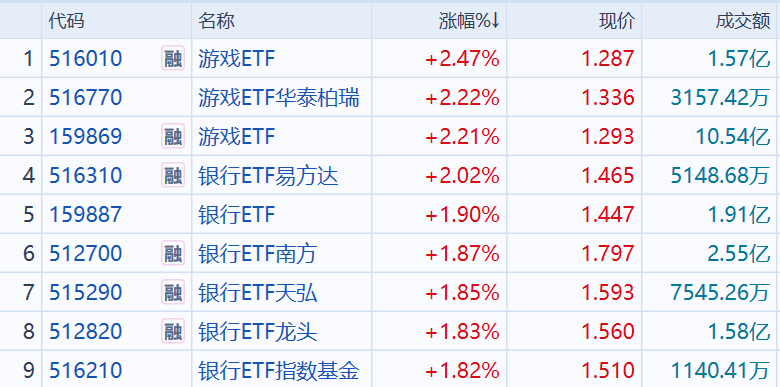
ETF收评:游戏ETF领涨2.47%,稀有金属ETF领跌1.81%
news flash· 2025-07-04 07:04
Market Overview - The three major A-share indices showed mixed results, with the Shanghai Composite Index rising by 0.32%, while the Shenzhen Component Index and the ChiNext Index fell by 0.25% and 0.36% respectively [1] - The total market turnover reached 14,545 billion, an increase of 1,210 billion compared to the previous day [1] - Over 4,100 stocks in the market experienced declines [1] Sector Performance - Sectors such as cross-border payments, banking, gaming, electricity, steel, and innovative pharmaceuticals saw the highest gains [1] - Conversely, sectors like solid-state batteries, non-ferrous metals, beauty care, and wind power equipment faced the largest declines [1] ETF Performance - The gaming ETFs led the gains, with the following performances: - Gaming ETF (516010) up by 2.47% with a turnover of 157 million - Gaming ETF Huatai-PB (516770) up by 2.22% with a turnover of 31.57 million - Gaming ETF (159869) up by 2.21% with a turnover of 1,054 million [2] - Other notable ETFs included: - Banking ETFs also showed positive performance, with the top performer being Banking ETF (516310) up by 2.02% [2] Regulatory Developments - The Hong Kong Financial Secretary announced that the "Stablecoin Regulation" will take effect on August 1, allowing the Hong Kong Monetary Authority to start accepting license applications [2] - Several companies have expressed intentions to apply for stablecoin licenses, indicating a growing interest in this market segment [2] Industry Trends - Open-source Securities reported that stablecoins are entering a "singularity" moment, with their application expanding from cryptocurrency trading to broader payment scenarios, leading to rapid growth in market size and trading activity [3]
刚刚!股市异动!发生了什么?
券商中国· 2025-07-04 07:02
Core Viewpoint - The surge in Chinese brokerage stocks in Hong Kong is attributed to the upcoming implementation of the stablecoin regulations, which has led to increased interest and investment in the sector [1][3][4]. Group 1: Market Performance - Chinese brokerage stocks in Hong Kong experienced a significant rally, with gains exceeding 7% in the afternoon session, including a rise of over 23% for Guotai Junan International and over 10% for Hongye Futures [1][3]. - In the A-share market, stocks such as Xiangcai Securities and Tianfeng Securities also saw substantial increases, with Jingbeifang hitting the daily limit and other fintech stocks showing strong performance [1][3]. - The overall market indices reflected this bullish sentiment, with the Shanghai Composite Index rising by 0.9% and the Shenzhen Component Index increasing by over 0.4% [3]. Group 2: Stablecoin Developments - The stablecoin sector is experiencing a pivotal moment, with applications expanding from cryptocurrency trading to broader payment scenarios, leading to rapid growth in market size and trading activity [2]. - Several companies are preparing to apply for stablecoin licenses in Hong Kong, with the regulatory framework set to take effect on August 1 [1][4]. - Notable developments include Multi-Point Intelligence's announcement of plans to apply for a stablecoin license and collaborate with HashKey Group to offer stablecoin payment services, resulting in a stock surge of 25% [3]. Group 3: Stablecoin Characteristics and Market Dynamics - Stablecoins are defined as cryptocurrencies that peg their market value to external references, such as fiat currencies or specific assets, addressing key pain points in the cryptocurrency market [5][6]. - The demand for stablecoins arises from the need to solve two major trading issues: the lack of fiat currency inflow and outflow channels and the high volatility of Bitcoin, making stablecoins more suitable for everyday transactions [6]. - Stablecoins can be categorized into three types based on their stabilization methods: fully collateralized, multi-asset over-collateralized, and algorithmically adjusted [7]. Group 4: Future Outlook - The market for stablecoins is expected to grow significantly, with projections indicating a total market value of $253.6 billion by June 30, 2025, with fiat-collateralized stablecoins, particularly USD-pegged ones, dominating the market [7]. - The integration of stablecoins into decentralized finance (DeFi), cross-border payments, and other financial applications is anticipated to accelerate, especially as regulatory frameworks evolve [6][8].