传统消费

Search documents
行业年度策略报告:新兴需求领航,传统消费破局-20251213
Ping An Securities· 2025-12-13 08:08
Group 1 - The core viewpoint of the report emphasizes that emerging demand is leading the way, while traditional consumption is breaking through. The year 2026, as the start of the 14th Five-Year Plan, is expected to see continued implementation of consumption stimulus policies, effectively releasing residents' consumption willingness and promoting a steady recovery in consumption demand [4][11] - The report suggests that the traditional consumption industry is likely to experience a rebound, while new demands such as "new products, new channels, and new business formats" will continue to drive the rapid development of new consumption [4][11] - The report highlights the importance of the 14th Five-Year Plan, which emphasizes the need to stimulate consumption and enhance domestic demand as a key driver of economic growth [11][12] Group 2 - In the textile and media sectors, new demand is leading to new supply, and new supply is creating new demand. The report recommends focusing on investment opportunities in three segments: outdoor sports, gold jewelry, and cultural and trendy IP in 2026 [4][30] - The outdoor sports segment is identified as a growing trend, with social aspects becoming increasingly important for young consumers. The report notes that outdoor activities such as cycling, hiking, and climbing are gaining popularity [32][33] - The gold jewelry market is expected to see continued growth in consumer spending, with a positive outlook for retail sales in 2026. The report suggests focusing on leading gold jewelry brands [32][33] Group 3 - The social services sector is evolving, with a focus on leading companies that actively respond to changes in consumer demand. The report indicates that tourism and beauty industries are experiencing changes, with a shift towards rational consumption and a focus on value for money [4][30] - The food and beverage sector is expected to stabilize, with signs of recovery emerging. The report notes that the industry is closely tied to macroeconomic conditions and consumer income expectations [4][30] - The agricultural, forestry, animal husbandry, and fishery sectors are experiencing a cyclical upturn, particularly in the pig farming segment, which is expected to stabilize due to policy-driven transformations [4][5] Group 4 - The home appliance industry is characterized by resilience in demand, with policies such as "trade-in for new" supporting consumption. The report suggests looking for structural highlights within the home appliance sector, particularly in high-dividend white goods and rapidly growing new consumption categories [4][5] - The report emphasizes the importance of exploring new consumption trends and adapting to changing consumer preferences, particularly in the context of the ongoing economic recovery [4][5]






福建发布12条惠台政策措施,食品饮料ETF天弘(159736)昨日成交额超1500万元,机构:食品饮料行业明年主线是底部回暖复苏
2 1 Shi Ji Jing Ji Bao Dao· 2025-12-03 01:24
Group 1 - The market experienced fluctuations on December 2, with all three major indices closing lower. The Tianhong Food and Beverage ETF (159736) saw a trading volume exceeding 150 million yuan, with several constituent stocks such as Xiwang Food, Babi Food, and Yanjing Beer rising [1] - The Tianhong Food and Beverage ETF tracks the CSI Food and Beverage Index, focusing on leading stocks in the high-end and sub-high-end liquor sectors, while also covering leading stocks in beverages, dairy, condiments, and beer. The top ten weighted stocks include Moutai, Wuliangye, and Yili [1] - Fujian Province has recently formulated policies to support cross-strait integration development, including measures to assist Taiwanese residents in opening Shaxian snack stores [1] Group 2 - In November, the food and beverage index continued to recover, achieving excess returns compared to the broader market, driven by a shift in market style and a positive CPI growth rate. Within the sector, pre-processed foods, baked goods, and dairy products saw the highest increases [2] - Looking ahead to 2026, the core view is that new consumption will remain sustainable but will experience internal rotation, while traditional consumption is expected to see bottom improvement [2] - Since early 2025, the food and beverage sector has significantly underperformed the broader market due to changes in the consumption environment and market style. However, the sector's fundamentals are at a low point, and the valuation has declined, indicating no need for pessimism. The expectation for 2026 is a recovery in the food and beverage industry, with hopes for resilient consumer spending and increased business activity [2]


视频|中泰国际首席经济学家李迅雷:加大传统消费不现实 聚焦“老龄化”和“新消费”
Xin Lang Cai Jing· 2025-12-02 09:59
Core Insights - The 2025 Analyst Conference highlighted the importance of building a strong domestic market and boosting consumption, which is increasingly influenced by demographic trends such as aging populations and new consumption patterns [1][2]. Group 1: Domestic Market and Consumption - The focus on consumption has shifted from traditional definitions to considerations of aging demographics and emerging consumption trends [2]. - A comparison between China and Western countries shows that China's per capita consumption has surpassed that of Western nations [2]. - The example of the traditional liquor industry illustrates this shift: China's liquor consumption dropped from 15 million tons a decade ago to only 4 million tons now, indicating that relying solely on traditional consumption for growth is unrealistic [2]. - Future consumption stimulation strategies must align with the realities of an aging population and the changing habits of younger consumers [2].
食品饮料股上扬 安记食品、惠发食品涨停
Zheng Quan Shi Bao Wang· 2025-12-02 06:41
Core Viewpoint - The food and beverage sector has shown significant upward momentum, with specific stocks reaching their daily limits and others experiencing notable gains, driven by market style shifts and positive CPI growth [1] Sector Performance - As of November, the food and beverage index has been recovering, outperforming the broader market due to a change in market style and a positive CPI growth rate [1] - Within the sector, pre-processed foods, baked goods, and dairy products have seen the highest increases [1] Investment Insights - Xiangcai Securities highlights that the current valuation of the sector is at historical lows, indicating potential for relative gains as market styles shift [1] - The report suggests focusing on opportunities for recovery and valuation repair following the release of fundamental pressures [1] - It emphasizes the importance of innovation in categories, channels, and consumption scenarios, while also recognizing opportunities in traditional consumption sectors that are actively seeking change and are undervalued [1] Strategic Recommendations - Two main investment lines are recommended: 1. Leading companies with stable demand and strong risk resistance [1] 2. Companies actively developing new products, channels, and scenarios to capture high-growth markets, particularly those with strategic foresight and execution capabilities [1]

中国银河证券:26年新消费具持续性但将内部轮动 传统消费有望迎来底部改善
Zhi Tong Cai Jing· 2025-11-26 11:06
Core Insights - The food and beverage index in early November showed a recovery, outperforming the broader market due to a shift in market style and a positive CPI growth rate [1][3] - The pre-processed food, baked goods, and dairy products sectors experienced the highest gains [1][3] - The konjac snack industry is expected to be highly prosperous in 2025, with a focus on the sustainability of this trend in 2026 [1] Group 1: Konjac Snack Industry - The konjac snack industry is projected to have strong growth in 2025, with companies like Salted Fish (002847) and Wei Long achieving significant revenue and stock price increases compared to the overall snack market [1] - The growth of konjac snacks is supported by health and taste trends, with potential for increased market penetration and innovation in "konjac+" products to attract new customers and boost repeat purchases [1] - The competitive landscape is favorable for leading companies, which are expected to maintain or increase market share through product innovation and supply chain capabilities [1] Group 2: Alcohol Industry Pricing - As of mid-November, the wholesale prices of Moutai have stabilized, with slight increases compared to the end of October, but still lower than the same period last year [2] - The prices of packaging materials have shown a mixed trend, with glass and PET prices decreasing, while aluminum and cardboard prices have increased [2] - Raw material prices for sugar, flour, palm oil, pork, and sunflower seeds have decreased year-on-year, while quail eggs and soybean prices have increased [2] Group 3: Food and Beverage Sector Performance - From November 1 to November 17, the food and beverage sector rose by 2.6%, matching the excess return of the overall A-share index [3] - Nine out of ten sub-sectors within the food and beverage industry reported positive returns, with pre-processed foods, baked goods, and dairy products leading the gains at 9.4%, 7.6%, and 4.5% respectively [3]

蜜雪幸运咖全球门店破万!食品饮料ETF天弘(159736)昨日成交额超7000万元,机构:2026消费大年看好大众品需求
2 1 Shi Ji Jing Ji Bao Dao· 2025-11-26 01:32
Group 1 - The A-share market experienced a rebound on November 25, with all three major indices closing in the green [1] - The Tianhong Food and Beverage ETF (159736) recorded a trading volume exceeding 70 million yuan, with leading stocks including Jinzi Ham, Angel Yeast, and Bailong Chuangyuan showing significant gains [1] - The Tianhong Agriculture ETF (512620) was actively traded, achieving a turnover rate of 5.27% and a trading volume over 20 million yuan, with top-performing stocks including Biological Shares, Roniu Mountain, and Cangge Mining [1] Group 2 - The Tianhong Food and Beverage ETF (159736) tracks the CSI Food and Beverage Index, focusing on leading high-end and mid-range liquor stocks, as well as key players in beverages, dairy, and condiments, with top ten weighted stocks including "Moutai, Wuliangye, Luzhou Laojiao, and Yanghe" [1] - As of November 24, the Tianhong Food and Beverage ETF (159736) had a scale of 5.627 billion yuan, ranking first among food and beverage ETFs in Shenzhen [1] - The Tianhong Agriculture ETF (512620) closely follows the CSI Agriculture Index, covering sectors such as breeding and agricultural chemicals, with leading stocks including Muyuan Foods, Wens Foodstuff Group, and Haida Group [1] Group 3 - The Huashu Network announced a public auction for 6,500 tons of domestic frozen pork on November 20, 2025 [2] - Structural opportunities in the food and beverage industry are expected to continue, with new consumption trends and a recovery in traditional consumption [2] - According to Citic Securities, the demand for most consumer goods has experienced a decline over the past two years, but inventory levels are stabilizing, and demand is expected to improve, particularly in dairy and frozen food sectors [2]
A股指数集体高开:创业板指涨1.42%,算力硬件领涨
Feng Huang Wang Cai Jing· 2025-11-25 01:36
Market Overview - Major indices in China opened higher, with the Shanghai Composite Index up 0.36%, Shenzhen Component Index up 0.85%, and ChiNext Index up 1.42% [1] - Key sectors showing strong performance include precious metals, computing hardware, and storage chips [1] Index Performance - Shanghai Composite Index: 3850.57, up 0.36%, with 1669 gainers and 332 losers, total turnover of 6.918 billion [2] - Shenzhen Component Index: 12692.09, up 0.85%, with 2156 gainers and 435 losers, total turnover of 11.132 billion [2] - ChiNext Index: 2970.73, up 1.42%, with 1053 gainers and 223 losers, total turnover of 4.762 billion [2] External Market - US stock markets rebounded, with the Nasdaq Composite Index rising 2.69% to 22872.01, marking the largest single-day gain since May [3] - Notable gains in Chinese concept stocks, with the Nasdaq China Golden Dragon Index up 2.82% [3] Industry Insights - CITIC Construction Investment highlights positive changes in the humanoid robot sector, suggesting focus on quality segments and upcoming product launches [4] - China Galaxy Securities anticipates structural opportunities in the food and beverage industry, with traditional consumption showing signs of recovery [5] - Huatai Securities projects a significant increase in global gas turbine orders, driven by various factors including energy policy shifts and AI power demand [6] - CITIC Construction Investment maintains a positive outlook on energy storage demand, despite short-term market adjustments [7]


中国银河证券:明年食饮行业仍以结构性机会为主 新消费将出现内部轮动
Zhi Tong Cai Jing· 2025-11-25 01:25
Core Viewpoint - The food and beverage industry is expected to perform weakly in 2025, primarily due to the adjustment in the liquor sector, while the recovery trend for consumer staples remains unchanged [1][2]. Group 1: 2025 Review - The food and beverage sector's revenue increased by only 0.1% year-on-year in the first three quarters of 2025, while profits decreased by 14.6%, underperforming compared to the previous year [2]. - The main factor for the weak performance is the adjustment cycle in the liquor sector, although the long-term recovery trend for consumer staples persists [2]. - The internal rhythm of the sector shows that new consumption led in the first half of the year, while traditional consumption is expected to recover in the second half, particularly in frozen foods [2]. Group 2: 2026 Outlook - The food and beverage industry is anticipated to continue presenting structural opportunities in 2026, with new consumption remaining sustainable but experiencing internal rotation [3]. - Traditional consumption is expected to improve as supply gradually clears, with potential recovery in sectors like dairy and frozen foods [3]. - The company predicts that new consumption will see internal rotation, with a shift in channel strategies and the emergence of new product categories, such as health foods and convenient foods [3]. Group 3: Liquor Sector - The liquor industry is expected to remain in an adjustment phase in 2026, gradually entering a bottoming stage with narrowing declines in sales and prices [4]. - Since Q3 2025, supply has accelerated clearance, with only a few leading brands, such as Moutai and Fenjiu, achieving positive growth [4]. - Historical patterns suggest that after a significant decline, stock prices may begin to recover as market expectations stabilize and funding conditions improve [4]. Group 4: Consumer Staples - The consumer staples sector is projected to maintain a long-term recovery trend, with new and traditional consumption rotating to drive positive index returns [5]. - Structural opportunities remain in 2026, particularly in new channels and product categories, with a focus on snack retail and health-oriented products [5]. - The gradual clearing of supply in traditional consumption is expected to enhance demand and support sector recovery [5].
食品饮料行业2026年度投资策略:新消费内部轮动传统消费底部改善
Yin He Zheng Quan· 2025-11-24 11:23
Investment Rating - The report maintains a "Buy" rating for the food and beverage industry, highlighting several key companies as investment opportunities [3][4]. Core Insights - The food and beverage industry is experiencing internal rotation in new consumption and improvement at the bottom of traditional consumption. The overall performance in 2025 was weak, primarily due to the adjustment in the liquor sector, but the long-term recovery trend for mass consumer goods remains intact [3][8]. - For 2026, structural opportunities are expected to continue, with new consumption showing internal rotation and traditional consumption gradually recovering from the bottom [3][15]. Summary by Sections Industry Overview - In 2025, the food and beverage sector's revenue grew by only 0.1% year-on-year, while profits fell by 14.6%, underperforming compared to the previous year. The industry index ranked last among 31 sub-industries with a decline of 4.8% [8][11]. - The adjustment in the liquor sector is identified as the main factor for the overall weak performance, while the recovery trend for mass consumer goods is expected to persist [8][11]. Soft Drinks - The beverage industry is projected to benefit from a rebound in travel demand in 2026, with a revenue increase of 6.2% in the first half of 2025 compared to the previous year [42][45]. - Cost advantages from declining prices of raw materials like sugar and PET are expected to continue, enhancing profit margins for beverage companies [45][49]. Snacks - The konjac snack sector is experiencing high growth, with companies like Salted Fish and Wei Long achieving significant revenue increases in 2025 [66][67]. - The competitive landscape for konjac products is expected to remain manageable, with established brands likely to maintain their market positions despite new entrants [70][76]. Dairy Products - The dairy sector is anticipated to see a recovery in supply-demand balance, with raw milk prices expected to stabilize in 2026 due to ongoing supply adjustments [38][39]. - Policies promoting consumption are expected to benefit liquid milk and milk powder sales, driving demand improvements [38][39]. Frozen and Condiment Products - The frozen food sector is expected to see performance improvements as competition stabilizes, with a focus on recovery in demand [38][39]. - The condiment sector is also projected to benefit from a gradual recovery in consumer demand [38][39]. Liquor - The liquor industry is still in an adjustment phase but is gradually approaching a bottoming out stage, with supply clearing expected to continue into 2026 [6][25]. - The report suggests that the long-term value of liquor stocks will become more apparent as the market stabilizes [6][25]. Investment Recommendations - Key companies to watch include Dongpeng Beverage, Nongfu Spring, and Moutai in the beverage sector, as well as Wei Long and Salted Fish in the snack sector [6][8].




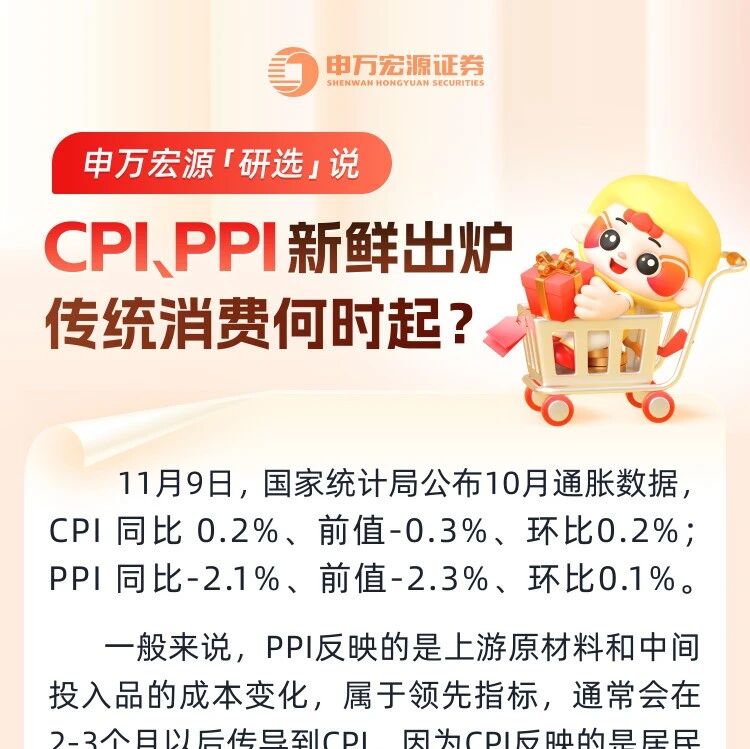
申万宏源“研选”说——CPI、PPI新鲜出炉,传统消费何时起?
申万宏源证券上海北京西路营业部· 2025-11-21 02:08
Core Viewpoint - The recent CPI and PPI data indicate a potential recovery in traditional consumption, with slight positive changes in both indices suggesting an improving economic environment [2][3]. CPI and PPI Analysis - In October, the CPI showed a year-on-year increase of 0.2%, compared to a previous value of -0.3%, and a month-on-month increase of 0.2%. The PPI, on the other hand, recorded a year-on-year decrease of -2.1%, an improvement from -2.3%, with a month-on-month increase of 0.1% [2]. - PPI serves as a leading indicator reflecting changes in the costs of upstream raw materials and intermediate goods, while CPI is a lagging indicator that reflects changes in the prices of consumer goods and services [2]. Economic Implications - A positive trend in PPI, especially if it turns positive on a month-on-month basis, indicates a recovery in industrial product prices and an improvement in corporate profit margins, which could lead to better financial reports for companies [2]. - Conversely, a negative CPI often signals deflation, while a positive CPI suggests inflation. Continuous positive month-on-month growth in CPI indicates a likely recovery in consumer demand [2]. Investment Opportunities - The slight positive changes in both PPI and CPI can be viewed as signals of economic improvement, with moderate inflation being beneficial for investors, potentially leading to increased corporate profits and stock price appreciation [3]. - The performance of the Shenwan Consumption Industry Index shows that the overall consumption sector has underperformed compared to the CSI 300 index, with some sub-sectors being relatively undervalued [4]. Sector Performance - As of November 7, 2025, the performance of various sectors is as follows: - CSI 300: +18.90% - Agriculture, Forestry, Animal Husbandry, and Fishery: +17.35% - Home Appliances: +7.23% - Food and Beverage: -6.05% - Textile and Apparel: +11.97% - Light Industry Manufacturing: +14.34% - Retail: +4.20% - Social Services: +9.12% [3][4]. Recommendations - It is suggested to consider tracking ETFs related to consumption, food and beverage, agriculture, and home appliances, as these sectors may experience growth in the near future [4].