加息
Search documents
日本央行会议纪要暗示加息远未结束:实际利率“全球最低档”
智通财经网· 2025-12-29 02:03
智通财经APP获悉,日本央行货币政策委员会部分成员在本月早些时候的一次利率会议上(当时日本央行上调了基 准利率)表示,日本的实际利率仍然非常低,暗示未来可能还会进一步上调日本国内借贷成本。 根据周一公布的一份日本央行内部讨论摘要,在于12月19日结束的为期两天货币政策会议上,九名委员中的一位 表示:"日本的实际政策利率在全球范围内是最低水平之一,甚至可以说断崖式地最低。"该委员表示,日本央行 调整货币宽松程度是合适的,并提及汇率变动对物价的影响。 在该次利率会议上,日本央行货币政策委员会将基准利率上调至0.75%,为30年来最高政策利率水平。此份摘要 的发布正值金融市场资深交易员们一直在寻找线索,以判断日本央行下一次加息可能会有多迅速之际。纪要显 示,有一位政策委员表示,日本央行在短期内应以数月为间隔来调整政策,这一节奏大体与关注日本央行观察人 士们的预期中位数一致。 经济学家们在一项调查中普遍表示,他们预计大约六个月后日本央行将宣布再度加息,许多经济学家认为本轮加 息周期的终端利率为1.5%。日本央行前执行委员会成员早川英男本月早些时候表示,央行可能在2027年初之前将 政策利率上调至最高1.50%。 整体 ...
招商宏观 | 静极思动
Sou Hu Cai Jing· 2025-12-29 00:35
文 | 招商宏观张静静团队 核心观点 国内方面,高频数据显示Q4有效需求不足持续挤压企业盈利空间。人民币升值或暂时接近到位,此前年底结汇需求集中释放使人民 币汇率明显升值,但央行或开始有意控制汇率升值幅度,中间价破7仍需企业套保率及跨境人民币结算占比进一步提升,预计明年中 后期大概率时机成熟。 海外方面,日本央行议息会议后,近期植田和男称正稳步接近2%通胀目标,将继续加息。美国Q3经济增速超预期,其中过半为个人 消费支出项所贡献,抵押贷款利率的高位回落对地产的传导仍有时滞,但是能显著影响当期消费。 资产方面,A股权益市场配置行情延续,但短期波动或将加剧。过去两周处于海外市场交易清淡期,但静极思动,新年过后外部扰 动或将加大。目前美元兑日元仍高于155,一旦日本央行干预汇市或美联储降息预期降温,海外市场仍将对国内权益资产造成阶段扰 动。 国内方面, 1)高频数据显示2025年四季度以来有效需求不足正在持续挤压企业盈利空间,导致"以价换量"边际效应锐减。11月当月 工业企业利润增速仍在负区间运行,并且跌幅较上月再度扩大了7.6个百分点。2)人民币升值或暂时接近到位。临近年底结汇需求 集中释放推动人民币汇率明显升值 ...
日本央行会议纪要:即便12月已加息 委员仍就进一步加息必要性展开讨论
Xin Lang Cai Jing· 2025-12-29 00:31
日本央行 12 月货币政策会议纪要于周一公布,纪要显示,政策制定者就继续加息的必要性展开讨论, 部分委员呼吁采取 "适时" 行动,以遏制未来的通胀压力。 在 12 月 18 日至 19 日召开的会议上,日本央行将政策利率从 0.5% 上调至 0.75%,创下 30 年来新高。 此举是日本央行终结数十年大规模货币宽松政策和近零利率时代的又一标志性举措。 纪要显示,多名政策委员会成员认为,日本央行需进一步上调政策利率 —— 当前政策利率经通胀调整 后仍处于显著负值区间。 其中一份意见指出:"政策利率距离中性水平仍有相当大差距",并补充称,日本央行短期内应维持每隔 数月加息一次的节奏。 另有意见认为,日元走弱及长期利率攀升,部分原因在于政策利率相对于通胀水平过低。 责任编辑:王许宁 责任编辑:王许宁 日本央行 12 月货币政策会议纪要于周一公布,纪要显示,政策制定者就继续加息的必要性展开讨论, 部分委员呼吁采取 "适时" 行动,以遏制未来的通胀压力。 在 12 月 18 日至 19 日召开的会议上,日本央行将政策利率从 0.5% 上调至 0.75%,创下 30 年来新高。 此举是日本央行终结数十年大规模货币宽松政策 ...
欧美货币政策趋势生变,成为日元贬值原因之一
日经中文网· 2025-12-27 00:32
Core Viewpoint - The article discusses the contrasting monetary policies of major central banks, particularly focusing on the Bank of Japan's (BOJ) interest rate hikes and the potential for the European Central Bank (ECB) to shift towards tightening, which could impact the Japanese yen's value against the dollar and euro [2][4][6]. Group 1: Monetary Policy Changes - The Bank of Japan has initiated interest rate hikes, while the Federal Reserve is expected to lower rates, creating a complex market dynamic where long-term interest rates in Japan rise, but the yen depreciates due to expectations of slower BOJ rate increases [2]. - The ECB has maintained its policy rate but signals a potential shift towards tightening, which could fundamentally alter the conditions supporting the yen's exchange rate [6]. - Market participants are increasingly betting on a policy shift from the ECB, with euro long positions reaching a two-year high, indicating a potential capital shift from dollars to euros [6]. Group 2: Economic Implications - The Federal Reserve's cautious approach to future rate cuts suggests that the pace of easing will slow, with only one more cut expected in 2026, indicating a more stable economic outlook [8]. - The difference in policy flexibility between the BOJ and Western central banks is highlighted, with the BOJ being more cautious and slower to react to economic changes, which could lead to a significant lag in its rate hikes compared to the West [8]. - The Japanese government is becoming increasingly vigilant about yen depreciation, with recent verbal interventions aimed at curbing the yen's decline, reflecting a shift in sentiment compared to previous optimism [9].
黄金还能涨多久?复盘70年代牛市,揭秘暴涨逻辑,现在该不该买?
Sou Hu Cai Jing· 2025-12-26 10:13
Core Viewpoint - The article discusses the complexities of gold price movements and the factors influencing these changes, emphasizing the importance of understanding historical trends and economic conditions to make informed investment decisions in gold. Group 1: Historical Context of Gold Prices - The last major bull market for gold began in August 1971 when the U.S. abandoned the gold standard, leading to a significant increase in gold prices [14] - The 1970s saw a dramatic rise in gold prices, but also significant corrections, such as a nearly 30% drop between 1975 and 1976 due to changes in monetary policy [16] - Economic conditions, such as the oil crisis and subsequent inflation, initially drove gold prices up, but rising interest rates led to a collapse in gold prices as investors preferred interest-bearing assets [18] Group 2: Current Market Dynamics - Recent gold price increases are attributed to three main factors: expectations of Federal Reserve interest rate cuts, geopolitical instability, and ongoing central bank purchases of gold [24] - The domestic gold market in China has lagged behind international prices due to currency fluctuations, particularly the depreciation of the RMB against the USD [5][10] - The recent appreciation of the RMB has made gold purchases more expensive for domestic investors, highlighting the need to consider exchange rates when investing in gold [10] Group 3: Investment Considerations - Gold serves as a hedge against inflation but does not generate interest, making its attractiveness relative to bank savings dependent on interest rates [9][12] - The article warns that no asset can continuously rise in value, with potential risks including uncontrolled inflation leading to interest rate hikes, which could drive investors away from gold [26][28] - The emergence of AI and its potential to boost economic productivity could lead to a shift away from gold investments towards riskier assets, depending on the actual impact of AI on the economy [30][32]
日经225指数收涨0.7% 芯片股领涨
Xin Lang Cai Jing· 2025-12-26 06:41
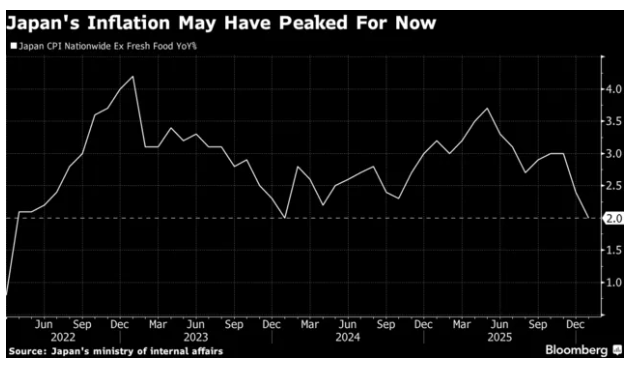
周五公布的数据显示,由于食品成本压力减缓,日本东京地区12月份的核心消费者物价指数(CPI)同 比涨幅放缓,但仍高于央行2%的目标,这为进一步加息提供了更多理由。该数据支持了日本央行的观 点,即未来几个月核心通胀率将因成本压力缓解而下滑至2%的目标水平以下,之后将恢复更多由需求 驱动的上升,从而可能为进一步加息提供依据。 但一些分析师警告说, 日元重新下跌可能会促使企业继续提价,从而导致由成本拉动的持续通胀,这 可能会加快日本央行的加息步伐。"今天的数据表明,食品通胀可能已经见顶。但 日元疲软可能会给企 业恢复食品涨价提供借口,这可能会使通胀维持在高位。"第一生命经济研究所(Dai-ichi Life Research Institute)的高级执行经济学家Yoshiki Shinke表示。 日本首相高市早苗内阁周五批准创纪录的 7,850 亿美元下一财年预算,旨在通过限制新债发行,在其 积极财政政策与债务恶化担忧之间取得平衡。面对公债收益率上升和 日元疲软,高市政府加大力度安 抚投资者,强调政府不会采取不负责任的发债或减税措施。 将于明年初提交国会的下一财年年度预算,总额将达到创纪录的 122.3 万亿 日 ...
东京通胀降温,加息难停?日元陷政策博弈困局
Sou Hu Cai Jing· 2025-12-26 02:32
Group 1: Inflation Data - Tokyo's core CPI rose by 2.3% year-on-year in December, which is a significant slowdown from the previous month's 2.8% and below the market expectation of 2.5% [6][7] - This marks the first inflation slowdown since August, primarily reflecting a deceleration in food price increases and a decline in energy costs [7] - Excluding fresh food, food prices in Tokyo increased by 6.2% year-on-year, down from 6.5% in the previous month [8] Group 2: Energy Prices - Tokyo's energy prices fell by 3.4% year-on-year in December, contrasting with a 2.6% increase in the previous month [10] - Electricity prices decreased by 2.5%, city gas prices dropped by 4.7%, and gasoline prices fell by 6.4% compared to the same month last year [10] Group 3: Economic Indicators - Japan's industrial output fell by 2.6% in November, reversing a 1.5% increase in October, which was worse than the expected decline of 1.8% [11] - Despite the decline, companies expect output to rebound, forecasting a 1.3% increase in December and a significant 8.0% rise in January [11] Group 4: Monetary Policy and Currency - The Bank of Japan raised its policy interest rate to 0.75%, the highest level in 30 years, indicating a potential for further tightening of monetary policy [13] - Despite the interest rate hike, the yen remains weak, trading near its lowest levels against the dollar, which may increase import costs and exacerbate inflationary pressures [14] - The Japanese government is prepared to intervene in the foreign exchange market if necessary, as indicated by recent statements from officials [15] Group 5: Fiscal Policy - The Japanese cabinet approved a record budget of 122.3 trillion yen (approximately $785 billion) for the next fiscal year, aiming to balance active fiscal policies with concerns over rising debt [16] - The government has assured investors that it will not engage in irresponsible debt issuance or tax cuts amid rising national debt yields and a weak yen [16]
东京12月通胀意外放缓难挡日本央行紧缩步伐 加息节奏成市场焦点
Zhi Tong Cai Jing· 2025-12-26 02:09
Group 1 - The core inflation in Tokyo has cooled more than market expectations, with the CPI excluding fresh food rising by 2.3% year-on-year in December, down from 2.8% the previous month and below the economist forecast of 2.5% [1][4] - Overall inflation indicators decreased from 2.7% the previous year to 2%, while the deeper inflation measure excluding energy slowed to 2.6% [1][4] - The Bank of Japan (BOJ) raised the policy interest rate to 0.75%, the highest level since 1995, indicating a continued tightening path despite the cooling inflation [4] Group 2 - Economists expect the BOJ to raise interest rates approximately every six months, with a terminal rate projected around 1.25%, suggesting two more rate hikes in the current cycle [5] - The weakening yen, hovering near its lowest level against the dollar since January, may increase import costs and subsequently domestic prices, prompting warnings from Japanese officials about potential market intervention [5] - The cooling of overall inflation may provide Japanese Prime Minister Fumio Kishida with leverage to urge the BOJ to maintain patience regarding further rate hikes, with expectations that the next action may not occur until July [5]
广发早知道:汇总版-20251226
Guang Fa Qi Huo· 2025-12-26 01:12
Report Industry Investment Rating No relevant content provided. Core Viewpoints of the Report The report offers a comprehensive analysis of various futures markets, including financial derivatives, precious metals, shipping indices, non - ferrous metals, black metals, agricultural products, and energy chemicals. It details the current market situation, influencing factors, and future outlooks for each category, and provides corresponding trading strategies. Summary by Directory Daily Selections - **Copper**: High copper prices have suppressed terminal demand, leading to significant spot discounts and inventory accumulation. Upward drivers include further deterioration of overseas inventory structure and improved interest - rate cut expectations; downward drivers are weak demand. Suggest a light - position holding of a protective put option portfolio [2]. - **PP**: The basis weakens, and trading improves. Pay attention to the expansion of PDH profits [3]. - **Coking Coal**: Spot coal prices vary, and the upside of the futures price is limited. Switch to short - selling on rallies [3]. - **Soybean Meal**: South American harvest expectations suppress prices, but cost supports the downside. Concerns about customs policies affect domestic supply. Be cautious in short - term operations [4]. - **Silver**: Supply tightness and capital drive prices to maintain a strong - side oscillation. Hold long positions, and reduce or lock positions before the Spring Festival [5]. Financial Derivatives Stock Index Futures - **Market Performance**: A - share indices rise, and the basis of the four major stock index futures contracts is repaired. The short - term negative factors are exhausted, and the index rebounds [7][8][9]. - **News**: Beijing eases housing purchase restrictions, and the US raises IPO liquidity thresholds [8][9]. - **Funding**: A - share trading volume is stable, and the central bank conducts net injections [9]. - **Operation Suggestion**: Try a bull - spread strategy on the CSI 300 index [9]. Treasury Bond Futures - **Market Performance**: Treasury bond futures decline, and short - term bonds are relatively strong [10]. - **Funding**: The central bank's reverse - repurchase operations result in net injections, and the funding rate is seasonally up but controllable [10]. - **Operation Suggestion**: Consider going long on the T contract on pullbacks and participate in the 2603 contract cash - and - carry arbitrage and basis - widening strategies [12]. Precious Metals - **Market Review**: Overseas markets are closed for holidays. Some precious metals experience price adjustments, with platinum strengthening and palladium once hitting the daily limit down [13][15]. - **Outlook**: The medium - to - long - term price of precious metals has an upward trend, but short - term fluctuations exist. Adopt a long - position strategy on dips [16]. Shipping Index (European Line) - **Index**: SCFIS and SCFI indices show an upward trend [19]. - **Fundamentals**: Container capacity increases, and demand in the eurozone and the US is weak [19]. - **Logic**: The futures contract is in a consolidation phase, with limited drivers, and is expected to oscillate in the short term [19]. Non - Ferrous Metals - **Copper**: High prices suppress demand, and the price is expected to oscillate strongly in the short term. Hold protective put options [24]. - **Alumina**: The market is oversupplied, and the price is expected to oscillate around the cash - cost line [26]. - **Aluminum**: The market is in a state of macro - positive expectations versus fundamental pressure, and the price is expected to oscillate widely [29]. - **Aluminum Alloy**: High costs and weak demand limit price movements, and the price is expected to oscillate in a high - level range [31]. - **Zinc**: TC stabilizes, demand is weak, and the price is expected to oscillate weakly [36]. - **Tin**: Supply is improving, and the price is expected to oscillate at a high level. Adopt a wait - and - see approach [40]. - **Nickel**: The market is affected by expectations of tightened ore supply, and the price is expected to oscillate strongly [42]. - **Stainless Steel**: The market is in a state of strong expectations versus weak reality, and the price is expected to oscillate and adjust [46]. - **Lithium Carbonate**: The market is in a state of high - level oscillation, with strong capital sentiment. The price is expected to oscillate widely [50]. - **Polysilicon**: The price is in a high - level oscillation, with demand weakness. Adopt a wait - and - see approach [53]. - **Industrial Silicon**: The price is expected to oscillate at a low level. Pay attention to production - cut implementation [55]. Black Metals - **Steel**: Steel production is cut, and inventory is reduced. The price is expected to oscillate. Consider exiting the 1 - 5 positive spread and looking for opportunities to go long on the 5 - month iron - ore ratio [57][58]. - **Iron Ore**: Supply is at a high level, and demand is weak. The price is expected to oscillate. Adopt a short - term range - trading strategy on the 05 contract [60]. - **Coking Coal**: Supply may decrease, and demand is weak. Switch to short - selling on rallies [66]. - **Coke**: The third price cut is implemented, and the price is expected to decline. Switch to short - selling on rallies [70][71]. - **Silicon Iron**: Supply is reduced, and demand is stable. The price is expected to oscillate in a range [73]. - **Silicon Manganese**: High inventory suppresses price rebounds, and the price is expected to run weakly. Consider short - selling when the price rebounds above the Ningxia spot cost [76]. Agricultural Products - **Soybean Meal and Rapeseed Meal**: South American harvest expectations suppress prices, and customs policies affect domestic supply. Be cautious in short - term operations [79]. - **Pigs**: Seasonal demand supports the market, and the price is expected to oscillate strongly in the short term [81]. - **Corn**: Supply and demand are balanced, and the price is in a stalemate. Pay attention to selling sentiment and policy releases [84]. - **Sugar**: The international market is bearish, and the domestic market may have limited rebounds. Adopt a bearish - on - rebounds strategy [85]. - **Cotton**: US cotton oscillates at the bottom, and domestic cotton prices are expected to rise. The supply pressure is released, and the long - term outlook is optimistic [88]. - **Eggs**: Supply pressure is high but eases marginally. Near - month contracts are expected to oscillate at the bottom [92]. - **Oils**: Palm oil may continue to rise but also faces downward risks. Soybean oil and rapeseed oil have different market situations. Adopt corresponding strategies according to different varieties [93][95][96]. - **Jujubes**: The price rebounds. Pay attention to sales in the distribution areas. Consider selling call options [97]. - **Apples**: The price oscillates. Consider closing long positions [98]. Energy Chemicals - **PX**: Valuation increases, and downstream feedback is negative. The upside is limited. Reduce long positions on rallies and consider long - term low - buying [100]. - **PTA**: Follow PX trends, and the upside is limited. Reduce long positions on rallies and consider long - term low - buying [102]. - **Short - Fiber**: Supply is high, and demand is weak. Follow raw - material fluctuations [104]. - **Bottle Chips**: Supply is expected to increase, and processing fees may be compressed. Adopt the same strategy as PTA and short - sell processing fees on rallies [106]. - **Ethylene Glycol**: Supply is expected to decrease, but the cost support is limited. The price is expected to oscillate. Adopt a 5 - 9 reverse - arbitrage strategy [108]. - **Pure Benzene**: Supply is stable, and demand is weak. The price is expected to oscillate in a range [109]. - **Styrene**: Supply and demand both increase, and the price is expected to oscillate in a range [111]. - **LLDPE**: Supply and demand are weak. Go long on the 2605 contract in the short term [113]. - **PP**: Pay attention to the expansion of PDH profits [3]. - **Methanol**: The market is expected to balance in the first quarter of next year. Pay attention to the contraction of MTO05 [114]. - **Caustic Soda**: Supply and demand are under pressure, and the price is expected to decline [116]. - **PVC**: Supply is expected to increase, and demand is weak. The price is expected to decline after a rebound [117]. - **Soda Ash**: Supply is stable, and demand is weak. Short - sell on rallies [120]. - **Glass**: The price is under pressure. Adopt a wait - and - see approach [120]. - **Natural Rubber**: The price is driven by macro - sentiment, but the fundamentals are weak. Try short - selling around 15700 [122]. - **Synthetic Rubber**: The price is expected to oscillate strongly in the short term. Avoid short - selling the BR2602 contract [124][125].
东京通胀降温幅度超预期 但不太可能阻止日本央行继续加息
Xin Hua Cai Jing· 2025-12-26 00:56
新华财经北京12月26日电东京通胀降温幅度超出预期,随着食品和能源价格带来的压力减弱,但这不太 可能阻止日本央行继续加息。 日本总务省周五公布的数据显示,12月东京不含生鲜食品的消费者价格指数(CPI)同比上涨2.3%,较 前一个月的2.8%明显放缓。这是自8月以来首次出现通胀放缓,主要反映了食品价格涨幅趋缓以及能源 成本下降。此前经济学家预计该指标将放缓至2.5%。 整体通胀指标从上年同期的2.7%降至2.0%;而剔除能源价格的更深层通胀指标也放缓至2.6%。 东京的通胀数据通常被视为全国通胀走势的领先指标。尽管整体通胀数据明显放缓,但仍高于日本央行 的2%目标,使央行继续走在进一步收紧政策的轨道上。 (文章来源:新华财经) ...