商业闭环

Search documents
智谱与MiniMax上市:从“讲故事”到“交报表” | AI系列
Sou Hu Cai Jing· 2026-01-12 12:41
Core Insights - The article discusses the transition of the AI large model industry from a phase of intense competition to a period focused on commercial validation, marked by the recent IPOs of two major players, Zhiyu and MiniMax [2][17]. Group 1: Business Models and Strategies - Zhiyu adopts a "MaaS" (Model as a Service) approach, focusing on becoming a foundational infrastructure for various industries, emphasizing stability and long-term value [3][5]. - MiniMax, on the other hand, pursues a global C-end strategy, leveraging its innovative product offerings and aiming for rapid market penetration [3][5]. - Both companies' paths reflect their foundational philosophies and strategic judgments regarding the commercialization of AI [4]. Group 2: Financial Performance - Zhiyu's revenue is projected to grow from 57.4 million yuan in 2022 to 312.4 million yuan in 2024, with a compound annual growth rate of 130% [7]. - MiniMax's revenue is expected to surge from 3.5 million USD in 2023 to 30.5 million USD in 2024, reflecting a staggering growth rate of 782.2% [8]. - Despite high revenue growth, both companies face significant losses, with Zhiyu accumulating over 6.2 billion yuan in losses from 2022 to mid-2025, and MiniMax around 9.3 billion yuan during the same period [9][10]. Group 3: Industry Dynamics - The successful IPOs of Zhiyu and MiniMax signify a shift in the AI large model industry, moving away from the "parameter competition" era towards a more structured commercial phase [17][22]. - The competitive landscape is evolving, with major internet companies like ByteDance, Alibaba, and Tencent entering the market, leveraging their resources and ecosystems [23][25]. - The article highlights a growing recognition among investors regarding the importance of clear business models and growth potential in the AI sector [21][22]. Group 4: Future Outlook - The article concludes that the paths taken by Zhiyu and MiniMax illustrate the diverse possibilities within the AI industry, with both companies facing similar challenges of high operational costs and the need for sustainable profitability [26][27]. - The successful listings of these companies mark a new beginning in the competition for AI development, emphasizing the importance of continuous iteration and adaptation in the industry [27].


抖音杀入移动支付,微信支付宝慌不慌?
Tai Mei Ti A P P· 2025-12-26 12:47
Core Insights - Douyin has launched its offline payment feature, "Douyin Buy," in major cities, marking a significant expansion into the payment sector, which is seen as a crucial piece of its commercialization strategy [1][4] - The Chinese mobile payment market is dominated by WeChat Pay and Alipay, which together hold over 90% market share, making it a challenging environment for new entrants like Douyin [2][3] - Douyin's strategy is to create a complete commercial ecosystem that retains user data and enhances user experience by keeping transactions within its platform [5][6] Market Dynamics - WeChat Pay and Alipay have established a stronghold in the payment market, with WeChat Pay leading at 59.7% and Alipay at 36.2% as of Q1 2025 [2] - Douyin's entry into the payment space is viewed as a defensive move to complement its existing online content and e-commerce offerings [2][6] - The competitive landscape is characterized by a "dual oligopoly," with both WeChat and Alipay continuously innovating to maintain their market positions [3][8] Douyin's Strategic Intent - Douyin aims to create a seamless transaction experience by integrating payment into its existing content and e-commerce ecosystem, thus preventing user data from flowing to competitors [4][5] - The introduction of "Douyin Buy" is seen as essential for Douyin to achieve its goal of a complete commercial loop, facilitating user transactions directly within the app [5][10] - Douyin's payment strategy is not merely optional but a necessary infrastructure for its broader ambitions in local commerce [5][12] Challenges Ahead - Douyin faces significant challenges in gaining market share due to the entrenched positions of WeChat and Alipay, which have established ecosystems that provide essential value beyond just payment [9][10] - Initial promotional strategies, such as subsidies, have shown limited effectiveness and may not sustain long-term user engagement [7][11] - The lack of unique payment scenarios and the reliance on existing payment methods like WeChat and Alipay within its own platform may undermine Douyin's payment initiative [11][12] User Experience and Merchant Perspective - User experience issues have been reported, including delays in transaction confirmations and refunds, which could hinder adoption [11] - Merchants prioritize transaction volume over the choice of payment method, making it difficult for Douyin to incentivize its payment solution [12] - The perception of Douyin's payment service as an additional option rather than a necessity may limit its growth potential in the competitive landscape [12]


进击的千问,藏着阿里“AI实体化”的野心
Sou Hu Cai Jing· 2025-12-18 12:27
Core Insights - The article discusses the integration of Qwen APP with Gaode, transforming it into a personal assistant that connects AI with real-world applications [3][6] - Alibaba aims to create an "AI-native C-end super entrance," allowing users to perform various tasks seamlessly within a single app [3][8] - The focus has shifted from mere AI capabilities to practical applications that solve real user problems, marking a new phase in AI development [7][10] Group 1: Integration and Functionality - Qwen APP's integration with Gaode enables it to provide real-time geographic information and decision-making capabilities for users [4][6] - The app can assist users in unfamiliar cities by suggesting restaurants, hotels, and travel plans, utilizing Gaode's extensive data [4][5] - Users can expect a comprehensive service that includes planning trips, making reservations, and processing payments all within the app [3][9] Group 2: Market Position and Growth - Qwen APP has quickly become the fastest-growing AI application globally, with a growth rate of 149.03% in monthly active users since its public testing began [9] - The app is positioned as a central hub for Alibaba's various services, including maps, e-commerce, and local life, creating a robust ecosystem [8][9] - The integration of AI with real-world applications is seen as a significant competitive advantage in the evolving AI landscape [17][18] Group 3: Strategic Vision - Alibaba's strategy focuses on building an "entity-based ecological advantage" in the AI era, leveraging its extensive offline service network [15][17] - The company aims to transform its entire business model into an "AI model," similar to Google's approach with its Gemini application [12][18] - The ambition is for Qwen to become the super entrance of the AI era, expanding its reach into various sectors such as food delivery, ticketing, and shopping [18]

刚买下支付牌照的小红书,为何关停了“小红卡”?
Xin Lang Cai Jing· 2025-12-11 08:29
Core Viewpoint - Xiaohongshu has made a strategic move by acquiring a payment license, but it simultaneously announced the suspension of its local life membership program "Xiaohong Card," indicating a complex strategic landscape with both expansion and contraction elements [1][8]. Group 1: Payment License Acquisition - Xiaohongshu acquired 100% of Dongfang Electronic Payment Co., Ltd., gaining a payment license that allows for core functions such as user recharge, consumption, and transfer, which aligns with its e-commerce and local life payment needs [3][10]. - The acquisition of the payment license is expected to optimize cost structures, improve merchant settlement efficiency, and provide valuable data assets for the platform [3][10][11]. - Previously, Xiaohongshu relied on third-party payment channels, incurring high transaction fees estimated at around 2.4 billion yuan annually based on a projected GMV of over 400 billion yuan for 2024 [2][9]. Group 2: Suspension of Xiaohong Card - The "Xiaohong Card," launched in September 2025 with an annual fee of 168 yuan, aimed to create a premium membership experience in cities like Shanghai, Hangzhou, and Guangzhou, but will be suspended starting January 1, 2026 [5][12]. - The suspension is attributed to high operational costs and a mismatch with Xiaohongshu's core online content-driven model, which contrasts with the "heavy operation" nature of local life services [5][12][13]. - The decision to pause the program allows Xiaohongshu to reallocate resources towards more critical areas, particularly the integration of its e-commerce and payment systems [6][13].
“小红卡”折戟,小红书本地生活“小而美”的故事不好讲
2 1 Shi Ji Jing Ji Bao Dao· 2025-12-10 09:39
Core Viewpoint - The recent announcement by Xiaohongshu to suspend its local life membership product "Xiaohong Card" indicates challenges in establishing a successful business model in the competitive local life market, despite the platform's strong community influence and user engagement [1][5][6]. Group 1: Product Launch and Suspension - Xiaohongshu's "Xiaohong Card" was launched on September 8, 2023, during the third "Street Life Festival" but will be suspended from January 1, 2026, with full refunds for users [1][4]. - The company aims to refocus resources on enhancing local life content and tools rather than continuing the card's trial operation [4][8]. Group 2: Market Position and Strategy - The "Xiaohong Card" was intended to create a paid model based on community trust, differentiating itself from competitors like Meituan and Dazhong Dianping by focusing on high-quality, niche offerings [5][7]. - Despite the initial goal of not prioritizing GMV, the limited user engagement and merchant coverage have raised concerns about the card's effectiveness in driving actual transactions [8][9]. Group 3: Competitive Landscape - The local life service market is projected to grow to 35.3 trillion yuan by 2025, with a compound annual growth rate of 12.6%, indicating a lucrative but highly competitive environment [10]. - Major players like Meituan and Douyin have established strong positions, making it challenging for Xiaohongshu to carve out a niche without a robust merchant network and competitive pricing [12][13]. Group 4: Future Directions - Xiaohongshu remains committed to the local life sector, planning to enhance its content and tools to assist users in discovering quality local options, despite the suspension of the Xiaohong Card [14][15]. - The company acknowledges the need for a more effective commercial model and aims to innovate its approach to achieve a sustainable business strategy in the local life market [14].
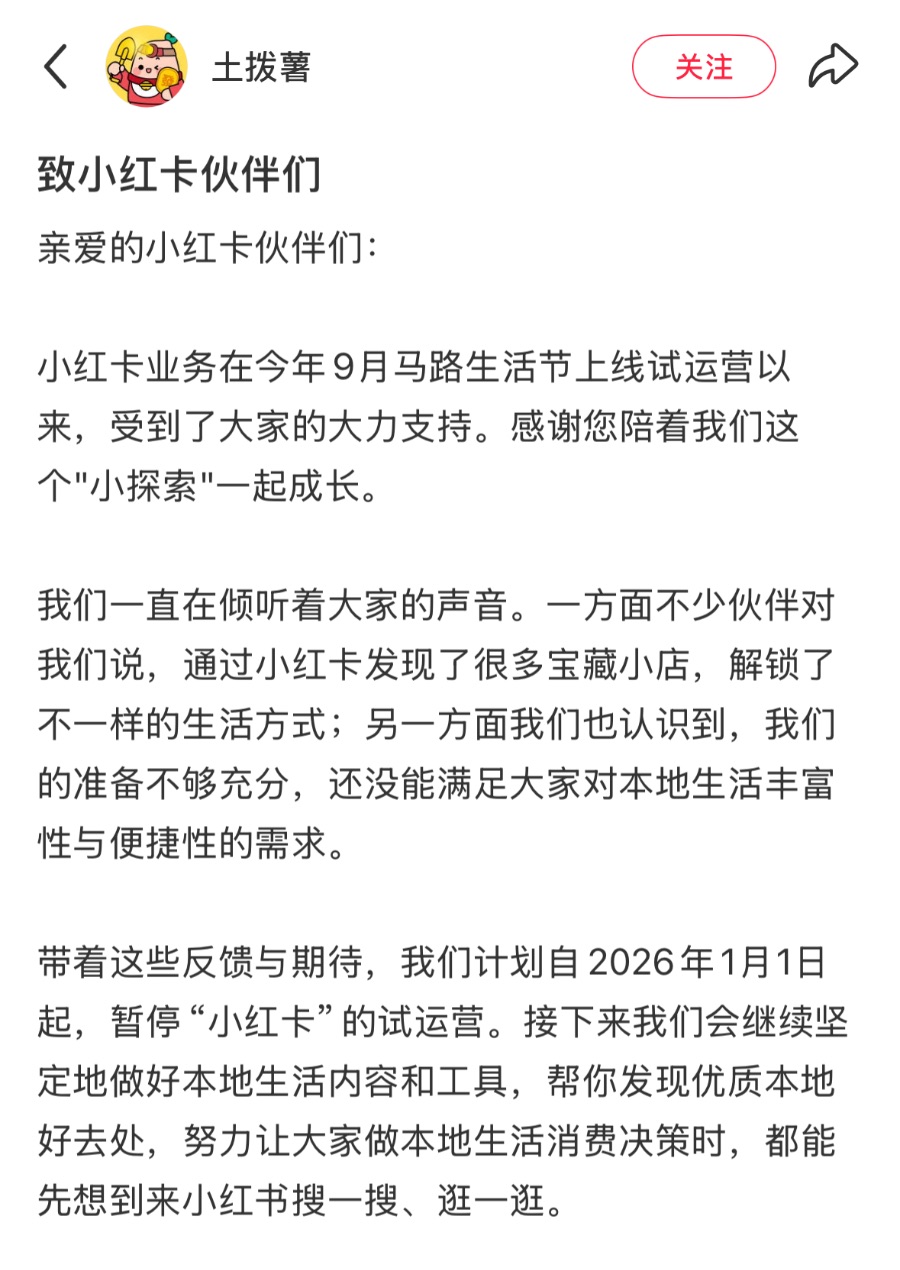
0元入驻、流量补贴,小红书加码本地生活
3 6 Ke· 2025-12-05 11:04
Group 1 - Xiaohongshu continues to enhance its local life services, with numerous service providers offering support for merchants, including traffic support and one-stop operational services [1][3] - The platform has implemented a "0 yuan entry" policy for new merchants, significantly lowering the barriers to entry and encouraging participation in local life services [3][7] - Xiaohongshu's local life business is showing stable progress, with a reported 37% year-on-year increase in search trends and a 39% increase in note publishing volume since 2025 [7][12] Group 2 - The platform has developed a complete commercial loop in local life services, transitioning from content-driven engagement to direct consumer transactions [8][12] - Xiaohongshu has introduced the "Xiaohong Card," allowing users to enjoy discounts at selected stores, enhancing user engagement and loyalty [10][12] - The company has obtained a payment license, enabling it to facilitate transactions within its ecosystem, further solidifying its business model [12] Group 3 - The competition in the local life sector is intensifying, with major players like Meituan, Douyin, and Gaode actively expanding their market presence [13][20] - Douyin has rapidly captured 30% of the local life market share within two years, leveraging its large user base and effective promotional strategies [20][21] - Xiaohongshu faces challenges in merchant coverage and user adoption of group buying, but its content ecosystem and ability to attract high-value users remain significant advantages [21]
一边对标英伟达,一边巨亏30亿:沐曦股份“光速”闯入资本市场
Sou Hu Cai Jing· 2025-12-02 14:35
Group 1: Company Overview - Muxi Co., Ltd. has experienced a rapid listing process, taking only 116 days from application acceptance to approval, which is rare in the history of the Sci-Tech Innovation Board [1] - Established in 2020 during a surge in domestic GPU entrepreneurship, Muxi has attracted significant investment from top venture capital firms and state-owned funds, achieving a valuation of 21.071 billion yuan by March 2025 [1] - The company has not yet achieved profitability, with projected revenues of 42,600 yuan in 2022, 53.021 million yuan in 2023, and 743 million yuan in 2024, while incurring net losses of 7.8 billion yuan, 8.7 billion yuan, and 14.1 billion yuan respectively [3] Group 2: Financial Performance - Muxi's cumulative net loss reached 32.9 billion yuan by the first quarter of 2025, with a revenue of 3.2 billion yuan and a net loss of 2.33 billion yuan in Q1 2025 [3] - The company has invested heavily in R&D, with expenditures of 2.18 billion yuan, 9.01 billion yuan, and 6.99 billion yuan from 2022 to 2024, representing 282.11% of cumulative revenue [4] Group 3: Industry Context - The GPU industry is characterized by high capital intensity, technological complexity, and significant ecological barriers, with NVIDIA controlling over 80% of the global GPU market [5] - The transition to domestic GPUs faces challenges, including high migration costs estimated at 80% and production capacity limitations due to U.S. export controls [6] - Muxi has chosen a different technical path compared to competitors, focusing on high-performance general-purpose GPUs for vertical applications in sectors like research, finance, and healthcare [6][7] Group 4: Market Opportunities - Despite challenges, the domestic GPU market presents significant growth opportunities, with a potential market space of 3.6 billion USD if the domestic replacement rate increases from 10% to 30% [12] - The company’s flagship product, the Xiyun C500 series, has achieved domestic leadership in various performance metrics and has sold over 25,000 units, deployed in over 10 computing clusters [12] Group 5: Future Projections - Muxi forecasts revenues of 1.5 billion to 1.98 billion yuan for 2025, representing a growth of 101.86% to 166.46% compared to 2024, while expecting a reduction in net losses by 45.84% to 62.59% [13]


小红书搅动投资圈
经济观察报· 2025-11-25 12:27
Core Insights - The article discusses the emergence of Xiaohongshu Venture Capital in Shenzhen's investment scene, highlighting its rapid investment capabilities and unique approach to deal-making [1][3][5]. Investment Strategy - Xiaohongshu Venture Capital has invested in nearly 10 startups within six months, showcasing a preference for quick decision-making and minimal due diligence [5][9]. - The team can complete investments within 24 hours, often bypassing traditional due diligence processes, which has led to a competitive environment among seasoned investors [3][5]. - Xiaohongshu is willing to increase valuations by 20%-30% to secure exclusive investment opportunities, with investments typically ranging from several million to over 10 million USD [5][10]. Market Position - The valuation of Xiaohongshu surged by 19% in just three months, reaching 31 billion USD, indicating a shift in investor perception from a mere traffic platform to a platform giant with a complete business ecosystem [9][10]. - The company aims to build an ecosystem rather than focusing solely on short-term financial returns, as evidenced by its active investment strategy [8][10]. User Engagement - As of August 2025, Xiaohongshu's monthly active users exceeded 350 million, with an average daily usage time of over 74 minutes, reflecting strong user engagement [11]. Strategic Acquisitions - Xiaohongshu's acquisition of Guangdong Oriental Electronic Payment Co., Ltd. for 100% ownership is seen as a strategic move to complete its commercial ecosystem by obtaining a payment license, reducing reliance on third-party payment platforms [10].

小红书搅动投资圈
Jing Ji Guan Cha Wang· 2025-11-25 12:20
Core Insights - The article discusses the rapid investment activities of Xiaohongshu Ventures in Shenzhen's investment landscape, highlighting its aggressive approach to funding startups and its strategic positioning in the market [3][4][10]. Investment Trends - Xiaohongshu Ventures has invested in nearly 10 startups within six months, showcasing a fast-paced investment strategy that can complete deals in as little as 24 hours [4][5]. - The firm is known for its "lightning investment" approach, often skipping due diligence to expedite the investment process, which has raised eyebrows among traditional investors [4][5]. Market Positioning - Xiaohongshu is shifting its perception from a mere traffic platform to a platform giant with a complete business ecosystem, as evidenced by its valuation surge to $31 billion within three months [8][9]. - The company aims to build an ecosystem rather than focusing solely on financial returns, indicating a long-term strategic vision [8][9]. User Engagement - As of August 2025, Xiaohongshu's monthly active users exceeded 350 million, with an average daily usage time of over 74 minutes, reflecting strong user engagement [10]. Strategic Acquisitions - The acquisition of Guangdong Oriental Electronic Payment Co., Ltd. for 100% ownership is seen as a critical move to complete Xiaohongshu's commercial ecosystem by securing a payment license [9].

她退赛,他“发疯”,它卖爆!谁是荒野求生的真正赢家?
新浪财经· 2025-11-24 12:00
Core Insights - The "Qixing Mountain Camel Cup" extreme wilderness survival challenge has become a phenomenon, attracting over 5 billion clicks online and generating significant commercial interest [3][5] - The event has led to a 30% year-on-year increase in tourism revenue for Zhangjiajie, with the sponsor Camel Clothing achieving over 30 million in sales [6][19] Event Overview - The event is hosted by Zhangjiajie Qixing Mountain Scenic Area and organized by Lao Liu Wilderness, with exclusive sponsorship from Camel Clothing [5][6] - The competition has garnered massive attention, with participants gaining popularity and being sought after by MCN agencies [3][14] Commercial Impact - The event has significantly boosted ticket sales for the scenic area, although specific growth figures have not been disclosed [4][5] - Camel Clothing's products, particularly the "Wangzhe Kaijia ICON" jacket, have been prominently featured, leading to increased brand exposure and sales [6][19] Social Media and Audience Engagement - The event has resulted in a dramatic increase in followers for the organizing account, with a 770% growth in just eight months [5] - Participants have leveraged their newfound fame on social media, with some amassing tens of thousands of followers [15][17] Long-term Viability - Analysts suggest that while the event has created a temporary surge in interest, sustaining this momentum will require ongoing engagement and innovation [7][18] - The potential for participants to become long-term influencers remains uncertain, as many may only achieve short-lived fame [18] Strategic Marketing - Camel Clothing has established a dedicated product category for "Wilderness Survival" items to capitalize on the event's traffic [9][11] - The brand's marketing strategy has been closely aligned with the event, enhancing its visibility during major sales events like Double Eleven [12][19]