四中全会

Search documents
螺纹钢周报:需求修复乏力,关注政策动向-20250920
Wu Kuang Qi Huo· 2025-09-20 14:50
1. Report Industry Investment Rating No relevant content provided. 2. Core Viewpoints of the Report - The overall atmosphere in the commodity market is favorable, with the prices of finished steel products continuing to fluctuate in a moderately strong manner. Overseas, after the Fed's interest - rate meeting, the monetary policy stance is cautious, and a preventive rate cut has begun. In the short term, market sentiment has cooled slightly; in the long term, global liquidity easing is expected to drive a manufacturing recovery, indirectly boosting steel demand. [11][12] - In China, economic data in August slowed down and fell short of expectations, increasing the possibility of more stimulus policies. The real - estate sales performance remains weak, and it will take time for the real - estate market to stabilize. Exports showed a slight decline last week and are in a weak and volatile state. [11][12] - Fundamentally, the output of rebar has declined, apparent demand has increased slightly, and inventory pressure has marginally eased; the output of hot - rolled coils has increased, apparent demand is neutral, and inventory has slightly accumulated. Currently, the demand for both rebar and hot - rolled coils is weak, and the peak - season demand is lackluster. Overall, although the traditional peak season has arrived, the demand for rebar remains weak, and while hot - rolled coils have some resilience, they are still weak overall. If the demand cannot be effectively restored in the future, steel prices may still face a downward risk. Attention should be paid to the policy trends of the upcoming Fourth Plenary Session. [11][12] 3. Summary by Relevant Catalogs 3.1 Supply - side - **Production volume**: This week, the total rebar output was 2.06 million tons, a week - on - week decrease of 2.59% and a year - on - year increase of 9.86%. The cumulative output was 81.1297 million tons, a year - on - year increase of 0.04%. The long - process output was 1.8 million tons, a week - on - week decrease of 2.63% and a year - on - year increase of 7.69%. The short - process output was 0.27 million tons, a week - on - week decrease of 2.30% and a year - on - year increase of 27.04%. [6] - **Capacity utilization**: This week, the blast - furnace capacity utilization rate was 90% (unchanged from the previous value), and the electric - furnace capacity utilization rate was 54%, down from 55% in the previous period. [53] - **Hot - metal output**: The average daily hot - metal output this week was 2.41 million tons, the same as the previous value. [58] - **Regional output**: The rebar output in the northern region was 0.4 million tons (down from 0.45 million tons in the previous period), and in the southern region was 0.83 million tons (up from 0.8 million tons in the previous period). The output in East China was 0.83 million tons, including 0.35 million tons in Jiangsu, 0.08 million tons in Shandong, and 0.18 million tons in Anhui. The output in Guangdong was 0.23 million tons, and in Guangxi was 0.08 million tons. [61][64][67] 3.2 Demand - side - **Apparent demand**: This week, the apparent demand for rebar was 2.1 million tons, compared with 1.98 million tons in the previous period, a week - on - week increase of 6.1% and a year - on - year decrease of 5.4%. The cumulative demand was 78.63 million tons, a year - on - year decrease of 4.5%. [7] - **Building - material trading volume**: The trading volume of building materials was 117,741 tons (up from 105,098 tons last week), and the trading volume of building materials in Shanghai was 18,400 tons (unchanged from last week). [70] - **Regional trading volume**: The trading volume of construction steel for mainstream traders in the northern region was 20,465 tons, and in Beijing was 8,120 tons. In East China, it was 35,531 tons, including 4,970 tons in Shanghai and 4,900 tons in Hangzhou. In the southern region, it was 31,840 tons, and in Guangzhou was 5,000 tons. In Chengdu, it was 2,620 tons, in Chongqing was 5,000 tons, and in Xi'an was 2,300 tons. [72][73][76] - **Consumption volume**: The weekly consumption volume of rebar was 2.1 million tons, with 0.87 million tons in East China, 0.34 million tons in Southwest China, 0.26 million tons in South China, 0.11 million tons in North China, 0.19 million tons in Central China, 0.17 million tons in Northeast China, and 0.13 million tons in Northwest China. [78][80][83] - **Related prices and trade**: The price of cement (P.O 42.5) in Hangzhou was 465 yuan/ton, and in Shanghai was 455 yuan/ton. [85] 3.3 Profit - **Furnace profit**: The blast - furnace profit for rebar in East China remained around 22 yuan/ton, and the on - the - spot profit increased slightly. The profit during off - peak electricity hours was - 33 yuan/ton, and the price performance was neutral. [6] - **Electric - furnace profit**: The average profit of independent electric - arc - furnace steel mills was - 130 yuan/ton, an increase of 21 yuan/ton compared with last week. The blast - furnace profit for rebar was 22 yuan/ton, an increase of 36 yuan/ton compared with last week. [9][39] - **Cost**: The cost of hot - metal was 2,625 yuan/ton, the cost of scrap steel delivered to the factory was 2,257 yuan/ton, and the average cost of hot - metal for 64 steel mills was 2,625 yuan/ton. [9][47] 3.4 Inventory - **Total inventory**: This week, the social inventory of rebar was 4.85 million tons (down from 4.87 million tons in the previous period), a week - on - week decrease of 0.4% and a year - on - year increase of 36.3%. The factory inventory was 1.65 million tons (down from 1.67 million tons in the previous period), a week - on - week decrease of 0.9% and a year - on - year increase of 20.0%. The total inventory was 6.5 million tons (down from 6.54 million tons in the previous period), a week - on - week decrease of 0.5% and a year - on - year increase of 31.7%. The inventory of billets in Tangshan was 1.22 million tons, down from 1.29 million tons in the previous period. [8][88][90] - **Regional inventory**: The social inventory of rebar in 132 cities was 6.9 million tons, in East China was 3.29 million tons, in Hangzhou was 0.96 million tons, and in Shanghai was 0.37 million tons. In South China, it was 0.72 million tons, in North China was 0.99 million tons, in Guangzhou was 0.18 million tons, and in Beijing was 0.46 million tons. In Central China, it was 0.51 million tons, in Northwest China was 0.5 million tons, in Wuhan was 0.2 million tons, and in Xi'an was 0.22 million tons. In Southwest China, it was 0.62 million tons, in Northeast China was 0.59 million tons, in Chengdu was 0.23 million tons, and in Chongqing was 0.17 million tons. [93][96][99][102] 3.5期现市场 - **Price and basis**: The lowest - warehouse - receipt basis was 28 yuan/ton, and the basis rate was 0.9%. The basis for the 01 contract was 9 yuan/ton, the 05 contract was - 48 yuan/ton, and the 10 contract was 102 yuan/ton. [10][20] - **Spread**: The spread between the 01 and 05 contracts of rebar was - 57 yuan/ton, between the 05 and 10 contracts was 150 yuan/ton, and between the 10 and 01 contracts was - 93 yuan/ton. The Beijing rebar - hot - rolled coil spread was 290 yuan/ton (up from 250 yuan/ton last week), the Shanghai spread was 140 yuan/ton (down from 190 yuan/ton last week), and the Guangzhou spread was 60 yuan/ton (down from 100 yuan/ton last week). The Shanghai - Beijing rebar spread was 70 yuan/ton (up from 40 yuan/ton last week), and the Guangzhou - Shanghai spread was - 7 yuan/ton (up from - 37 yuan/ton last week). The Beijing premium for spiral rebar was 150 yuan/ton (up from 140 yuan/ton last week), the Shanghai premium was 130 yuan/ton (unchanged from last week), and the Guangzhou premium was 160 yuan/ton (unchanged from last week). [22][25][28][30] - **Other prices**: The price of billets (20MnSi) in Tangshan was 3,130 yuan/ton, the aggregated price of rebar (HRB400E, Φ20) in Beijing was 3,170 yuan/ton, the FOB export price of rebar in China was 471 US dollars/ton, the CFR import price of rebar in Southeast Asia was 470 US dollars/ton, in the United States was 985 US dollars/ton, in the EU was 605 US dollars/ton, and the CFR import price of rebar from the UAE in the Middle East was 640 US dollars/ton. The lowest spot price of rebar was 3,156 yuan/ton, the lowest spot price of coke was 1,438 yuan/ton, and the lowest spot price of iron ore was 936 yuan/ton. [33][36] 3.6 Trading Strategy Suggestion No trading strategy suggestions were provided in the report. [13]
黑色建材日报:2025-09-19-20250919
Wu Kuang Qi Huo· 2025-09-19 01:13
Report Industry Investment Rating No relevant content provided. Core Viewpoints of the Report - The overall atmosphere in the commodity market is weak, and the prices of finished steel products continue to fluctuate weakly. Although the global liquidity easing is expected to drive the recovery of the manufacturing industry and indirectly boost steel demand in the long - term, currently, the demand for both rebar and hot - rolled coils is weak, and steel prices may still decline if demand cannot be effectively restored [2]. - The supply of iron ore has increased, with overseas shipments reaching a high level in the same period. Although the demand for iron ore remains strong in the short - term, the price is expected to fluctuate as the profitability of steel mills has been decreasing [5]. - The prices of ferrosilicon and silicomanganese are in a range - bound pattern, and the operation difficulty is high. From a fundamental perspective, they are likely to follow the trend of the black sector, and the operation cost - effectiveness is relatively low [9][11]. - The price of industrial silicon is expected to fluctuate. Although there is some support from the demand side, the problems of over - capacity, high inventory, and insufficient demand still exist. The price of polysilicon is more influenced by policies, and the inventory reduction space of the whole industry is limited [14][17]. - The glass market shows a differentiated trend, with supply slightly increasing and inventory decreasing marginally. However, terminal demand is weak, and it is expected to maintain a volatile trend. The demand for soda ash is average, and it is expected to fluctuate narrowly [20][22]. Summary by Related Catalogs Steel Products Rebar - **Market Quotes**: The closing price of the rebar main contract was 3147 yuan/ton, down 21 yuan/ton (- 0.66%) from the previous trading day. The registered warehouse receipts decreased by 14137 tons, and the position increased by 36313 lots. In the spot market, the prices in Tianjin and Shanghai decreased [1]. - **Strategy Viewpoints**: The demand for rebar is weak even in the traditional peak season. If demand cannot be effectively restored, steel prices may decline. Attention should be paid to the policy trends of the Fourth Plenary Session [2]. Hot - Rolled Coils - **Market Quotes**: The closing price of the hot - rolled coil main contract was 3354 yuan/ton, down 36 yuan/ton (- 1.06%) from the previous trading day. The registered warehouse receipts decreased by 13892 tons, and the position increased by 20862 lots. The spot prices in Lecong and Shanghai remained unchanged [1]. - **Strategy Viewpoints**: Although hot - rolled coils have some resilience, the overall demand is still weak. The inventory has slightly increased, and steel prices may decline if demand cannot be effectively restored [2]. Iron Ore - **Market Quotes**: The main contract (I2601) of iron ore closed at 800.00 yuan/ton, with a change of - 0.56% (- 4.50), and the position decreased by 936 lots to 53.35 million lots. The weighted position was 84.20 million lots. The spot price of PB powder at Qingdao Port was 792 yuan/wet ton, with a basis of 42.25 yuan/ton and a basis rate of 5.02% [4]. - **Strategy Viewpoints**: The supply of iron ore has increased, with the shipments from Australia, Brazil, and non - mainstream countries all rising. The demand is strong in the short - term, but the profitability of steel mills has been decreasing. The port inventory has slightly decreased, and the price is expected to fluctuate [5]. Ferrosilicon and Silicomanganese Silicomanganese - **Market Quotes**: The main contract (SM601) of silicomanganese closed down 0.33% at 5970 yuan/ton. The spot price in Tianjin was 5820 yuan/ton, unchanged from the previous day, with a premium of 40 yuan/ton to the futures price [8]. - **Strategy Viewpoints**: The price of silicomanganese is in a range - bound pattern. It is recommended to wait and see, focusing on the resistance near 6000 yuan/ton and the support between 5600 - 5650 yuan/ton [9]. Ferrosilicon - **Market Quotes**: The main contract (SF511) of ferrosilicon closed down 0.17% at 5756 yuan/ton. The spot price in Tianjin was 5750 yuan/ton, unchanged from the previous day, with a discount of 6 yuan/ton to the futures price [8]. - **Strategy Viewpoints**: The price of ferrosilicon is also in a range - bound pattern. It is recommended to wait and see, focusing on the resistance near 5800 yuan/ton and the support between 5400 - 5450 yuan/ton [9]. Industrial Silicon and Polysilicon Industrial Silicon - **Market Quotes**: The main contract (SI2511) of industrial silicon closed at 8905 yuan/ton, down 0.67% (- 60). The weighted position increased by 5945 lots to 516168 lots. The spot prices of 553 and 421 in East China remained unchanged, with a basis of 195 yuan/ton and - 105 yuan/ton respectively [13]. - **Strategy Viewpoints**: The price of industrial silicon is expected to fluctuate. Although the demand from downstream polysilicon and silicone DMC has increased, the problems of over - capacity, high inventory, and insufficient demand still exist. Attention should be paid to the progress of capacity reduction and the resumption of production on the supply side [14][15]. Polysilicon - **Market Quotes**: The main contract (PS2511) of polysilicon closed at 53205 yuan/ton, down 0.53% (- 285). The weighted position decreased by 5951 lots to 283593 lots. The average spot prices of N - type granular silicon, N - type dense material, and N - type re - feeding material were 49.5 yuan/kg, 51.1 yuan/kg, and 52.6 yuan/kg respectively, with a basis of - 605 yuan/ton [16]. - **Strategy Viewpoints**: The price of polysilicon is more influenced by policies. The supply is close to the high level in the same period, and the inventory reduction space of the whole industry is limited. Attention should be paid to the progress of capacity integration and downstream price transfer [17]. Glass and Soda Ash Glass - **Market Quotes**: The main contract of glass closed at 1208 yuan/ton on Thursday afternoon, down 2.11% (- 26). The prices in North China and Central China were 1150 yuan and 1140 yuan respectively, with the former remaining unchanged and the latter increasing by 10 yuan. The weekly inventory of float glass sample enterprises decreased by 67.5 million cases (- 1.10%). The atmosphere in the market was bearish [19]. - **Strategy Viewpoints**: The spot market shows a differentiated trend. The supply has slightly increased, and the inventory has decreased marginally due to pre - holiday stocking. However, terminal demand is weak, and it is expected to maintain a volatile trend [20]. Soda Ash - **Market Quotes**: The main contract of soda ash closed at 1306 yuan/ton on Thursday afternoon, down 2.10% (- 28). The price in Shahe decreased by 23 yuan to 1216 yuan. The weekly inventory of soda ash sample enterprises decreased by 4.19 million tons (- 1.10%), including a decrease of 2.84 million tons in heavy - soda ash inventory and 1.35 million tons in light - soda ash inventory. The atmosphere in the market was bullish [21]. - **Strategy Viewpoints**: The demand for soda ash is average, and the orders before the National Day have increased, but the transaction is still based on rigid demand. The market lacks substantial positive support and is expected to fluctuate narrowly [22].
跳水的原因找到了!商K公主开始谈股票了,知名私募高呼上车最后机会
Sou Hu Cai Jing· 2025-08-14 16:36
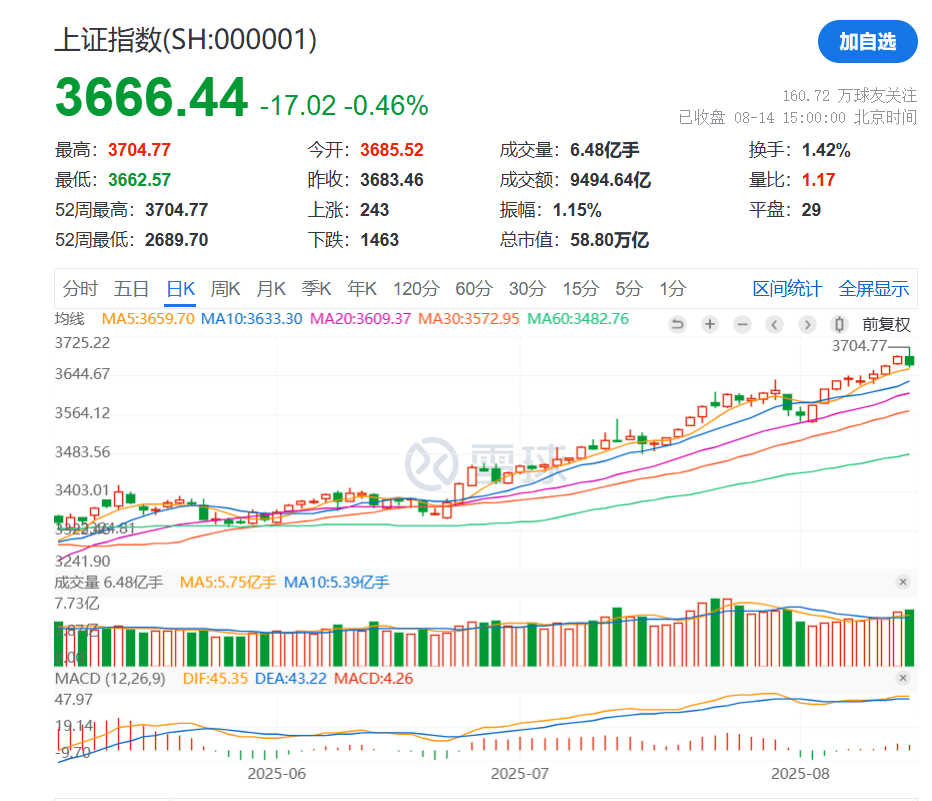
Market Overview - A-shares have recently surged, breaking through the 3700-point mark, reaching a four-year high, the last occurrence being in December 2021 [1][3] - The market experienced a significant drop after briefly surpassing 3700 points, with major indices like the Shanghai Composite and Hang Seng turning negative [3][6] Market Dynamics - The rise in A-shares is attributed to various factors including easing monetary policies, strong performance from insurance funds, and active retail trading [3][6] - The recent market correction is seen as a healthy adjustment after a substantial increase, particularly affecting stocks in hot sectors such as military, PCB, and CPO, which had previously gained around 10% in the last ten days [6][14] Investor Sentiment - There is a noticeable increase in retail investor interest, with many individuals sharing their stock market gains on social media, indicating a growing enthusiasm for stock trading [6][8] - Prominent fund managers are publicly sharing their investment strategies, with some managing substantial amounts, reflecting a trend of increased transparency in the investment community [6][17] Future Outlook - Analysts suggest that the market may experience fluctuations in the short term, with potential for a significant upward movement around mid-September [16][17] - Key upcoming events, such as the Federal Reserve's meetings and important policy announcements in October, are expected to influence market dynamics and investor confidence [17][18] Sector Performance - Specific sectors like military equipment, PCB, and CPO have shown significant declines, with the PCB index dropping by 4.37%, indicating a broader trend of profit-taking in previously high-performing areas [5][14] - The market is characterized by a "bull market" mentality, with strategies focusing on liquidity and fundamental growth expected to drive future performance [18]

A股市场:短期上行,四季度或震荡,明年有望再上台阶
Xin Lang Zheng Quan· 2025-08-14 07:50
Group 1 - The A-share market has potential favorable factors, with key attention on the upcoming Federal Reserve meeting and possible interest rate cuts in September, which may lead to a phase of market consolidation when expectations are realized [1] - Important policy windows such as the Fourth Plenary Session in October, the formulation of the 14th Five-Year Plan, and the Central Economic Work Conference at the end of the year could act as catalysts for market breakthroughs [1] - The current market is in an upward channel, but a healthy consolidation phase may occur in the fourth quarter, laying the groundwork for profit growth stories in the following year, with the market expected to reach new heights [1] Group 2 - Investors should closely monitor the dynamic balance of policies and funds to grasp changes in market rhythms [1]

南华煤焦产业风险管理日报-20250805
Nan Hua Qi Huo· 2025-08-05 11:51
Group 1: Report Industry Investment Rating - Not provided Group 2: Core Views of the Report - The market sentiment was reignited by the news of strict inspections on over - production in Shanxi coal mines, and the far - month contracts of coking coal hit the daily limit first. The strengthening of the reverse spread of coking coal 9 - 1 reflects concerns about near - month delivery pressure and strong expectations for far - month valuations. The "anti - involution" policy may be hyped repeatedly, and the coking coal futures price is expected to be more volatile. The report is not pessimistic about the medium - and long - term trends of coal and coke. Attention should be paid to macro events at home and abroad such as the military parade, the Fed's interest rate cut game, and the Fourth Plenary Session. Investors without spot handling ability are not recommended to participate in the delivery game near the 09 contract delivery. The previously recommended coking coal 9 - 1 reverse spread can consider taking profits, and it is recommended to temporarily observe the 09 on - disk coking profit [4]. Group 3: Summary by Relevant Catalogs 1. Price Forecast and Risk Management Strategy - **Price Forecast**: The monthly price range for coking coal is predicted to be 950 - 1350, with a current 20 - day rolling volatility of 32.68% and a historical percentile of 63.87%. For coke, the monthly price range is 1480 - 1900, with a current 20 - day rolling volatility of 25.37% and a historical percentile of 49.13% [3]. - **Risk Management Strategy**: For the arbitrage scenario of monthly spread arbitrage with no spot exposure, the recommended strategy is to short the coking coal 9 - 1 spread (jm2509&jm2601), with a suggested entry range of (- 40, - 30) [3]. 2. Black Warehouse Receipt Daily Report - On August 5, 2025, compared with August 4, 2025, the warehouse receipts of rebar increased by 5723 tons to 88363 tons, hot - rolled coil remained unchanged at 55998 tons, iron ore remained unchanged at 3600 hands, coking coal decreased by 500 hands to 0 hands, coke remained unchanged at 760 hands, ferrosilicon decreased by 112 sheets to 21930 sheets, and silicomanganese decreased by 243 sheets to 77611 sheets [3]. 3. Core Contradictions - The news of strict inspections on over - production in Shanxi coal mines reignited market sentiment, and the far - month contracts of coking coal hit the daily limit first. The strengthening of the coking coal 9 - 1 reverse spread reflects concerns about near - month delivery pressure and strong expectations for far - month valuations. The "anti - involution" policy may be hyped repeatedly, and the coking coal futures price is expected to be more volatile. The report is not pessimistic about the medium - and long - term trends of coal and coke. Attention should be paid to macro events at home and abroad. Near the 09 contract delivery, investors without spot handling ability are not recommended to participate in the delivery game, and the previously recommended coking coal 9 - 1 reverse spread can consider taking profits, and it is recommended to temporarily observe the 09 on - disk coking profit [4]. 4. Profit and Loss Analysis - **Positive Factors**: The expectation of "anti - involution" in coal mines remains, and the mine production increase space in the second half of the year may be limited. The downstream steel mills have good profits, providing a basis for raw material price increases. There is room for policy expectation game before the Fourth Plenary Session in October [5]. - **Negative Factors**: The import profit of overseas coal has recovered, and there will be pressure on subsequent arrivals. The customs clearance of Mongolian coal has resumed, with more than 1000 trucks per day currently. Off - balance - sheet inventory in the spot - futures market flows into the market, putting pressure on spot prices [5]. 5. Coal and Coke Futures and Spot Prices - **Futures Prices**: On August 5, 2025, compared with August 4, 2025, the basis of coking coal and coke futures had different degrees of change, and the on - disk coking profit decreased from - 18 to - 50 [6]. - **Spot Prices**: On August 5, 2025, compared with August 4, 2025, most coal and coke spot prices remained unchanged, and the immediate coking profit increased from - 60 to - 12 [7]. 6. Import Profits and Ratios - **Import Profits**: On August 5, 2025, compared with August 4, 2025, the import profit of Mongolian coal (long - term agreement) decreased by 51 to 234 yuan/ton, the import profit of Australian coal (Peak Downs) increased by 15 to - 241 yuan/ton, etc [8]. - **Ratios**: On August 5, 2025, compared with August 4, 2025, the ratio of coking coal to thermal coal increased from 2.39 to 2.4072 [8].

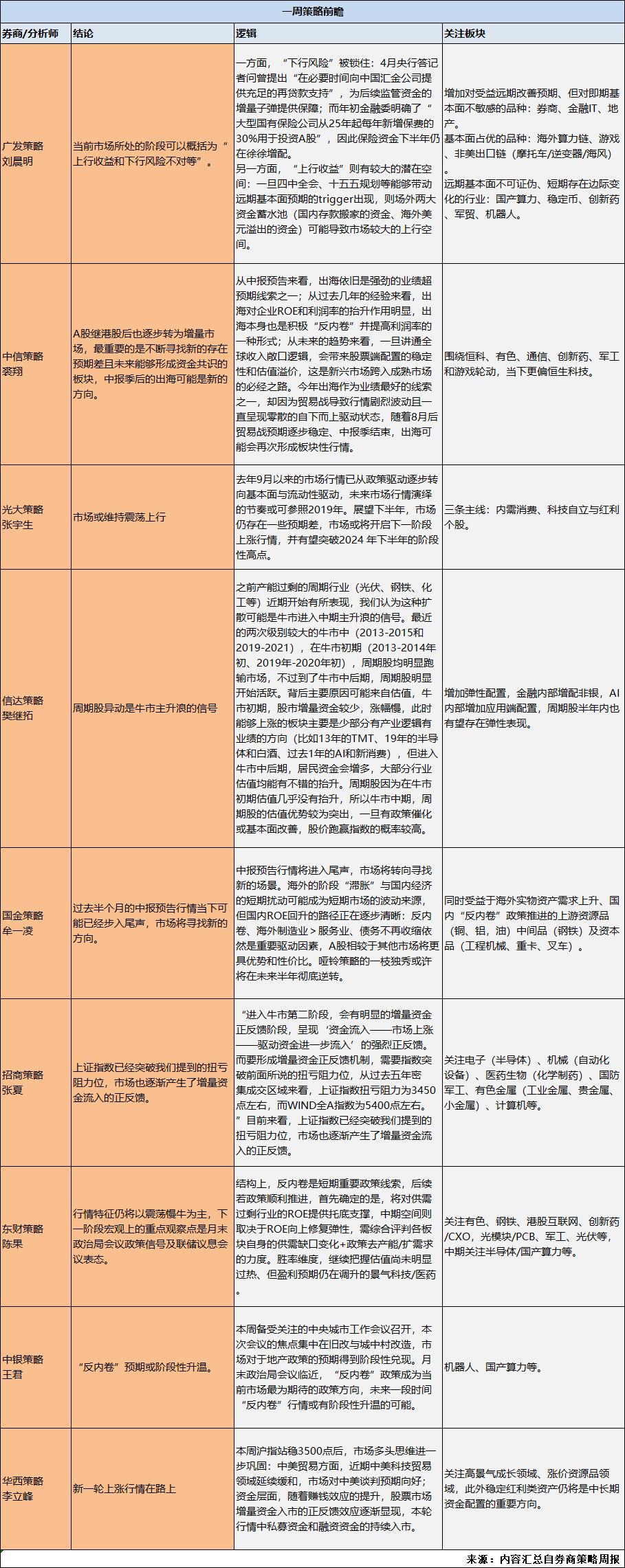
A股分析师前瞻:普遍积极,“上行收益”有较大的潜在空间
Xuan Gu Bao· 2025-07-20 15:06
Group 1 - The current market stage is characterized by "asymmetric upside potential and locked downside risk," indicating that while downside risks are contained, there is significant room for upside gains [1][2] - The People's Bank of China has provided assurances for sufficient re-lending support to financial institutions, which is expected to bolster market liquidity [1][2] - Large state-owned insurance companies are mandated to invest 30% of their new premiums in A-shares starting from 2025, suggesting a gradual increase in insurance capital allocation to the market [1][2] Group 2 - The recent performance of cyclical stocks may signal the onset of a mid-term bull market rally, as these stocks typically underperform in the early stages of a bull market but gain traction later [2][3] - Historical data from previous bull markets (2013-2015 and 2019-2021) shows that cyclical stocks lag in the early phases but become more active as the market matures, primarily due to valuation advantages [2][3] - The Shanghai Composite Index has surpassed the resistance level of 3450 points, indicating a positive feedback loop of incremental capital inflow into the market [3][4] Group 3 - The market is expected to maintain a slow upward trend, driven by fundamental improvements and liquidity dynamics, with a focus on sectors such as domestic consumption, technology independence, and resource stocks [3][4] - The upcoming Central Urban Work Conference is anticipated to address urban renewal and village renovation, which may influence market expectations regarding real estate policies [4]