央行购金潮

Search documents
黄金飙破4400美元!专家重磅发声:突破5000美元并非没有可能
Sou Hu Cai Jing· 2025-12-23 00:56
Core Viewpoint - The recent surge in gold prices, reaching a historic high of $4,400 per ounce, raises questions about whether this is a short-term spike or the beginning of a long-term bull market, with speculation about potential prices exceeding $5,000 in the future [1][3]. Group 1: Factors Driving Gold Prices - The Federal Reserve's policy shift is seen as a key driver, with expectations of interest rate cuts by 2025 due to falling inflation and a cooling job market, enhancing the appeal of non-yielding assets like gold [3]. - Central banks are increasing their gold purchases as part of a strategy to diversify foreign exchange reserves and reduce reliance on the US dollar, creating a stable and rigid demand for gold [3]. - Long-term geopolitical and financial risks, including tensions in the Middle East and high debt levels in Europe and the US, are reinforcing gold's status as a safe-haven asset [3]. Group 2: Market Sentiment and Predictions - Despite the historical price peak, caution is advised as gold prices are highly sensitive to monetary policy expectations and risk sentiment, with potential for significant volatility if the Fed delays rate cuts or if the dollar strengthens unexpectedly [5]. - Institutions like ANZ have predicted that gold prices could reach $5,000 per ounce by 2026, contingent on three key variables: the initiation of a global easing cycle, a long-term depreciation of the dollar, and the normalization of geopolitical and financial uncertainties [5].

见证历史,现货黄金首次涨破4408美元
2 1 Shi Ji Jing Ji Bao Dao· 2025-12-22 05:47
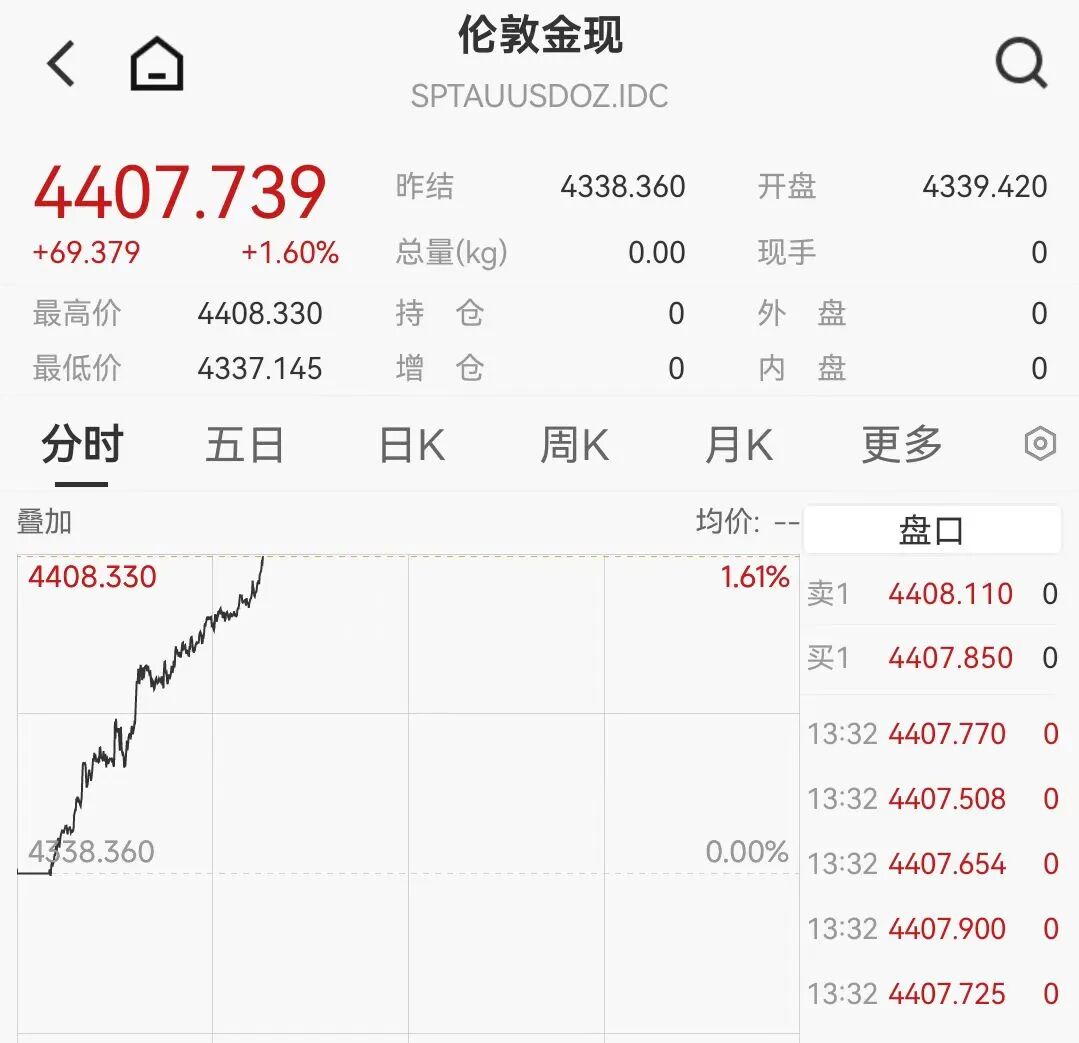
Core Insights - The spot gold price has reached a historic high of $4,407.7 per ounce, with a daily increase of over 1.5% and an annual increase of over 67% [1][3] - Other precious metals have also surged, with platinum rising to $2,056, an increase of over 4% and an annual increase of over 127%, while palladium has seen an annual increase of over 95% [2][3] - Silver prices have also reached new highs, with spot silver exceeding $69 per ounce, marking an annual increase of approximately 139.64% [3] Market Dynamics - The market is experiencing heightened expectations for a potential interest rate cut by the Federal Reserve in 2026, alongside increasing geopolitical uncertainties as the holiday season approaches, which supports gold prices [3][4] - The global demand for gold is being driven by a surge in risk aversion, skepticism towards the U.S. dollar credit system, and continued central bank purchases of gold [4] Investment Trends - In November, global physical gold ETF inflows reached $5.2 billion, marking six consecutive months of inflows, with total assets under management rising to $530 billion, a 5.4% increase [4] - The total holdings in gold ETFs have increased by 1% to 3,932 tons, setting new records, and the total inflow for the year is expected to achieve the best annual performance in history [4] Future Outlook - The short-term bullish outlook for gold is expected to remain unchanged, with price targets potentially moving to the range of $4,500 to $5,000 per ounce, and extreme scenarios could see prices surpassing $5,200 [4]
见证历史,现货黄金首次涨破4408美元
21世纪经济报道· 2025-12-22 05:43
Core Viewpoint - The article highlights the significant surge in precious metal prices, particularly gold, which has reached a historical high, driven by various economic factors and market sentiments [1][4]. Group 1: Gold Market Performance - As of December 22, the spot gold price hit $4407.7 per ounce, with a daily increase of over 1.5%, marking a year-to-date increase of over 67% [1][3]. - The global physical gold ETF inflows reached $5.2 billion in November, continuing a six-month streak of inflows, with total assets under management rising to $530 billion [4]. Group 2: Other Precious Metals - Platinum prices surged to $2056 per ounce, reflecting a year-to-date increase of over 127%, while palladium prices also rose significantly, exceeding 95% year-to-date [2][3]. - Silver prices reached above $69 per ounce, achieving a historical high with a year-to-date increase of approximately 139.64% [3]. Group 3: Economic Factors Influencing Prices - The rise in gold prices is attributed to heightened global risk aversion, skepticism towards the U.S. dollar credit system, and ongoing central bank gold purchases [4]. - Market expectations for a potential interest rate cut by the Federal Reserve in 2026, along with increasing geopolitical uncertainties, are providing additional support for gold prices [3][4].
美联储降息倒计时:都是谁在等风来?
Tai Mei Ti A P P· 2025-12-10 11:25
Group 1: Federal Reserve Decision - The Federal Reserve is expected to lower interest rates by 25 basis points, with significant attention on Chairman Powell's handling of internal dissent among committee members [1][2] - There is a rare internal division within the Federal Reserve, with at least five out of twelve voting members favoring a pause in rate cuts, which could lead to a historic number of dissenting votes [2] - Powell faces political pressure as his term ends in mid-2026, complicating his policy decisions and increasing scrutiny from the market [2] Group 2: Gold and Silver Market Dynamics - The gold market is in a "rate cut countdown" mode, with traders pricing in an 87% probability of a 25 basis point rate cut, supporting the inflow of safe-haven assets [3] - The gold price fluctuated between $4,163.80 and $4,264.70, closing at $4,198.68, indicating a slight decline of 0.41% [3] - The gold-silver ratio remains high at around 86, suggesting silver is undervalued compared to gold, creating opportunities for investors to shift towards silver for potential gains [3] Group 3: Hong Kong Stock Market - The Hong Kong stock market is experiencing a tug-of-war between global liquidity expectations and actual economic fundamentals, leading to a market pullback since Q4 2025 [5][6] - Despite the market's volatility, the economic fundamentals in Hong Kong, supported by resilient domestic macro data and strong export performance, provide a buffer for the stock market [6] - The valuation advantage of Hong Kong stocks is notable, with the Hang Seng Stock Connect Index's TTM P/E ratio at 11.68, significantly lower than other indices, indicating potential for future foreign capital inflow [7]
12月9日金价:大家要提前做好准备,接下来,金价要迎来更大变盘
Sou Hu Cai Jing· 2025-12-09 16:22
Group 1 - The core viewpoint of the articles revolves around the volatility of gold prices influenced by market expectations regarding the Federal Reserve's interest rate decisions, with significant fluctuations in the probability of a rate cut impacting gold prices [1][3] - The current gold price is experiencing intense fluctuations around the $4200 mark, with a notable drop from a high of $4218.91 to around $4180, reflecting the market's extreme bets on the Fed's December meeting [1] - The divergence in gold prices between investment bars and retail jewelry indicates rising anxiety in the market, with investment gold bars priced at 968 yuan per gram, while retail jewelry prices remain above 1300 yuan per gram, creating a significant price gap of 360 yuan [1] Group 2 - The Federal Reserve is experiencing unprecedented internal divisions regarding interest rate cuts, with only 3 out of 12 voting members clearly supporting a rate cut, leading to uncertainty in market predictions [3] - The upcoming "dot plot" from the Fed will reveal the anticipated interest rate path for 2026, which could significantly influence gold prices, potentially pushing them above $4300 or down to the psychological level of $4000 depending on the Fed's stance [3] - Central banks globally have significantly increased gold purchases, with a net acquisition of 987 tons in the first three quarters of 2025, surpassing the total for 2022, indicating a strategic shift to reduce reliance on a single currency [5] Group 3 - The gold ETF market has seen substantial inflows, with a total increase of 298 tons in the first three quarters of 2025, highlighting a mismatch between extreme bullish positions and tight physical inventory, which could lead to market vulnerabilities [7] - The current gold price trend mirrors that of 2015, where prices initially fell before entering a prolonged bull market, with key resistance levels around $4250 and support between $4130 and $4150 [9] - High gold prices have suppressed physical demand, with a 19% year-on-year decline in gold jewelry demand in Q3 2025, while investment demand has risen, as evidenced by an increase in bank gold bar sales premiums and ETF holdings [11]
一财主播说|贵金属风云又起 白银领涨 金价重回4260美元上方 上涨空间还有多大?
Di Yi Cai Jing· 2025-12-01 02:44
Core Viewpoint - The precious metals sector has regained focus, with silver prices reaching a historical high of $57.245 per ounce, reflecting a weekly increase of 13% [1]. Group 1: Silver Market - COMEX silver futures surged to $57.245 per ounce, marking a new historical peak [1]. - London spot silver also broke through $56.5 per ounce [1]. - UBS has raised its silver price forecast, expecting it to reach $60 per ounce by 2026 [1]. Group 2: Gold and Copper Markets - Gold prices on COMEX have returned above $4263 per ounce, while LME copper prices are nearing historical highs [1]. - Although gold's price increase is not as significant as silver's, bullish sentiment in the market is re-emerging [1]. Group 3: Economic Factors - The recent surge in precious metals is supported by global economic uncertainty and rising inflation expectations [1]. - Factors such as high U.S. debt, geopolitical conflict uncertainties, and central bank gold purchases are providing long-term support for gold prices [1]. - The probability of a 25 basis point rate cut by the Federal Reserve in December has risen to 85.4%, up from approximately 40% a week ago [1].
香港第一金:金价突破4070美元一带,现在上车还来得及吗?
Sou Hu Cai Jing· 2025-10-13 08:49
Core Viewpoint - The gold market has shown a strong upward trend, with spot gold prices reaching historical highs due to escalating trade tensions and expectations of interest rate cuts by the Federal Reserve [2][3][6]. Group 1: Price Movements - On Monday morning, spot gold prices surged to $4,059.30 per ounce, marking a historical peak [3]. - The upward trend continued, with prices breaking through the $4,070 per ounce mark in the afternoon [4]. - Domestic gold jewelry prices have also risen, with brands like Chow Tai Fook and Lao Feng Xiang seeing prices exceed 1,190 yuan per gram [5]. Group 2: Driving Forces - Trade tensions have intensified, with the U.S. announcing a 100% tariff on Chinese goods and implementing key software export controls, leading to increased global market risk aversion [6]. - There is a strong expectation for the Federal Reserve to cut interest rates by 25 basis points in both October and December, with a 96% probability for the October cut, putting further pressure on the dollar and supporting gold prices [6]. - Central bank gold purchases continue, with China's gold reserves rising for 11 consecutive months, reaching 74.06 million ounces by the end of September, and global central banks net purchasing 166 tons of gold in Q2, providing a "safety cushion" for gold prices [6]. Group 3: Market Strategy - The bullish trend remains intact, with any pullback seen as a buying opportunity [6]. - Key support levels to watch include $4,020 (short-term buying point) and $4,000 (psychological strong support), with a warning of deeper corrections if prices fall below $3,965 [7]. - Suggested trading strategy includes entering long positions in the $4,020-$4,030 range for aggressive traders, while conservative traders should wait for the $4,010-$4,000 range, with stop-loss set below $3,980 [8]. The short-term target is $4,070-$4,080, with potential to hold for $4,200 if broken [8].

黄金站上4000美元:历史性突破的机遇与警示
Sou Hu Cai Jing· 2025-10-08 23:48
Core Viewpoint - The international spot gold price has historically surpassed $4000 per ounce for the first time, indicating a significant surge in gold prices driven by various factors, including increased demand for safe-haven assets and expectations of monetary policy changes [3][4]. Price Surge - On October 7, 2025, gold futures prices reached $4000.05 per ounce, marking a historic milestone. Following this, on October 8, the spot gold price also crossed the $4000 threshold, peaking at $4020.9 per ounce [4]. - Since the beginning of 2025, gold prices have risen over 50%, potentially achieving the strongest annual increase since 1979 [3][4]. Driving Factors - **Increased Safe-Haven Demand**: The ongoing U.S. government shutdown crisis has significantly boosted demand for gold as a safe-haven asset, with predictions of permanent job losses in federal positions [5]. - **Monetary Policy Expectations**: Anticipation of multiple interest rate cuts by the Federal Reserve has contributed to rising gold prices, as lower real interest rates reduce the opportunity cost of holding non-yielding gold [5]. - **Central Bank Gold Purchases**: Global central banks have been increasing their gold reserves, with China's central bank reporting a gold reserve of 74.06 million ounces as of September, marking the 11th consecutive month of increases [6]. Historical Context - Over the past 50 years, gold prices have shown a clear cyclical pattern, increasing from $35 per ounce in 1971 to a current price that has risen 94 times, demonstrating its long-term value as a safe-haven asset [7]. - Major price increases have occurred in distinct phases, influenced by various geopolitical and economic factors, including the end of the gold standard, oil crises, and financial market turmoil [7]. Market Outlook - Major financial institutions remain optimistic about future gold prices, with Goldman Sachs raising its 2026 gold price forecast from $4300 to $4900 per ounce, citing strong inflows into ETFs and continued central bank purchases [8]. - UBS predicts gold prices will reach $4200 per ounce by the end of the year, supported by fundamental and momentum factors [8].
环球智投:黄金大涨背后的五大驱动因素深度解析
Sou Hu Cai Jing· 2025-09-29 09:31
Group 1: Federal Reserve Policy Shift - The Federal Reserve is transitioning from a hawkish to a dovish stance, with Chairman Powell indicating that inflation is nearing target levels and monetary policy will gradually shift towards easing [1] - Market expectations for a rate cut in November have surged to 92%, significantly lowering the holding cost of gold, which has led to gold prices breaking historical highs [1] Group 2: Geopolitical Risks - The escalation of the Russia-Ukraine conflict and the breakdown of negotiations over Iran's nuclear issue have heightened global risk aversion, resulting in a single-day influx of over $5 billion into gold [2] Group 3: Weakening Dollar Index - The dollar index has fallen from a high of 105 to below 103, which has positively impacted gold prices, as historical data shows that a 1% drop in the dollar index correlates with an average 1.2% increase in gold prices [3] Group 4: Central Bank Gold Purchases - Central banks globally have increased gold purchases, with a report indicating that by 2025, purchases will exceed 1,200 tons, and China's central bank has been increasing its holdings for 10 consecutive months, raising gold reserves to 7.2% [4] Group 5: Rising Inflation Expectations - Despite the Federal Reserve's attempts to control inflation, rising energy prices and supply chain disruptions are pushing inflation expectations higher, increasing the demand for gold as a traditional hedge against inflation [5] Group 6: Investment Recommendations - Short-term focus on a support level of $3,680 for gold, with a recommendation to increase the allocation to 15% of the asset portfolio for the medium to long term [6] Group 7: Technical Analysis of Gold - Gold has confirmed a "flag breakout" on the weekly chart, closing at $3,727, indicating strong bullish momentum [7] - The key resistance level of $3,700 has turned into strong support, with the next target at $3,820 based on Fibonacci extension [8] Group 8: Domestic Gold Market Insights - Domestic demand for gold jewelry has decreased by 24%, while investment gold bars have surged by 25%, indicating a shift from consumption to preservation of value [10][11] - The price difference between domestic and international gold has reached a historical high, presenting arbitrage opportunities for professional investors [12] Group 9: U.S. Treasury Yield Inversion - The 10-year U.S. Treasury yield has dropped below 4%, showing a strong negative correlation with gold prices, which reduces the holding cost of gold [14] - Bridgewater Associates has increased its holdings in gold ETFs from 15% to 25%, reflecting institutional concerns over stagflation risks [15] Group 10: Gold Mining and Recycling Trends - The average global gold mining cost has risen to $1,800, putting pressure on mining profits, suggesting a focus on low-cost leaders like Barrick Gold [17] - The volume of gold recycling has increased by 40% year-on-year, with a record 120 tons recycled in September [18] - The open interest in gold options has doubled, indicating a surge in market hedging demand [19]
金价再上历史高位!3800美元后还能进场吗?
Sou Hu Cai Jing· 2025-09-23 13:10
Core Viewpoint - The recent surge in gold prices, surpassing $3800 per ounce, is driven by a combination of factors including anticipated interest rate cuts by the Federal Reserve, geopolitical tensions, and increased central bank gold purchases [2][4][9]. Group 1: Market Dynamics - Gold futures prices on the New York Commodity Exchange have seen a significant increase, breaking the $3800 per ounce barrier [2]. - In the domestic market, gold bar prices reached 843 RMB per gram, with major brands like Chow Tai Fook and Lao Feng Xiang seeing prices rise to 1098 RMB per gram, reflecting a daily increase of over 10 RMB [2]. - The influx of new capital into the gold market has been identified as a direct driver of the price increase [3]. Group 2: Federal Reserve Influence - The Federal Reserve's decision to lower interest rates is considered a key catalyst for the rising gold prices [4]. - Market expectations suggest that the Federal Reserve may cut rates 1-2 more times this year, which typically inversely affects gold prices [5]. - An analysis report indicates a greater than 60% probability of two additional rate cuts in the fourth quarter, further fueling gold price increases [6]. Group 3: Geopolitical Factors - Ongoing geopolitical conflicts, particularly in the Middle East, have heightened market risk aversion, leading investors to seek safety in gold [7]. - Recent global recognition of Palestine by several countries has escalated tensions, contributing to the demand for gold as a safe-haven asset [7]. Group 4: Central Bank Purchases - The People's Bank of China has increased its gold reserves to 74.02 million ounces (approximately 2302 tons), marking the tenth consecutive month of purchases [9]. - Data indicates that the proportion of gold in global central bank reserves has surpassed that of U.S. Treasury bonds for the first time since 1996, reflecting a strategic shift towards physical assets [9]. Group 5: Future Price Outlook - There are differing opinions on the future trajectory of gold prices. Some analysts believe that the current environment supports a prolonged upward trend, potentially reaching $4000 per ounce [10]. - Concerns about a possible short-term price correction exist, as historical patterns show that gold bull markets often experience pullbacks [10]. - Investors are advised to consider safer investment options such as gold ETFs or physical gold, while being cautious of the risks associated with high leverage products [11].