
房价

Search documents
新房成交环比四连增
HUAXI Securities· 2025-12-06 12:25
Report Summary 1. Investment Rating The provided content does not mention the industry investment rating. 2. Core Viewpoints - The new - home market shows signs of marginal repair with four consecutive weeks of环比 growth, but the year - on - year readings are under pressure due to high - base effects. The second - hand housing market has certain resilience, though it also experiences fluctuations [1][2]. - There are significant structural differences in the real - estate market across different city tiers. First - tier cities have a mixed performance in new - and second - hand housing, while second - and third - tier cities also show different trends in new - and second - hand housing transactions [3][6]. - The second - hand housing listing prices show a differentiated trend among different city tiers, with first - tier cities stabilizing, and second - and third - tier cities continuing to decline [7]. 3. Summary by Relevant Catalogs 3.1 Weekly Data - **New Homes**: In the week from November 28 to December 4, the transaction area of new homes in 38 cities reached 2.92 million square meters, a 5%环比 increase, and the absolute scale is higher than the past four weeks, indicating a gradual recovery [1]. - **Second - hand Homes**: The transaction area of second - hand homes in 15 cities was 2.14 million square meters, a 3%环比 decline after two weeks of high - level consolidation. However, the trading volume in the past four weeks remained relatively stable [1]. - **Year - on - year**: Affected by high - base effects, both new - and second - hand home transactions declined year - on - year, with the decline in second - hand homes expanding significantly [1]. 3.2 Monthly Data - **New Homes**: In November, the transaction area of new homes in 38 cities decreased by 35% year - on - year, a further decline from the 27% drop in October, mainly due to the high - base effect of the same period last year [2]. - **Second - hand Homes**: In November, the transaction area of second - hand homes in 15 cities decreased by 20% year - on - year, the same as in October, showing stronger resilience compared to the new - home market [2]. 3.3 First - tier City Performance - **New Homes**: The new - home market in first - tier cities continued to recover, with a 7%环比 increase in weekly transactions, but the growth rate narrowed. There was significant differentiation among cities, with Beijing showing a large increase due to a low - base effect, while Guangzhou and Shenzhen declined [3]. - **Second - hand Homes**: The second - hand housing market cooled down, with a 4%环比 decline in the combined transactions of Beijing, Shanghai, and Shenzhen. All three cities experienced declines [3]. - **Year - on - year**: Both new - and second - hand home transactions in first - tier cities declined year - on - year, with the decline in second - hand homes expanding significantly. Shenzhen was particularly affected by the high - base effect [4]. 3.4 Second - and Third - tier City Performance - **Second - tier Cities**: New - home transactions increased slightly by 6%环比, but the recovery momentum was weak. Second - hand home transactions decreased by 7%环比 [6]. - **Third - tier Cities**: New - home transactions increased for three consecutive weeks, with a 3%环比 increase this week. Second - hand home transactions increased by 11%环比, approaching the annual high [6]. - **Year - on - year**: In second - tier cities, the decline in both new - and second - hand home transactions expanded. In third - tier cities, the decline in new - home transactions narrowed marginally [6]. 3.5 Housing Price Observation - **Overall**: From November 24 to December 1, the listing prices of second - hand homes in first - tier cities stabilized, while those in second - and third - tier cities continued to decline [7]. - **First - tier Cities**: Shenzhen's listing price rebounded, while other first - tier cities declined. Guangzhou had the deepest year - on - year decline [7]. - **Second - tier Cities**: Xi'an and Wuhan had relatively strong环比 performance, but their long - term prices were still in a downward adjustment channel. Hangzhou was relatively resistant to decline [7].
读懂当前经济,李稻葵解读房价、返乡与货币政策,误解该澄清了
Sou Hu Cai Jing· 2025-12-05 15:27
Group 1 - The core viewpoint of the article emphasizes the importance of transaction volume over price fluctuations in the real estate market, suggesting that true market conditions are better reflected by transaction activity rather than just price trends [3][5][9] - Historical trends indicate that significant shifts in the real estate market often begin with changes in transaction volume, as seen in previous years where volume changes preceded price adjustments [5][9] - Regional differentiation is crucial in real estate analysis, as different cities exhibit varying trends in transaction volume and price stability, highlighting the need for localized market assessments [9][12] Group 2 - The "return to hometown" policy has been misinterpreted; the focus is on preventing returning populations from facing unemployment and poverty, rather than restricting urban migration [9][10][12] - The policy aims to create job opportunities in rural areas while also supporting urban employment stability, ensuring that individuals have viable options whether they choose to stay in cities or return to their hometowns [12][14] - The monetary policy in China is independent and tailored to domestic economic conditions, rather than simply following the U.S. Federal Reserve's actions, emphasizing a more localized approach to economic management [14][16][18]


“十五五”居民消费率明显提高大有可为
Di Yi Cai Jing· 2025-12-01 12:39
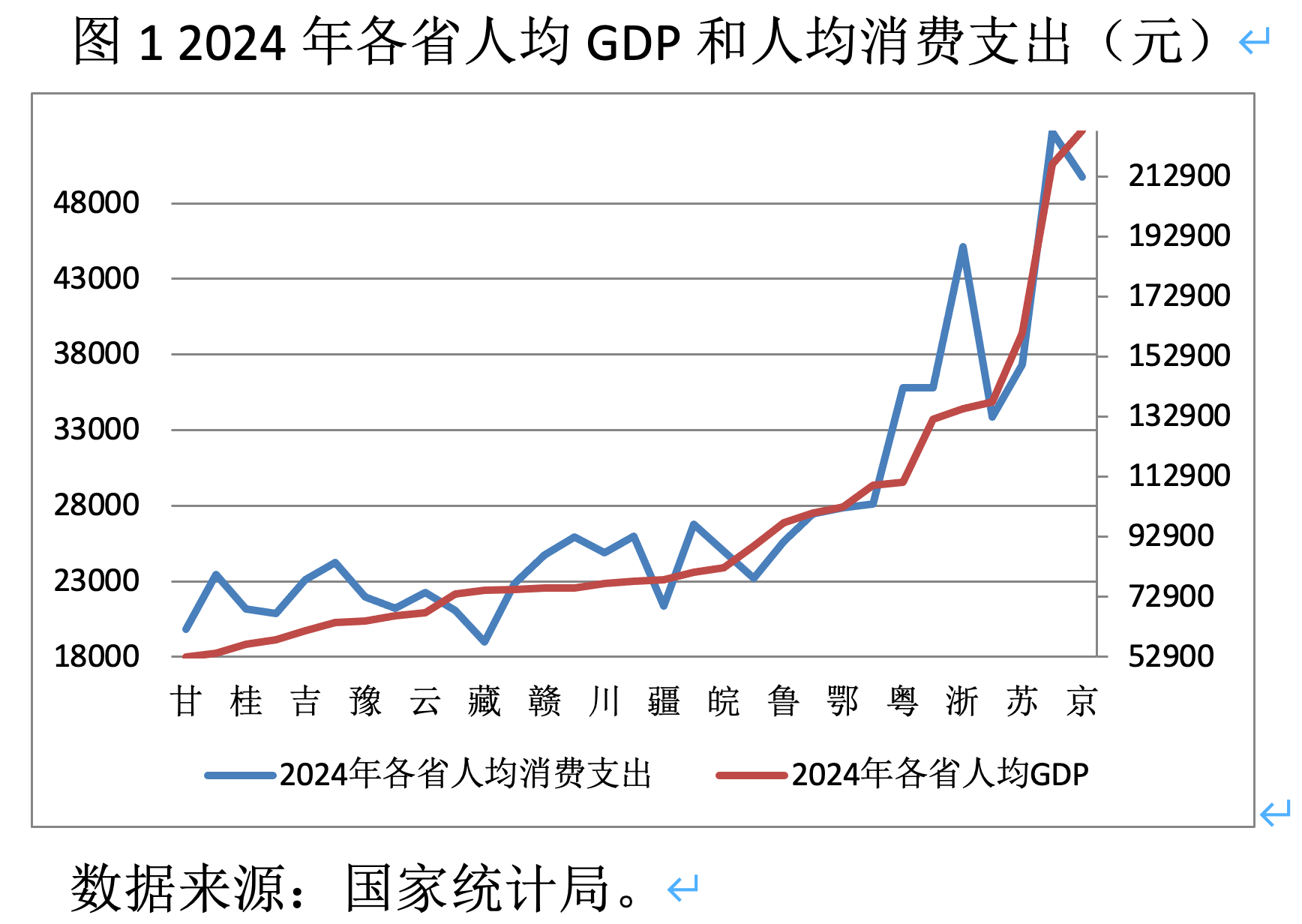
Group 1 - The core viewpoint is that the timing for increasing China's consumption rate is gradually approaching, as highlighted in the central government's proposal for the 15th Five-Year Plan, which emphasizes the need for a consumption-driven economic model [1][2][5] - The proposal suggests that improving residents' income is essential for increasing overall consumption, indicating a correlation between economic development and higher consumption levels in more developed provinces [2][5] - There is a significant disparity in average consumption rates across different regions and income levels in China, with some provinces showing higher consumption rates despite similar income levels [5][7] Group 2 - The relationship between rising housing prices and consumer spending is complex, exhibiting both substitution and complementary effects, where rising housing costs can displace spending in other areas [11][13] - The financial sector has a substantial role in promoting increased consumption rates, with recent government initiatives encouraging financial institutions to enhance personal consumption loan offerings [15][20] - The trend of consumer loans in China has seen fluctuations, with a notable peak in 2016, followed by a decline, indicating a potential shift in consumer behavior and financial strategies [15][16] Group 3 - The classification of housing purchases as investments rather than consumption in statistical reports affects the perception of consumer spending, as many households buy homes primarily for self-use [13][21] - The interplay between housing loans and consumer loans is significant, with higher levels of one type of loan impacting the availability of the other, reflecting a balancing act in household financial management [23][24] - As housing prices stabilize, there is potential for increased consumer spending as household debt constraints ease, particularly among groups with higher average consumption tendencies [24]
那套让我负债多年的房子,我终于卖了
Sou Hu Cai Jing· 2025-11-30 01:42
Core Insights - The narrative highlights the emotional and financial burdens associated with homeownership, particularly the stress of mortgage payments and the impact on personal well-being [3][6][8] - The decision to sell the property is portrayed as a means to regain control over one's life and alleviate financial pressure, despite potential losses [4][7][8] Group 1: Emotional Impact of Homeownership - Homeownership is described as a source of anxiety and pressure, leading to feelings of being trapped and financially strained [3][6] - The experience of being a "slave to the mortgage" is emphasized, with individuals questioning their decisions to buy property in a declining market [3][6] Group 2: Market Conditions and Selling Experience - The current real estate market is characterized by falling prices and a surplus of sellers, leading to challenges in selling properties [3][4] - The negotiation process during the sale reflects the broader market sentiment, with buyers also feeling the weight of financial pressure [3][4] Group 3: Personal Reflection and Moving Forward - After selling the property, there is a sense of relief and a newfound ability to focus on personal life rather than financial burdens [7][9] - The narrative serves as a reminder that many individuals share similar struggles with homeownership, encouraging those in similar situations to prioritize their well-being over property ownership [8][9]

一线城市二手房价领跌
HUAXI Securities· 2025-11-15 13:47
受去年"924"新政后销售放量形成的高基数影响,二手房和新房销售同比增速均承压。本周 15 城二手 房成交面积同比下降 21%,已连续第五周走弱(此前曾连续七周同比改善);38 城新房成交面积同比跌幅为 34%,已连续第七周录得负增长。然而,若与 2023 年同期比较以剔除高基数扰动,本周成交表现有所改善。 15 城二手房成交面积较 23 年同期增长 14%,增速较上周(+4%)明显回升;38 城新房成交面积较 23 年同期 下跌 21%,降幅亦较上周(下跌 36%)显著收窄。 2)月度: 证券研究报告|固收点评报告 [Table_Date] 2025 年 11 月 15 日 [Table_Title] 一线城市二手房价领跌 [Table_Title2] able_Summary] 地产周速达 1)周度: 二手房成交连续两周下滑后微增。本周(11 月 7-13 日),15 城二手房成交面积为 219 万平方米,环比增 长 3%,但仍处于过去四周(213–233 万平)区间的低位,约相当于年内高点的 74%。 新房亦自近期低点小幅回升。38城新房成交面积为 220 万平方米,环比小幅增长 2%,同样位于过去四周 ...
新房成交跌至近七周低位
HUAXI Securities· 2025-11-08 14:59
Report Industry Investment Rating No information provided in the content. Core Viewpoints - After the National Day holiday, the property market transactions showed a pattern of "pulsatile rebound and weekly decline." Both second - hand and new home sales cooled down, with new home sales hitting a low in nearly seven weeks, and the decline in transaction volume accelerating compared to the previous week [1][2]. - High - base effects from the same period last year continued to suppress year - on - year growth rates, while the comparison with 2023 showed that second - hand home sales growth slowed and new home sales declines widened [1][2]. - First - tier cities' property markets also faced downward pressure, with both second - hand and new home sales experiencing significant week - on - week and year - on - year declines, and new home sales being weaker [3]. Summary by Relevant Catalogs 1. Overall Market Conditions - **Second - hand Homes**: In the week from October 31st to November 6th, the transaction area of second - hand homes in 15 cities was 2.13 million square meters, a 6% week - on - week decrease, at the lower end of the past four - week range and about 72% of the annual high. Year - on - year, it decreased by 24%, and compared with 2023, the growth rate slowed from 8% to 4% [1][2]. - **New Homes**: The transaction area of new homes in 38 cities was 2.16 million square meters, a 26% week - on - week drop, reaching the lowest point in nearly seven weeks and about 41% of the annual high. Year - on - year, the decline widened to 41%, and compared with 2023, the decline increased from 31% to 36% [1][2]. 2. First - tier City Performance - **Week - on - Week**: Second - hand home sales in Beijing, Shanghai, Shenzhen, and Guangzhou decreased by 9% in total, with Beijing and Shanghai dropping by 14% and 7% respectively, and Shenzhen by 1%. New home sales in these four cities decreased by 20% in total, with Beijing leading the decline at 35%, followed by Guangzhou at 26%, Shenzhen at 16%, and Shanghai at 4% [3]. - **Year - on - Year**: Second - hand home sales in first - tier cities decreased by 19% in total, with Shenzhen and Beijing down 33% and 24% respectively. New home sales decreased by 41%, with Shenzhen, Beijing, and Shanghai down 70%, 47%, and 36% respectively, and Guangzhou down 19% [3]. - **Compared with 2023**: Second - hand home sales in first - tier cities maintained a stable growth of 32% - 37% in the past four weeks, while new home sales remained weak, with a decline of 18% - 33% [3]. 3. Other Major City Observations - **Hangzhou**: Second - hand home sales decreased by 21% week - on - week, equivalent to 39% of the annual high, and new home sales decreased by 42%, equivalent to 25% of the annual high [26]. - **Chengdu**: Second - hand home sales increased by 2% week - on - week, equivalent to 70% of the annual high, and new home sales decreased by 16%, equivalent to 58% of the annual high [26]. 4. Housing Price Observation - From October 27th to November 2nd, the weekly listing prices of second - hand homes in Shanghai, Beijing, and Shenzhen decreased by 0.42%, 0.37%, and 0.40% respectively week - on - week. Compared with the week before the "924" policy last year, they decreased by 3.8%, 10.3%, and 10.0% respectively [46].
国家拉股市促经济不会大跌是种共识了吗?
集思录· 2025-10-28 13:49
Core Viewpoint - The article discusses the current state of the stock market, highlighting the significant increase in share reduction plans by listed companies and the implications for various industries, particularly electronics and semiconductors. Group 1: Share Reduction Plans - As of September 2025, a total of 1,979 listed companies have announced share reduction plans involving 3,597 individuals, with an expected reduction amount exceeding 380 billion [3] - The scale of share reductions in 2025 is significantly larger than the 170 billion in 2024, with over 60% of the reductions occurring during the index rise from May to July [3] - The electronics, computer, and machinery equipment sectors lead in share reduction amounts, with the electronics sector accounting for nearly 20% of total reductions in A-shares [3] Group 2: Market Valuation Comparison - The current price-to-book (PB) ratio of the Shanghai Composite Index at 4,000 points is 2.87, compared to 5 around the same index level in April 2015, indicating a substantial decrease in valuation [5] - The price-to-earnings (PE) ratio has also dropped from 67 times in 2015 to 28.11 currently, suggesting that the current market valuation is significantly lower than in the past [5] - Similar trends are observed in the CSI 500 index, where the PB ratio has decreased from 4.6 to 2.23, and the PE ratio from 50 to 24.33 [5] Group 3: Market Dynamics and Government Role - The government can provide short-term stimulation to the stock market but cannot sustain long-term growth without consistent economic growth, profit sharing through dividends, and regulatory reforms [10] - There is a consensus that the government’s intervention in the stock market is often temporary, with significant volatility following such interventions [11] - The perception of market consensus among retail investors is less critical than that of major shareholders and institutions, whose strategies and sentiments are less transparent [12]

不可理喻!北上广等城市开始流行“洗房”,不少家庭都受影响
Sou Hu Cai Jing· 2025-10-03 22:55
Core Viewpoint - The article discusses the emotional and financial significance of home ownership for ordinary people, highlighting the rising property prices in major cities and the emergence of fraudulent practices like "house washing" as a result of these pressures [1][3][12]. Group 1: Housing Market Dynamics - Over the past two decades, property prices in major cities like Beijing have skyrocketed, making home ownership increasingly unattainable for young people [1][3]. - Many individuals find it nearly impossible to save enough for a down payment in first-tier cities, leading to feelings of despair and frustration [3][12]. Group 2: "House Washing" Explained - "House washing" refers to fraudulent schemes where individuals deceive others into transferring property ownership under the guise of marriage, often involving fake commitments and legal loopholes [5][6]. - This practice is particularly prevalent in high-priced housing markets, where the pressure to own property drives some to resort to unethical means [6][12]. Group 3: Real-Life Consequences - Numerous real-life cases illustrate the devastating impact of "house washing," where victims lose their homes and face emotional trauma, leading to family breakdowns and financial ruin [8][9][10][12]. - The psychological toll on victims is significant, with many experiencing anxiety, depression, and a loss of trust in relationships [12][13]. Group 4: Societal Implications - The rise of "house washing" not only affects individuals but also threatens the integrity of marriage as a social institution, fostering a culture of mistrust and materialism [12][18]. - The normalization of viewing property ownership as a measure of success can lead to a decline in marriage rates and a shift in societal values [12][18]. Group 5: Preventive Measures - The article emphasizes the importance of clear communication regarding financial matters before marriage, including the necessity of legal documentation to protect individual assets [14][15][16]. - Seeking legal advice before adding names to property titles is crucial to avoid potential exploitation [15][16]. - In cases of "house washing," victims are encouraged to seek legal assistance promptly to protect their rights and recover losses [17].
9月全国百城房价出炉!机构:新房价格上涨 二手房环比连跌41个月
天天基金网· 2025-10-02 07:55
Core Viewpoint - The real estate market is experiencing a mixed performance, with new home prices showing slight increases in some cities while second-hand home prices continue to decline, indicating ongoing market adjustments [3][10][11]. New Home Market - In September, the average price of new homes in 100 cities was 16,926 yuan per square meter, a slight increase of 0.09% month-on-month and a year-on-year increase of 2.68% [5][6]. - The third quarter saw a cumulative increase of 0.47% in new home prices, although the growth rate slowed compared to the second quarter [5]. - First-tier cities, such as Shanghai and Guangzhou, showed stronger performance with new home prices rising by 0.82% and 0.32% respectively in September [6][8]. - The increase in new home prices is attributed to the active launch of quality projects in core cities, which is expected to support new home sales [10][11]. Second-Hand Home Market - The average price of second-hand homes in September was 13,381 yuan per square meter, reflecting a month-on-month decrease of 0.74% and a year-on-year decrease of 7.38% [10][11]. - Second-hand home prices have been declining for 41 consecutive months, with a cumulative drop of 5.79% in the first three quarters of the year [10][11]. - The decline in second-hand home prices is particularly pronounced in second-tier cities, which experienced a month-on-month drop of 0.87% in September [11][13]. Market Dynamics - The real estate market is characterized by a significant disparity between first-tier and third/fourth-tier cities, with the latter struggling with inventory issues and price declines [8][10]. - Policies aimed at improving housing quality and easing purchasing restrictions in key cities are being implemented to stimulate demand and stabilize prices [15][16]. - The overall market sentiment remains cautious, with expectations of continued price adjustments in the second-hand market due to high inventory levels [15][16].

央行二季度问卷调查最新出炉
Zheng Quan Shi Bao Wang· 2025-07-30 05:16
Core Insights - The People's Bank of China released the results of the Q2 2025 survey indicating that over half of entrepreneurs and bankers view the current macroeconomic performance as stable and normal, holding a neutral to cautious attitude towards the overall economy [1][3][4] Group 1: Entrepreneur Insights - The entrepreneur's business climate index and profit index both increased compared to the previous quarter, with values of 49.3% and 53.2% respectively, indicating a slight improvement in business sentiment [3] - 50.8% of entrepreneurs believe the macroeconomic performance is normal, while 48.6% consider it "cold" [3] - The survey revealed that 32.5% of entrepreneurs expect to "increase profits or reduce losses," an increase of 6.5 percentage points from the previous quarter [3] Group 2: Banker Insights - The banker macroeconomic heat index for Q2 was 33.2%, a decrease from the previous quarter, with 61.9% of bankers viewing the macroeconomic performance as normal [4] - 50% of bankers rated the monetary policy as loose, with a monetary policy sentiment index of 74.6%, which is high [4] - The banker’s expectation for the macroeconomic heat index for Q3 is 37.3%, indicating a more optimistic outlook compared to Q2 [4] Group 3: Resident Insights - In a survey of urban residents, 69.7% reported that their income remained stable in Q2, with a cautious outlook on employment [5] - 51.5% of residents perceive the employment situation as severe, reflecting a cautious sentiment towards job security [5] - 32.1% of residents plan to increase spending on tourism, surpassing education as the top choice for additional expenditures [2][6]