扩内需促消费

Search documents
金融监管总局:鼓励开发兼具养老风险保障和财富管理功能的商业保险年金产品
Xin Lang Cai Jing· 2026-02-11 07:00
2月11日金融一线消息,国务院新闻办公室今日举行新闻发布会,介绍2026"乐购新春"春节特别活动、 保障春节市场供应有关情况。金融监管总局新闻发言人、政策研究司司长郭武平表示,金融机构是"乐 购新春"活动的重要参与者,扩内需促消费是金融服务实体经济的重要内容,也是金融工作政治性、人 民性的具体体现。金融监管总局引导金融机构优化资源配置,加强金融产品和服务创新,聚焦消费重点 领域和环节,提供高效、精准、便捷的金融服务,满足人民群众多样化的消费金融需求。重点根据不同 消费方式,提供有针对性的金融服务。 2月11日金融一线消息,国务院新闻办公室今日举行新闻发布会,介绍2026"乐购新春"春节特别活动、 保障春节市场供应有关情况。金融监管总局新闻发言人、政策研究司司长郭武平表示,金融机构是"乐 购新春"活动的重要参与者,扩内需促消费是金融服务实体经济的重要内容,也是金融工作政治性、人 民性的具体体现。金融监管总局引导金融机构优化资源配置,加强金融产品和服务创新,聚焦消费重点 领域和环节,提供高效、精准、便捷的金融服务,满足人民群众多样化的消费金融需求。重点根据不同 消费方式,提供有针对性的金融服务。 在服务消费领域, ...
以惠民生为牵引 中国人寿助力扩内需促消费
Jing Ji Ri Bao· 2026-02-03 22:19
Core Viewpoint - China Life Insurance Group is actively engaging in initiatives to enhance consumer welfare and stimulate domestic demand through various insurance products and services, aligning with national policies aimed at improving living standards and economic growth [1][4]. Group 1: Consumer Welfare Initiatives - China Life launched the "Guangzhou Mama Love Plan" to provide affordable insurance coverage, significantly reducing out-of-pocket medical expenses for individuals like a local breakfast shop owner [2]. - The company has been involved in long-term care insurance projects, offering services such as home visits for elderly care, thereby alleviating the burden on families [3]. - In 2025, the total claims paid by China Life's life insurance company exceeded 100.4 billion yuan, while the property insurance company paid out over 72 billion yuan in claims, demonstrating its commitment to consumer protection [3]. Group 2: Investment in Consumer Services - China Life is focusing on enhancing service consumption by investing in senior living communities and health-related projects, such as the "Guangzhou Jia Garden" senior community, which aims to cater to the growing silver economy [4]. - The company has established a 10 billion yuan investment fund targeting the silver economy, indicating a strategic move to meet the diverse needs of the aging population [4]. Group 3: Green and Sustainable Consumption - China Life's subsidiaries are promoting green consumption through innovative financial products, such as low-carbon credit cards and zero down payment options for electric vehicles, integrating financial services into sustainable consumer practices [5]. - The company has introduced specialized insurance for high-risk flower cultivation, providing over 50 million yuan in risk coverage to local farmers, thus supporting the agricultural sector [6]. Group 4: Enhancing Travel and Tourism - China Life has developed a comprehensive service ecosystem for tourism in Hainan, integrating financial services with travel needs, which has led to a 62% increase in credit card spending at duty-free shops [7]. - The company is also innovating in the hospitality sector by transforming traditional hotels into wellness destinations, promoting a shift from sightseeing to health-oriented travel experiences [7]. Group 5: Overall Economic Impact - China Life's initiatives are contributing to a robust domestic consumption environment, with significant increases in travel and spending during holidays, reflecting a shift in consumer preferences towards quality and experience [8]. - The company aims to enhance the resilience of the economic cycle by providing comprehensive financial services that support employment, income, and consumption, thereby contributing to the overall economic development of China [8].

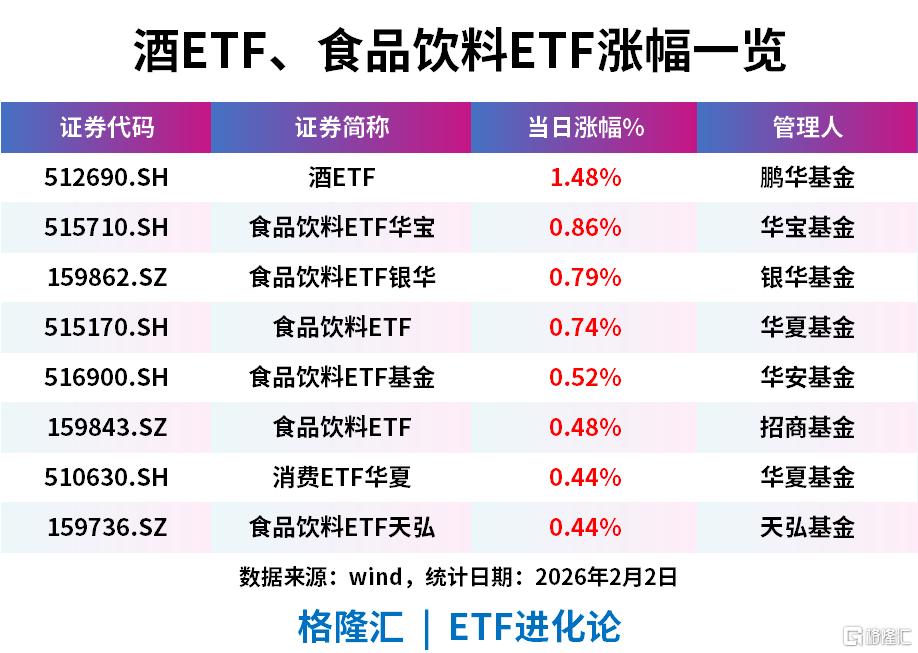
酒ETF、食品饮料ETF逆势上涨,公募基金四季度减配食饮板块
Ge Long Hui A P P· 2026-02-02 07:54
Market Overview - The A-share market experienced a collective decline, with the Shanghai Composite Index falling by 2.48% to 4015 points, the Shenzhen Component Index down by 2.69%, and the ChiNext Index decreasing by 2.46%. The STAR 50 Index dropped by 3.88% [1] - The total market turnover was 2.61 trillion yuan, a decrease of 255.8 billion yuan compared to the previous trading day, with over 4600 stocks declining and more than a hundred hitting the daily limit down [1] Sector Performance - The food and beverage sector showed resilience, with several ETFs in this category, including the liquor ETF and various food and beverage ETFs, experiencing gains [1] - Specific ETFs and their respective gains included: - Liquor ETF: +1.48% - Food and Beverage ETF (Huabao): +0.86% - Food and Beverage ETF (Yinhua): +0.79% - Food and Beverage ETF: +0.74% - Food and Beverage ETF Fund: +0.52% - Food and Beverage ETF: +0.48% - Consumer ETF (Huaxia): +0.44% - Food and Beverage ETF (Tianhong): +0.44% [2] Fund Holdings Analysis - Public funds reduced their allocation to the food and beverage sector in Q4 2025, with the heavy holdings in this sector dropping to 6%, a decrease of 0.3 percentage points from the previous quarter [4] - The food and beverage sector ranked 7th in heavy holdings among all industries, with a slight decrease in its over-allocation status, now at 2.5 percentage points [4] - Both active and passive funds reduced their allocations, with passive funds showing a more significant decrease [4] Stock Performance Insights - The leading liquor stocks, including Kweichow Moutai, experienced a reduction in allocation, while consumer goods stocks saw notable increases in holdings [5] - Specific increases in holdings included: - Yurun Agriculture: +256.7% - Modern Farming: +80.5% - Ximai Foods: +170.4% - Yili Group: +25.9% - Mengniu Dairy: +48.2% [5] Market Outlook - Analysts suggest that the upcoming Spring Festival may support industry improvement, particularly in the snack sector, with expectations for positive growth in Q1 2026 due to seasonal demand [5] - The food and beverage sector is currently viewed as having significant layout value due to low valuations and improving demand signals [5] - The liquor sector is at a low valuation point, with expectations for a rebound as pessimistic forecasts are gradually released [5] Investment Strategy - Analysts recommend focusing on stocks with strong pricing power and those positioned in the upstream of the supply chain, particularly in the food and beverage sector [6] - The selection criteria include scarcity of products and clear competitive landscapes, with a focus on companies that possess pricing power [6]

黑龙江:今年发放政府消费券8亿元以上
Sou Hu Cai Jing· 2026-01-31 13:57
今日开幕的黑龙江省第十四届人民代表大会第四次会议上,扩内需、促消费再次成为政府工作报告里的 重点工作,2026年,黑龙江省将举办"购在龙江"等促消费活动超2000场,发放政府消费券8亿元以上。 2025年,黑龙江省开展提振消费专项行动,扩围实施消费品以旧换新,组织系列促消费活动,拉动消费 728.4亿元。激发 首发经济、直播电商等有潜能消费,新设国际国内知名 首店15家,网上零售额同比增 长14.7%。投资结构持续优化,高技术制造业投资同比增长11.5%,民间投资占比提高2.2个百分点。 ...
黑龙江省扩内需促消费,今年发放政府消费券8亿元以上
Xin Lang Cai Jing· 2026-01-31 12:16
格隆汇1月31日|据中新网,1月31日开幕的黑龙江省第十四届人民代表大会第四次会议上,扩内需、促 消费再次成为政府工作报告里的重点工作,2026年,黑龙江省将举办"购在龙江"等促消费活动超2000 场,发放政府消费券8亿元以上。 2025年,黑龙江省开展提振消费专项行动,扩围实施消费品以旧换 新,组织系列促消费活动,拉动消费728.4亿元。激发首发经济、直播电商等有潜能消费,新设国际国 内知名首店15家,网上零售额同比增长14.7%。投资结构持续优化,高技术制造业投资同比增长 11.5%,民间投资占比提高2.2个百分点。1000个省级重点产业项目完成投资1865.7亿元、同比增长4%, 243个重点项目建成投产。招商引资效果明显,新落地项目、实际利用内资分别同比增长18.7%、 31.3%。 ...
开源证券:维持卫龙美味(09985)“增持”评级 旺季备货强势能
智通财经网· 2026-01-28 01:44
Core Viewpoint - The report from Kaiyuan Securities maintains a "Buy" rating for Weilong Delicious (09985), anticipating strong performance driven by the upcoming Spring Festival in 2026 and the introduction of new products and celebrity endorsements [1] Group 1: Performance Expectations - The Spring Festival in 2026, falling in mid-February, is expected to boost demand for consumer goods, with inventory buildup starting in January [1] - The company forecasts net profits for 2025, 2026, and 2027 to be 1.38 billion, 1.70 billion, and 2.06 billion yuan respectively, representing year-on-year growth of 29.2%, 23.1%, and 21.1% [1] - Current price-to-earnings ratios are projected at 19.6, 15.9, and 13.1 times for the years 2025, 2026, and 2027 [1] Group 2: Product and Brand Strategy - The company is a leading brand in the spicy snack sector, leveraging a big product strategy for rapid growth [2] - New flavors such as crayfish and spicy beef are set to launch in 2025, supported by celebrity endorsements to drive sales [1][2] - The company plans to enhance its konjac product line with new flavors like high-fiber beef liver mushrooms and Dai-style chicken feet in the second half of 2025, aiming for sustained growth [1] Group 3: Channel Strategy - The company is enhancing its traditional offline supermarket channels while embracing new emerging channels, including collaborations with bulk snack retailers and membership stores [2] - Initial efforts are being made to penetrate the Southeast Asian market, alongside seizing opportunities in new e-commerce platforms like Douyin and Kuaishou [2] - Increased investment in new product launches and core terminal promotions is expected to enhance brand strength and overall operational momentum [2]
新闻1+1丨各地如何因地制宜制定发展目标?2026地方两会释放这些信号
Yang Shi Wang· 2026-01-27 22:06
Group 1 - The core viewpoint emphasizes the importance of maintaining a GDP growth target around 5% for local governments as they set their economic goals for 2026, which is the beginning of the 14th Five-Year Plan [3][6] - The significance of technological innovation is highlighted, with local governments prioritizing advancements in areas such as artificial intelligence and renewable energy to drive economic growth [3][6] - The need to expand domestic demand and promote consumption is identified as a major task for 2026, with strategies focusing on increasing disposable income and creating diverse consumption scenarios [7][9] Group 2 - Effective investment is crucial for enhancing domestic demand, with local governments encouraged to tailor investment projects to their specific conditions rather than adopting a one-size-fits-all approach [10] - The construction of a unified national market is emphasized, with local governments needing to balance central directives with local development needs, aiming for both quantity and quality in economic growth [11][12] - The focus on high-quality development is essential, with local governments urged to prioritize investments that enhance residents' welfare and increase disposable income, aligning with central government expectations [12]

行业点评报告:春节错期旺季备货开启,重视鸣鸣很忙上市催化
KAIYUAN SECURITIES· 2026-01-27 13:12
Investment Rating - The industry investment rating is "Overweight" (maintained) [1] Core Insights - The upcoming Spring Festival in mid-February 2026 is expected to boost demand for leisure food products, as the low performance base in Q1 2026 will catalyze strong performance in the sector. The emphasis on expanding domestic demand and promoting consumption by policies will further support this trend. Leading snack companies are expected to benefit from category and channel changes, with net profit margins likely to improve due to their large product strategies and cost advantages [3][4] Summary by Sections Industry Performance - The leisure food sector is projected to experience a strong performance in Q1 2026 due to the Spring Festival, which is a peak consumption period for food and beverages. The demand for stocking up on products is expected to be released, leading to significant sales growth for snack companies [3] Company Focus - The upcoming IPO of Mingming Hen Mang Group is anticipated to reshape traditional retail with its bulk purchasing model, enhancing operational efficiency and rapid store expansion through a modern franchise system. This positive cycle in its business model is expected to create a strong competitive advantage [4] Recommended Stocks - **Weilong Delicious**: Expected to maintain rapid growth with new flavors in konjac products, and the potential for recovery in noodle products. The overseas market also presents significant opportunities [5] - **Ganyuan Food**: Anticipated recovery from operational difficulties, with positive trends across channels and significant elasticity in Q1 2026 due to the low base from H1 2025 [5] - **Yanjinpuzi**: Strong potential in sesame konjac products, with steady brand enhancement and ongoing expansion of distribution networks, leading to expected stable performance [5] - **Wancheng Group**: The IPO of Mingming Hen Mang is expected to increase market attention, with stable store expansion and potential for profit improvement due to scale effects [5]
金融科技搭桥,消费场景焕新——金团平台助力实体复苏与民生普惠
Qi Lu Wan Bao· 2026-01-22 03:23
场景布局上,平台持续拓宽服务边界,规划搭建社区服务站与专属社群矩阵,精准匹配居民日常消费需 求;同步拓展高效物流配送,实现"到店消费+即时配送"双覆盖,兼顾线下实体客流与消费者多元习 惯,丰富本地生活服务生态。 合规运营方面,平台构建全方位风险防控体系:消费者支付走合规通道,商家收益实时到账且无截留, 杜绝资金池风险;严格审核商家营业执照、经营许可等资质,保障合规合作;优惠力度由商家自主制 定,平台仅提供技术与流量支持,避免恶性竞争,同时通过社群管理、售后反馈及时处理纠纷,维护双 方权益。 未来,金团平台将深化"消费+服务+物流"一体化布局,覆盖更多社区与场景,以创新模式与普惠服务 激活本地消费,助力实体经济复苏,让金融科技红利惠及更多商家与百姓。 为响应"扩内需促消费"政策导向,金团超级会员服务平台(济南金科团代科技自主研发)秉持"金融助 微、数字兴商"核心,以金融科技链接商家与消费者,破解线下实体引流难、成本高痛点,既为小微商 家赋能,也让消费者享便捷优惠,激活社区消费活力。 为释放社区消费潜力、提振实体经济,金团平台携手山东省电视台综合广播频道,于2026年1月8日至2 月10日推出14场社区春晚活动。 ...
第七届川货电商节暨“川字号”优品100启动活动举行 打通线上线下促销链路 推动川品出川出海
Si Chuan Ri Bao· 2026-01-21 00:36
Group 1 - The event aims to promote "Chuan-Style" quality products, facilitating the integration of online and offline sales channels to meet consumer demand and enhance the export of "Sichuan-made" products [1][2] - The seventh Sichuan E-commerce Festival and the launch of "Chuan-Style" quality products 100 took place in Chengdu, featuring 1,200 products from 249 enterprises across 21 cities, with a focus on 117 key categories including Sichuan liquor, tea, and fruits [1] - Following the launch, Sichuan will conduct a 20-day regular showcase of "Chuan-Style" quality products, opening selection to national influencers and buyers, and hosting two specialized resource matching events at the end of January and February [1][2] Group 2 - The provincial commerce department will continue to encourage platform enterprises to leverage their technology, traffic, and big data advantages to optimize product selection, expand market channels, and enhance event effectiveness [2] - The initiative is designed to contribute to the promotion of "Sichuan-made" products both domestically and internationally, emphasizing the importance of precise resource matching [2]