
政治极化

Search documents
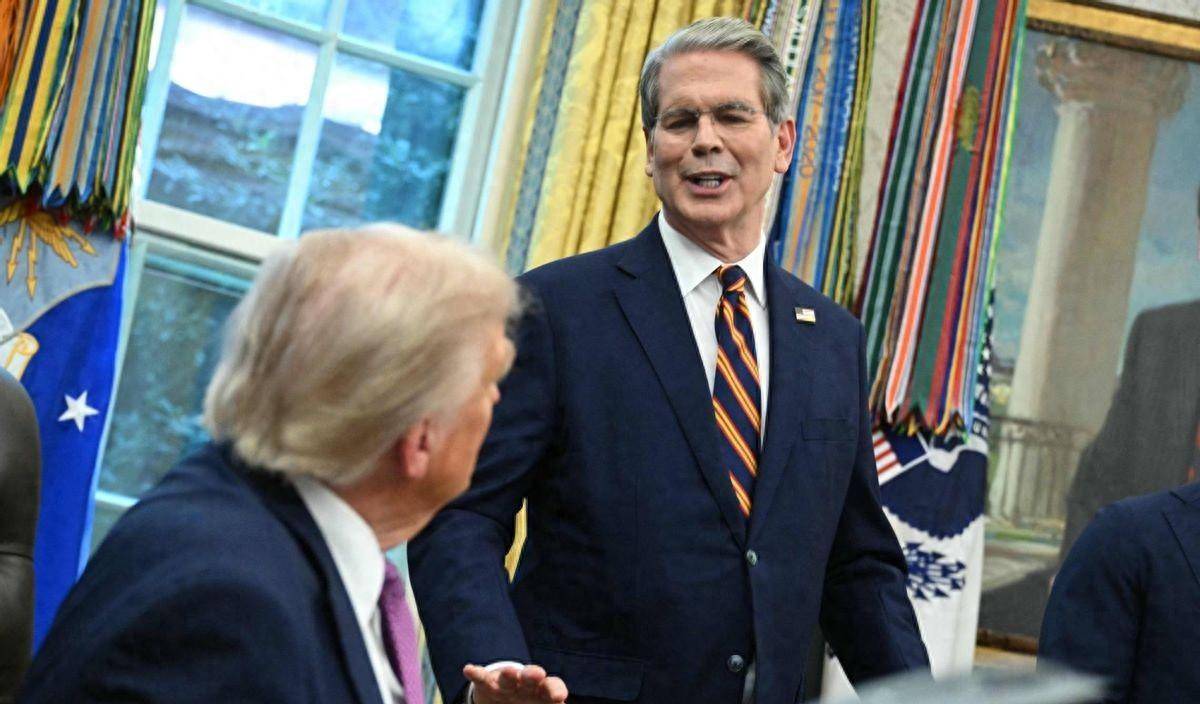
美高层起内讧,特朗普公开表态,贝森特因搞不定中国遭解雇?
Sou Hu Cai Jing· 2025-12-21 17:50
Core Viewpoint - The article discusses the precarious situation of U.S. Treasury Secretary Besant, highlighting the tension between political pressures from President Trump and the independent monetary policy of the Federal Reserve, amidst a backdrop of significant national debt and economic instability [1][25]. Group 1: Economic Context - The U.S. national debt has reached an unprecedented $38 trillion, raising concerns about its sustainability and the potential classification of U.S. Treasuries as "credit assets" rather than risk-free [1][25]. - Analysts are increasingly skeptical about the long-term viability of U.S. debt, with some predicting that the U.S. may rank at the bottom among major global markets in terms of asset returns over the next decade [1][25]. - The economic growth driven by debt rather than productivity or innovation suggests that long-term returns may be overestimated [2]. Group 2: Political Dynamics - The political landscape is characterized by extreme polarization, making it difficult to implement long-term reforms necessary for economic recovery [7][25]. - Trump's administration is seen as shifting blame internally, with Besant becoming a scapegoat for broader systemic issues rather than a reflection of his capabilities [5][19]. - The article suggests that the U.S. is experiencing a decline similar to that of the British Empire, where internal weaknesses are masked by attempts to maintain external dominance [12][13]. Group 3: Market Implications - The independence of the Federal Reserve is under threat from political pressures, which could undermine the credibility of U.S. financial markets and the dollar's status as the world's reserve currency [10][25]. - The yield curve inversion indicates that investors are anticipating a future economic recession, reflecting a lack of confidence in the current economic trajectory [9][25]. - The ongoing political maneuvering and failure to address structural economic issues may lead to a permanent reduction in the "safety premium" associated with U.S. assets [10][25].

美国政坛大地震!特朗普支持率暴跌42%,58%反对率创纪录!
Sou Hu Cai Jing· 2025-12-15 16:09
Core Viewpoint - The recent NBC News poll indicates a decline in public support for President Trump, with approval ratings dropping to 42% and disapproval rising to 58%, marking a 3 percentage point decrease since April [1][3]. Group 1: Poll Findings - The poll, conducted from November 20 to December 8, surveyed 20,252 American adults, including registered and unregistered voters, with a margin of error of ±1.9% at a 95% confidence level [3]. - A significant concern among respondents is the perception that the country is "on the wrong track," with economic issues such as rising living costs and inflation being the primary sources of public anxiety [3][5]. - Despite Trump's repeated emphasis on economic governance to address inflation and control spending, the poll results show that these commitments have not translated into widespread public confidence, contributing to his declining support [3][5]. Group 2: Factors Influencing Support Decline - There is a general bipartisan concern regarding the economic outlook, which directly impacts the support for political figures [5]. - A notable shift in support among Trump's core MAGA supporters is alarming, as this group has traditionally been seen as his strongest political base. Any signs of detachment or decreased enthusiasm could indicate challenges in his core mobilization ability [5]. - The ongoing political polarization in the U.S. is reflected in the high disapproval rate of 58%, suggesting that persistent political conflict and congressional gridlock may lead to disappointment among independent voters who have performance expectations [5]. - Long-standing legal controversies and media narratives surrounding Trump and his administration may have subtly influenced voter attitudes, complicating efforts to regain support [5]. Group 3: Implications for Trump's Political Strategy - The poll serves as both a warning and a guide for Trump and his political team, highlighting the urgent need to restore economic confidence among the public [7]. - Developing more persuasive policy proposals that resonate with the economic experiences of ordinary families presents a significant challenge for Trump moving forward [7]. - Overall, the NBC News poll clearly indicates that Trump's support base is under pressure, with not only an overall decline in numbers but also concerning fluctuations within his traditional core support group [7].
美债“雪球”为何越滚越大?(环球热点)
Ren Min Ri Bao Hai Wai Ban· 2025-11-14 22:03
Core Viewpoint - The U.S. federal government has ended the longest shutdown in history, lasting 43 days, but the situation has exacerbated the already critical federal debt, which has surpassed $38 trillion, raising concerns about fiscal sustainability and the current federal policies [1][2]. Group 1: Reasons for Rising U.S. National Debt - The rapid increase in U.S. national debt is attributed to two main factors: a large existing debt stock and high new deficits, leading to a "snowball effect" where new debt is issued to pay off old debt [2][4]. - Structural spending growth, particularly in social security and healthcare, coupled with slow growth in fiscal revenue, has created a mismatch between spending and income, resulting in a deficit structure [4][5]. - The rising cost of debt due to multiple interest rate hikes by the Federal Reserve to combat economic slowdown and inflation has further expanded the debt scale [4][5]. Group 2: Consequences of High National Debt - In the short term, high national debt will lead to sustained inflation, a loss of the highest credit rating for U.S. Treasury bonds, and increased volatility in bond yields [7][8]. - Long-term effects include erosion of budgetary space for the government, reduced fiscal flexibility during economic downturns, and increased borrowing costs due to rising risk premiums [9][10]. - The societal impact includes intergenerational debt transfer, where the current generation's debt burden will fall on future generations [9][10]. Group 3: Policy Responses and Challenges - The U.S. government has limited policy tools to address the rising debt, with current strategies focusing on increasing revenue through tariffs and reducing spending, but these measures face significant political resistance [10][12]. - Structural reforms are necessary to address the underlying issues of debt, including tax reforms and adjustments to high-spending programs like healthcare and social security [13]. - Achieving a bipartisan consensus on long-term fiscal responsibility remains a significant challenge due to increasing political polarization [13].
特稿丨盘点美政府“停摆”的经济民生“坏账”
Xin Hua Wang· 2025-11-13 05:36
Core Points - The U.S. government shutdown lasted for a record 43 days and has now ended with the passing of a temporary funding bill, but the economic and social impacts are significant and lasting [1][3] Economic Impact - The Congressional Budget Office estimates that the shutdown could lead to a $11 billion economic loss if it lasts for 6 weeks, and up to $14 billion if it extends to 8 weeks, with a potential decrease in GDP growth rate by 1 to 2 percentage points in Q4 [7] - The shutdown has exacerbated an already weak U.S. economy, with canceled flights and delayed consumer spending contributing to long-term economic repercussions [7] Social Impact - Approximately 42 million Americans are affected by disruptions in the Supplemental Nutrition Assistance Program due to the shutdown, leading to significant hardship for low-income families [2] - Federal employees have also faced wage delays, with some relying on food assistance programs during the shutdown [2] Transportation Sector Impact - The shutdown has caused significant disruptions in the aviation sector, with thousands of flights delayed or canceled, leading to operational chaos at airports [4][6] - The Federal Aviation Administration has reduced flight numbers at 40 major airports, with daily cancellations reaching nearly 3,000 and delays exceeding 10,000 flights on certain days [4][6] Political Context - The shutdown reflects deep political polarization in the U.S., with both parties blaming each other for the suffering of the public, particularly low-income individuals [2][3] - The political stalemate has made it increasingly difficult to reach compromises on critical issues such as government funding [7]
盘点美政府“停摆”的经济民生“坏账”
Xin Hua She· 2025-11-13 05:26
Economic Impact - The recent government shutdown lasted for 43 days, marking a record duration, and has left significant economic and social damages, referred to as "bad debts" [1][3] - The Congressional Budget Office estimates that if the shutdown lasts for 6 weeks, the economic loss could reach $11 billion, and if it extends to 8 weeks, losses could rise to $14 billion, with a potential decrease in GDP growth rate by 1 to 2 percentage points in Q4 [7] Social Consequences - The shutdown has severely impacted low-income groups, with 42 million Americans affected by disruptions in the Supplemental Nutrition Assistance Program, leading to emotional distress among recipients [2][3] - Federal employees have also faced wage delays, with some resorting to food banks, highlighting the human cost of political stalemate [2] Transportation Sector - The aviation sector experienced significant disruptions, with thousands of flights delayed or canceled, leading to chaos at airports and raising safety concerns due to air traffic controller shortages [4][5] - The American Airlines Association reported that approximately 5.2 million passengers were affected by flight delays or cancellations since the shutdown began [5] Long-term Economic Outlook - Analysts suggest that the recurring nature of government shutdowns, driven by increasing political polarization, complicates consensus on critical issues like government funding, potentially leading to long-term economic repercussions [7] - The inability to recover lost economic activities, such as canceled flights and missed dining reservations, further exacerbates the economic fallout from the shutdown [7]
美联邦政府最长“停摆”折射治理之失(环球热点)
Ren Min Ri Bao Hai Wai Ban· 2025-11-10 22:57
Core Points - The U.S. federal government is experiencing its longest shutdown in history, now entering its 40th day, with a temporary funding bill only providing resources until January 2026 [2][3] - The shutdown has significant impacts on the economy and public welfare, with millions affected as political disputes overshadow the needs of ordinary citizens [2][9] Political Dynamics - The shutdown began on October 1, following a failure to pass a temporary funding bill in the Senate, with both parties blaming each other for the impasse [2][4] - The Republican Party is using the shutdown to push for cuts to government employment and programs supported by Democrats, while Democrats are trying to maintain their political stance ahead of upcoming elections [4][5] Legislative Challenges - The current political polarization has made it increasingly difficult for Congress to complete budgetary processes, with no fiscal year starting without a completed budget since the 21st century [6][8] - The Senate's "filibuster" rules complicate the passage of funding bills, requiring a supermajority for closure on debates, which has become a significant hurdle [7][8] Economic Impact - The shutdown is projected to reduce the U.S. GDP growth rate by 1-2 percentage points in Q4, with estimates suggesting a loss of approximately $15 billion for each week the shutdown continues [11] - Essential services and welfare programs are being severely affected, including food assistance for 42 million people and heating subsidies for low-income families [9][10] Public Sentiment - Polls indicate that a majority of Americans feel disconnected from both political parties, with nearly 80% expressing dissatisfaction with Congress's performance [11]

他能成为荷兰最年轻的首相吗
Qi Lu Wan Bao· 2025-11-09 17:42
Core Points - The recent Dutch parliamentary elections resulted in the unexpected rise of the Six Six Party, which became the largest party, with Rob Jetten as a leading candidate for Prime Minister [2][3] - Jetten's party gained significant seats compared to the previous election, increasing from 9 to an expected 27 seats, while traditional parties faced setbacks [3][4] - The political landscape in the Netherlands has shifted, with voters expressing fatigue over political polarization and seeking solutions to pressing issues like housing and immigration [5][6] Election Results - The Six Six Party, led by Jetten, is projected to win 27 seats, narrowly ahead of the Freedom Party with 25 seats, and the People's Party for Freedom and Democracy with 23 seats [2][3] - The total votes for the Six Six Party were approximately 1.77 million, while the Freedom Party received around 1.75 million votes [2] Political Context - The previous coalition government, which included the Freedom Party, collapsed due to disagreements over immigration policies, leading to the early elections [4][5] - Jetten's rise is attributed to a combination of factors, including public dissatisfaction with extreme political views and a focus on more moderate, centrist policies [6][7] Jetten's Leadership - Rob Jetten, at 38, represents a new generation of centrist leadership, combining elements from both left and right policies [6][8] - His campaign effectively addressed key voter concerns, particularly housing shortages, proposing the construction of new cities and significant government investment in housing [6][9] Coalition Formation Challenges - Forming a stable coalition will be a significant challenge, as it is anticipated that at least four parties will need to collaborate, with Jetten reaching out to potential allies [10] - The Freedom Party is likely to be excluded from the new coalition, as other parties have expressed unwillingness to partner with them [10]
科学家发现:去掉推荐算法,社会极化反而更严重?
3 6 Ke· 2025-11-06 07:50
Core Insights - The concept of "information cocoon" has gained significant attention, highlighting the challenges posed by social media in limiting individuals' exposure to diverse information [1][2][4] - Concerns about algorithmic recommendations leading to echo chambers and polarization are prevalent, yet empirical evidence on the existence and impact of these phenomena remains limited [2][17] - Research indicates that exposure to opposing viewpoints on social media may not foster reflection but could instead reinforce extreme political positions [4][17] Group 1: Information Cocoon and Algorithmic Impact - The term "information cocoon" describes how social media algorithms can confine users to a narrow range of information, exacerbating concerns about self-isolation and the amplification of extreme views [1][2] - Algorithm engineers have proposed various intervention strategies to mitigate the effects of personalized recommendations, aiming to create a more balanced information environment [2][9] - Despite attempts to address these issues, studies show that many interventions have only marginal effects, and some may even worsen the problems of polarization and inequality in attention [9][10] Group 2: Research Findings and Theoretical Perspectives - A study by Chris Bail suggests that encountering opposing viewpoints on social media does not necessarily lead to self-reflection but may intensify users' existing political beliefs [4][17] - The research conducted by Törnberg and Larooij utilized generative social simulation to explore the dynamics of social media interactions, revealing persistent negative phenomena such as echo chambers and the amplification of extreme voices [7][9] - Historical analysis of platforms like Reddit indicates that political polarization is often driven by external political events rather than the internal dynamics of social media [14][17] Group 3: Broader Implications and Human Behavior - The relationship between social media and political polarization is complex, with evidence suggesting that societal divisions are reflected in online content rather than solely created by algorithms [17][18] - Understanding the limitations of human behavior in the context of social media is crucial, as individuals tend to gravitate towards like-minded groups, reinforcing their own beliefs [18]

美国政府破纪录“停摆”背后:经济状况恶化,底层民众受冲击
Nan Fang Du Shi Bao· 2025-11-06 07:17
Core Points - The U.S. government shutdown has reached a new record duration, surpassing the previous 35-day shutdown from late 2018 to early 2019, marking it as the longest in U.S. history [1] - The ongoing shutdown is expected to have significant negative impacts on various sectors, particularly aviation, food, and healthcare, with effects likely to worsen over time [1] - The shutdown reflects a failure of the "new liberalism" model represented by the establishment, leading to increased dissatisfaction among the middle and lower classes, potentially fueling a resurgence of populism in the U.S. [2] Impact on Society - The middle and lower classes in the U.S. are likely to face greater hardships due to the shutdown, with an increase in poverty levels that may drive demands for economic and wealth redistribution [2] - The recent election of a leftist populist candidate in New York City indicates a growing leftward shift within the Democratic Party, while the Republican Party continues to move right, exacerbating political polarization [2] Political Dynamics - The Trump administration is expected to maintain a hardline stance without compromise, particularly against the Democratic Party's efforts to uphold the Affordable Care Act [3] - The ongoing political deadlock may benefit Trump by undermining the Democratic base and paralyzing the "deep state" within Congress and the federal government, consolidating his presidential power [3]
民主党横扫多州选举,共和党失利背后的政治极化趋势
第一财经· 2025-11-05 13:00
Core Viewpoint - The recent special elections in the U.S. indicate a significant victory for the Democratic Party, suggesting a shift in political dynamics and strategies, particularly in response to rising living costs and the impact of Trump's presidency [3][4][6]. Group 1: Election Outcomes - The Democratic Party achieved key victories in Virginia, New Jersey, and Pennsylvania, winning all state-level positions in Virginia and securing significant wins in New Jersey [3]. - In California, Governor Gavin Newsom's proposal to change the redistricting process is expected to secure up to five additional congressional seats for the Democratic Party [3]. - The elections are seen as a reflection of public sentiment towards Trump's administration, with many voters expressing dissatisfaction with his performance [10]. Group 2: Key Issues - "Cost of living" emerged as a central campaign issue for Democratic candidates, with several candidates successfully leveraging this topic to gain voter support [6]. - In New Jersey, Democratic candidate Mikie Sherrill won by a 13-point margin, promising to freeze public utility rates and criticizing Trump's unfulfilled promises regarding affordable living [6]. - A Yale University estimate indicates that the average effective tax rate for U.S. consumers is at its highest since 1934, which is projected to negatively impact the labor market and purchasing power [7]. Group 3: Republican Challenges - The Republican Party is facing challenges in the wake of these elections, with analysts suggesting that the party's failure to address rising living costs contributed to their poor performance [6][8]. - Trump's absence from the ballot is cited as a factor in the Republican losses, with concerns about how to convert his support into votes for other candidates [10].
