新能源汽车发展

Search documents
东风汽车集团2025年销售汽车189.62万辆,新能源同比增长42.62%
Ju Chao Zi Xun· 2026-01-13 02:52
Core Insights - Dongfeng Group reported a slight increase in total vehicle sales for 2025, reaching 1,896,185 units, up 0.01% year-on-year, with significant growth in the new energy vehicle (NEV) segment, which saw sales of 562,833 units, a 42.62% increase [2][5] Vehicle Production and Sales Overview - Total vehicle production for 2025 was 1,945,390 units, reflecting a 3.41% year-on-year growth [2][4] - Passenger vehicles produced totaled 1,581,513 units, with a 2.64% increase, while sales slightly decreased by 1.32% to 1,523,783 units [3] - Commercial vehicles showed overall growth, with production at 363,877 units (up 6.90%) and sales at 372,402 units (up 5.86%) [4] Segment Performance - In the passenger vehicle segment, SUVs performed well with production of 721,240 units (up 12.40%) and sales of 693,828 units (up 5.17%) [3] - The multi-purpose vehicle (MPV) segment also saw growth, with production of 106,469 units (up 7.49%) and sales of 104,866 units (up 9.58%) [3] - Basic passenger vehicles experienced a decline, with production of 753,804 units (down 5.78%) and sales of 725,089 units (down 8.07%) [3] New Energy Vehicle Highlights - NEVs emerged as a key growth driver, with total production of 594,222 units (up 51.51%) and sales of 562,833 units (up 42.62%) [5] - Within the NEV category, passenger vehicles accounted for 545,894 units produced and 514,638 units sold, marking increases of 54% and 44.09%, respectively [5] Subsidiary and Joint Venture Performance - The subsidiary brands such as Lantu and Mengshi showed remarkable growth, with Lantu producing 170,066 units (up 99.86%) and Mengshi achieving a production increase of 464.13% to 10,837 units [6] - Dongfeng Nissan (including Infiniti and Venucia) reported a decline in sales to 600,006 units (down 4.94%), while Zhengzhou Nissan saw a 30.67% increase in sales to 52,140 units [7] - Dongfeng Commercial Vehicle Company achieved sales of 131,125 units, up 23.95% [7]


乘联分会:预计今年车市批发销量增1%,新能源车增长10%
Xin Lang Cai Jing· 2026-01-09 11:28
2026年车市销量增长将承压。 1月9日,中国汽车流通协会乘用车市场信息联席分会(乘联分会)发布的数据显示,2025年12月全国乘 用车市场零售226.1万辆,同比下降14%,环比增长1.6%。2025年以来累计零售2374.4万辆,同比增长 3.8%;全年乘用车厂商批发2955.4万辆,同比增长8.8%。 乘联分会秘书长崔东树指出,去年第四季度销量走平,是中国汽车市场历年来都罕见的走势,这体现出 了"两新政策"对车市的强烈影响。在政策的推动下,消费者在第四季度前积极购车,而各地补贴力度在 10月收缩或暂停,明显体现在了第四季度的销量数据上。 此外,崔东树介绍,去年第四季度,汽车厂家也更为理性,并没有对经销商施加过多销售压力。同时, 新车批量上市,叠加"反内卷"工作推进遏制了无序降价,12月新能源促销保持在10%左右,没有出现明 显的以价换量走势,这也在一定程度上促成了第四季度车市走平。 新能源汽车方面,新能源汽车免征购置税政策到期,对销量带来了明显的拉动效果。 数据显示,2025年12月新能源乘用车零售133.7万辆,同比增长2.6%,环比增长1.2%;12月新能源车在 国内总体乘用车的零售渗透率59.1% ...
【地方市场】2025年11月北京汽车市场分析
乘联分会· 2026-01-09 08:11
点 击 蓝 字 关 注 我 们 本文全文共 1847 字,阅读全文约需 6 分钟 新车交易情况 。 11月份北京新车交易6.42万辆,环比增长12.88%,同比下降3.91%。环比增幅高于全国10.08个百分 点,同比增幅低于全国7.31个百分点 。 1—11月北京累计交易新车60.77万辆,同比去年62.34万辆下降2.52%,增幅低于全国13.92个百分点 进口车销售情况 11月份北京市进口车交易2074辆,环比增长11.93%,同比下降31.66% 。 1-11月北京市进口车累计交易2.56万辆,同比下降21.68% 。 二手车交易情况 11月份北京市二手车交易过户5.58万辆次,环比增长9.13%,同比增长1.17%,新旧车比为1:0.87 1-11月北京市二手车累计成交过户60.8万辆次,同比增长0.56%,新旧车比为1:1 。 新能源汽车销售情况 11月北京进口车销量占北京新车交易总量的3.23%,占有率环比下降0.03个百分点,同比下降1.31个 百分点 。 11月份北京市新能源汽车共交易4.46万辆,环比增长20.83%,同比增长20.36%,占新车总交易量的 69.49%。纯电动汽车销售2. ...
蔚来第100万台车下线,李斌称未来每年销量要增长约50%
第一财经· 2026-01-06 02:33
记者|葛慧 编辑 |瑜见 2026年1月6日,蔚来公司第100万台量产车在位于安徽合肥的蔚来先进制造新桥二工厂下线。 仪式现场,蔚来创始人、董事长、CEO李斌表示,未来将保持每年40%~50%的销量增长;同时,到 2030年充换电站都突破一万座。 ...


电力设备及新能源周报20260104:国内政策助力商业航天产业化,多家车企创单月销量新高-20260104
Guolian Minsheng Securities· 2026-01-04 12:20
Investment Rating - The report maintains a "Recommended" rating for several key companies in the electric equipment and new energy sectors, including Ningde Times, Keda Li, and others [5][6]. Core Insights - The electric equipment and new energy sector experienced a decline of 2.18% in the last week, underperforming compared to the Shanghai Composite Index [1]. - The report highlights significant sales achievements in the new energy vehicle sector, with multiple companies reporting record monthly deliveries in December 2025 [2][14]. - The photovoltaic industry is facing a mixed scenario with rising upstream prices but weak downstream demand, leading to a "price without market" situation [3][38]. Summary by Sections New Energy Vehicles - In December 2025, several new energy vehicle manufacturers reported record sales, including Li Auto with 44,246 units delivered, a year-on-year decrease of 24.4% [15][21]. - Leap Motor achieved a delivery of 60,423 units, up 42% year-on-year, while BYD delivered 420,398 units, reflecting a year-on-year decrease of 17.5% [2][21]. New Energy Generation - The main industry chain prices are on the rise, with silicon material prices testing above 65 yuan/kg, although actual transactions are still based on previous orders [38]. - The report notes a significant reduction in demand, with a 78% decrease in procurement for domestic centralized projects [39]. Electric Equipment and Automation - The report indicates that the sixth batch of State Grid's bidding for power transmission and transformation equipment reached 13.205 billion yuan, with a total of 495 packages awarded [54]. - The largest single package was valued at 399.66 million yuan, with various categories such as switchgear and transformers receiving substantial funding [54]. Commercial Aerospace - Domestic policies are accelerating the industrialization of the commercial aerospace sector, with the National Space Administration incorporating commercial aerospace into the national development framework [4]. Market Trends - The report emphasizes the importance of technological advancements and market dynamics in shaping the future of the electric equipment and new energy sectors, suggesting a focus on companies that can leverage these changes for competitive advantage [40][41].




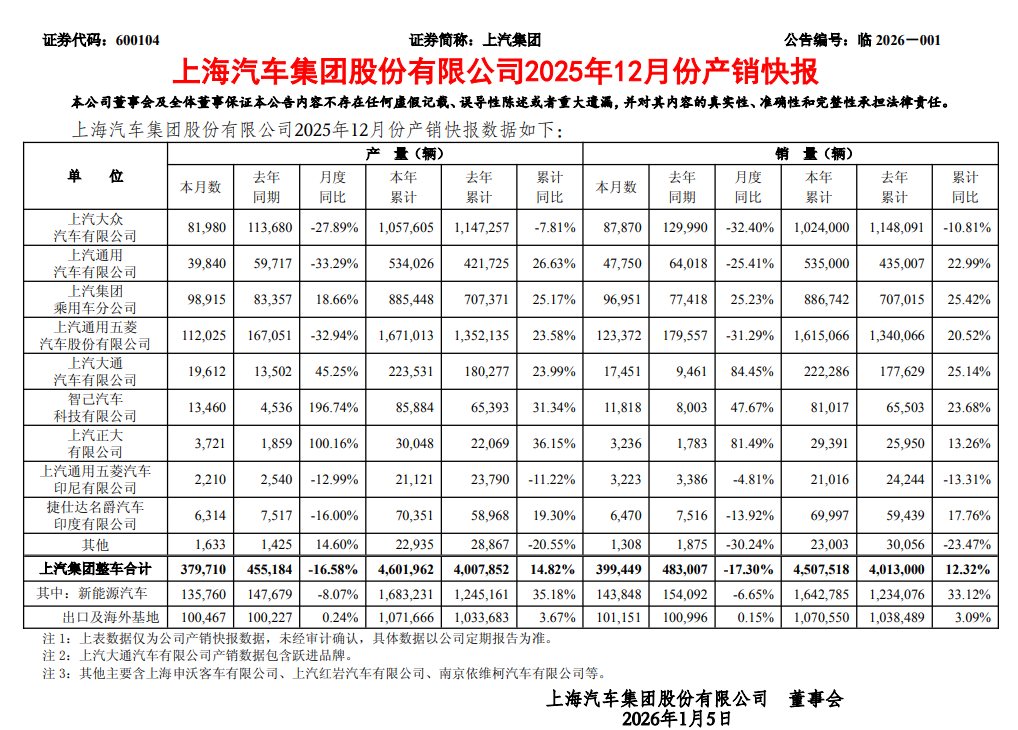
上汽集团2025年销售汽车450.75万辆,同比增长12.32%
Ju Chao Zi Xun· 2026-01-04 10:41
Core Viewpoint - SAIC Motor Corporation Limited reported a decline in production and sales for December 2025, with a notable performance from SAIC Maxus and Zhiji Auto, indicating strong market competitiveness in certain segments [1][5]. Group 1: December Performance - In December, SAIC's total vehicle production was 379,710 units, a year-on-year decrease of 16.58% [1][3]. - Total vehicle sales for December reached 399,449 units, down 17.30% year-on-year [1][3]. - SAIC Maxus and Zhiji Auto showed significant growth, with sales increasing by 84.45% and 47.67% respectively [1][3]. Group 2: Yearly Performance - For the entire year of 2025, SAIC's cumulative production reached 4.602 million units, reflecting a year-on-year growth of 14.82% [5]. - Cumulative sales for 2025 were 4.507 million units, up 12.32% compared to the previous year [5]. - New energy vehicles emerged as a core growth driver, with annual production and sales of 1.6832 million and 1.6428 million units, both exceeding a growth rate of 33% [5].

阶段性机会来临,锂能买了么?| A股2026投资策略⑪
Xin Lang Cai Jing· 2026-01-02 04:53
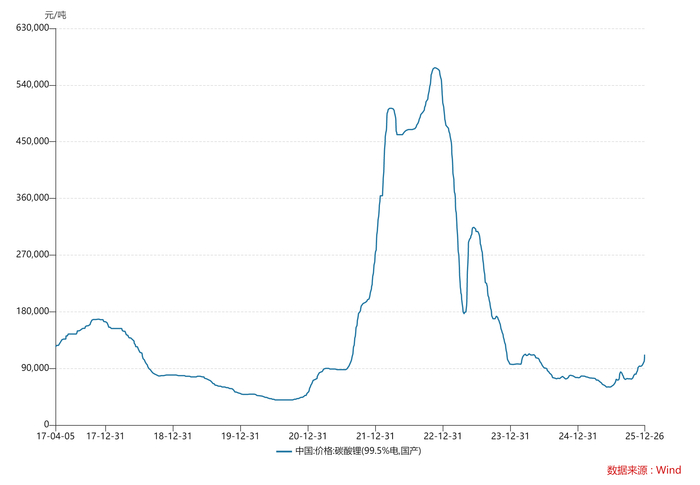
Core Viewpoint - The lithium industry is currently experiencing a downturn due to oversupply, leading to a significant drop in lithium prices, but a potential recovery is anticipated by 2025 driven by strong demand in energy storage and electric vehicles [1][6][12] Industry Status: Low Point with Signs of Recovery - The lithium industry is in a "winter period" from 2023 to mid-2025, with an overall operating rate around 50% and many high-cost projects either ceasing operations or enduring losses [1] - Lithium prices have dropped over 89% during this downturn, with some projects facing existential threats [1] - As of November 20, 2025, lithium carbonate weekly output reached 22,000 tons, a 3% month-on-month increase, indicating a recovery in supply and demand [3] - Inventory levels for lithium carbonate are at historical lows, with a total of 118,000 tons, down 2,052 tons from the previous period [3] 2025 Market Dynamics - The lithium carbonate market is expected to show a volatile pattern in 2025, with prices initially declining from 73,900 yuan/ton to 59,000 yuan/ton, a drop of 20.11%, before rebounding to a peak of 126,800 yuan/ton in the second half of the year [4] - The demand for lithium carbonate is projected to reach 1.45 million tons in 2025, driven by a 65% year-on-year increase in domestic lithium iron phosphate production [6][8] 2026 Supply and Demand Outlook - The lithium industry is expected to transition from oversupply to a balanced state due to unexpected growth in energy storage demand and the continued rollout of new electric vehicle applications [6] - Energy storage demand is projected to reach 345,000 tons of lithium carbonate in 2025, with expectations of exceeding 500,000 tons in 2026, marking a tenfold increase from 2021 [6] - The global lithium supply is estimated at 1.57 million tons LCE in 2025, with further increases expected in 2026, leading to a narrowing of the oversupply to approximately 30,000 tons [8][10] Price Support Factors - Key factors supporting lithium prices include historically low inventory levels, strong growth in demand from energy storage and electric vehicles, and a willingness among mining companies to maintain price levels [11] - The lowest lithium price in 2025 was 58,000 yuan/ton, which has already impacted high-cost projects, but with improved processing profits, production enthusiasm is expected to rise [11] - Predictions indicate that lithium prices in 2026 will range between 70,000 and 130,000 yuan/ton, with a gradual upward shift in price levels as the industry moves towards a tighter balance [11] Industry Cycle and Valuation - The lithium industry is entering a recovery phase after a prolonged downturn, with historical comparisons suggesting that recovery to profitability may take time [12] - Current valuations for lithium-related companies are at historical lows, indicating significant potential for valuation recovery as profit expectations improve [12] - Leading companies such as Ganfeng Lithium and Tianqi Lithium are expected to benefit the most from any price rebounds, with current price-to-book ratios significantly below historical averages [12]


今日财经要闻TOP10|2026年1月1日
Xin Lang Cai Jing· 2026-01-01 12:33
Group 1 - DeepSeek released a new paper on New Year's Day proposing a new architecture called mHC (Manifold-Constrained Hyperconnection) aimed at addressing instability issues in traditional hyperconnections during large-scale model training while maintaining significant performance gains [1] - The paper's first authors include Zhenda Xie, Yixuan Wei, and Huanqi Cao, with DeepSeek's founder and CEO Liang Wenfeng also listed as an author [1] Group 2 - The EU's Carbon Border Adjustment Mechanism (CBAM) will officially implement on January 1, 2026, with recent legislative proposals and implementation details released by the EU [2] - China expressed concerns over the EU's high default carbon emission intensity values for Chinese products, which are deemed unfair and discriminatory, and plans to gradually increase these values over the next three years [2] - The EU plans to expand the CBAM scope to include approximately 180 steel and aluminum-intensive downstream products by 2028, which China views as unilateral and protectionist [2] Group 3 - Multiple electric vehicle manufacturers have reported their delivery data for December 2025 and the entire year, with Li Auto delivering 44,246 vehicles in December and a total of 1,540,215 vehicles since inception [6][16] - NIO delivered 48,135 vehicles in December, marking a 54.6% year-on-year increase, and a total of 326,028 vehicles for the year, a 46.9% increase [6][16] - Xpeng Motors reported 37,508 vehicles delivered in December, with a total of 429,445 vehicles for the year, reflecting a 126% year-on-year growth [6][16] Group 4 - Warren Buffett officially retired as CEO of Berkshire Hathaway on December 31, 2025 [7][18]


2026国补细节来了!汽车以旧换新按比例补贴,最高2万元
2 1 Shi Ji Jing Ji Bao Dao· 2025-12-31 10:26
Core Viewpoint - The new round of vehicle trade-in policy for 2026 has been implemented, adjusting the subsidy method and amount compared to 2025, aiming to stimulate consumption and stabilize the automotive market [1][4]. Group 1: Policy Changes - The 2026 vehicle trade-in subsidy will shift from a fixed amount to a percentage of the new car price, with a maximum subsidy of 20,000 yuan [1][4]. - For new energy vehicles, the scrapping subsidy will be 12% of the new car price (up to 20,000 yuan), while the replacement subsidy will be 8% (up to 15,000 yuan). For fuel vehicles, the corresponding rates are 10% and 6%, with limits of 15,000 yuan and 13,000 yuan respectively [1][4]. Group 2: Market Impact - The trade-in policy has significantly influenced the automotive market, with over 11.5 million vehicles traded in 2025, generating over 1.6 trillion yuan in new car sales [2]. - More than 55% of domestic passenger car retail sales in 2025 involved trade-ins, with new energy vehicles accounting for 57.2% of trade-ins, leading to a 19.6% year-on-year increase in retail sales of new energy passenger vehicles [2]. Group 3: Industry Growth - In the first 11 months of 2023, China's automotive production and sales reached 31.23 million and 31.13 million units, respectively, with year-on-year growth of 11.9% and 11.4% [3]. - New energy vehicles have become a core growth driver, with their sales volume reaching 47.5% of total automotive sales, nearing the 50% threshold [3]. Group 4: Implementation and Efficiency - The Ministry of Commerce aims to streamline the subsidy application process, with a principle of completing reviews within 15 working days and subsidy payments within 30 working days [6]. - The adjustments in the subsidy structure are designed to encourage the purchase of higher-priced vehicles while preventing excessive subsidies for luxury cars, thus maintaining policy continuity and addressing the needs of essential consumer groups [6].
明势创投焦腾:AI大时代下的科技投资拐点|甲子引力
Sou Hu Cai Jing· 2025-12-26 07:31
Core Insights - The AI era is fundamentally reshaping the underlying logic of technology investment, with large models entering a deep application phase, and the fusion of hard technology and AI creating new opportunities, marking a critical turning point for tech investments [2] Group 1: Historical Context of Productivity - Over the past 2000 years, global productivity, measured by GDP per capita, has seen slow progress until the last 200 years, which marked significant advancements due to technological revolutions [3] - The timeline of productivity growth shows that it took 1800 years to reach a GDP per capita of $9,000, while it took only 200 years to rise from $9,000 to $12,000, indicating a rapid acceleration in productivity [3] Group 2: Capital Market Changes - In the past year, the total market capitalization of U.S. stocks increased by $7.3 trillion, reaching $68 trillion, with seven major companies (M7) contributing significantly to this growth [4] - The M7 companies' market capitalization grew from $19 trillion to $25.5 trillion over the past year, highlighting the accelerating value of tech giants [4] Group 3: Stages of Technological Investment - The investment focus in the AI era should shift towards specific stages of technology commercialization, with an emphasis on understanding the competitive landscape and China's position within it [5] - The evolution of technology investment can be categorized into four stages: science, technology, engineering, and product [15][16][17][18] Group 4: Electric Vehicle Industry Development - The electric vehicle industry has transformed from negligible demand and infrastructure ten years ago to a projected production and sales volume of 1.6 million units in China this year, surpassing all other countries combined [10][11] - The growth trajectory of electric vehicles in China illustrates a significant shift, with sales increasing from 130,000 units in 2020 to an expected 1.6 million units in 2024, driven by policy support and market demand [9][10] Group 5: AI's Impact on Investment - The concept of "Pavito Compression" in AI indicates a dramatic improvement in performance and cost efficiency, with the cost per million tokens dropping from $50 to $0.05 in just 18 months, surpassing traditional metrics like Moore's Law [21][22] - The four capabilities essential for AI development include advanced manufacturing, communication networks, AI and software capabilities, and energy technology, with China and the U.S. being the only countries possessing all four [12][22] Group 6: Future of AI and Investment Strategy - The next phase of AI is expected to transition from tools to partners, where AI will autonomously decompose tasks and execute processes, marking a significant shift in its application by 2025 [23] - The investment strategy should focus on engineering and product stages, as exemplified by the development of power batteries and AI technologies, which are progressing rapidly compared to historical timelines [19][20]