
权益类资产配置

Search documents
长城人寿收警示函,“举牌大户”的投资扩张合规之题待解
Sou Hu Cai Jing· 2025-12-18 07:42
Core Viewpoint - The reliance of insurance companies on investment, particularly in equity assets, is increasing in a market characterized by low interest rates and high debt costs. This trend highlights the challenges of compliance and operational boundaries in investment expansion [2][10]. Group 1: Compliance and Regulatory Challenges - On December 9, 2025, the Hebei Securities Regulatory Bureau issued a warning letter to Great Wall Life Insurance Co., Ltd. for failing to halt trading after exceeding the 5% shareholding threshold in New Tian Green Energy Co., Ltd. [2][3] - The warning letter emphasizes the importance of maintaining a dynamic balance between investment operations and compliance boundaries, particularly for insurance companies that are significant shareholders in the market [2][10]. - Great Wall Life's response indicated that the violation was due to a technical execution issue, and the company plans to enhance its internal control and risk management processes to prevent future occurrences [6][9]. Group 2: Investment Strategy and Performance - Great Wall Life has actively engaged in equity investments, having made at least 12 significant shareholding actions since June 2023, which is notably high among life insurance companies [10]. - As of June 30, 2025, the company's equity assets amounted to 28.355 billion yuan, representing 18.84% of its total assets, significantly above the industry average [10]. - The company achieved an investment income of 4.262 billion yuan in 2024, a 106% increase year-on-year, and 3.502 billion yuan in the first three quarters of 2025, a 24.65% increase year-on-year, indicating strong performance in equity investments [11]. Group 3: Risks and Challenges in Investment Expansion - The increase in equity investment poses new challenges, including the need for dynamic tracking of the relationship between investment returns and risks, especially in a volatile market environment [12]. - The current portfolio structure of Great Wall Life is focused on long-term, stable revenue-generating assets, primarily in public utilities and energy sectors, which are relatively stable [12]. - The company must ensure that its growing equity investments align with its liability structure to avoid potential mismatches that could exacerbate risks [12][13].

银行理财资产配置探索“新增量”
Shang Hai Zheng Quan Bao· 2025-11-25 18:14
Core Viewpoint - The banking wealth management companies are shifting towards diversified investment strategies in response to the low interest rate environment, focusing on multi-asset and multi-strategy products to enhance performance and meet investor demands [1][2][4]. Group 1: Investment Strategy Shift - The transition from single bond investments to diversified asset allocation is driven by declining yields on fixed-income products, prompting banks to explore various asset classes [2][3]. - Institutions are increasingly adopting a "multi-asset multi-strategy" approach, incorporating REITs, convertible bonds, equities, and derivatives to create better investment combinations while managing overall volatility [2][3]. - The need for dynamic asset allocation strategies has risen, as static models may fail in rapidly changing market conditions, necessitating regular adjustments based on market dynamics and economic factors [3][6]. Group 2: Focus on Equity Assets - Equity assets are viewed as a crucial component for enhancing overall portfolio returns, with many institutions optimistic about their potential [4][5]. - Predictions for 2026 suggest a rebound in the Producer Price Index (PPI), with expectations that the stock market will outperform bonds, potentially attracting more funds into the A-share market [5]. - Investment strategies include a focus on high-certainty sectors such as technology and AI, while also balancing investments in cyclical value stocks and commodities to mitigate risks associated with overexposure to any single asset class [5][6]. Group 3: Operational Considerations - Wealth management firms are advised to maintain a conservative approach when entering equity markets, ensuring adherence to risk management and return optimization principles [6]. - Collaboration with public funds and brokerages is being explored to enhance investment capabilities, allowing banks to participate in new stock inquiries and strategic placements to diversify their investment tools [6].
173家险企前三季度平均投资收益率为3.27%
Zheng Quan Ri Bao· 2025-11-11 16:15
Core Viewpoint - Insurance institutions have reported strong investment performance in the first three quarters of the year, attributed to a recovering equity market and declining long-term bond yields, leading to improved valuations [1][3]. Group 1: Investment Performance - As of November 11, 173 insurance institutions disclosed their financial investment returns, with the highest return at 22.77% and the lowest at -0.31%. A total of 91 institutions achieved returns of 3% or higher, while only one institution reported a negative return [1][2]. - The average investment return for the 173 insurance institutions was 3.27%, with a median of 3.04%. The highest return was from Fubon Property Insurance at 22.77%, and the lowest was from AXA Global Re (Shanghai) at -0.31% [2]. - Among life insurance companies, 72 reported an average return of 3.74% and a median of 3.28%. The highest return was from Junlong Life Insurance at 12.21%, while the lowest was from Aixin Life Insurance at 1.96% [2]. - For property and casualty insurance companies, 86 reported an average return of 3.05% and a median of 3.06%. Fubon Property Insurance had the highest return at 22.77%, and Suzhou Dongwu Property Insurance had the lowest at 0.19% [2]. Group 2: Reinsurance Performance - 15 reinsurance companies reported an average investment return of 2.28% and a median of 2.75%. The highest return was from China Property Reinsurance at 3.98%, while AXA Global Re (Shanghai) had the lowest at -0.31% [3]. Group 3: Asset Allocation Strategies - Insurance companies have increased their allocation to equity assets through various methods, including establishing private equity investment funds and increasing stock investments. As of the second quarter of 2025, the balance of funds allocated to stocks was 3.07 trillion yuan, accounting for 8.5% of total investments, showing an increase from the previous year [4]. - Since August, at least three private equity funds involving insurance capital have been established, with 10 insurance institutions participating in fund setups. In the third quarter, financial institutions contributed a total of 43.4 billion yuan to private equity funds, with insurance institutions contributing the highest amount of 18.3 billion yuan [4]. - In the first half of the year, insurance asset management institutions registered 11 equity investment plans, an increase of 6 plans year-on-year, with a total registered scale of 26.8 billion yuan, up 188% [4]. Group 4: Reasons for Increased Equity Investment - The increase in equity asset allocation by insurance capital is driven by several factors: declining yields on traditional fixed-income assets, regulatory encouragement for insurance capital to leverage long-term advantages, and the alignment of certain equity asset characteristics with the long-term liabilities of insurance companies [5]. - The diversification of equity investment forms has created a more flexible asset allocation framework for insurance capital, allowing for stable dividends and industry synergy through long-term equity investments, while increasing stock allocations enhances liquidity [5][6].
多家险企三季报大幅预喜 股市投资业绩成胜负手
2 1 Shi Ji Jing Ji Bao Dao· 2025-10-20 07:01
Core Insights - The insurance industry is experiencing significant profit growth, with increases ranging from 40% to 70% for several companies in their third-quarter reports [1][2][3] - The positive performance is largely attributed to a favorable stock market environment, which has encouraged insurance funds to increase their equity investments [1][5] Group 1: Company Performance - China Life Insurance expects a net profit of approximately RMB 156.79 billion to RMB 177.69 billion for the first three quarters of 2025, representing a year-on-year increase of about RMB 52.26 billion to RMB 73.17 billion, or 50% to 70% growth [2][3] - New China Life Insurance anticipates a net profit of RMB 29.99 billion to RMB 34.12 billion for the same period, marking a year-on-year surge of 45% to 65%, surpassing its entire 2024 net profit of RMB 26.2 billion [2][3][4] - China Pacific Insurance also projects a net profit increase of approximately 40% to 60% for the first three quarters of 2025, benefiting from the rising capital market [5][6] Group 2: Investment Strategies - Insurance funds have significantly increased their investments in the stock market, with a total balance exceeding RMB 3 trillion, up RMB 640 billion from the end of 2024 [1][7][9] - The banking sector remains the largest investment focus for insurance funds, accounting for 47.2% of the total market value of heavy-weight stocks held by these funds [7][9] - The shift towards equity assets is driven by a low-interest-rate environment and government policies encouraging long-term capital market participation, with bank stocks being favored for their stability and reliable dividends [9][10] Group 3: Market Trends - The A-share and Hong Kong markets have shown strong performance, prompting insurance funds to increase their equity market investments, resulting in substantial income [7][8] - Insurance companies have actively participated in IPOs, with significant investments in various sectors, including materials and technology [7][8]


指数基金波动这么大,真的能养老吗?
Sou Hu Cai Jing· 2025-10-17 10:37
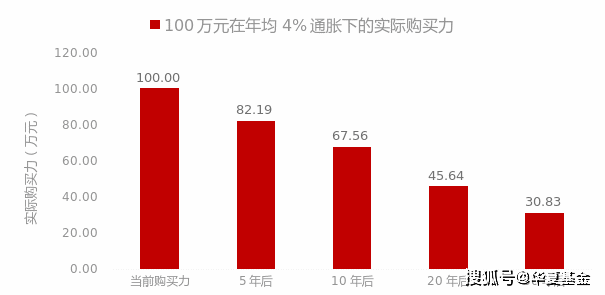
Core Insights - The article highlights the misconception that "stability" equates to "zero volatility," leading investors to allocate retirement funds into low-risk savings, which ultimately exposes them to hidden risks of purchasing power erosion [1] - It emphasizes the importance of achieving a long-term annualized return of at least 4%-5% to counteract inflation, despite the current low interest rate environment posing challenges [3] Group 1: Inflation and Purchasing Power - The "real inflation rate" indicator, derived from the difference between M2 money supply growth and GDP growth, reveals the reality of monetary overexpansion, with China's real inflation rate fluctuating between 0.4% and 8.7% from 2014 to 2025, with median and average values at 4.3% and 4.0% respectively [1] - Assuming a moderate inflation rate of 4%, the actual purchasing power of 1 million yuan will decrease to approximately 330,000 yuan over 30 years, indicating that relying solely on low-risk savings products will struggle to withstand this gradual erosion [1] Group 2: Asset Allocation Trends - In response to the low interest rate environment, many countries have adjusted their pension asset allocations, with the National Pension Service of Korea allocating 43.5% to equity assets and Japan's GPIF increasing its equity asset target allocation from 20% in 2006 to 50% in 2020, with over 90% of investments being passive [3] Group 3: Investment Strategies in Equity Assets - Investing in broad-based index funds can achieve long-term profitability by capitalizing on market fluctuations through buying low and selling high, as illustrated by the "smile curve" in systematic investment plans [7] - Broad-based indices represent a basket of quality listed companies, which benefit from national economic growth, ensuring that these representative industry leaders will appreciate over time [8] - Dividend income from core broad-based indices provides cash flow and compounding benefits, as stable companies tend to distribute profits as dividends, which can be reinvested to enhance overall returns [10] Group 4: Historical Performance of Indices - Historical performance data shows significant returns for various indices from 2004 to 2025, with the CSI A500 index achieving a total return of 592.97% when considering reinvested dividends [11]
规模扩张、权益配置增加,理财子增资潮或开启
2 1 Shi Ji Jing Ji Bao Dao· 2025-10-16 11:19
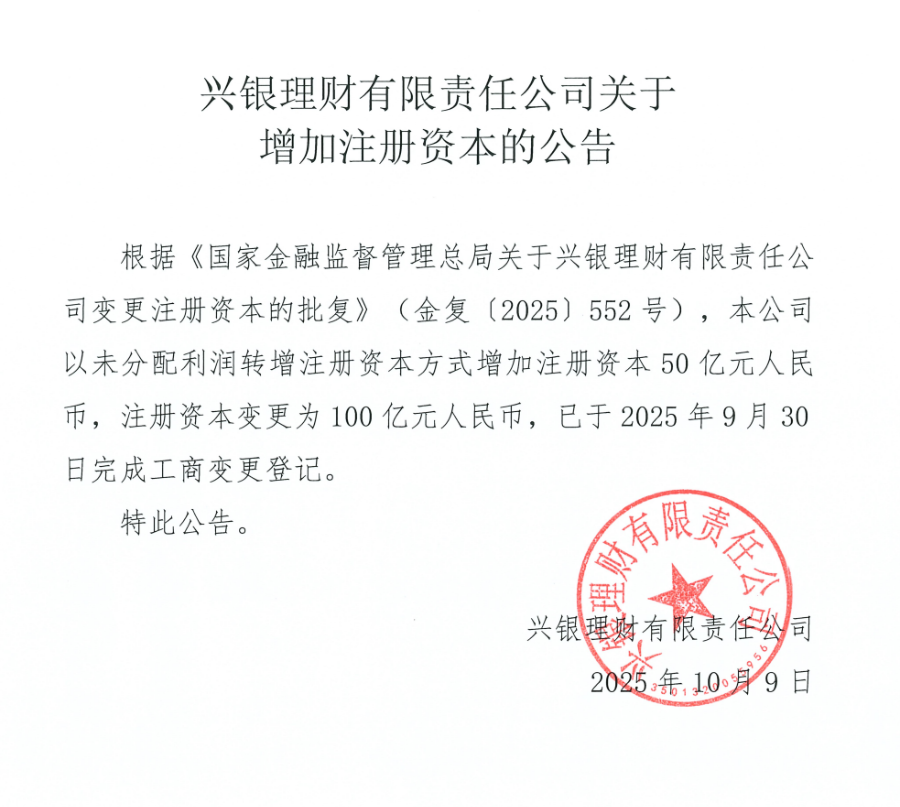
Core Insights - The article highlights the trend of wealth management companies increasing their registered capital to support their growing asset management scale and ensure compliance with regulatory requirements [4][10]. Capital Increase Details - On October 9, 2025, Xingyin Wealth Management announced an increase in registered capital from 5 billion to 10 billion yuan through the conversion of undistributed profits, completing the necessary business registration changes [1][4]. - Other wealth management companies that have also increased their capital this year include Hangyin Wealth Management, Schroder Jiao Yin Wealth Management, and Goldman Sachs ICBC Wealth Management [4][9]. Industry Trends - As of the end of September 2025, the total scale of bank wealth management reached 30.82 trillion yuan, showing a seasonal decline compared to August but maintaining a long-term upward trend [6]. - The capital adequacy ratio requirements for wealth management companies include maintaining a net capital of at least 500 million yuan and ensuring that net capital is no less than 40% of net assets [6][10]. Growth in Asset Management Scale - Xingyin Wealth Management's managed product scale reached 2.32 trillion yuan by mid-2025, ranking second in the industry, with a year-on-year growth of 6.34% [7]. - The increase in registered capital is seen as essential for supporting the expansion of risk capital, especially as wealth management companies increase their allocations to equity assets [10]. Capital Increase Methods - Wealth management companies primarily use two methods for increasing registered capital: converting undistributed profits and external capital injection [11][12]. - The internal financing method of converting undistributed profits avoids dilution of equity and allows for reinvestment in long-term strategic projects [12]. Comparison of Capital Increases - In 2024, only one wealth management company, BlackRock Jianxin Wealth Management, increased its registered capital, while four companies have done so in 2025, indicating a significant increase in capital raising activities [8][9].
申银万国期货早间策略-20251016
Shen Yin Wan Guo Qi Huo· 2025-10-16 02:50
1. Report Industry Investment Rating - Not provided in the content 2. Core View of the Report - After the high - level oscillation in September, the stock index is expected to enter a direction - selection phase again, and it is likely to maintain a bullish trend. Domestically, the liquidity environment is expected to remain loose, and residents may increase their allocation of equity assets. Externally, with the Fed's interest rate cuts and RMB appreciation, foreign funds are also expected to flow into the domestic market. In terms of market style, although technology growth has been the core theme in the current upward market trend, considering the possible intensification of Q4's growth - stabilization policies and the potential resonance of global monetary and fiscal policies, the market style in Q4 may shift towards value and become more balanced compared to Q3 [2] 3. Summary by Relevant Catalogs 3.1 Stock Index Futures Market - **IF Contracts**: The previous day's closing prices of IF contracts (current month, next month, next quarter, and far - quarter) were 4601.60, 4586.60, 4576.40, and 4555.00 respectively, with increases of 70.60, 73.20, 77.20, and 77.80. The trading volumes were 40430.00, 16606.00, 86223.00, and 12308.00, and the open interests were 35819.00, 24260.00, 160428.00, and 56592.00, with changes of - 9895.00, 5467.00, - 2013.00, and - 848.00 respectively. The increases of the CSI 300 corresponding to these contracts were 1.56%, 1.62%, 1.72%, and 1.74% [1] - **IH Contracts**: The previous day's closing prices of IH contracts were 2999.40, 2998.20, 2997.40, and 2998.40, with increases of 41.00, 46.00, 44.40, and 44.60. The trading volumes were 17842.00, 6567.00, 41717.00, and 5176.00, and the open interests were 13703.00, 6914.00, 63594.00, and 13300.00, with changes of - 5392.00, 1526.00, - 1687.00, and - 796.00 respectively. The increases of the SSE 50 corresponding to these contracts were 1.39%, 1.56%, 1.50%, and 1.51% [1] - **IC Contracts**: The previous day's closing prices of IC contracts were 7278.20, 7196.20, 7140.20, and 6977.00, with increases of 118.40, 124.20, 121.60, and 120.00. The trading volumes were 38456.00, 19428.00, 105607.00, and 19123.00, and the open interests were 34255.00, 32793.00, 141518.00, and 52944.00, with changes of - 9786.00, 5875.00, - 10422.00, and - 2023.00 respectively. The increases of the CSI 500 corresponding to these contracts were 1.65%, 1.76%, 1.73%, and 1.75% [1] - **IM Contracts**: The previous day's closing prices of IM contracts were 7455.80, 7362.60, 7275.20, and 7060.20, with increases of 117.60, 128.20, 126.60, and 134.20. The trading volumes were 55423.00, 28745.00, 178569.00, and 30417.00, and the open interests were 47911.00, 46218.00, 191595.00, and 84507.00, with changes of - 11189.00, 7939.00, - 2448.00, and - 280.00 respectively. The increases of the CSI 1000 corresponding to these contracts were 1.60%, 1.77%, 1.77%, and 1.94% [1] - **Inter - month Spreads**: The current inter - month spreads of IF (next month - current month), IH (next month - current month), IC (next month - current month), and IM (next month - current month) were - 15.00, - 1.20, - 82.00, and - 93.20 respectively, compared to the previous values of - 25.20, - 3.60, - 87.40, and - 110.00 [1] 3.2 Stock Index Spot Market - **Major Indexes**: The previous day's values of the CSI 300, SSE 50, CSI 500, and CSI 1000 were 4606.29, 3001.35, 7294.00, and 7483.45 respectively, with increases of 1.48%, 1.36%, 1.38%, and 1.50%. The trading volumes (in billions of lots) were 284.77, 63.38, 217.56, and 244.85, and the total trading amounts (in billions of yuan) were 6073.26, 1571.06, 3974.59, and 4037.98 respectively [1] - **Industry Indexes**: Among different industries, the increases of energy, raw materials, industry, optional consumption, major consumption, medical and health, real - estate finance, information technology, telecommunications, and public utilities were 0.32%, 1.18%, 1.98%, 1.49%, 0.45%, 1.77%, 1.06%, 2.75%, 1.11%, and - 0.20% respectively [1] 3.3 Futures - Spot Basis - **IF Contracts**: The previous day's basis values of IF (current month - CSI 300), IF (next month - CSI 300), IF (next quarter - CSI 300), and IF (far - quarter - CSI 300) were - 4.69, - 19.69, - 29.89, and - 51.29 respectively, compared to the previous two - day values of 1.34, - 23.86, - 31.86, and - 52.86 [1] - **IH Contracts**: The previous day's basis values of IH (current month - SSE 50), IH (next month - SSE 50), IH (next quarter - SSE 50), and IH (far - quarter - SSE 50) were - 1.95, - 3.15, - 3.95, and - 2.95 respectively, compared to the previous two - day values of 3.90, 0.30, - 2.70, and - 0.10 [1] - **IC Contracts**: The previous day's basis values of IC (current month - CSI 500), IC (next month - CSI 500), IC (next quarter - CSI 500), and IC (far - quarter - CSI 500) were - 15.80, - 97.80, - 153.80, and - 317.00 respectively, compared to the previous two - day values of - 41.45, - 128.85, - 184.85, and - 350.65 [1] - **IM Contracts**: The previous day's basis values of IM (current month - CSI 1000), IM (next month - CSI 1000), IM (next quarter - CSI 1000), and IM (far - quarter - CSI 1000) were - 27.65, - 120.85, - 208.25, and - 423.25 respectively, compared to the previous two - day values of - 33.15, - 143.15, - 227.35, and - 451.15 [1] 3.4 Other Domestic and Overseas Indexes - **Domestic Indexes**: The previous day's values of the Shanghai Composite Index, Shenzhen Component Index, Small and Medium - sized Board Index, and ChiNext Index were 3912.21, 13118.75, 8106.60, and 3025.87 respectively, with increases of 1.22%, 1.73%, 1.77%, and 2.36% [1] - **Overseas Indexes**: The previous day's values of the Hang Seng Index, Nikkei 225, S&P, and DAX Index were 25910.60, 46847.32, 6671.06, and 24181.37 respectively, with increases of 1.84%, - 2.58%, 0.40%, and - 0.23% [1] 3.5 Macroeconomic Information - The US side said that whether to impose a 100% tariff on China depends on China's actions. The Chinese Ministry of Foreign Affairs responded, urging the US to correct its wrong practices and resolve issues through dialogue and negotiation. China also opposes the EU's protectionist and discriminatory practices in the name of enhancing competitiveness [2] - In September, M2 increased by 8.4% year - on - year, M1 increased by 7.2% year - on - year, and the "scissors gap" between M1 and M2 reached a new low for the year. In the first three quarters, RMB loans increased by 14.75 trillion yuan, and the cumulative increase in social financing scale was 30.09 trillion yuan, 4.42 trillion yuan more than the same period last year [2] - In September, China's CPI increased by 0.1% month - on - month and decreased by 0.3% year - on - year. Core CPI increased by 1% year - on - year, with the increase expanding for the fifth consecutive month and returning to 1% for the first time in nearly 19 months. PPI remained flat month - on - month and decreased by 2.3% year - on - year, with the decline narrowing by 0.6 percentage points compared to the previous month [2] - In September, the average interest rate of newly issued corporate loans was about 3.1%, about 40 basis points lower than the same period last year, and the average interest rate of newly issued personal housing loans was about 3.1%, about 25 basis points lower than the same period last year [2] 3.6 Industry Information - Six departments including the National Development and Reform Commission issued an action plan to double the service capacity of electric vehicle charging facilities in three years, aiming to build 28 million charging facilities nationwide by the end of 2027, providing over 300 million kilowatts of public charging capacity to meet the charging needs of over 80 million electric vehicles [2] - In September, the trading volume of the national second - hand car market was 1.7944 million, a month - on - month increase of 5.1% and a year - on - year increase of 8.2%, with a trading amount of 110.466 billion yuan [2] - Chengdu expanded the scope of beneficiaries of the "commercial - to - provident" loan policy,取消了本市缴存限制,符合条件的异地缴存人也可申请办理,and all commercial banks that have signed cooperation agreements with the Chengdu Housing Provident Fund Center can participate [2]
52只新基本周启动认购 权益类占比超八成
Zheng Quan Ri Bao· 2025-10-13 16:12
Group 1 - The A-share market has shown strong performance, leading to a surge in fund issuance and subscription, with 52 new funds starting subscription this week, a significant increase of over 116% compared to the previous week [1] - The average subscription period for new funds has shortened to 12.73 days, indicating an increased willingness among investors to allocate to equity assets [1] - The strong performance of the A-share market and the impressive average return of 25.93% for actively managed equity products in the third quarter have boosted investor confidence [1] Group 2 - Equity products dominate the new fund issuance, with 43 out of 52 new funds being equity-based, accounting for over 80% of the total [1] - Passive index equity funds have become mainstream, with 23 such products issued this week, driven by their low cost and high transparency [2] - Mixed funds saw 11 products launched, with 10 being equity-oriented, allowing for flexible positioning to capture structural market opportunities [2] Group 3 - A total of 40 institutions launched new funds this week, with 32 institutions introducing only one product each, while 8 institutions issued two or more products, including major firms like Huaxia Fund and Huitianfu Fund [3]
上半年狂买 险资重仓板块曝光
Jing Ji Guan Cha Wang· 2025-09-06 10:02
Core Insights - Insurance funds have significantly increased their presence in the A-share market, with nearly 800 companies listed among the top ten shareholders as of June 2025, and over 280 stocks being increased in the second quarter alone [2][3] - The total investment scale of insurance funds reached 36 trillion yuan by the end of the second quarter of 2025, with stock investments amounting to 3.07 trillion yuan, a net increase of approximately 640 billion yuan compared to the previous quarter [2][3] Group 1: Investment Trends - The seven major A+H listed insurance companies have a combined investment scale of 21.85 trillion yuan, accounting for 60.30% of the total industry [2] - The stock investment scale of these companies reached 2.05 trillion yuan, with a net increase of 431.3 billion yuan, representing 67.39% of the industry's net increase [3] - Insurance funds are increasingly allocating to equity assets due to declining risk-free returns, with different companies showing varied strategies in their asset allocation [4][5] Group 2: Company-Specific Actions - China Ping An saw the largest increase in stock investment, with a net increase of 211.9 billion yuan, raising its proportion by 2.9 percentage points [4] - China Life's stock investment increased by 119.1 billion yuan, with a 1.1 percentage point rise in proportion [4] - Sunshine Insurance has the highest stock investment proportion among the seven companies at 14.1%, with a 23.9% increase [4] Group 3: Sector Preferences - As of mid-2025, insurance funds have allocated nearly 1 trillion yuan to high-dividend other comprehensive income (OCI) stocks, with a significant increase in the proportion of OCI stocks in their portfolios [6] - The top five sectors for insurance fund holdings include banking, transportation, communication, real estate, and utilities, with the media, communication, and utilities sectors seeing the largest increases in holdings [6] Group 4: Market Dynamics - Insurance funds have engaged in 30 "block trades" since the beginning of 2025, with the banking sector being the most active [8] - The shift in accounting standards is expected to influence the stability of insurance companies' net profits, prompting a greater focus on OCI asset allocation [9] - Recent policy changes have encouraged insurance companies to invest more in the A-share market, with a target of 30% of new premiums allocated annually [10]



深度研究:保险框架:险资中长期配置逻辑与趋势
2025-09-01 02:01
Summary of Insurance Asset Allocation Conference Call Industry Overview - The focus is on the insurance industry, specifically the asset allocation strategies of insurance funds in response to changing market conditions and regulatory frameworks [1][2][3]. Core Insights and Arguments - **Asset-Liability Matching**: The core of insurance asset allocation is to match assets with liabilities, considering duration, cash flow, and cost-benefit analysis to mitigate interest rate risks and unexpected claims [1][3][4]. - **Current Challenges**: Insurance funds face a mismatch between the increasing duration of liabilities and the slower growth of asset duration, exacerbated by a rise in whole life insurance products [1][4]. - **Improved Liability Costs**: The reduction in liability costs, including lower pricing rates and improved costs for new policies, has decreased the expected return requirements on assets, favoring equity allocations [1][4]. - **Regulatory Constraints**: External constraints such as solvency ratios and asset allocation limits significantly influence investment behavior. The solvency ratio can range from a minimum of 10% to a maximum of 50%, affecting the allocation to equities [5]. - **Policy Adjustments**: Recent macroeconomic and market policy adjustments are expected to enhance the stability of A-shares, encouraging insurance funds to increase their equity allocations [5][6]. Future Trends - **Increased Equity Allocation**: There is an anticipated increase in the proportion of equity assets in insurance fund allocations, driven by a growing demand for long-term stable assets and favorable policy changes [6][8]. - **Focus on High-Quality Stocks**: Insurance funds are expected to prioritize long-term stable assets, particularly value stocks with stable Return on Equity (ROE) and cyclical stocks that fit their investment criteria [7][8]. - **High Cost-Performance Sectors**: Sectors with high cost-performance ratios (high ROE/PB) are projected to attract more attention from insurance funds, with a focus on stocks that demonstrate stable ROE over a three-year average [2][7][8]. Additional Important Points - **Limitations of Traditional Strategies**: Traditional strategies such as extending duration, credit downgrading, or investing in non-standard assets face challenges, including insufficient long-duration bond supply and shrinking market sizes for non-standard assets [6][7]. - **Investment Logic**: The investment logic of insurance funds is centered around achieving asset-liability matching, with a gradual shift towards increasing equity proportions in response to both policy encouragement and internal investment needs [3][8].