
欧元汇率

Search documents
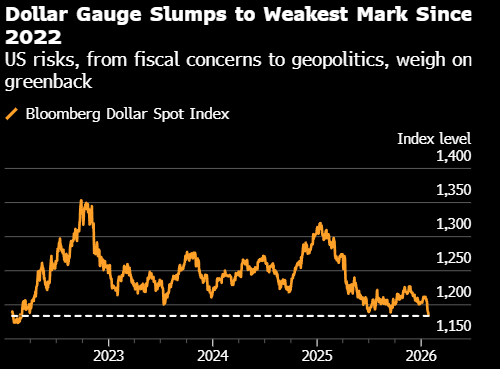
纽约汇市:美元跌至2022年以来最弱 欧元、英镑走高
Xin Lang Cai Jing· 2026-01-27 21:40
Core Viewpoint - The Bloomberg Dollar Index has fallen to its lowest level in nearly four years, driven by a rebound in the yen and uncertainties surrounding a potential government shutdown, leading to a weaker dollar that has strengthened the euro and pound to their highest levels since 2021 [1][4]. Group 1: Dollar Index and Currency Movements - The Bloomberg Dollar Index dropped 0.8%, falling below 1180 points, marking its lowest level since March 2022 [1][4]. - The USD/JPY pair decreased by 1% to 152.57, the lowest since October 30 [7]. - The euro rose by 0.9% to 1.1990, the highest since 2021, while the pound increased by 0.8% to 1.3791, also the strongest since 2021 [7]. Group 2: Market Sentiment and Economic Indicators - Concerns about potential government intervention in the currency market to support the yen and the rising likelihood of a government shutdown have intensified the dollar's downward trend, according to UBS strategist Vassili Serebriakov [1][4]. - The consumer confidence index fell to 84.5 in January, the lowest level since May 2014, as reported by the World Large Enterprises Association [4]. - The short-term options premium benefiting from the weaker dollar has expanded to the highest level since Bloomberg began collecting this data in 2011 [5]. Group 3: Central Bank Actions - Federal Reserve officials are widely expected to keep interest rates unchanged, with close attention on Chairman Powell's press conference following the policy decision [1][4]. - Japan's Finance Minister, after the G7 meeting, stated that they would coordinate closely with U.S. authorities to take appropriate action against currency fluctuations if necessary [7].

【财经分析】12月利率大概率按兵不动 欧洲央行政策转向仍需观察窗口
Sou Hu Cai Jing· 2025-12-11 06:37
Core Viewpoint - The European Central Bank (ECB) is expected to maintain interest rates unchanged in the upcoming December meeting, despite facing pressures from weak external demand and cautious business investment in the Eurozone. Inflation has significantly decreased from earlier highs to 2.2% in November, indicating a cooling trend in core prices and a temporary improvement in economic indicators [1][2]. Group 1: Economic Performance and ECB's Position - The Eurozone economy has shown unexpected resilience, with GDP growth forecast for 2025 revised upward from 0.9% to 1.2% due to increased investment in the digital services sector [2]. - ECB President Christine Lagarde stated that the current monetary policy is appropriately positioned, and there is no immediate need to adjust key interest rates [2]. - The Eurozone's inflation rate for November was reported at 2.2%, slightly up from 2.1% in October, marking the third consecutive month above the ECB's 2% target [2]. Group 2: External Influences and Currency Dynamics - The strong Euro, alongside potential shifts in the Federal Reserve's monetary policy, may impact the ECB's interest rate decisions. The Euro has been fluctuating between 1.15 and 1.17 against the US dollar [3]. - A strong Euro makes imports cheaper, which can help lower internal price levels in the Eurozone, supporting domestic consumption amid moderate inflation and ongoing economic recovery [3]. - Concerns have been raised regarding the Eurozone's trade deficit with China, which reached €33 billion in September, potentially exerting deflationary pressure and negatively affecting export competitiveness [3]. Group 3: Future Outlook and Policy Considerations - Analysts suggest that the ECB may prioritize overall economic stability and inflation control over the risks posed by weak exports, as the contribution of exports to economic growth is currently moderate [4]. - The Federal Reserve's recent decision to lower the federal funds rate target range to 3.5% to 3.75% may influence the Euro's trajectory and, consequently, the ECB's policy decisions [4]. - Market expectations indicate that the Fed may implement a series of rate cuts in the coming year, which could weaken the dollar and subsequently strengthen the Euro [5].
裕信银行:预计欧元汇率四季度或升至1.20
Sou Hu Cai Jing· 2025-09-16 11:45
Core Viewpoint - The market widely anticipates a 25 basis point rate cut by the Federal Reserve, with the subsequent reaction of the US dollar depending on any signals regarding future policy from the Fed [1] Group 1: Federal Reserve Expectations - Analysts from UBS indicate that the guidance on future interest rate paths will be crucial, especially amid concerns that the Fed may increasingly be influenced by political factors [1] - President Trump has repeatedly called for rate cuts, exerting pressure on the Federal Reserve [1] Group 2: Currency Forecasts - UBS forecasts a weakening of the US dollar, predicting that the EUR/USD exchange rate could rise to 1.20 by Q4 2025 and further to 1.23 by Q4 2026 [1]
欧洲央行或按兵不动 欧元走势止跌转涨
Jin Tou Wang· 2025-09-05 03:26
Group 1 - The majority of economists (66 out of 69) expect the European Central Bank (ECB) to maintain the deposit rate at 2.00% during the meeting on September 11, aligning with market expectations [1] - Recent data shows inflation nearing the 2% target and unemployment at historical lows, leading most economists to believe the ECB has completed its rate-cutting cycle [1] - Approximately 60% of economists (40 out of 69) predict that the ECB will keep rates unchanged for the remainder of the year [1] Group 2 - Economists forecast the Eurozone economy to grow by 1.2% this year and 1.1% next year, consistent with the results from the August survey [1] - There are risks identified in the region, including the contraction of the German economy and political instability in some Eurozone countries [1]
国泰海通|国别研究:服务业强劲,英国股市稳定上涨——欧洲市场跟踪系列第一期
国泰海通证券研究· 2025-08-17 12:27
Financial Market Performance - The European industrial production showed weakness in Q2, while the US dollar index remained weak, leading to a decline in investor confidence in August. The investor confidence index in Europe fell again, with institutional investors showing stronger confidence than individual investors [1] - Following the appreciation of the euro against the dollar in May-June 2025, the dollar index rebounded in July, but uncertainty in US economic data increased in August, leading to a rise in the euro to 1.17 against the dollar by August 15 [1] - Expectations of increased defense spending in Germany and other countries are anticipated to boost the Eurozone economy, alongside improved expectations regarding the Russia-Ukraine conflict [1] Bond Market Analysis - The European bond market continues to exhibit a bear flattening trend, with 10-year government bond yields in the UK, Germany, and France remaining relatively high. In August, the yield spread on government bonds widened slightly [2] - Concerns over potential inflation fluctuations and uncertainties regarding US tariff agreements are driving the widening of bond spreads, while the European Central Bank maintains a cautious stance on interest rate cuts for the remainder of 2025 [2] Stock Market Performance - Since April, the UK stock market has shown stable growth, with the German stock market performing well since the beginning of the year. European bank stocks have recently led the market [3] - The Eurozone STOXX50 index has seen a cumulative increase of 24.6% over the past quarter, driven by the return of overseas funds to the European market and the resilience of the European economy [3][4] - The UK FTSE 100 index reached a record high on August 15, supported by economic resilience and service sector growth [4] Sector Performance - In the past two weeks, large-cap value stocks in banking and energy sectors have performed well, while sectors like biotechnology, transportation, food, and airlines have also shown strong performance. The AI technology sector, however, faced pressure [5] - Current valuations for major indices in the UK, France, and Germany are around 17-20 times PE, close to historical averages. In comparison, the S&P 500 index stands at 29 times, significantly higher than European indices [5] - The European stock market is expected to have allocation value and potential for growth in 2025, supported by active fiscal policies and a relatively loose monetary policy environment [5]


人民币汇率最新数据出炉,你的钱换值了还是贬了?
Sou Hu Cai Jing· 2025-08-06 16:47
Core Insights - Exchange rate fluctuations significantly impact various aspects of daily life, including overseas consumption, investment decisions, and travel plans [1][2][8] Group 1: Impact on Overseas Study and Travel - Minor differences in exchange rates can accumulate, leading to substantial losses when exchanging currency for studying abroad or traveling [3] - For those planning to study or travel abroad, current exchange rates should be monitored closely to optimize currency exchange [9][10] Group 2: Cross-Border E-commerce and Purchasing - Prices of overseas goods fluctuate in real-time with exchange rate changes, affecting cross-border e-commerce and purchasing decisions [5][8] Group 3: Financial Investments and Corporate Earnings - Exchange rate volatility influences the profitability of multinational companies, which in turn affects stock market performance and returns on foreign currency investment products [6][8] - Companies engaged in import and export activities face direct impacts on their operating costs due to exchange rate changes [7][8] Group 4: Currency Trends Analysis - The current exchange rate of the Chinese Yuan against the US Dollar shows a slight increase of 0.14% since August 1, indicating a stable outlook for the Yuan [9] - The Euro has depreciated recently due to economic weaknesses in the Eurozone, suggesting potential savings for travelers or students in Europe [10] - The Japanese Yen has appreciated slightly due to increased demand for safe-haven currencies amid global uncertainties, but caution is advised for those planning to exchange Yen [11] Group 5: Emerging Market Currency Performance - The performance of various emerging market currencies reflects their respective economic fundamentals, with the Korean Won showing significant depreciation [15] - The Malaysian Ringgit has strengthened, indicating a stable economic foundation [16] - The Russian Ruble remains supported by energy exports, while currencies like the South African Rand and Turkish Lira exhibit high volatility due to inflation and interest rate factors [17][18] Group 6: Future Outlook for the Chinese Yuan - Recent policy signals suggest that the Chinese Yuan will maintain a pattern of "two-way fluctuations and stable ranges," requiring close monitoring of policy developments for strategic adjustments [19]

宏观视角看汇率
2025-07-25 00:52
Summary of Key Points from Conference Call Industry Overview - The discussion revolves around the macroeconomic perspective on exchange rates, particularly focusing on the US dollar, euro, and Chinese yuan [2][3][4]. Core Insights and Arguments 1. **Divergent Views on US Dollar**: There is a split within the US government regarding the dollar's strength. White House advisors advocate for a weaker dollar to enhance trade, while the Treasury Secretary emphasizes a strong dollar to attract capital [2][4][9]. 2. **Challenges in Exchange Rate Prediction**: Predicting exchange rates is complex due to multiple influencing factors. Even authoritative bodies like the IMF struggle to provide accurate forecasts [2][5][10][11]. 3. **Impact of Capital Flows**: Recent trends show that capital flows significantly influence exchange rates, with foreign exchange trading volumes far exceeding international trade volumes [2][8][14]. 4. **US Trade Deficit and Dollar Stability**: Despite a long-term trade deficit, the influx of foreign investment has prevented systemic depreciation of the dollar [2][15]. 5. **Foreign Investment in US Assets**: In 2023-2024, foreign investments accounted for 70% of net purchases in US equities, supporting the dollar despite high fiscal and trade deficits [2][15]. 6. **Potential for Yuan Strengthening**: The accumulation of $1.7 trillion in unconverted funds by Chinese exporters may lead to a stronger yuan, especially in the context of US debt monetization [2][17]. 7. **Market Reactions to Dollar Depreciation**: A weaker dollar is expected to benefit A-shares and Hong Kong stocks, enhancing risk appetite and liquidity in these markets [2][19]. 8. **Long-term Outlook for Global Markets**: The expectation of increased fiscal spending in the US and Europe may boost global demand and investment, positively impacting stock markets and commodities [2][19]. Additional Important Content 1. **Complex Interactions Among Currencies**: The interplay between major currencies is intricate, with recent trends showing the yuan's rise, the dollar's rebound, and the euro's slight weakening [3][7]. 2. **The Role of Theoretical Perspectives**: Different economic theories (e.g., classical vs. Keynesian) provide varying insights into the factors influencing exchange rates, highlighting the need for a comprehensive approach [10][11]. 3. **Current Trends in Currency Behavior**: The yuan's recent appreciation against the dollar is not indicative of a clear upward trend, as market dynamics remain complex and influenced by various factors [22][23]. 4. **Implications for Exports**: The yuan's appreciation against the dollar has a limited negative impact on overall exports, supported by adjustments in a basket of currencies [20][23]. 5. **Future of US Debt and Monetary Policy**: The US may adopt measures to manage increasing debt levels, potentially leading to a sustained pressure on the dollar in the medium to long term [18][19]. This summary encapsulates the key points discussed in the conference call, providing insights into the current state and future outlook of the currency markets and their implications for various stakeholders.
【环球财经】欧洲央行暂停降息 贸易不确定性令其回避前瞻指引
Xin Hua Cai Jing· 2025-07-24 13:34
Group 1 - The European Central Bank (ECB) decided to maintain interest rates unchanged after seven consecutive rate cuts, awaiting clearer signals regarding EU-US trade relations [1][2] - The deposit facility rate remains at 2%, while the main refinancing rate and marginal lending rate are held steady at 2.15% and 2.40% respectively [2] - The ECB emphasized a "data-driven, meeting-by-meeting" approach, avoiding preset interest rate paths, with decisions based on the latest data [2] Group 2 - Eurozone inflation has eased to the target level of 2%, prompting the ECB to adopt a wait-and-see stance due to the potential impacts of a US-EU trade agreement [2] - The Eurozone's business activity accelerated in July, with the composite PMI rising to an 11-month high of 51.0, driven by service sector growth and stabilization in manufacturing [3] - The strong Euro, which has appreciated over 13% against the US dollar this year, has raised concerns among ECB policymakers about its potential impact on inflation and export competitiveness [4] Group 3 - Market expectations suggest a potential rate cut of 22 basis points by the end of the year, with an 88% probability of a 25 basis point cut in upcoming meetings [4] - Analysts predict that the ECB may cut rates again in September, with some expressing concerns about the rapid appreciation of the Euro [4][5] - The International Monetary Fund reported a slight decrease in the dollar's share of global foreign exchange reserves, while the Euro's share increased to 20.1%, the highest since the end of 2022 [4]
美元兑人民币或保持震荡走势
Sou Hu Cai Jing· 2025-07-21 13:46
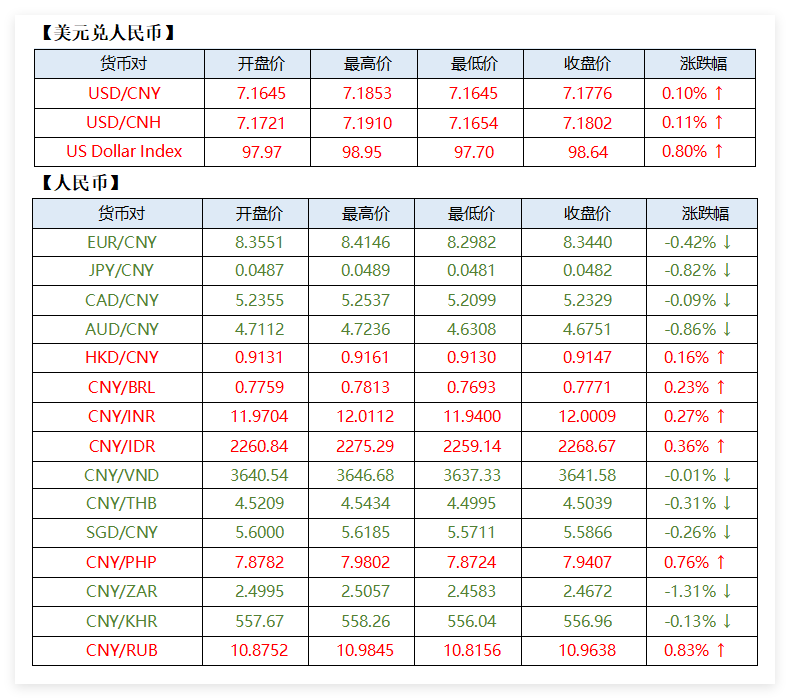
Group 1: Market Overview - The US Dollar Index increased by 0.80% to close at 98.64, with a weekly high of 98.95 [1] - USD/CNY rose by 0.10% to 7.1776, while USD/CNH increased by 0.11% to 7.1802 [1] - The Chinese Yuan showed mixed performance against other currencies, with notable declines against EUR, JPY, and AUD [1] Group 2: Economic Data Focus - Key economic data releases include the US Leading Economic Index for June, expected to decline from -0.1% to -0.2% [2] - The Eurozone's manufacturing and services PMI for July are anticipated to improve, while the US manufacturing PMI is expected to drop from 52.9 to 52.5 [2][4] - The US durable goods orders for June are forecasted to decrease significantly by 10.5% after a previous increase of 16.4% [2] Group 3: Central Bank Decisions - The European Central Bank (ECB) is expected to maintain interest rates during its upcoming meeting, with market focus on President Lagarde's comments regarding future monetary policy [3][11] - The market anticipates that the ECB will continue to reference inflation and tariff policies in its future decisions, which could impact the Euro's value [3][11] Group 4: Currency Trends - The USD/CNY is expected to remain stable around 7.18, influenced by the performance of the US Dollar Index [9][10] - The Euro is projected to face downward pressure if the ECB signals potential rate cuts, especially with upcoming PMI data expected to show improvement [11] - The Japanese Yen is under pressure due to inflation data and impending tariffs from the US, with the USD/JPY reaching a high of 149.18 [15]
欧洲央行或推迟至12月完成最后降息,政策路径分歧加剧
Jin Shi Shu Ju· 2025-07-18 07:24
Core Viewpoint - The European Central Bank (ECB) can delay its final interest rate cut until December without worrying about premature market assumptions regarding the end of the easing cycle [2][3] Group 1: Interest Rate Outlook - Most respondents expect the deposit rate to be reduced by 25 basis points to 1.75% in September, while half of the economists believe that even if the ECB maintains rates in the following three meetings, traders will not immediately conclude that rates have bottomed out [2] - Approximately one-quarter of respondents believe the ECB has ended its rate-cutting cycle, while nearly half predict the last cut will occur in September, and 21% expect it to wait until December [3] - The ECB is currently in a wait-and-see mode, with expectations for further easing in September and December [3] Group 2: Trade Policy and Economic Conditions - The progress of EU-US trade negotiations is a critical observation point that could disrupt the balance between domestic and external demand [4] - The ECB will be unable to signal whether further rate cuts are necessary or if the terminal rate has been reached before the upcoming meetings due to the lack of a trade agreement [4] - The ECB's June forecast indicated inflation stabilizing at 2% by 2027, with an average of only 1.6% expected for the following year [4] Group 3: Currency and Inflation Concerns - The euro has appreciated nearly 12% against the dollar this year, with ECB Vice President Luis de Guindos warning that if the exchange rate exceeds 1.20, the economy may face challenges [5] - Economists show a higher tolerance for exchange rate pain points, with only about one-quarter agreeing with de Guindos' view, while others believe the warning threshold could be as high as 1.35 [6] - There are concerns that increased public spending may keep core inflation above target levels, and the ECB should not assume that core inflation will easily return to the target range [6]
