
煤炭价格走势

Search documents
中煤能源20251217
2025-12-17 15:50
Summary of the Conference Call for China Coal Energy Industry Overview - The conference call primarily discusses the coal and coal chemical industry, focusing on China Coal Energy's performance and outlook for 2025 and 2026. Key Points Production and Sales Performance - In the first 11 months of 2025, the total coal production was 124 million tons, a decrease of 1.52 million tons year-on-year, while sales were 234 million tons, down by 22.43 million tons year-on-year. However, self-produced coal sales increased by 900,000 tons [2][3] - Polyolefin production was 1.249 million tons, down by 139,000 tons year-on-year, primarily due to major equipment maintenance. Sales were 1.233 million tons [3] - Urea production increased to 1.956 million tons, up by 272,000 tons year-on-year, with sales reaching 2.16 million tons, an increase of 336,000 tons [3] - Methanol production was 1.767 million tons, up by 211,000 tons year-on-year, with sales of 1.783 million tons, an increase of 237,000 tons [3] - The output value of coal mining equipment was 8.6 billion yuan, a decrease of 800 million yuan year-on-year [3] Cost and Pricing Outlook - The production cost for Q4 2025 is expected to rise compared to Q3 due to increased safety and maintenance costs, but a year-on-year decrease is anticipated due to cost reduction measures [2][9] - The average cost per ton is projected to stabilize around 290-300 yuan, reflecting a reasonable alignment with production realities [10] - Coal prices are expected to rise, with a cautious optimistic outlook for 2026. The anticipated price range for December is between 750-820 yuan [4][11] Future Production Plans - The production plan for 2026 is nearly finalized, with expectations to maintain stability compared to 2025. Main mines are operating normally [7][8] - New mine production may be delayed, but this will have a limited impact on total output for 2026 [8] - The long-term contract situation for 2026 remains stable, with a continuation of the pricing mechanism based on a base price plus a floating price [13] Market Dynamics and Strategic Focus - The company is focused on optimizing production and sales coordination, enhancing product structure, and managing costs effectively [3][19] - The recent fluctuations in coal prices are considered normal, with expectations of a return to fundamental market conditions [14] - The company emphasizes the importance of safety and environmental regulations, aiming to maintain a competitive edge while ensuring sustainable development [15][19] Challenges and Risks - The company acknowledges potential challenges from market volatility and regulatory pressures but remains committed to strategic investments in coal chemical projects to enhance product value and reduce dependency on external resources [18] Conclusion - Overall, China Coal Energy is positioned to navigate the current market dynamics with a focus on stability in production and sales, cost management, and strategic investments in coal chemical projects to ensure long-term growth and sustainability [16][19]

二轮提降开启,双焦持续走弱
Hong Yuan Qi Huo· 2025-12-12 11:16
Report Information - Report Title: Black Metal Weekly - Coking Coal and Coke [1] - Date: December 12, 2025 [2] - Analyst: Bai Jing - Qualification Number: F03097282; Investment Consulting Certificate Number: Z0018999 [2] - Contact: TEL 82292661 [2] Report Industry Investment Rating - Not provided in the document Core Viewpoints Coking Coal - This week, the second - round price reduction of coke started, and coking coal prices continued to be weak due to the weakening coking profit. Near the end of the year, some coal mines actively reduced production, and some mines had temporary production cuts. Although the local supply decreased this week, the recent increase in Mongolian coal customs clearance and the decline in demand led to an overall loose supply and downward pressure on prices. The January contract is currently at a large discount to the spot, and considering the high probability of non - standard delivery items, buyers' participation enthusiasm is not high, and short positions are relatively concentrated. It is not advisable to participate in long positions, and short positions can consider taking profits at low prices [6]. Coke - This week, the coke spot market was weak. The second - round price reduction was initiated in areas such as Hebei and Tianjin, putting pressure on prices. The supply - demand contradiction of coke is not significant. Recently, the demand in the coke market has been continuously declining. Under the pressure of blast furnace production cuts, coke enterprises may further seek profits from upstream. The current market sentiment is poor, and prices are under pressure for adjustment. The January contract is currently at a discount to the port wet - basis warehouse receipt price. Due to the continued expectation of price reduction in the market, prices may continue the pattern of volatile adjustment [43]. Summary by Directory Part One: Coking Coal Price - As of December 11, the warehouse receipt price of Mongolian No. 5 raw coal was 1068 yuan/ton (- 49), and that of high - quality coking coal in Anze, Shanxi was 1273 yuan/ton. The warehouse receipt price of Canadian Lukin was 1255 yuan/ton (- 1). The futures price of the main coking coal contract decreased, with a week - on - week decline of 10.83%, and the JM1 - 5 spread was - 71 (+ 13) yuan/ton [5]. Fundamentals - **Supply**: In December, more coal mines reduced production, and the local supply continued to decrease. Recent snowfall in the main production areas affected the downstream delivery rhythm, and some coal types temporarily stabilized due to limited resources. The operating rate of coking coal (523 enterprises) was 85.31%, a week - on - week decrease of 0.28 percentage points, and the daily average clean coal output was 750,000 tons, a week - on - week decrease of 3700 tons. In terms of imported seaborne coal, Australian mines continued to control supplies, while overseas terminal demand remained, and coal prices continued to rise due to tight supply. The forward transaction price of Australian quasi - first - line high - quality coking coal Goonyella rose to about FOB 209.9 US dollars, a week - on - week increase of 3.39 US dollars, equivalent to about 1834 yuan/ton at domestic port pick - up prices, and the inversion range with domestic local prices has expanded to over 160 yuan/ton [5]. - **Demand**: Terminal hot metal production continued to decline, and the rigid demand for coking coal and coke remained under pressure. After two rounds of coke price cuts, there was still an expectation of further cuts, and high - price transactions at mines were still difficult. The clean coal inventory of 523 enterprises monitored by Steel Union was 2.5531 million tons, a week - on - week increase of 83,000 tons [5]. Part Two: Coke Price - As of December 11, the warehouse receipt price of quasi - first - grade coke at Rizhao Port was 1576 yuan/ton (- 21), the warehouse receipt price of port dry - quenched coke was 1815 yuan/ton, and the warehouse receipt price of quasi - first - grade dry - quenched coke in Shanxi was 1850 yuan/ton. The futures price of the main coke contract decreased significantly, with a week - on - week decline of 6.94%, and the J1 - 5 spread was - 153 yuan/ton (- 4) [41]. Fundamentals - **Supply**: The coking operation was at a high level, but in winter, coking was frequently affected by environmental protection. Currently, the production of some coke enterprises in areas such as Shanxi, Shaanxi, and Henan was restricted, and the supply tightened. On the other hand, a few coke enterprises had resumed production after previous maintenance, and production had recovered. Overall, coke supply continued to decline this period, with a limited decline. The capacity utilization rate of all - sample independent coke enterprises was 73.16%, a week - on - week decrease of 0.68 percentage points. The daily average output of all - sample independent coking plants was 639,800 tons, a week - on - week decrease of 5500 tons, and the daily average output of 247 steel mill coking plants was 466,100 tons, a week - on - week decrease of 100 tons [42]. - **Demand**: Affected by the off - season, demand continued to be weak. Blast furnace maintenance increased, and hot metal production continued to decline this period. The supply of finished products decreased, and steel mills' enthusiasm for raw material procurement was weak. Downstream steel mills continued to passively accumulate inventory. The daily average hot metal output this period was 2.292 million tons, a week - on - week decrease of 31,000 tons [42]. - **Inventory**: The coke inventory of 247 steel mills monitored by Steel Union was 635,280 tons, a week - on - week increase of 10,030 tons; the coke inventory of all - sample independent coking plants was 87,320 tons, a week - on - week increase of 10,880 tons, an increase of 14.2%. The coke inventory at ports was 181,200 tons, a week - on - week decrease of 100 tons [42]
广发证券:11月煤炭进口同比下滑12% 旺季需求仍有提升空间
Zhi Tong Cai Jing· 2025-12-11 05:57
Core Viewpoint - The coal market is expected to stabilize and recover in price due to seasonal demand increases and supply constraints as the year-end safety inspections become stricter [1][2]. Group 1: Market Overview - In October, electricity consumption exceeded expectations with a growth of 10.4%, while non-electric demand remained weak, leading to a 9.7% year-on-year decline in coal imports [1]. - Domestic coal prices saw fluctuations in November, with a rise followed by a decline, while long-term contract prices were adjusted upwards [1]. - International coal prices, particularly for Australian thermal and coking coal, continued to rise in November [2]. Group 2: Supply and Demand Dynamics - Domestic coal production decreased by 2.3% year-on-year in October, and coal imports fell by 12.0% in November [1]. - The global seaborne coal loading volume dropped by 3.6% year-on-year in the first ten months, but demand from emerging markets remained strong [1]. - Seasonal demand is expected to increase from December to January, supporting coal prices as supply remains relatively low due to stricter safety regulations [2]. Group 3: Key Companies - Companies with stable earnings and dividends include China Shenhua (601008.SH), Shaanxi Coal and Chemical Industry (601225.SH), and China Coal Energy (601898.SH) [3]. - Companies likely to benefit from improved demand expectations and supply reductions include Shanxi Coking Coal (000983.SZ) and Lu'an Environmental Energy (601699.SH) [3]. - Companies with notable long-term growth potential include Baofeng Energy (600989.SH) and China Qinfa (00866) [3].



【资讯】12月9日煤焦信息汇总
Xin Lang Cai Jing· 2025-12-09 14:54
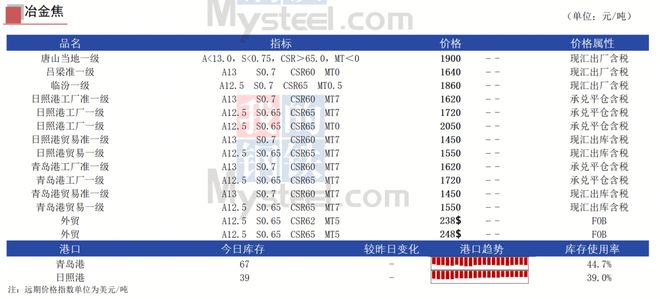
Group 1: Market Overview - On December 9, the port coke spot market showed weak performance, influenced by futures trends and expectations of domestic coke prices, leading to a generally weak trading atmosphere [1] - The metallurgical coke price in the Lüliang market remained weak and stable, with major steel mills in Hebei and Shandong reducing coke procurement prices by 50-55 yuan/ton, effective from December 1 [1][3] - The overall supply of coke is notably relaxed, but the demand from downstream steel mills is cautious due to declining iron output and ongoing maintenance plans [1][3] Group 2: Price Trends - As of December 9, the price for premium dry quenching metallurgical coke was reported at 1630-1645 yuan/ton, while first-grade dry quenching metallurgical coke was at 1740-1750 yuan/ton, both prices are ex-factory and tax-inclusive [1] - In the Hebei market, the price for first-grade dry quenching metallurgical coke was reported at 1690 yuan/ton, with variations in other regions such as Tangshan and Handan [2] - The price for wet quenching coke in the Longzhi market was reported at 1550 yuan/ton, indicating a downward trend in the market [3] Group 3: Supply and Demand Dynamics - The supply of coking coal is expected to remain low due to safety production considerations and the completion of annual mining plans, which may continue to pressure coke prices [8] - The demand from steel mills is weak, with many enterprises maintaining a cautious purchasing attitude, primarily buying on an as-needed basis [8] - The overall market sentiment is bearish, with limited actual transactions reported across various regions [12]

尿素: 下游需求平稳 出厂价坚挺
Qi Huo Ri Bao· 2025-12-09 06:23
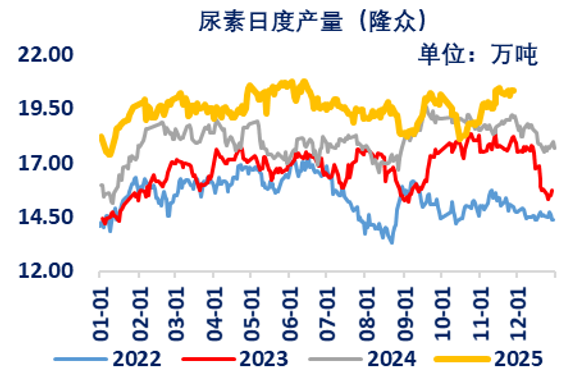
Group 1: Coal Industry - Domestic coal production has increased to an average of 4 million tons per day, with Ordos region's coal operating rate at 78% and Yulin region at 46%, indicating a stable supply [1] - Coal prices have started to decline from high levels, while demand from power plants has shown a gradual increase, with current port inventories rising to over 26 million tons [1][2] - The operating rate of coal-based urea production is at 87.53%, up 4 percentage points from last month, with daily production at 19.8 million tons, indicating a further loosening of domestic supply [2] Group 2: Urea Market - Urea prices are holding steady at 1660-1700 RMB per ton, with cash flow profits for coal-based urea around 200 RMB per ton for fixed bed units and 280 RMB per ton for gas flow bed units [2] - Urea inventory levels are high, with total inventory at 1.2905 million tons, down 73,400 tons from the previous week, but still at historically high levels [5] - The demand for urea is supported by increased procurement activities in Northeast China and the upcoming spring fertilizer production in Central China, which may provide some price support [4][7] Group 3: Compound Fertilizer - The operating rate of compound fertilizer plants is steadily increasing, with Northeast regions actively procuring fertilizers, which strengthens the demand for urea [4] - The fourth batch of export quotas totaling 600,000 tons has been issued, but the impact on the domestic market is expected to be short-lived as the focus returns to domestic fundamentals [4] - As of the end of November, overall inventory levels for compound fertilizers are expected to reach around 30%, indicating a stable supply situation [4]
【资讯】12月4日煤焦信息汇总
Xin Lang Cai Jing· 2025-12-04 15:08
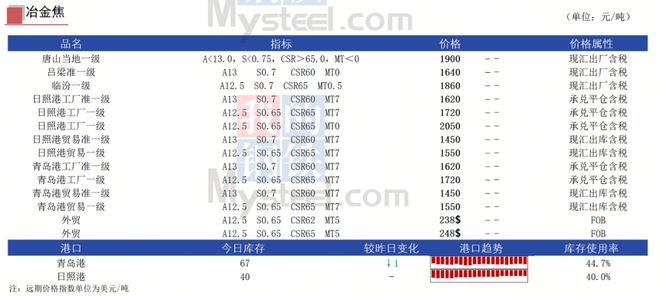
Group 1: Metallurgical Coke Market Overview - The metallurgical coke prices in the Lüliang market are operating weakly and steadily, with major steel mills in Hebei and Shandong reducing procurement prices by 50-55 yuan/ton, effective from December 1 [1][2][3] - The overall supply of coke is significantly relaxed due to improved profits for coke enterprises, leading to stable production levels, although some enterprises are experiencing slight inventory accumulation [1][2][3] - Downstream demand is cautious, with steel mills maintaining a prudent purchasing strategy, primarily based on actual needs, and ongoing maintenance plans affecting production [1][2][3] Group 2: Price Trends - Current prices for metallurgical coke are reported as follows: Lüliang's first-grade dry coke at 1740-1750 yuan/ton, and first-grade dry coke in Taiyuan at 1840 yuan/ton [1][3] - In the Jinzhong market, prices for various grades of coke are reported, with first-grade dry coke at 1860 yuan/ton and semi-dry coke at 1410-1430 yuan/ton [2][3] - The overall trend indicates a short-term stabilization in coke prices, with ongoing monitoring required for the impact of raw material costs and steel prices on future pricing [1][2][3] Group 3: Coking Coal Market Dynamics - The coking coal market is experiencing downward pressure, with some previously high-priced coal types showing slight recovery [5][6] - Supply from coal mines remains stable, but demand from downstream users is weak, leading to cautious purchasing behavior [6][9] - The overall sentiment in the coking coal market remains bearish, with expectations of further price declines as steel mills reduce production and maintain low inventory levels [5][6][9] Group 4: International Coal Market Insights - The Australian coal export volume from the three major ports in North Queensland reached 11.55 million tons in November, marking a year-on-year increase of 2.85% [17] - India's coal inventory at thermal power plants reached 53.6 million tons by the end of November, a 34% increase compared to the previous year, indicating a strong supply position [16] - The Mongolian coking coal market is also showing weakness, with limited demand and a cautious approach from trading companies [7][9]
行业周报:煤价第四目标上穿过程兑现,稳价逻辑依旧-20251130
KAIYUAN SECURITIES· 2025-11-30 12:44
Investment Rating - The report maintains a "Positive" investment rating for the coal industry [1] Core Viewpoints - The coal price has successfully crossed the fourth target, and the logic for price stability remains intact. The current dynamics are influenced by supply contraction and a surge in demand due to seasonal heating needs [3][4] - The report indicates that both thermal coal and coking coal prices are at a turning point, with thermal coal being a policy-driven commodity. The price recovery process involves several stages, including the restoration of long-term contracts and achieving a balance in profitability between coal and power companies [4][13] - The report highlights that the current coal prices are still at historical lows, providing room for a rebound, especially with the onset of the heating season and supply-side policies [5][14] Summary by Sections Industry Investment Rating - The coal industry is rated as "Positive" [1] Price Trends - As of November 28, the price of Qinhuangdao Q5500 thermal coal is 816 CNY/ton, showing a slight decrease from the previous week. The price at Guangzhou Port is 855 CNY/ton, having reached the target of 750 CNY for coal-power profitability [3][4] - Coking coal prices have also seen significant rebounds, with the price at Jing Tang Port reaching 1670 CNY/ton, up from 1230 CNY/ton in July, marking a 48.4% increase [3][4] Investment Logic - The report outlines that the price of thermal coal will follow a recovery process involving the restoration of long-term contracts and achieving a profitability balance for coal and power companies, with an ideal target price of around 750 CNY for 2025 [4][13] - Coking coal prices are more influenced by market dynamics, with target prices based on the ratio of coking coal to thermal coal prices, indicating potential target prices of 1608 CNY to 2064 CNY depending on market conditions [4][13] Investment Recommendations - The report suggests a dual logic for coal stocks: cyclical elasticity and stable dividends. It identifies four main lines for stock selection: cyclical logic, dividend logic, diversified aluminum elasticity, and growth logic [5][14] - Specific companies recommended include Jin控煤业, 兖矿能源 for cyclical logic, 中国神华, 中煤能源 for dividend logic, 神火股份, 电投能源 for diversified aluminum elasticity, and 新集能源, 广汇能源 for growth logic [5][14]



——煤炭行业周报(2025.11.22-2025.11.28):旺季需求韧性仍存,煤价有望企稳回升-20251130
Shenwan Hongyuan Securities· 2025-11-30 12:02
Investment Rating - The report maintains a positive outlook on the coal industry, suggesting that the demand during the peak season remains resilient, and coal prices are expected to rise after adjustments [2]. Core Views - The report highlights that the supply side is constrained due to increased safety and environmental inspections, while demand is bolstered by winter heating needs, leading to an anticipated rebound in coal prices [2][8]. - The report recommends focusing on companies with elastic demand for thermal coal, such as Jinkong Coal Industry, Huayang Co., and TBEA, as well as undervalued stocks like Shanxi Coking Coal and Huaibei Mining [2]. Summary by Sections 1. Recent Industry Policies and Dynamics - The 2026 National Coal Trading Conference is scheduled for December 3-5 in Rizhao, Shandong [7]. - The Longwanggou Coal Mine's capacity replacement plan has been approved, marking a significant development in coal production capacity [7]. - Shanxi has established 281 green mines, enhancing the province's coal production capabilities [7]. 2. Price Trends of Thermal and Coking Coal - As of November 28, thermal coal prices have decreased slightly, with prices reported at 619, 713, and 816 RMB/ton for different grades [2]. - Coking coal prices have shown stability with minor declines, such as the price for low-sulfur coking coal at 1580 RMB/ton [2][11]. 3. International Oil Price Movements - Brent crude oil futures settled at 63.2 USD/barrel, reflecting a 1.02% increase [14]. 4. Inventory Levels in the Bohai Rim - The average daily coal inflow in the Bohai Rim ports decreased to 2.0511 million tons, while the outflow increased to 1.9854 million tons, indicating a supply-demand adjustment [18]. - The total coal inventory at the Bohai Rim ports rose to 26.671 million tons, marking a 2.65% increase [18]. 5. Coastal Shipping Rates - Domestic coastal shipping rates have decreased to 42.62 RMB/ton, a drop of 9.84% [27]. - International shipping rates have seen an increase, with Indonesian coal prices rising to 10.36 USD/ton [27]. 6. Key Company Valuation Table - The report includes a valuation table for key companies, indicating stock prices and market capitalizations, such as China Shenhua at 41.14 RMB with a market cap of 817.4 billion RMB [33].


银河期货煤炭日报-20251126
Yin He Qi Huo· 2025-11-26 11:12
Group 1: Report Information - Report title: Coal Daily, November 26, 2025 [1] - Researcher: Zhang Mengchao [5] -从业资格号: F3068848 [5] - Investment consulting qualification certificate number: Z0017786 [5] - Contact information: zhangmengchao_qh@chinastock.com.cn [5] Group 2: Market Review - On November 26, port market coal prices were under pressure, with price ranges of various calorific value coal types generally shifting downward, weak trading volume, and a cold market atmosphere. For example, the 5500 - kcal coal was quoted at 825 - 830 yuan/ton [2] - Different regions had different price ranges for non - electric enterprise coal, such as Inner Mongolia, Yulin, and Shanxi [2] Group 3: Important News - From January to October this year, national railways cumulatively transported 33.78 billion tons of goods, a year - on - year increase of 3%, reaching a record high for the same period. The average daily loading was 186,000 cars, a year - on - year increase of 4% [3] Group 4: Logic Analysis - **Supply**: The impact of production restrictions still exists. The coal mine start - up rates in the main coal - producing areas of Shanxi, Shaanxi, and Inner Mongolia are generally stable. As of November 25, the coal mine start - up rate in Ordos was 78%, and in Yulin was 46%. The daily coal output of Ordos and Yulin exceeded 4 million tons, and domestic supply tended to be loose [4] - **Import**: China's procurement demand weakened, while international coal prices continued to rise [4] - **Demand**: This week's demand was mediocre. China's procurement demand weakened, Japan and South Korea's procurement was average, and India's procurement demand still showed no improvement. Power plant load increased, and inventories were relatively sufficient. Power plants mostly preferred long - term contract supplies, with low enthusiasm for market coal procurement. Port market prices fell slightly, and terminal demand boost was poor, resulting in limited market transaction activity [4] - **Inventory**: Railway transportation returned to normal. The average daily transport volume of the Datong - Qinhuangdao Line was 1.3 million tons, and the number of approved cars by the Huhhot Railway Bureau was around 30 trains. Port inventory was generally stable, and as of November 26, the inventory of Bohai Rim ports was 25.12 million tons, returning to the high level of the same period. Coastal power plant daily consumption was low, but inventories continued to decline. Inland power plant inventories were at a moderate level [4] - **Outlook**: In late November, coal production in the main producing areas was low. The coal start - up rates in Ordos and Yulin were stable, with a daily output of around 4.2 million tons, and supply tightened. Power plant inventories continued to decline, import profits emerged, coastal power plant procurement weakened, port inflow was high and outflow was low, and port inventory increased rapidly. The national temperature was relatively high, power plant daily consumption was low, and coal consumption was average, but coastal power plant inventories were lower than the same period, and they continued to make necessary purchases. Port FOB prices declined weakly. After the safety supervision at the mine pit was lifted, the coal mine start - up rate increased, production increased, and the demand for chemical coal was okay. Pit - mouth prices declined weakly. It is expected that coal prices will be weak in the short term [4] Group 5: Related Charts - The report presents multiple charts showing the inventory and daily consumption of different types of ports and power plants from 2022 to 2025, including national ports, Bohai Rim ports, downstream ports, etc. [7][8]
动力煤新长协维持不变,稳价逻辑依旧
KAIYUAN SECURITIES· 2025-11-23 14:11
Investment Rating - The report maintains a "Positive" investment rating for the coal industry [1] Core Views - The report indicates that the new long-term contracts for thermal coal remain unchanged, supporting a stable pricing logic [3] - Thermal coal prices have risen, with the Qinhuangdao Q5500 thermal coal closing at 834 CNY/ton as of November 21, remaining flat week-on-week, while the Guangzhou port price has reached 890 CNY, achieving the previously indicated profit-sharing target of 750 CNY [3][4] - The increase in thermal coal prices is attributed to a combination of supply contraction and a surge in demand due to colder weather in northern regions [4] - The report outlines a four-step process for the upward movement of thermal coal prices, including the restoration of central and local long-term contracts, reaching a profit-sharing line for coal and power companies, and approaching the breakeven point for power plants [4][13] - The report predicts that the price of thermal coal will range between 800 CNY and 860 CNY, with a breakeven point at 860 CNY [4][13] Summary by Sections Thermal Coal Market - As of November 21, the price of Qinhuangdao Q5500 thermal coal is 834 CNY/ton, unchanged from the previous week [17] - The Guangzhou port price for thermal coal has increased to 890 CNY/ton, achieving the profit-sharing target [3][17] - The report notes a significant increase in port inventories and a rise in daily consumption at coastal power plants [17][18] Coking Coal Market - The price of coking coal at the Jing Tang port is reported at 1780 CNY/ton, down from 1860 CNY/ton [18] - The report highlights a strong correlation between coking coal prices and thermal coal prices, with a current ratio of 2.4 times [4][13] - The report suggests that the target prices for coking coal, based on the thermal coal price movements, are set at 1608 CNY, 1680 CNY, 1800 CNY, and 2064 CNY [4][13] Investment Recommendations - The report identifies four main investment lines in the coal sector: 1. Cyclical logic: Companies like Jinko Coal and Yanzhou Coal 2. Dividend logic: Companies such as China Shenhua and Zhongmei Energy 3. Diversified aluminum elasticity: Companies like Shenhua Holdings and Electric Power Investment 4. Growth logic: Companies such as Xinji Energy and Guanghui Energy [5][14]

