牛市思维

Search documents
A股指数集体高开:沪指涨0.31%,有色金属、半导体芯片等板块涨幅居前
Feng Huang Wang Cai Jing· 2025-09-01 01:37
Group 1 - Huatai Securities suggests that technology stocks may continue to perform well in September due to concentrated industrial catalysts, despite a slight decline in non-financial performance growth in mid-year reports [1] - The overall A-share market shows a high degree of valuation differentiation, with TMT sector transaction volume exceeding 40%, indicating a need for capital rotation after rapid short-term gains [1] - Investment strategy should focus on strong sectors such as AI, pharmaceuticals, military industry, and consumer sectors benefiting from RMB appreciation [1] Group 2 - CITIC Construction points out that the current market sentiment is overheated, with a need to pay attention to deteriorating trading structures, suggesting a shift towards undervalued consumer and cyclical sectors for better cost-effectiveness [2] - The long-term trend remains unchanged, with a recommendation to invest in low-valuation sectors like consumer goods, non-ferrous metals, and new energy [2] - Key sectors to watch include large consumption, new energy, non-bank financials, innovative pharmaceuticals, TMT, and satellite internet [2] Group 3 - GF Securities maintains that investors holding technology stocks in the current bull market should continue to stay invested, as the trend is difficult to reverse once established [3] - For new market entrants, considering low-position call options may be a viable strategy, with attention to sectors like automotive parts, robotics, consumer electronics, and cyclical consumer goods [3] Group 4 - GF Securities forecasts that coal prices are likely to stabilize and gradually recover, with a strong performance expected in the fourth quarter due to a balanced supply-demand situation [4] - The second quarter saw coal prices at a low point, but leading companies have shown strong cost control and profitability resilience, with expectations for both volume and price increases in the second half of the year [4]


量化择时周报:牛市思维,优选哪些行业?-20250831
Tianfeng Securities· 2025-08-31 10:47
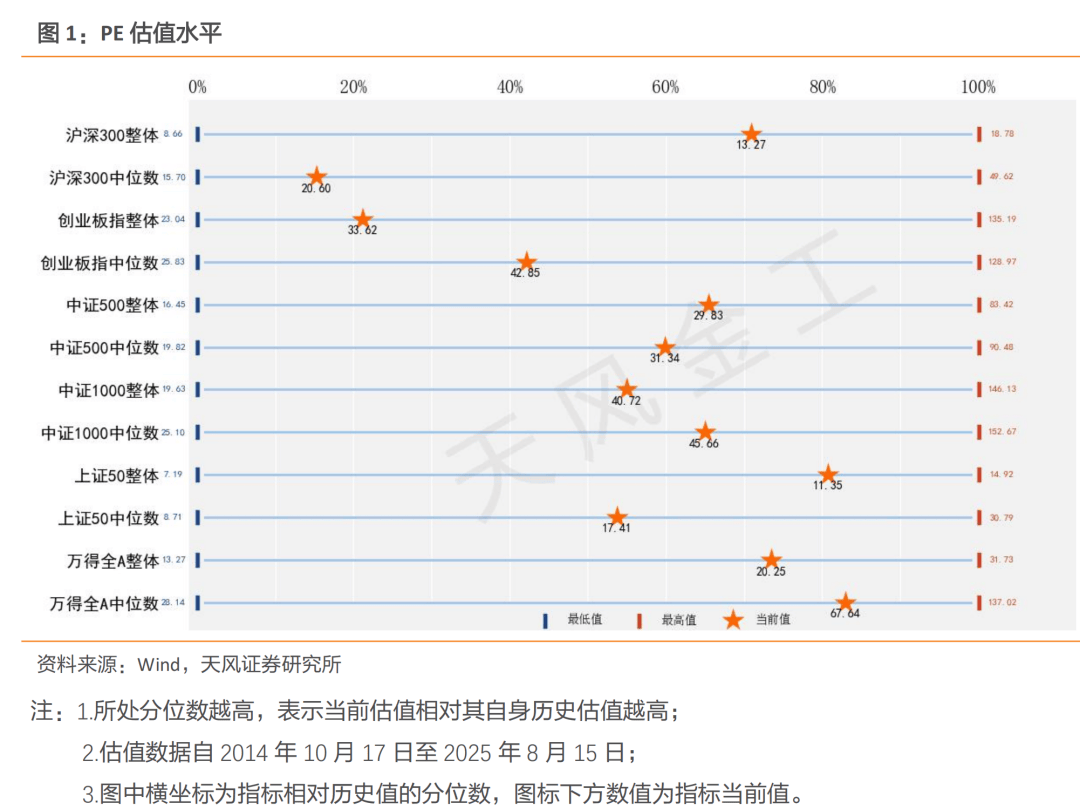
Core Insights - The report emphasizes a bullish market sentiment, suggesting that investors should maintain high positions and accumulate during dips as long as the market's profitability remains positive [1][2][3] - The current trend line for the WIND All A index is around 5926 points, with a profitability effect value of 4.2%, indicating a strong positive sentiment [2][10] - The report recommends focusing on sectors that are likely to benefit from policy support, including innovative pharmaceuticals, securities insurance, chemicals, and new energy technologies [2][10] Market Overview - The market is in an upward trend, with the short-term moving average (20-day) at 5884 points and the long-term moving average (120-day) at 5310 points, showing a widening gap of 10.81% [2][9] - The profitability effect has been positive, with a previous value of 5.22% and a recent value of 4.2%, suggesting continued market interest and potential for new capital inflows [1][10] - The report notes that small-cap stocks (represented by the CSI 2000) decreased by 0.78%, while mid-cap (CSI 500) and large-cap stocks (CSI 300 and SSE 50) showed increases of 3.24%, 2.71%, and 1.63% respectively [1][9] Sector Recommendations - The report continues to recommend sectors that are in a turnaround phase, specifically highlighting innovative pharmaceuticals and securities insurance as key areas for investment [2][10] - Additionally, sectors driven by policy support, such as chemicals and new energy technologies, are expected to maintain an upward trajectory [2][10] - The TWO BETA model suggests a focus on technology sectors, particularly in AI applications, computing power, and battery technologies [2][10] Valuation Metrics - The overall PE ratio for the WIND All A index is around the 85th percentile, while the PB ratio is at the 50th percentile, indicating a moderate valuation level [3][10] - Based on the current market conditions, the report advises maintaining an 80% allocation in absolute return products based on the WIND All A index [3][10]
熊市思维和牛市思维
Hu Xiu· 2025-08-29 01:09
Group 1 - The article discusses the concept of "bear market thinking," which involves a tendency to sell early due to fears of market stagnation, leading to a volatile market environment [1][2] - The A-share market has predominantly been in a bear market for the past decade, influencing investor sentiment and behavior, with many investors feeling the market is nearing its peak despite strong performance [2][3] - Recent market trends suggest that the current phase may be a primary upward wave, although this will only be confirmed in hindsight [3] Group 2 - There is a noticeable divide between seasoned investors, who are more cautious due to past bear market experiences, and new investors, who are more optimistic and aggressive in their trading strategies [4][6] - Observations indicate that older investors are becoming hesitant and are considering taking profits, while younger investors are more willing to take risks [5][6] - The article notes that the traditional methods of older investors may not be effective in the current market environment, which appears to favor the strategies of newer investors [7][10] Group 3 - Recent financial data shows a significant decrease in household and corporate deposits, while non-bank deposits have increased, suggesting a potential shift of funds into the stock market [15][18] - A new fiscal subsidy policy for personal consumption loans is expected to encourage borrowing and potentially increase investment in the stock market [19][20] - The article highlights that the current low volatility and steady market rise are unusual, indicating that new funds entering the market may be more vulnerable to fluctuations [13][27] Group 4 - "Bull market thinking" is characterized by following market trends without the fear of selling at the top, focusing instead on the potential for continued growth [28][29] - The article suggests that there is still significant potential for funds to move into the market, and the overall market sentiment is optimistic [29][30] - The current market environment is described as stable, with no substantial corrections, despite some indicators suggesting potential downturns [32][39] Group 5 - The article concludes that past decision-making models based on bear market experiences may no longer be applicable, and a shift in strategy is necessary to adapt to the current market conditions [41][42] - Investors are advised to adopt a more observational approach, minimizing active decision-making until the market situation becomes clearer [43][44]
量化择时周报:牛市思维,行业如何配置?-20250824
Tianfeng Securities· 2025-08-24 10:14
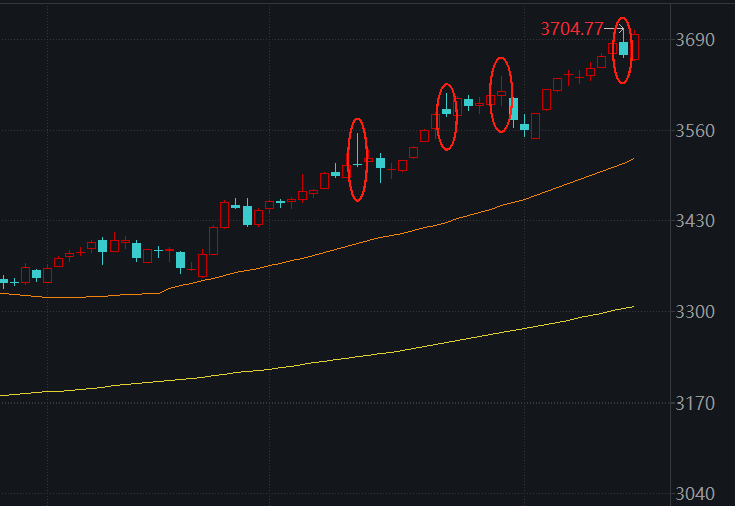
Core Insights - The report emphasizes a bullish market sentiment, suggesting that investors should continue to accumulate positions during dips as long as the market maintains a positive profit effect [1][2][3] - The current profit effect value is reported at 5.22%, indicating a strong market environment, and the recommendation is to hold high positions until the profit effect turns negative [2][10] - The report identifies key sectors for investment, including innovative pharmaceuticals and securities insurance, which are expected to benefit from ongoing upward trends [2][10] Market Overview - The Wind All A index is currently in an upward trend, with the short-term moving average (20-day) at 5752 points and the long-term moving average (120-day) at 5271 points, resulting in a distance of 9.12% between the two [2][10] - The overall market saw significant gains, with the Wind All A index rising by 3.87% last week, and small-cap stocks (CSI 2000) increasing by 3.23% [1][9] - The report highlights strong performance in the telecommunications and electronics sectors, with telecommunications stocks rising by 10.47% [1][9] Investment Strategy - The report recommends maintaining an 80% position in absolute return products based on the Wind All A index, as the current PE ratio is at the 85th percentile, indicating a moderate valuation level [3][10] - The focus for mid-term investments should be on sectors that are expected to experience a turnaround, particularly innovative pharmaceuticals and securities insurance, alongside policy-driven sectors like photovoltaics and chemicals [2][10] - The Two Beta model continues to recommend technology sectors, specifically military computing and battery technologies, while short-term signals suggest a potential rebound for gold stocks after adjustments [2][10]
十年高点A股还能上车吗?陈嘉禾:投资者需学会算账 关注性价比
Xin Jing Bao· 2025-08-20 16:03
Core Viewpoint - The core of investment lies in valuation and cost-effectiveness, rather than merely identifying good companies or stocks [1] Market Comparison - Compared to the bull market ten years ago, the current A-share market shows significant differences, with the index currently around 3700 points, while it peaked at 5178.19 points a decade ago [2] - The overall economic and market fundamentals have improved significantly over the past ten years, suggesting that if valuation levels remained constant, the index should be much higher [2] - Regulatory environments have changed, with stricter controls on credit funds entering the market, leading to a more stable and sustainable "slow bull" market rather than a "crazy bull" [2] Valuation Levels - The overall valuation of the A-share market is not considered expensive, with major indices like CSI 300 and SSE 50 having dynamic P/E ratios around ten times, which is relatively low compared to global markets [3] - There is significant divergence in individual stock valuations, with some stocks having P/E ratios in the tens or even hundreds, while others, especially in the Hong Kong market, have P/E ratios as low as six or seven times [3][6] Influencing Factors - Various factors such as U.S.-China relations, real estate trends, and financial risk management will influence market fluctuations, and the current macroeconomic context is markedly different from ten years ago [4] - Investors often base their decisions on qualitative assessments of a bull market, which may lack rigorous logic, leading to potential misjudgments [4] Investment Strategy - The focus should be on large-cap companies due to their better transparency, lower risk of "black swan" events, and more favorable valuations compared to small-cap stocks [5][6] - The investment strategy should prioritize valuation and cost-effectiveness, rather than following popular trends or sectors that may be overvalued [9] Recommendations for Investors - Investors should adopt a mindset focused on calculating real returns from their investments, rather than speculating on short-term market movements [10] - A comprehensive view of all assets as a single entity can help in assessing overall profitability and health, leading to clearer investment decisions [10]
ETF日报:A股主要股指在技术面上较为强劲,仍需保持牛市思维
Xin Lang Ji Jin· 2025-08-20 14:02
Market Overview - A-shares showed overall strength today, with the Shanghai Composite Index rising by 1.04% to 3766.21 points, continuing to set new highs [1] - The Shenzhen Component Index increased by 0.89%, while the ChiNext Index rose by 0.23% and the Sci-Tech Innovation Index climbed by 1.84% [1] - Total trading volume in the Shanghai and Shenzhen markets reached 240.82 billion yuan, a decrease of 19.23 billion yuan from the previous day [1] Sector Performance - Technology-related sectors led the gains, with chips, integrated circuits, and semiconductor equipment all performing well [1] - Conversely, innovative pharmaceuticals and film sectors experienced declines [1] Market Sentiment - The market structure indicates a neutral short-term sentiment, with more than 3600 stocks rising [1] - Small-cap stocks underperformed compared to large-cap stocks, and growth stocks outperformed value stocks, indicating significant differentiation in the dual innovation sectors [1] Future Outlook - The technical outlook for major A-share indices remains strong, suggesting a bullish market mindset, although the extent of the market's rise has exceeded expectations [2] - Recent macroeconomic data and financial figures have not met expectations, with July's new RMB loans showing a negative value for the first time in nearly 20 years, yet this has not hindered the Shanghai Composite Index from reaching new highs [2] - The primary driver of the recent market rise appears to be capital inflow, with significant contributions from speculative funds [2] Bond Market Analysis - The bond market is experiencing a pullback, attributed to institutions actively reducing duration and the stock-bond seesaw effect [4] - Despite the recent strength in the stock market, which reflects economic recovery and a move away from deflation, bond prices are under pressure [4] - There are indications that bonds may still hold value for allocation in the second half of the year, despite potential further pullbacks [4] Automotive Industry Insights - The automotive sector has shown strong performance in the first half of the year, with sales and export figures being robust, particularly in the new energy vehicle segment [10][11] - In July, despite being a traditional off-season, the automotive industry maintained a double-digit growth year-on-year, with exports reaching 575,400 vehicles, a 22.65% increase [11] - The focus on electronic, intelligent, and lightweight vehicles continues to drive development in the automotive sector [12] Policy Impact on Automotive Sector - Recent policies aimed at optimizing the automotive market environment are expected to improve the industry landscape, including regulations on payment terms for small and medium enterprises [14] - Major automotive companies have responded positively to these policies, indicating a broad industry commitment to compliance [14] - The automotive ETF has shown strong performance, suggesting potential for further gains in the context of these policy changes [15]
十年高点A股还能上车吗?陈嘉禾:投资者需学会算账,关注性价比
Bei Ke Cai Jing· 2025-08-20 13:37
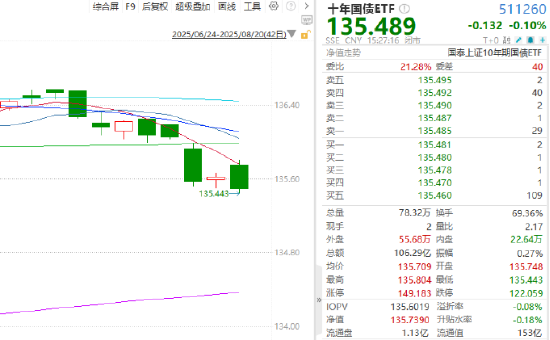
Core Viewpoint - The current A-share market shows significant differences compared to the bull market ten years ago, with changes in industry logic and macroeconomic background necessitating a more cautious investment approach rather than a simplistic "bull market thinking" [4][7]. Market Comparison - The current market is at around 3700 points, significantly lower than the peak of 5178.19 points ten years ago, despite substantial increases in GDP, monetary scale, and market fundamentals over the past decade [4]. - The regulatory environment has changed drastically, with stricter controls on credit funds entering the market, leading to a more stable and sustainable "slow bull" market rather than a "crazy bull" market [4]. Valuation Levels - The overall valuation of the A-share market is not considered expensive, with major indices like CSI 300 and SSE 50 having dynamic P/E ratios around ten times, which is relatively low compared to global markets [5]. - There is significant divergence in individual stock valuations, with some stocks having P/E ratios in the tens or even hundreds, while others, especially in the Hong Kong market, have P/E ratios as low as six or seven times [6]. Influencing Factors - Various factors such as Sino-U.S. relations, real estate trends, and financial risk management will impact market fluctuations, highlighting the need for a more analytical approach to investment decisions [7]. Investment Strategy - The focus should be on valuation and cost-effectiveness rather than simply identifying bull markets. Investors should consider the real return rates of their investments rather than speculating on short-term market movements [13]. - The investment strategy should involve treating all assets as a single entity to assess overall profitability and growth rates, ensuring a clear decision-making process regarding holdings [13]. Sector Preferences - The preference leans towards large-cap companies due to their better understanding, lower risk of "black swan" events, and more favorable valuations compared to small-cap stocks [8]. - The current holdings are concentrated in sectors like finance, port operations, pharmaceuticals, and manufacturing, which are perceived to have high cost-effectiveness and strong competitive positions [12]. Market Potential - The Hong Kong market is viewed as more attractive due to its significantly lower valuations compared to the A-share market, with an average P/E ratio of around six to eight times, presenting a 40% discount relative to A-shares [10].

“翻倍基”超百只!行情还能维持多久?
Guo Ji Jin Rong Bao· 2025-08-19 13:45
Core Viewpoint - The A-share market has shown a strong rebound, with the Shanghai Composite Index reaching a nearly ten-year high around 3720 points, driven primarily by growth-oriented sectors [1] Market Performance - As of August 19, the North Exchange 50 Index and the Sci-Tech Innovation 200 Index have both seen year-to-date gains exceeding 50%, while the CSI 2000 Index has risen over 30% [1] - The performance of technology growth-style broad-based indices has significantly outpaced that of the broader market indices, with over a hundred equity funds achieving net value increases of over 100% in the past year [1][3] - The leading funds in the past year include those focused on themes such as financial technology, humanoid robots, and pharmaceuticals, with actively managed funds dominating the top performers [1][3] Fund Performance - Three funds from the North Exchange have reported net value increases exceeding 200% in the past year, highlighting the strong performance of thematic funds [3] - A total of 137 funds have seen net value increases over 100% in the past year, with 103 of these being actively managed equity funds [3] - The Wind Mixed Equity Fund Index has shown a net value increase of over 40% in the past year, benefiting from several market rallies [4] Market Trends and Future Outlook - The current market rally is attributed to a bullish sentiment, with continuous inflow of new capital and easing of US-China tariffs [6] - Institutions like Morgan Stanley and Guotai Fund express optimism about the sustainability of the market rally, citing strong liquidity and upcoming positive events as potential support for market sentiment [6][8] - The technology sector, particularly in AI applications and semiconductor materials, is expected to continue leading the market, with other sectors also presenting investment opportunities [7][8]
牛市思维下的A股逻辑:加速行驶的火车正在鸣笛
Sou Hu Cai Jing· 2025-08-18 09:32
Core Viewpoint - The A-share market is experiencing a strong upward trend despite ongoing economic pressures, indicating a divergence between stock market performance and macroeconomic conditions [1][2]. Group 1: Economic Context - The current macroeconomic environment in China is characterized by structural adjustments and challenges, yet the stock market is exhibiting "counter-cyclical" behavior, suggesting a shift in funding logic and policy environment [2][4]. - Historical examples show that stock markets can rise independently of economic performance, as seen during the Great Depression and Japan's lost decades [2]. Group 2: Funding Logic - Recent reductions in domestic deposit rates are prompting a shift in capital flows, as lower interest rates diminish the attractiveness of bank savings, pushing funds towards higher-return investments [3][4]. - The stock market acts as a significant reservoir for capital, where rising indices attract more investments, creating a positive feedback loop that fuels further market growth [5]. Group 3: International Perspective - Anticipated interest rate cuts by the Federal Reserve are expected to create a more favorable global monetary environment, enhancing risk appetite in capital markets [6][7]. - As a major global economy, China is positioned to attract significant capital inflows, particularly in the context of global monetary easing, which will likely resonate with domestic funding trends [8]. Group 4: Bull Market Mindset - Transitioning to a bull market mindset involves a shift in investment strategies, where patience and trend-following become crucial for maximizing returns [9][10]. - Investors are encouraged to focus on leading sectors such as renewable energy, technology, and artificial intelligence, which are expected to drive long-term growth despite short-term market fluctuations [11][12]. Group 5: Investment Insights - Key strategies for navigating a bull market include selecting industry leaders, maintaining a long-term holding period, managing portfolio allocations wisely, and controlling emotional responses to market volatility [17][18][19][20]. - The current bull market phase in the A-share market is supported by favorable funding conditions and policy environments, suggesting a robust foundation for continued growth [22].
牛市思维,下周关注哪些行业?
Sou Hu Cai Jing· 2025-08-17 14:06
Market Overview - The market continues to operate in an upward trend, with the core observation variable being whether the market's profit-making effect can be sustained. As long as the profit-making effect remains positive, mid-term incremental capital is expected to continue entering the market [1][2][7] - The current WIND All A trend line is around 5625 points, with a profit-making effect value of 3.73%, which is significantly positive. It is recommended to hold positions patiently and maintain a high allocation until the profit-making effect turns negative [1][2][7] Industry Allocation - From a mid-term perspective, the industry allocation continues to recommend sectors that are experiencing a turnaround, specifically Hong Kong stocks in innovative pharmaceuticals and securities. The upward trend is still ongoing. Additionally, sectors benefiting from policy support, such as photovoltaics, coal, and non-ferrous metals, are expected to maintain an upward trajectory [3][7] - The TWO BETA model continues to recommend the technology sector, with a focus on military and computing power [2][3][7] Performance Metrics - The Davis Double Strategy has achieved a cumulative absolute return of 41.19% this year, exceeding the benchmark by 26.47%. This week, the strategy outperformed the benchmark by 1.62% [8][22] - The net profit gap strategy has achieved a cumulative absolute return of 42.83% this year, with a benchmark excess return of 28.11% [12][16] - The enhanced CSI 300 strategy has achieved an excess return of 19.88% relative to the CSI 300 index this year, with a weekly excess return of 0.01% [17][20]