端到端大模型

Search documents
城市NOA销量突破300万辆:智驾竞争进入体验决胜期
3 6 Ke· 2026-01-16 13:22
Group 1 - The report indicates that from January to November 2025, the cumulative sales of passenger cars equipped with urban NOA (Navigation Assisted Driving) in China reached 3.129 million units, accounting for 15.1% of the total passenger car insurance volume, an increase of 5.6 percentage points compared to the entire year of 2024 [1] - Notably, mainstream models priced below 300,000 yuan accounted for 68.9% of the sales, indicating that urban NOA, once a feature exclusive to high-end vehicles, is moving towards the mainstream consumer market [1] - The report highlights that domestic brands are actively innovating in the smart connected vehicle sector, capturing a dominant market position with an 81.1% share of urban NOA model sales [1][4] Group 2 - The market for third-party suppliers is becoming concentrated, with Momenta and Huawei together holding approximately 80% of the market share, with Momenta at about 61.06% and Huawei's HI model at approximately 19.76% [2][4] - The report anticipates that by 2030, urban NOA will become the mainstream function of assisted driving, with the Ministry of Industry and Information Technology predicting that high-level automated driving will create a trillion-yuan value increment for the automotive industry [2][7] - The report emphasizes that the current focus of industry competition has shifted from high-speed NOA to urban NOA, with the development level of NOA technology being crucial for China's competitive position in the global automotive industry [1][2] Group 3 - The report outlines a dual-driven market structure of "in-house development by car manufacturers + collaboration with third-party suppliers," with self-developed urban NOA models accounting for approximately 78.3% of total urban NOA sales from January to November 2025 [3] - New car manufacturers are leveraging software development and ecosystem capabilities to drive the development of NOA, with brands like Tesla, NIO, and Xpeng leading the market [3] - The report also notes that traditional brands are increasingly collaborating with local intelligent driving suppliers to accelerate the implementation of urban NOA features, indicating a shift in strategy among established automotive players [4] Group 4 - The report identifies the core elements of supplier competitiveness in the scaling phase as algorithm capability, data closure, and experience in large-scale production [5] - The end-to-end architecture is being restructured, with safety and user experience becoming focal points for upgrades, driven by the integration of end-to-end large models [6] - The ultimate goal of technological iteration is to enhance safety and user experience, with expectations that urban NOA's functionality and reliability will continue to expand as multi-modal large models and end-to-end technologies evolve [6][7]


《报告》:NOA供应商市场呈“双强主导”格局
Zhong Guo Jing Ying Bao· 2026-01-16 05:57
Core Insights - The report highlights the rapid development of intelligent connected vehicles in China, particularly focusing on urban Navigation Assisted Driving (NOA) technology, which is seen as a strategic pillar for modernizing the automotive industry [1][2]. Industry Background - Urban NOA technology is positioned as a critical bridge between advanced driver assistance systems and fully autonomous driving, directly impacting China's competitive stance in the global automotive industry [2]. - The market for urban NOA is characterized by a "dual strong leadership" structure, with companies like Momenta and Huawei holding significant market shares [2][5]. Market Dynamics - In the first eleven months of 2025, the cumulative sales of passenger vehicles equipped with urban NOA reached 3.129 million units, with a penetration rate of 15.1%, marking a 5.6 percentage point increase from 2024 [3][4]. - Domestic brands accounted for 81.1% of the urban NOA-equipped passenger vehicle sales, indicating strong innovation and competitiveness in the sector [3]. Technological Advancements - The market for NOA technology is rapidly expanding, with L2-level driving assistance features expected to be present in approximately 66.1% of new vehicles by the end of 2025 [3]. - The shift from highway NOA to urban NOA is accelerating, with a focus on integrating advanced technologies and enhancing user experience [7][8]. Competitive Landscape - The competitive landscape is driven by both in-house development by automakers and partnerships with third-party suppliers, with 19 brands developing their own urban NOA and 29 brands collaborating with third-party suppliers [5][6]. - Momenta leads the market with 414,400 units of urban NOA, representing 61.06% of the third-party supplier market, while Huawei follows with 19.76% [6]. Future Outlook - By 2030, urban NOA is projected to become a mainstream feature in both assisted and autonomous driving, with significant value creation anticipated for the automotive industry [9]. - The report outlines five key recommendations for enhancing the urban NOA ecosystem, including improving management systems, fostering technological innovation, and enhancing industry collaboration [10].
AI重塑汽车产业:从CES 2026看智能化革命的深度演进
Zhong Guo Qi Che Bao Wang· 2026-01-15 06:23
Core Insights - The CES 2026 event highlighted the accelerated transformation of the automotive industry towards smart technology, with AI becoming a core element in redefining automotive products [1] - The concept of "smart driving equity" emerged as a key theme in 2025, with advanced driving systems becoming accessible across a wider range of vehicle price points [2] - The rapid proliferation of smart driving technology necessitates new requirements for vehicle after-sales service systems, leveraging AI for efficient diagnostics [3] - The commercialization of Robotaxi services is gaining momentum, with significant growth in revenue and operational scale in major Chinese cities [5] - The evolution of smart cockpits is transforming vehicles into personalized assistants, enhancing user interaction and experience [6] - AI-driven marketing services are reshaping automotive marketing from broad outreach to precision targeting [7] - The competitive landscape is shifting towards ecosystem collaboration among automotive companies and technology suppliers, fostering innovation and efficiency [9] - The future of the automotive industry will be defined by AI, with a focus on collaborative ecosystems and comprehensive digital transformation [10] Group 1: Smart Driving Technology - The introduction of advanced driving systems like BYD's "Heavenly Eye" and Xiaopeng's XNGP is making smart driving features available in lower-priced vehicles [2] - The VLA architecture enables a more human-like decision-making process in driving, significantly reducing reliance on real vehicle data for testing [2] - The cost reduction in high-level driving systems, such as the integration of solid-state LiDAR, is facilitating their adoption in more affordable models [2] Group 2: After-Sales Service Innovations - The establishment of an AI-driven diagnostic system has achieved a 98.1% accuracy rate in diagnosing electric vehicle systems, significantly improving service efficiency [3] - The AI system reduces the time to address individual faults to approximately 20 seconds, enhancing the overall after-sales service experience [3] Group 3: Commercialization of Robotaxi - Major cities in China are rapidly expanding Robotaxi operations, with Wuhan leading in testing mileage and population coverage [5] - Companies like Pony.ai and WeRide are reporting substantial revenue growth in their Robotaxi services, indicating a shift towards profitability [5] - The market for Robotaxi services is projected to grow significantly, with estimates reaching $4.7 billion by 2035 [5] Group 4: Smart Cockpit Developments - The integration of advanced AI models in vehicle cockpits is transforming them into intelligent assistants capable of understanding user emotions and preferences [6] - The trend towards end-to-end AI solutions in cockpits is expected to enhance user experience and interaction [6] Group 5: Marketing and Service Automation - AI-driven marketing tools are enabling automotive brands to identify high-intent customers and streamline communication processes [7] - The use of AI in customer outreach has led to improved engagement rates and more efficient service delivery [8] Group 6: Ecosystem Collaboration - Automotive companies are increasingly forming strategic partnerships with technology suppliers to enhance their capabilities and reduce R&D costs [9] - The collaborative model is leading to faster product iteration cycles and improved technology deployment [9] Group 7: Future Outlook - The automotive industry is entering a new era defined by AI, with a focus on collaborative ecosystems and comprehensive digital transformation [10] - The competition will center around the efficiency of ecosystem collaboration and the ability to innovate rapidly [10]
智驾“中国方案”双强格局:Momenta与华为NOA合计占比超80%
Guan Cha Zhe Wang· 2026-01-15 03:50
Core Insights - The report highlights the rapid expansion of the urban NOA (Navigation Assisted Driving) market in China, with cumulative sales reaching 3.129 million units from January to November 2025, accounting for 15.1% of passenger car insurance volume, an increase of 5.6 percentage points compared to the entire year of 2024 [1][2] Industry Overview - The urban NOA technology is becoming a core configuration in automotive intelligence, with 2025 identified as a key year for its commercialization [2] - The market is characterized by a "dual strong" pattern among third-party urban NOA suppliers, with Momenta and Huawei leading, together holding over 80% of the market share [1][2] Company Performance - Momenta's urban NOA deployment reached 414,400 units, representing 61.06% of the third-party supplier market, with partnerships covering major domestic passenger car manufacturers and 8 out of the top 10 global automakers [2] - Huawei's HI model achieved a deployment of 134,100 units, accounting for 19.76% of the third-party supplier market [2] - Domestic brands excelled in the urban NOA segment, with related model sales reaching 2.5373 million units, making up 81.1% of the total [2] Competitive Landscape - Global automotive brands such as Mercedes-Benz, BMW, Audi, Cadillac, Buick, and Toyota are accelerating their urban NOA strategies through collaborations with leading Chinese intelligent driving suppliers [2] - The report indicates that the "Chinese solution" for intelligent driving, developed by companies like Huawei and Momenta, is attracting deep cooperation from renowned automotive brands in Germany, the US, Japan, and South Korea, enhancing China's influence in the global automotive value chain [2] Technological Advancements - The report suggests that as high-level assisted driving enters a phase of large-scale implementation, key factors determining supplier market position include algorithm strength, data loop capabilities, and experience in large-scale production [3][5] - The urban NOA is driving systemic changes in the intelligent driving sector, with applications extending from highway NOA to urban environments, and a shift towards integrated system architectures [3][5] Future Outlook - The report predicts that the integration of multimodal models and end-to-end technologies, along with continuous upgrades to computing platforms, will further enhance the safety experience of urban NOA [5] - Competition in the industry is shifting from a focus on individual technical metrics to a comprehensive competition based on product experience, technological limits, and scalability, with leading companies building systematic advantages through algorithms, data loops, and large-scale production [5]



中国智驾双强:Momenta与华为NOA合计占比超80%
Guan Cha Zhe Wang· 2026-01-15 03:44
Core Insights - The report highlights the rapid expansion of the urban NOA (Navigation Assisted Driving) market in China, with a cumulative sales of 3.129 million units from January to November 2025, accounting for 15.1% of passenger car insurance volume, an increase of 5.6 percentage points compared to the entire year of 2024 [1][2] Market Dynamics - The market for third-party urban NOA suppliers is characterized by a "dual strong" pattern, with Momenta and Huawei significantly leading, together holding over 80% of the market share among third-party suppliers [1][2] - Momenta's urban NOA deployment reached 414,400 units, representing 61.06% of the third-party supplier market, with partnerships covering major domestic passenger car manufacturers and 8 out of the top 10 global automakers [2] - Huawei's HI model achieved a deployment of 134,100 units, accounting for 19.76% of the third-party supplier market [2] Competitive Landscape - Domestic brands excelled in the urban NOA segment, with related model sales reaching 2.5373 million units, representing 81.1% of the total, showcasing the innovation and market competitiveness of Chinese automakers [2] - Global brands such as Mercedes-Benz, BMW, Audi, Cadillac, Buick, and Toyota are accelerating their strategies by collaborating with leading Chinese intelligent driving suppliers to implement urban NOA features [2] Technological Advancements - The report indicates that high-level assisted driving is entering a phase of large-scale implementation, where algorithm strength, data loop capabilities, and mass production experience are critical for determining suppliers' market positions and growth rates [3] - The urban NOA is driving systemic changes in the intelligent driving field, with applications extending from highway NOA to urban environments, and a shift towards integrated system architectures [5] - The end-to-end large model has become the core engine for NOA technology iteration, facilitating a transition from modular architectures to integrated perception and planning systems [5] Future Outlook - The report predicts that the integration of multimodal models and end-to-end technologies, along with continuous upgrades to computing platforms, will further enhance the safety experience of urban NOA [5] - The industry competition is shifting from a focus on individual technical metrics to a comprehensive competition based on product experience, technological limits, and mass production capabilities [5]
中汽协2025城市NOA报告发布:Momenta第三方供应商市场市占率超60%
Zhong Jin Zai Xian· 2026-01-15 03:01
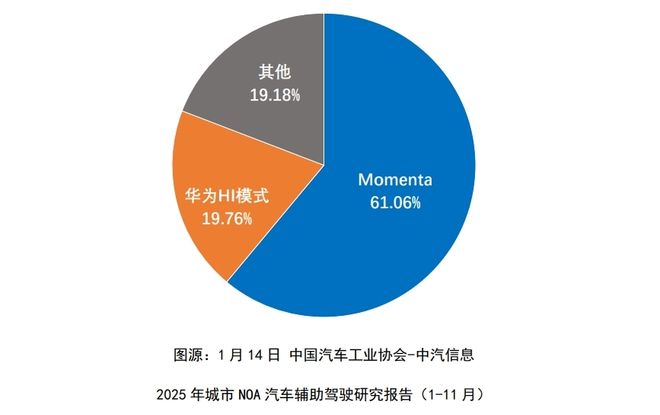
Core Insights - The report highlights the rapid growth of the urban NOA (Navigation on Autopilot) market in China, with a cumulative sales of 3.129 million passenger cars equipped with urban NOA from January to November 2025, achieving a penetration rate of 15.1%, an increase of 5.6 percentage points compared to the entire year of 2024 [3][4]. Group 1: Market Dynamics - The urban NOA market is characterized by a "dual strong" pattern among third-party suppliers, with Momenta and Huawei leading the market, together accounting for over 80% of the market share among third-party suppliers [3][4]. - Momenta has a leading position with 414,400 units of urban NOA equipped vehicles, representing approximately 61.06% of the third-party supplier market, while Huawei's HI model has around 134,100 units, accounting for about 19.76% [3][4]. Group 2: Competitive Landscape - Domestic brands have shown significant strength, with sales of urban NOA-equipped vehicles reaching 2.5373 million units, making up 81.1% of total sales, indicating their innovation and competitiveness in the smart connected vehicle sector [4]. - Global automotive brands are increasingly collaborating with leading domestic third-party suppliers to enhance their smart driving capabilities, with notable partnerships including Mercedes-Benz, BMW, Audi, Cadillac, Buick, and Toyota [4]. Group 3: Technological Advancements - The report emphasizes that algorithms, data closed-loop capabilities, and experience in large-scale production are critical factors determining the market position and development speed of autonomous driving suppliers [4][5]. - The end-to-end large model has become the core engine for the iteration of NOA auxiliary driving technology, promoting a shift from modular architecture to an integrated perception and planning system [5][6]. Group 4: Future Trends - The competition among autonomous driving suppliers is evolving from a focus on single technical indicators to a comprehensive capability that includes product experience, technological potential, and scalability [7]. - The integration of multi-modal models and end-to-end technology, along with continuous upgrades of computing platforms, is expected to enhance the safety experience of urban NOA technology [6][7].
车企自研、第三方合作“双轮驱动”,城市NOA规模化加速
Zhong Guo Jing Ji Wang· 2026-01-15 02:12
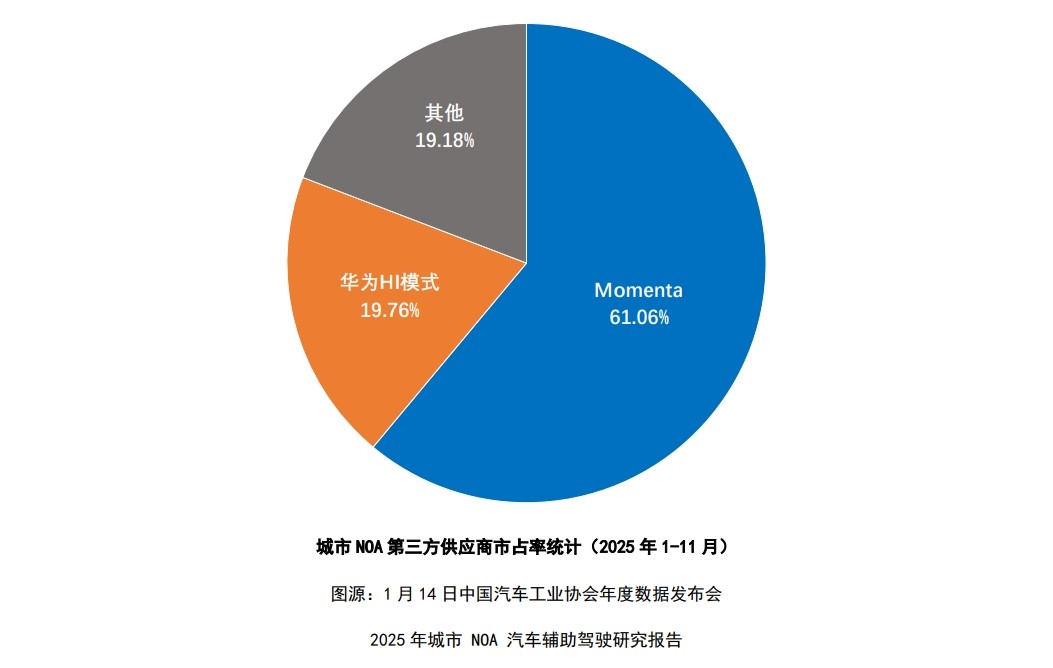
Core Insights - 2025 is identified as a critical year for the commercialization of urban NOA (Navigation Assisted Driving) in China, with a projected market scale growth [1] - The report indicates that from January to November 2025, the cumulative sales of passenger cars equipped with urban NOA reached 3.129 million units, with a penetration rate of 15.1%, an increase of 5.6 percentage points compared to the entire year of 2024 [1] Industry Background - NOA technology is seen as a key driver for smart connected vehicles, bridging advanced driver assistance and fully autonomous driving, which is crucial for enhancing user travel experience and asserting China's competitive voice in the global automotive industry [3] - The report highlights that among the passenger cars sold with urban NOA, domestic brands accounted for 2.5373 million units, representing 81.1% of the total, showcasing innovation and competitiveness in the smart connected vehicle sector [3] Market Dynamics - The current market for urban NOA is characterized by a dual-driven model of self-research by car manufacturers and collaboration with third-party suppliers [5] - Major players in self-research include Tesla, NIO, Xpeng, Li Auto, Xiaomi, and others, while approximately 29 brands collaborate with third-party suppliers [5] - The third-party supplier market is dominated by two key players, Momenta and Huawei, which together hold about 80% market share; Momenta's urban NOA installations reached 414,400 units, accounting for 61.06% of third-party suppliers, while Huawei's HI model accounted for 19.76% with 134,100 units [5] Technological Advancements - The rapid iteration of technology and market competition is driving systemic changes in smart driving technology, core architecture, and industrial ecology [9] - The report emphasizes that end-to-end large models are becoming the core engine for NOA technology iteration, facilitating a shift from modular architecture to integrated systems [10] - New energy vehicle manufacturers are building technological barriers through full-stack self-research, while traditional automakers are accelerating technology deployment through partnerships with third-party suppliers [10] Future Outlook - The report anticipates that by 2030, urban NOA will become a mainstream feature in both assisted and autonomous driving [10] - Recommendations for enhancing the high-quality development of NOA include improving top-level design, strengthening technological innovation, enhancing industry collaboration, and exploring global competitiveness for supply chain enterprises [11]
2025年超越300万辆!城市NOA规模化普及加速
Guo Ji Jin Rong Bao· 2026-01-15 02:09
Core Insights - The report by the China Automobile Industry Association indicates that from January to November 2025, the cumulative sales of passenger cars equipped with urban NOA (Navigation Assisted Driving) reached 3.129 million units, with a penetration rate of 15.1%, an increase of 5.6 percentage points compared to the entire year of 2024 [1] Group 1: Market Dynamics - The urban NOA market is characterized by a "dual-engine" model of self-research by car manufacturers and partnerships with third-party suppliers [1] - The third-party urban NOA supplier market is dominated by two major players, Momenta and Huawei, who together hold over 80% market share [1] - In the same period, Momenta's urban NOA installations reached 414,400 units, accounting for approximately 61.06% of third-party suppliers, with eight of the top ten global automakers collaborating with Momenta [1] Group 2: Brand Performance - Among the passenger cars equipped with urban NOA, domestic brands sold 2.5373 million units, representing 81.1% of the total [2] - Global automotive brands are increasingly partnering with leading domestic third-party suppliers to achieve breakthroughs in intelligent driving, with brands like Mercedes-Benz, BMW, Audi, Cadillac, Buick, and Toyota implementing urban NOA features through these collaborations [2] Group 3: Technological Advancements - The report highlights that in the phase of scaling high-level assisted driving, factors such as algorithms, data loop capabilities, and mass production experience are critical for determining the market position and development speed of assisted driving suppliers [2] - End-to-end large models have become the core engine for the iteration of NOA assisted driving technology, driving the industry towards an integrated approach and enhancing safety experiences [3] - New car manufacturers are building technological barriers through full-stack self-research, while traditional automakers are accelerating technology deployment by collaborating with third-party suppliers [3]
2025年NOA乘用车销售超300万辆,《2025城市NOA汽车辅助驾驶研究报告》发布
Zhong Guo Qi Che Bao Wang· 2026-01-15 02:03
Core Insights - The report titled "2025 Urban NOA Automotive Assisted Driving Research Report" was officially released at the China Automotive Industry Association's information conference, aiming to analyze the development trends of urban NOA technology and industry, providing references for high-quality development of China's intelligent connected vehicle industry [1] Group 1: Market Growth and Trends - By the end of 2025, it is projected that over 3 million urban NOA-equipped vehicles will be sold in China, with a penetration rate of 15.1% for urban NOA features in passenger vehicles from January to November 2025, an increase of 5.6 percentage points compared to the entire year of 2024 [3][4] - The sales of new passenger cars with Level 2 driving assistance functions increased by 21.2% year-on-year in the first three quarters of 2025, with a penetration rate reaching 64%, expected to rise to 66.1% by the end of 2025 [3] Group 2: Competitive Landscape - Domestic brands accounted for 81.1% of urban NOA-equipped vehicle sales from January to November 2025, showcasing their innovation and competitiveness in the intelligent connected vehicle sector [4] - Major global automotive brands are collaborating with leading domestic third-party suppliers to achieve breakthroughs in intelligent driving, with companies like Mercedes-Benz, BMW, Audi, and Toyota implementing urban NOA features [4][6] Group 3: Technology and Innovation - The current market for third-party urban NOA suppliers is dominated by Momenta and Huawei, which together hold approximately 80% of the market share, with Momenta leading at 61.06% and Huawei at 19.76% [6] - The report highlights that the end-to-end large model has become the core engine for NOA technology iteration, driving a shift from modular architecture to integrated deep restructuring [7][8] Group 4: Future Outlook and Recommendations - The report anticipates that by 2030, urban NOA will become a mainstream feature in assisted and autonomous driving, with significant value creation expected in the automotive industry [11] - Recommendations for enhancing the urban NOA industry ecosystem include improving top-level design, strengthening technological innovation, and exploring collaborative development models among various technological routes [11]
卓驭科技“跨界”:乘用车之外,拓展重卡NOA、无人车等泛自动驾驶
Jing Ji Guan Cha Wang· 2026-01-05 01:00
Core Insights - Zhuoyu Technology celebrated its 10th anniversary in Shenzhen, unveiling a new multimodal end-to-end world model as a "data-driven spatial intelligent mobility foundation" for the future [2] - The company, founded in 2016 and spun off from DJI in 2023, has transitioned to an independent player in the driver assistance solutions market [2] - CEO Shen Shaojie emphasized the shift from a "rule-driven" approach to an end-to-end model, which has improved the company's situation amid financial pressures [2] Technology and Market Position - Zhuoyu's end-to-end approach draws inspiration from Tesla's philosophy, breaking down the VLA into interpretable, modular components, effectively addressing industry challenges like causal reasoning and low-frequency data generation [3] - The company boasts a competitive edge in computational power and sensor optimization, achieving performance comparable to dual Orin X chips while maintaining lower computational requirements [3] - Zhuoyu has successfully implemented L2+ driver assistance using a mid-computational power visual solution, launching the world's first high Qualcomm 8775 integrated cockpit solution, which enhances cost efficiency in the industry [3] Client Base and Industry Strategy - Zhuoyu has secured nine major clients, serving 15 brands and covering over 50 vehicle models in the passenger car sector [3] - The company targets the mass-market passenger vehicle segment, offering affordable driver assistance solutions, which has earned it the nickname "price butcher" [4] - Zhuoyu aims to transition from L2+ to L3 driver assistance, believing that consumer trust in fully developed products will shift pricing logic from BOM cost to value in time savings and attention release [4] Future Expansion and Business Model - The company plans to extend its business beyond passenger vehicles into heavy-duty trucks and unmanned logistics vehicles, indicating a shift towards a more comprehensive mobility technology enterprise [5] - Zhuoyu has initiated a heavy-duty truck highway NOA project to enhance logistics safety and efficiency, collaborating with leading industry players for mass production by mid-2026 [6] - Despite diversifying, Zhuoyu expects that the majority of its revenue will continue to come from passenger vehicles in the near term, with any new ventures being carefully evaluated for resource allocation [6]