算力革命

Search documents
算力革命与能源革命共振美国缺电背景下的电力投资机遇
Hua Yuan Zheng Quan· 2025-12-24 05:30
Investment Rating - The industry investment rating is optimistic (maintained) [1] Core Insights - The report highlights a significant increase in computing power investment, with OpenAI raising its projected capacity investment to 250GW by 2033, leading to a potential electricity shortage in the U.S. as demand is expected to exceed 1000GW by 2030 [3][12] - The power generation side will rely on gas and nuclear power as primary sources, with storage and solid oxide fuel cells (SOFC) serving as emergency measures [3][29] - The report anticipates a substantial increase in U.S. grid investment, with projections indicating investments will exceed $30 billion in 2024 and continue to rise in subsequent years, presenting export opportunities for domestic companies [3][29] - The evolution towards 800VDC power systems is noted, with SST (solid-state transformers) expected to be a long-term solution for power supply challenges [3][29] - The domestic market is expected to experience a tightening of electricity supply due to AI investments, suggesting potential investment opportunities in domestic power and grid equipment manufacturers [3][29] Summary by Sections 1. Introduction - The report discusses the upward adjustment of computing power investments and the resulting significant electricity supply-demand imbalance in the U.S. [6] 2. Power Generation Side - Gas and nuclear power are identified as the main power sources, while storage and SOFC are positioned as emergency solutions [6][29] - The projected electricity gap by 2030 is estimated at 182GW, considering the retirement of existing power plants [3][29] 3. Grid Investment - U.S. grid investment is expected to increase significantly, with forecasts indicating investments reaching $37.8 billion by 2027 [3][29] - Domestic companies are likely to benefit from increased exports due to rising U.S. grid investments [3][29] 4. Power Equipment - The transition to 800VDC systems is highlighted as a trend, with SST potentially becoming a long-term solution for power supply issues [3][29] 5. Domestic Market - AI investments are projected to lead to a tightening of electricity supply in China, creating new investment opportunities in power and grid equipment sectors [3][29] 6. Investment Analysis - Detailed investment analysis and recommendations are provided in Chapter 6 of the report [3]
西门子发布数据中心解决方案5.0:创新型直流配电产品首次亮相中国市场
Huan Qiu Wang· 2025-12-11 08:32
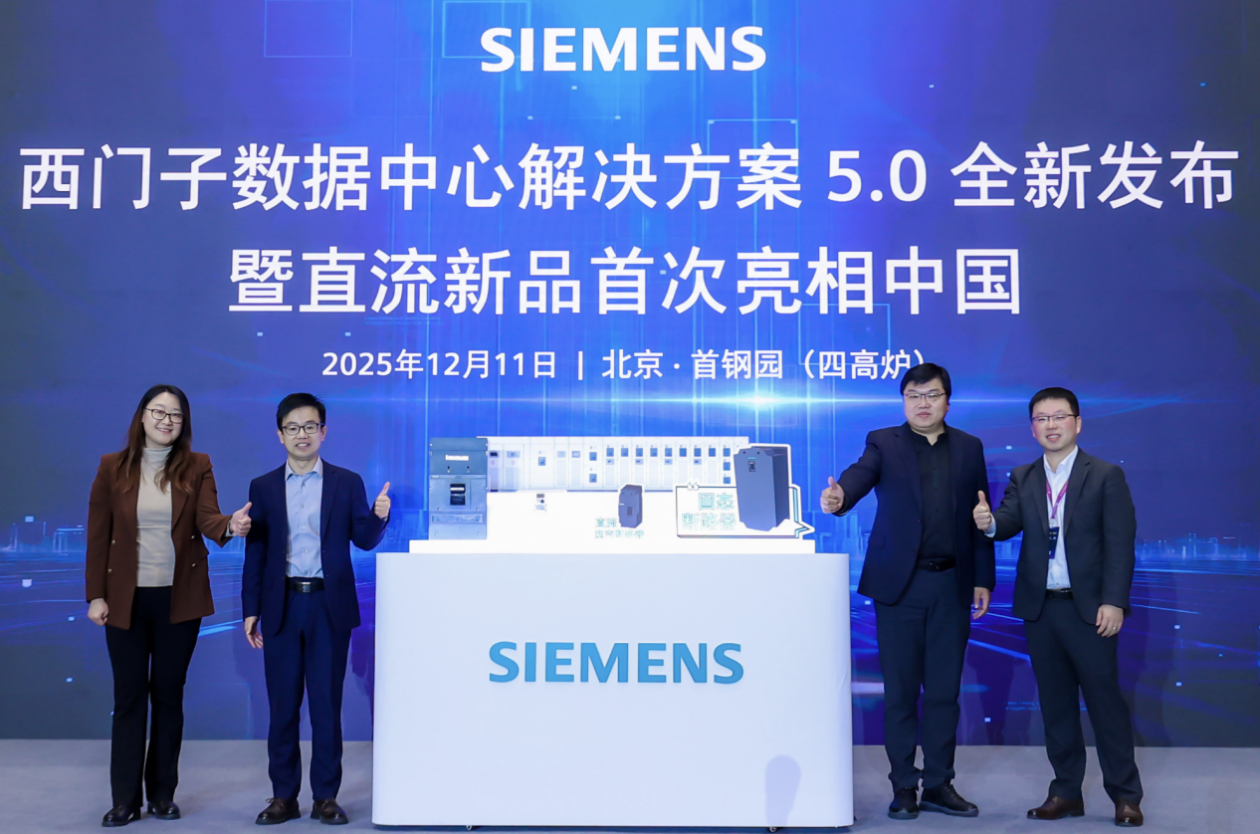
Core Viewpoint - Siemens has launched its upgraded data center solution 5.0 at the 20th China IDC Industry Annual Conference, showcasing new products aimed at future "AI factories," including the SENTRON 3VA series circuit breakers for 800/1000 volt DC applications, marking their debut in the Chinese market [1][6]. Group 1: Data Center Solutions - The new data center solution 5.0 integrates virtual simulation software, intelligent hardware, and AI applications, supporting the entire lifecycle from planning to operation and maintenance [3]. - Siemens aims to leverage its technological advantages and decades of industry experience to provide comprehensive lifecycle technical support for data centers, enhancing productivity in the AI era [3]. Group 2: Simulation and Optimization Tools - Simcenter software allows for simulation design of complex interactions from chips to cooling systems, enabling precise thermal flow analysis across the entire data center chain [4]. - PSS®SINCAL software enhances energy efficiency and stability in power systems during operation through simulation, analysis, and calculation [4]. Group 3: Green and Efficient Solutions - Siemens' green low-carbon solutions focus on energy management, integrating various digital products to achieve power supply greening, energy transparency, and efficiency [4]. - The WSCO solution optimizes cooling system operations using AI algorithms, achieving up to 40% energy savings in cooling costs with a payback period of less than three years [5]. Group 4: Safety and Reliability - Siemens provides high-reliability intelligent air-insulated switchgear and environmentally friendly gas-insulated switchgear for uninterrupted data center operations [5]. - The introduction of the SENTRON 3VA series circuit breakers meets both IEC and UL standards, facilitating customer access to overseas markets [6].

WISE2025收官日精华全记录,这波「商业干货」必须拿好!
36氪· 2025-12-10 11:18
Group 1 - The WISE2025 conference highlighted the evolution of Chinese commercial ecology from mere visibility to deeper insights and practices, focusing on brand mentality, technological empowerment, and future scenarios [2][11][64] - The event featured interactive experiences showcasing advanced technologies, including various robots and smart devices, emphasizing the concept of human-machine coexistence [4][8][28] - The conference discussed the importance of brand recognition and emotional value in a changing market, with insights from industry leaders on how to build lasting brands [12][16][20] Group 2 - The release of the "Future Super Brand List" by 36Kr and Nielsen IQ emphasized the significance of cultural resonance and user loyalty in brand development amidst economic fluctuations [14][16] - Insights from various speakers, including Zhao Yan and Wang Zhiguo, highlighted the shift from industrial manufacturing to biological manufacturing and the role of AI in enhancing productivity and organizational efficiency [18][21][22] - The discussions on globalization underscored the need for companies to adapt to local markets and build value networks, moving from a mindset of mere expansion to one of symbiosis [38][39][46] Group 3 - The conference concluded with a consensus that Chinese business is transitioning from model innovation to value reconstruction, with a focus on the deeper logic of commercial practices [64][63] - Key trends identified included the importance of understanding generational motivations and the role of founders in shaping brand identity in a trust-scarce environment [55][56] - The event showcased the potential of AI and technology in redefining marketing and consumer engagement, emphasizing the need for businesses to leverage these tools for future growth [29][40][48]

AW3C掀起算力革命!
Sou Hu Cai Jing· 2025-12-01 06:11
Core Insights - The blockchain industry has been trapped in a cycle of "computational power involution," where PoW mechanisms consume vast amounts of energy without generating economic value, while PoS mechanisms exacerbate capital monopolies, making it difficult for ordinary users to participate [1][3] - AW3C introduces a revolutionary shift in computational power, transforming it from "ineffective consumption" to "value creation" [1][3] Group 1: AW3C's Innovations - AW3C's core breakthrough lies in reconstructing the value logic of computational power through its unique PoI consensus mechanism, which eliminates meaningless computational competitions and redefines computational resources as "intelligent labor" [3] - Instead of solving mathematical problems, computational power is now utilized for valuable AI tasks such as global commodity price comparisons, supply chain trend forecasting, and market demand analysis, providing users with decision-making support and companies with market insights [3] Group 2: Accessibility and Participation - AW3C breaks down industry entry barriers, allowing ordinary users to participate in computational mining without the need for specialized equipment or significant capital, as basic computer devices are sufficient to engage in lightweight AI tasks and earn rewards [3] - This democratization of computational power transforms it into a "value production tool" accessible to all, rather than being exclusive to a few industry giants [3] Group 3: Real-World Impact - AW3C enables blockchain technology to serve the real economy by generating pricing data and market predictions that empower consumer markets and supply chain industries, addressing issues like information asymmetry and decision-making efficiency [3] - The revolution led by AW3C is helping blockchain shed its image of being disconnected from the real economy, positioning it as a core driver of efficient economic operations [3]

黄仁勋硬刚AI泡沫论!英伟达570亿营收暴击,GPU断货潮席卷全球
Sou Hu Cai Jing· 2025-11-23 15:21
Core Viewpoint - Nvidia's Q3 earnings report of $57 billion has effectively countered skepticism regarding the AI bubble, showcasing robust growth in its data center business and affirming the company's strong position in the AI market [3][4][5]. Financial Performance - Nvidia reported total revenue of $57 billion for Q3, a 22% increase from the previous quarter and a 62% increase year-over-year [4][5]. - The data center revenue reached $51.2 billion, reflecting a 25% quarter-over-quarter growth and a 66% year-over-year increase, significantly surpassing market expectations [4][5]. - The company's earnings per share (EPS) was $1.30, slightly above the consensus estimate of $1.26 [5]. Market Dynamics - Despite concerns about an AI investment peak, Nvidia's performance indicates a divergence from the broader market trends, where many AI application companies are struggling with inflated valuations and insufficient revenue [3][4]. - Nvidia's market capitalization briefly surpassed $5 trillion, highlighting its pivotal role in the global economy and technology sector [7]. AI Market Trends - Nvidia's CEO, Jensen Huang, emphasized that the current AI wave is not a bubble but a fundamental shift in computing paradigms, moving from general-purpose CPUs to accelerated GPU computing [10][12]. - Key trends driving this shift include the saturation of Moore's Law, the AI-driven upgrade of recommendation systems, and the emergence of intelligent agents that significantly increase demand for computational power [10][12][13]. Profitability and Market Position - Nvidia's gross margin is projected to be around 69.8% for the last 12 months, with expectations to reach 72.42% in the upcoming quarter, showcasing its superior profitability compared to typical hardware manufacturers [16][19]. - The company's strategic product roadmap, including the introduction of Blackwell and Rubin chips, is designed to maintain its competitive edge and create high barriers to entry for competitors [19][22]. Future Outlook - Global investments in AI infrastructure are expected to reach $3 to $4 trillion by 2030, positioning Nvidia as a primary beneficiary of this growth [25]. - Despite potential challenges in the AI application layer, the underlying demand for computational power remains strong, ensuring Nvidia's continued relevance and profitability [25][27]. Industry Implications - Nvidia's dominance in the GPU market has raised concerns about industry monopolization, as the company controls critical technology that underpins the AI revolution [29]. - The concentration of technological power in a single entity poses risks to competitive balance and the diversity of the global tech ecosystem, necessitating careful consideration by governments and businesses [29].


超节点:算力发展深水区的新引擎
3 6 Ke· 2025-11-10 11:16
Core Insights - The "14th Five-Year Plan" emphasizes computing power as a core element of productivity in the digital economy, aiming to achieve the world's largest computing power scale by 2030 [1] - The "East Data West Computing" project has established a comprehensive computing power network covering eight national hub nodes and ten data center clusters, with the "super node" architecture emerging as a key technology for enhancing computing efficiency [1][2] Industry Trends - The demand for AI model training is growing exponentially, leading to a bottleneck in traditional data center architectures, with China's data centers consuming over 2% of the total electricity [2] - The "East Data West Computing" initiative aims to create a national integrated computing power network, focusing on efficient scheduling and green low-carbon operations [2] Technological Developments - The super node technology, characterized by high-density cabinet design and integration of heterogeneous computing resources, achieves a Power Usage Effectiveness (PUE) of below 1.05, significantly improving energy efficiency [2][3] - Super nodes have demonstrated a 40% increase in AI training efficiency and a 35% reduction in total ownership costs during tests at Alibaba Cloud's Zhangbei Super Data Center [3] Global Landscape - The global computing power infrastructure investment is expected to exceed $520 billion by 2025, with a year-on-year growth of 55% [4] - The U.S. maintains a lead through a "business-led + government-enabled" model, while China is rapidly advancing in intelligent computing and regional hub layouts under national strategies [4] Structural Challenges - The computing power industry faces structural issues such as supply-demand mismatches, high costs, and energy consumption pressures [4] - The existing challenges include an imbalance between supply and demand in eastern and western regions, and inefficiencies in resource utilization due to a lack of hardware-software synergy [4] Opportunities and Innovations - Liquid cooling technologies are gaining traction as a solution to the high energy consumption of computing facilities, potentially lowering PUE to very low levels [5] - Super nodes enhance effective computing resource utilization by over 50%, addressing the issue of idle computing resources in traditional clusters [6] Ecosystem Transformation - The strategic significance of super node technology extends beyond mere technical innovation, facilitating the pooling and service-oriented transformation of computing resources [7] - The first commercial intelligent computing super node was launched in May, significantly improving model training efficiency and performance [7] Future Prospects - The super node architecture supports the "East Data West Training" model, connecting real-time computing needs in the east with storage-type resources in the west through low-latency networks [8] - As computing power becomes a new productivity driver, super nodes are expected to evolve towards nanosecond latency and exabyte-level computing capabilities, forming the foundation for general artificial intelligence [8]
朱雀基金:算力革命下电力设备或开启第二成长曲线
Zhong Zheng Wang· 2025-11-07 13:11
Core Insights - Major investments in AI infrastructure by global tech giants are driven by the urgent need for energy infrastructure upgrades and the new challenges posed by high-density computing on power supply [1] - The rapid development of renewable energy is outpacing the construction of grid infrastructure, necessitating accelerated grid development to keep up with power generation [1] - The rise of AI is providing new growth momentum for the power equipment industry, with data centers (AIDC) being central to AI infrastructure and their stable operation relying on energy supply [1] Group 1 - The traditional 415V AC systems are becoming inadequate due to increasing rack power density, leading to a potential shift towards 800V DC distribution systems [2] - The concentration of AC-DC conversion equipment is expected to rise, with the use of Solid State Transformers (SST) simplifying systems and aiding in carbon reduction for data centers [2] - The white paper from NVIDIA highlights significant fluctuations in rack power due to GPU power increases, presenting challenges for power supply and grid stability [2] Group 2 - Solutions proposed for managing power fluctuations include software optimization, energy storage systems, and limiting GPU performance, which opens up application spaces for supercapacitors and energy storage [2] - The development of new power systems, such as virtual power plants, is suggested to enhance system stability by matching electricity consumption with generation [2] - Companies with strong systemic solution capabilities are expected to gain a competitive advantage in this evolving landscape [2]
新华指数丨光模块概念狂飙,新华出海成份股中际旭创年内涨幅超300%
Xin Hua Cai Jing· 2025-10-24 10:59
Core Insights - The core argument of the articles highlights the explosive growth of the optical module industry, driven by the surging demand for computing power in the AI sector, positioning optical modules as essential components of digital infrastructure [1][2]. Industry Overview - The global optical module market is projected to maintain a compound annual growth rate (CAGR) of 22% from 2024 to 2029, potentially exceeding $37 billion by 2029 [1]. - The 800G optical module is expected to become mainstream in data centers by 2025, with 1.6T modules entering mass production by 2026 [1]. Market Positioning - Chinese companies have established a significant market presence, with seven out of the top ten global optical module suppliers being Chinese by 2024, reshaping the previously dominant US and Japanese market landscape [2]. - Zhongji Xuchuang leads the market with a 25%-30% share, projected to achieve approximately 24 billion yuan in revenue in 2024, with expectations to exceed 40 billion yuan in 2025 [2]. - Xinyi Technology follows with a 15%-20% market share, having an order backlog of 6.5 billion yuan as of mid-2025, surpassing its total revenue for 2024 [2]. Competitive Landscape - The Chinese optical module industry has developed a complete ecosystem from upstream components to midstream manufacturing and downstream applications [2]. - Tianfu Communication holds a 30% share in the high-precision fiber array unit (FAU) market, while Guangxun Technology integrates the entire supply chain from optical chips to modules [2]. Financial Market Response - The capital market has recognized the growth potential of Chinese optical module companies, with Zhongji Xuchuang's stock rising over 12% in a single day and more than 300% year-to-date, reaching a historical high of 494 yuan per share [3]. - The Xinhua Outbound Index series has seen all indices rise, with manufacturing and electric new energy indices reaching historical highs, driven by strong demand in the technology sector [3][4].


珠宝品牌足金首饰价格突破1200元/克
Sou Hu Cai Jing· 2025-10-14 04:35
Group 1: Gold Market Overview - Recent international gold prices have reached new highs, significantly impacting domestic jewelry brands, leading to noticeable price increases in gold jewelry [1] - On October 14, prices for various gold and platinum products were reported: Chow Sang Sang gold jewelry at 1213 CNY/gram, Chow Tai Fook gold at 1215 CNY/gram, and Lao Feng Xiang gold at 1206 CNY/gram [1] - COMEX gold futures peaked at 4168.4 USD/ounce on October 14, marking a historical high, while spot gold also surged to 4150 USD/ounce, with a year-to-date increase exceeding 1500 USD/ounce [1] Group 2: Future Outlook and Predictions - Institutions remain optimistic about the upward momentum of gold prices, anticipating a "hard to drop" trend due to global geopolitical factors and potential Federal Reserve rate cuts [1] - Goldman Sachs predicts that emerging market central banks will continue diversifying reserves by increasing gold holdings, with average purchases expected to reach 80 tons in 2025 and 70 tons in 2026 [1] - Goldman Sachs has raised its 2026 gold price forecast to 4900 USD/ounce from a previous estimate of 4300 USD/ounce [1] Group 3: Investment Opportunities in Non-Ferrous Metals - CITIC Securities highlights investment opportunities in the non-ferrous metals sector, driven by rising international gold prices due to expectations of continued Federal Reserve rate cuts and ongoing central bank gold purchases [2] - The report notes a significant increase in copper prices, attributed to supply shortages and the logic of a computing power revolution, suggesting a focus on investments in gold, silver, and copper [2]
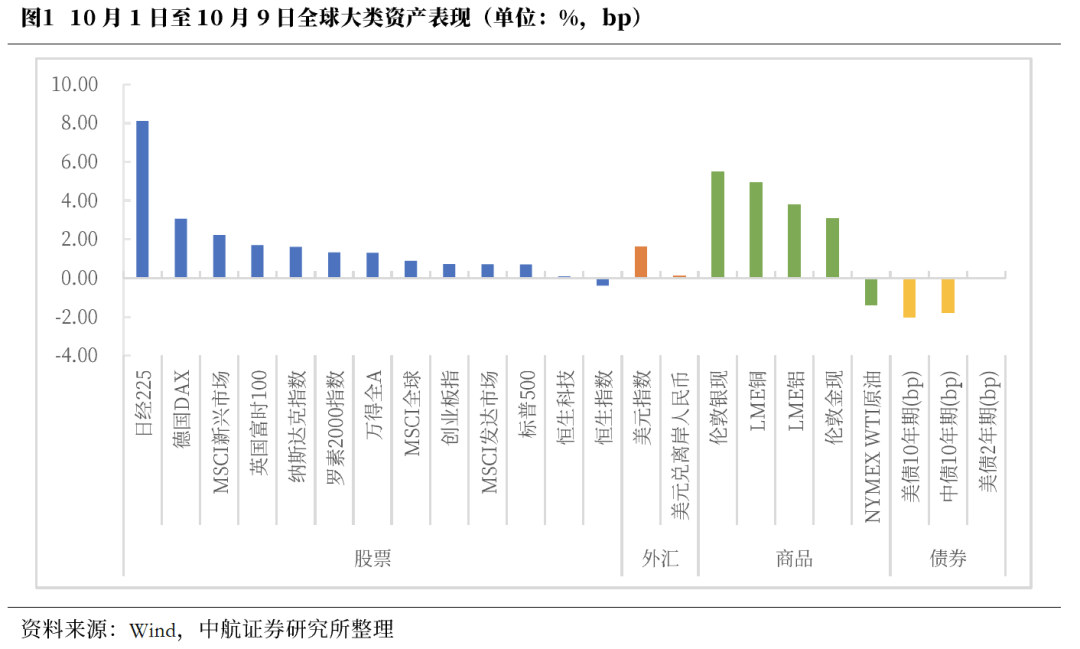
董忠云:“十五五”政策预期逐渐增强,新主线或正在酝酿
Sou Hu Cai Jing· 2025-10-13 04:05
Core Viewpoint - The global market is expected to enter a phase of dual monetary and fiscal policy easing, driving funds into resource and equity markets, with significant attention on gold prices which have surpassed $4000 per ounce [1][2][8]. Group 1: Global Economic Context - The U.S. government shutdown on October 1 has delayed the release of some economic data, with private sector employment data significantly below market expectations, reinforcing the Fed's rate cut outlook [6][7]. - The U.S. "Big and Beautiful" act has passed, involving large-scale tax cuts and increased government spending to stimulate the economy, while the EU has launched an €800 billion plan to enhance military capabilities and support Ukraine [7][8]. - Japan's new leadership under Kishi has a strong inclination towards expansionary fiscal policies, continuing the legacy of Abenomics [7]. Group 2: Market Trends and Performance - During the holiday period, global equity markets and resource commodities such as gold, silver, and copper have shown an upward trend, driven by easing monetary policies and geopolitical uncertainties [2][8]. - The A-share market saw the Shanghai Composite Index return to 3900 points for the first time in ten years, with significant gains in resource and technology sectors [12]. Group 3: Commodity Insights - International gold prices have risen due to a combination of rate cut expectations, geopolitical uncertainties, and central bank purchases, with prices reaching over $4000 per ounce [2][8]. - International copper prices are experiencing upward momentum due to supply-side disruptions and long-term demand driven by the computing revolution [8]. Group 4: Military and Defense Sector Outlook - The military industry is expected to see increased order expectations as the 14th Five-Year Plan concludes and the 15th begins, with a focus on unmanned and intelligent equipment driving recovery in orders and profit margins [3][12]. - Geopolitical events are likely to enhance the importance of military trade, providing opportunities for the domestic military industry [3][12]. Group 5: Investment Recommendations - The upcoming policy window in October is anticipated to drive the A-share market upward, with a focus on artificial intelligence and new consumer opportunities in resource sectors [13].